
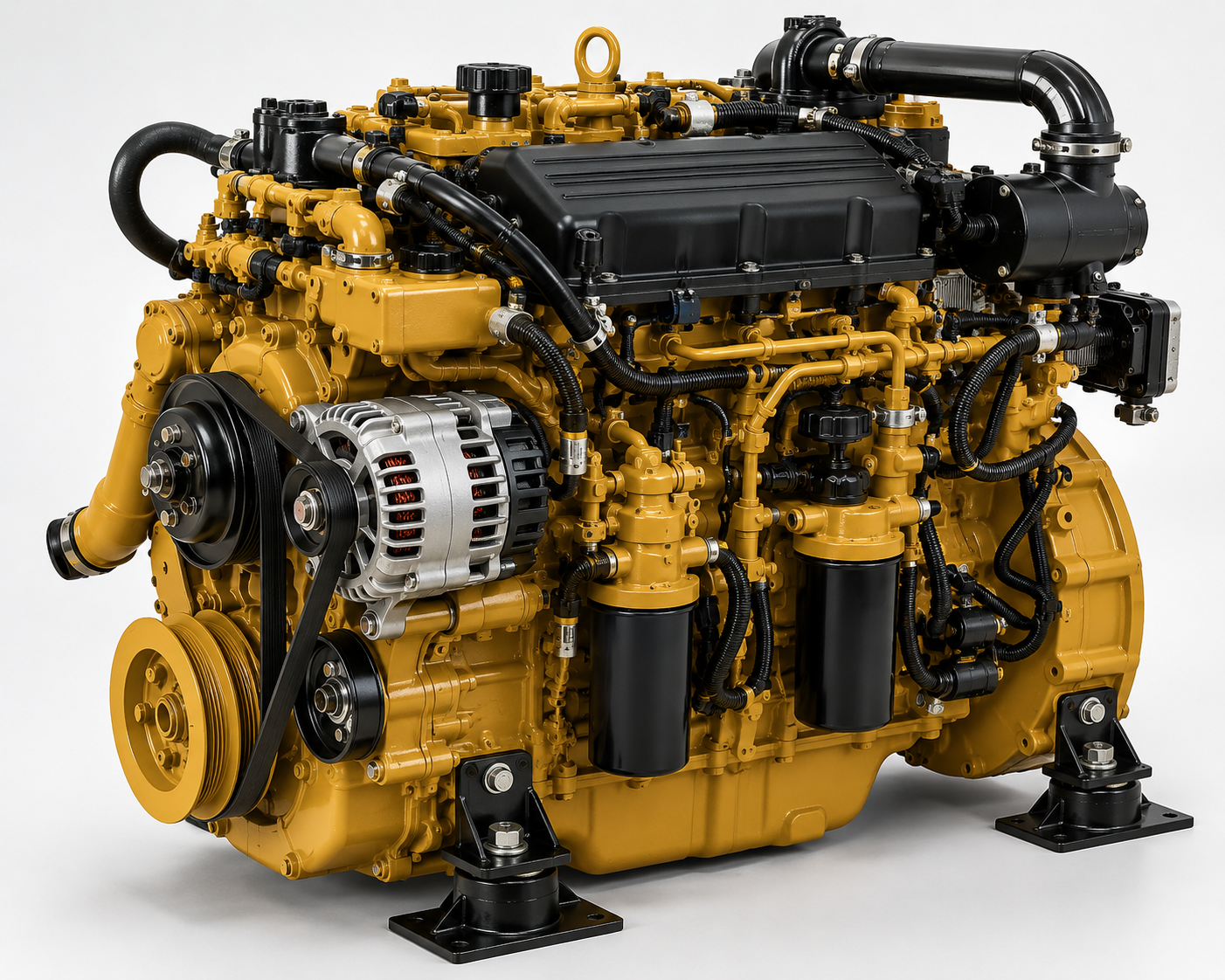
Caterpillar C4.4 Marine Auxiliary Engine Parts and Specifications
The Caterpillar C4.4 Marine Auxiliary Engine is a compact four-cylinder diesel engine developed to provide dependable onboard power for commercial ships, workboats, passenger vessels, fishing vessels and recreational marine applications.
Depending on the installation, the C4.4 can be used to drive a marine generator, hydraulic pump, fire pump, deck machinery or another auxiliary system. It is commonly installed where vessel operators need a compact engine capable of supporting essential electrical and mechanical equipment.
The current electronically controlled Cat C4.4 marine auxiliary-engine range is available for 50 Hz and 60 Hz applications, with published ratings ranging from approximately 71 to 129 bkW. Individual ratings, emissions certification and cooling arrangements depend on the selected configuration.
Alfa Marine Spare Parts supports enquiries for Caterpillar C4.4 marine auxiliary engine parts, including cooling-system components, fuel-system parts, turbochargers, electrical equipment, filters and overhaul components.
Caterpillar C4.4 Marine Auxiliary Engine Overview
The Cat C4.4 is an inline four-cylinder, four-stroke diesel engine with a displacement of 4.4 litres.
Its compact dimensions make it suitable for engine rooms where installation space is limited. The engine can be supplied with different cooling arrangements and power ratings to match the vessel’s electrical frequency, auxiliary load and operating conditions.
The electronic control system monitors and controls important engine functions. Depending on the installation, the engine may be connected to a Caterpillar control panel, vessel alarm system or generator-set controller.
The C4.4 should not be confused with a propulsion engine. A marine auxiliary engine is primarily intended to provide power for onboard equipment rather than to drive the vessel’s propeller directly.
What Is a Marine Auxiliary Engine?
A marine auxiliary engine provides power for systems that support the vessel’s operation.
It may be used to drive:
- A marine alternator
- An electrical generator
- A hydraulic pump
- A fire pump
- A cargo pump
- A deck-machinery system
- A refrigeration compressor
- A bow-thruster hydraulic system
- Emergency or standby equipment
On many vessels, the Caterpillar C4.4 is installed as part of a marine generator set. The engine drives an alternator that supplies electricity for lighting, navigation equipment, pumps, accommodation systems and other onboard consumers.
Caterpillar C4.4 Technical Specifications
Manufacturer: Caterpillar
Engine model: C4.4
Engine configuration: Inline four-cylinder
Operating cycle: Four-stroke diesel
Displacement: 4.4 litres / 268.5 cubic inches
Bore: 105 mm
Stroke: 127 mm
Aspiration: Naturally aspirated, turbocharged or turbocharged and aftercooled, depending on rating
Control system: Electronic control system
Rated speed:
- 1,500 rpm for typical 50 Hz operation
- 1,800 rpm for typical 60 Hz operation
Published auxiliary-engine power range: Approximately 71–129 bkW
Frequency options: 50 Hz and 60 Hz
Starting system: 12 V or 24 V electrical starting, depending on configuration
Cooling options may include:
- Heat-exchanger cooling
- Separate-circuit keel cooling
- Combined-circuit keel cooling
Emissions options may include:
- U.S. EPA Tier 3
- EU Stage V
- China Stage II
Actual specifications must be confirmed using the engine serial number and Caterpillar arrangement information. Ratings and installed components can vary according to production date, emissions configuration, cooling system and generator arrangement.
Caterpillar C4.4 50 Hz Ratings
A Caterpillar specification sheet for the electronic C4.4 lists 50 Hz auxiliary-engine ratings of:
- 71 bkW at 1,500 rpm
- 86 bkW at 1,500 rpm
- 108 bkW at 1,500 rpm
These engine ratings can be matched to different electrical outputs depending on alternator efficiency and generator-set configuration.
The engine’s brake power should not be treated as identical to the generator’s electrical output. Some mechanical power is lost through the alternator and other driven components.
Caterpillar C4.4 60 Hz Ratings
For 60 Hz operation, the engine normally operates at 1,800 rpm.
Available outputs depend on the exact Caterpillar arrangement. The broader electronic auxiliary-engine range reaches approximately 129 bkW.
Before replacing an engine or generator set, confirm:
- Required frequency
- Required voltage
- Required electrical output
- Engine rated speed
- Alternator type
- Emissions requirement
- Cooling arrangement
- Vessel classification requirements
A 50 Hz engine-generator arrangement cannot automatically be substituted for a 60 Hz arrangement without confirming the alternator, controls and electrical system.
Main Features of the Cat C4.4 Auxiliary EngineCompact Four-Cylinder Design
The inline four-cylinder configuration helps reduce the engine’s overall installation size.
This makes the C4.4 suitable for:
- Small commercial vessels
- Workboats
- Fishing boats
- Passenger boats
- Yachts
- Compact machinery spaces
- Repower projects
- Auxiliary generator rooms
Adequate service access must still be provided around the engine for filter changes, belt adjustment, cooling-system maintenance and major repairs.
Electronic Engine Control
The electronic control system manages engine operation and helps monitor important conditions.
Depending on the engine arrangement, monitored functions may include:
- Engine speed
- Coolant temperature
- Oil pressure
- Fuel-system operation
- Intake-air conditions
- Engine shutdown conditions
- Warning and diagnostic information
Electronic engine faults should be diagnosed using the correct Caterpillar service information and compatible diagnostic equipment.
Multiple Cooling Arrangements
The C4.4 marine auxiliary engine can be configured with a heat exchanger or keel-cooling system.
Heat-exchanger cooling
In a heat-exchanger installation, engine coolant circulates through the engine’s closed cooling circuit.
Seawater is drawn through a strainer by the seawater pump and passes through the heat exchanger. Heat is transferred from the engine coolant to the seawater before the seawater is discharged.
Keel cooling
A keel-cooled engine circulates coolant through an external cooler fitted to or incorporated into the vessel’s hull.
Keel cooling reduces dependence on an engine-mounted seawater pump and internal seawater heat exchanger. However, the keel cooler must be correctly sized for the engine output and operating environment.
Caterpillar C4.4 Marine Applications
The Cat C4.4 can support electrical and mechanical auxiliary systems in many types of vessels.
Typical applications include:
- Commercial fishing vessels
- Workboats
- Tugboats
- Pilot boats
- Patrol vessels
- Passenger ferries
- Coastal cargo vessels
- Survey vessels
- Research vessels
- Offshore support vessels
- Marine construction craft
- Commercial yachts
- Recreational yachts
- Emergency generator installations
The engine’s suitability depends on the required load, annual operating hours, cooling arrangement and vessel electrical system.
Caterpillar C4.4 Marine Auxiliary Engine Parts
Alfa Marine Spare Parts can assist with enquiries for Cat C4.4 marine auxiliary engine components, subject to correct identification and availability.
Caterpillar C4.4 Cooling-System Parts
Frequently requested cooling components include:
- Caterpillar C4.4 seawater pump
- Raw-water pump
- Seawater-pump impeller
- Seawater-pump repair kit
- Pump shaft
- Pump bearings
- Mechanical pump seal
- Heat exchanger
- Heat-exchanger core
- Heat-exchanger end covers
- Engine coolant pump
- Water-temperature regulator
- Thermostat housing
- Oil cooler
- Aftercooler
- Coolant hoses
- Seawater hoses
- Cooling-system gaskets
- O-rings and seals
A damaged impeller, restricted seawater strainer or fouled heat exchanger can cause high coolant temperature.
When replacing a seawater pump, confirm the original Caterpillar part number, drive arrangement, mounting position and engine serial number.
Caterpillar C4.4 Fuel-System Parts
Common fuel-system components include:
- Caterpillar C4.4 fuel injectors
- Injector seals
- Injector pipes
- High-pressure fuel pump
- Fuel-transfer pump
- Fuel priming pump
- Primary fuel filter
- Secondary fuel filter
- Fuel-filter housing
- Fuel-pressure sensor
- Fuel-temperature sensor
- Fuel rail components
- Fuel-return lines
- Electronic fuel-system components
Fuel-system problems can cause:
- Hard starting
- Engine misfiring
- Low power
- Unstable engine speed
- Excessive fuel consumption
- Black exhaust smoke
- White exhaust smoke
- Engine shutdown
- Fuel-pressure fault codes
The correct injector or fuel pump must be identified using the engine serial number and existing Caterpillar part number.
Caterpillar C4.4 Turbocharger and Air-System Parts
Depending on the selected rating, the C4.4 may use a turbocharged or turbocharged-aftercooled air system.
Common components include:
- Complete turbocharger
- Turbocharger cartridge
- Turbocharger repair kit
- Turbocharger oil-supply pipe
- Turbocharger oil-drain pipe
- Air cleaner
- Air-filter element
- Intake manifold
- Exhaust manifold
- Aftercooler
- Intake hoses
- Exhaust gaskets
- Exhaust elbow
- Exhaust bellows
Low turbocharger boost or restricted airflow can cause black smoke, high exhaust temperature and reduced engine output.
Before replacing a turbocharger, inspect the air cleaner, exhaust restriction, charge-air system, fuel system and engine load.
Caterpillar C4.4 Lubrication-System Parts
Common lubrication components include:
- Engine oil pump
- Engine oil filter
- Oil-filter housing
- Engine oil cooler
- Oil-pressure sensor
- Oil-pressure switch
- Oil-pressure regulating valve
- Oil pan
- Oil-pan gasket
- Crankcase breather
- Oil filler cap
- Oil dipstick
- Lubrication pipes
Low oil pressure must be investigated immediately.
Possible causes include:
- Low engine-oil level
- Incorrect oil viscosity
- Contaminated oil
- Restricted oil filter
- Worn oil pump
- Faulty pressure-regulating valve
- Excessive bearing clearances
- Defective oil-pressure sensor
Caterpillar C4.4 Cylinder-Head and Overhaul Parts
Engine overhaul components may include:
- Complete cylinder head
- Bare cylinder head
- Cylinder-head gasket
- Cylinder-head bolts
- Inlet valves
- Exhaust valves
- Valve guides
- Valve seats
- Valve springs
- Rocker arms
- Push rods
- Camshaft
- Tappets
- Pistons
- Piston rings
- Piston pins
- Connecting rods
- Connecting-rod bearings
- Main bearings
- Thrust bearings
- Crankshaft
- Front crankshaft seal
- Rear crankshaft seal
- Timing gears
- Flywheel
- Flywheel ring gear
- Complete gasket kit
- Overhaul kit
During a rebuild, all dimensions and clearances must be checked against the service information for the exact engine serial-number prefix.
Caterpillar C4.4 Electrical Parts
Common C4.4 electrical components include:
- Starter motor
- Charging alternator
- Electronic control module
- Engine wiring harness
- Engine-speed sensor
- Crankshaft-position sensor
- Camshaft-position sensor
- Coolant-temperature sensor
- Oil-pressure sensor
- Fuel-pressure sensor
- Intake-air-temperature sensor
- Relays
- Solenoids
- Control-panel components
- Shutdown switches
The current C4.4 can be equipped with optional engine shutdown sensors, shutdown controllers, gauge panels and EMCP control equipment.
Caterpillar C4.4 Generator Components
When the C4.4 is installed as a marine generator set, additional components may include:
- Generator alternator
- Automatic voltage regulator
- Excitation components
- Rotating rectifier
- Generator bearings
- Generator coupling
- Anti-vibration mounts
- Generator control panel
- Circuit breaker
- Voltage and frequency sensors
- Wiring and terminal components
Determine whether the requested component belongs to the diesel engine or the generator alternator before ordering.
The engine and alternator can have different serial numbers, manufacturers and parts catalogues.
Correct Cat C4.4 Parts Identification
The description “Caterpillar C4.4” is not enough to guarantee the correct replacement part.
Different C4.4 engines can have variations in:
- Power rating
- Rated speed
- Emissions configuration
- Fuel system
- Turbocharger
- Cooling arrangement
- Starter voltage
- Alternator configuration
- Control system
- Engine arrangement number
For an accurate parts enquiry, provide:
- Complete engine model
- Engine serial number
- Engine arrangement number
- Original Caterpillar part number
- Part description
- Clear photographs
- Casting numbers
- Generator model
- Generator serial number
- Rated voltage and frequency
- Required quantity
- Delivery destination
Photographs of the engine identification plate and the old component are particularly helpful.
Common Caterpillar C4.4 Engine ProblemsEngine Does Not Start
Possible causes include:
- Weak or discharged battery
- Loose battery connection
- Defective starter motor
- Faulty starter solenoid
- Restricted fuel filter
- Air in the fuel system
- Low fuel pressure
- Faulty speed sensor
- Electronic-control fault
- Shutdown circuit activated
Check active fault codes before replacing electronic or fuel-system components.
Engine Cranks but Does Not Start
Possible causes include:
- Empty fuel tank
- Closed fuel valve
- Air in the fuel system
- Restricted primary fuel filter
- Restricted secondary fuel filter
- Fuel-transfer-pump failure
- Fuel-pressure problem
- Faulty injector
- Incorrect sensor signal
- Electronic-control issue
High Coolant Temperature
Possible causes include:
- Low coolant level
- Blocked seawater strainer
- Damaged seawater-pump impeller
- Worn seawater pump
- Fouled heat exchanger
- Restricted keel cooler
- Defective thermostat
- Coolant-pump problem
- Excessive generator load
- Poor engine-room ventilation
Black Exhaust Smoke
Possible causes include:
- Restricted air cleaner
- Low turbocharger boost
- Fouled aftercooler
- Boost-air leakage
- Faulty injector
- Fuel-pressure problem
- Excessive generator load
- Restricted exhaust system
White Exhaust Smoke
Possible causes include:
- Cold engine operation
- Poor fuel quality
- Water in the fuel
- Injector fault
- Low compression
- Incorrect fuel-system operation
- Coolant entering a cylinder
Engine Runs Roughly
Possible causes include:
- Restricted fuel filter
- Air entering the fuel system
- Injector fault
- Fuel-pressure instability
- Speed-sensor fault
- Wiring-harness problem
- Low cylinder compression
- Electronic-control fault
Coolant in the Engine Oil
Caterpillar C4.4 troubleshooting documentation identifies possible sources including:
- Leaking engine oil cooler
- Damaged cylinder-head gasket
- Faulty cylinder head
- Cracked or damaged cylinder block
Do not continue operating the engine when coolant is found in the lubricating oil. Coolant contamination can reduce lubrication and cause bearing damage.
Caterpillar C4.4 Maintenance
Maintenance requirements must be taken from the operation and maintenance manual for the exact engine serial number.
Service intervals can change according to:
- Engine arrangement
- Fuel consumption
- Operating hours
- Calendar time
- Oil specification
- Coolant type
- Load profile
- Environmental conditions
Routine checks generally include:
- Check engine-oil level
- Check coolant level
- Inspect belts
- Inspect hoses
- Check the air-cleaner service indicator
- Drain water from the fuel pre-filter
- Inspect electrical connections
- Check engine instruments
- Inspect for fuel, oil, coolant and seawater leaks
- Check generator load
- Perform a walk-around inspection
Periodic maintenance may include:
- Replace engine oil
- Replace oil filters
- Replace primary and secondary fuel filters
- Inspect or replace the seawater-pump impeller
- Inspect the heat exchanger
- Clean the cooling system
- Check coolant condition
- Inspect the air cleaner
- Inspect the turbocharger
- Check valve clearance
- Inspect the crankcase breather
- Test alarms and shutdown systems
- Inspect generator electrical connections
- Check generator insulation
- Inspect the rotating rectifier
- Inspect belts and pulleys
Caterpillar maintenance documentation states that operating hours, fuel consumption and calendar time should all be considered, using whichever maintenance limit occurs first. Engines working in severe conditions may require more frequent service.
New, Remanufactured and Used C4.4 Parts
Depending on the component and availability, Alfa Marine Spare Parts may support enquiries for:
- New genuine Caterpillar parts
- Cat Reman components
- New OEM-quality replacement parts
- Selected aftermarket parts
- Reconditioned parts
- Rebuilt components
- Used serviceable components
- Exchange components requiring a returnable core
For remanufactured or exchange parts, confirm:
- Core-return requirement
- Core condition
- Warranty terms
- Scope of remanufacturing
- Included accessories
- Part-number compatibility
- Surcharge conditions
Frequently Asked QuestionsWhat is the Caterpillar C4.4 Marine Auxiliary Engine?
The Caterpillar C4.4 is an inline four-cylinder, 4.4-litre diesel engine used to power marine generators and other onboard auxiliary equipment.
What is the displacement of the Cat C4.4?
The Caterpillar C4.4 has a displacement of 4.4 litres or approximately 268.5 cubic inches.
How much power does the Caterpillar C4.4 auxiliary engine produce?
The current electronic marine auxiliary-engine range is published at approximately 71 to 129 bkW, depending on frequency, rated speed and engine configuration.
What speed does the Cat C4.4 marine generator engine operate at?
Typical fixed-speed generator applications operate at 1,500 rpm for 50 Hz power and 1,800 rpm for 60 Hz power.
Is the Caterpillar C4.4 turbocharged?
Some C4.4 ratings are turbocharged or turbocharged and aftercooled. The exact aspiration arrangement depends on the engine rating and configuration.
What cooling systems are available?
Cooling arrangements may include heat-exchanger cooling, separate-circuit keel cooling and combined-circuit keel cooling.
Which Caterpillar C4.4 parts are commonly replaced?
Commonly requested parts include fuel injectors, fuel pumps, seawater pumps, impellers, heat exchangers, oil coolers, turbochargers, filters, starter motors, alternators, sensors and overhaul parts.
Why is my Caterpillar C4.4 overheating?
Common causes include low coolant, a blocked seawater strainer, damaged pump impeller, fouled heat exchanger, thermostat failure, restricted keel cooler or excessive generator load.
Why is my Cat C4.4 producing black smoke?
Possible causes include a restricted air cleaner, low turbocharger boost, faulty injector, fuel-pressure problem, restricted exhaust or excessive load.
Can I order C4.4 parts using only the engine model?
The engine model alone is normally insufficient. Provide the engine serial number, arrangement number and original component part number whenever possible.
What information is needed for a Caterpillar C4.4 parts enquiry?
Provide the engine model, serial number, arrangement number, existing part number, component description, photographs, quantity and delivery destination.
Request Caterpillar C4.4 Marine Auxiliary Engine Parts
Alfa Marine Spare Parts supports international enquiries for Caterpillar C4.4 marine auxiliary engine and generator parts.
To request availability, send:
- Engine model
- Engine serial number
- Engine arrangement number
- Required part number
- Part description
- Required quantity
- Clear photographs
- Generator information when applicable
- Delivery country or port
Contact Alfa Marine Spare Parts for assistance with Caterpillar C4.4 cooling parts, fuel-system components, turbochargers, electronic parts, generator components and engine overhaul parts.
Browse Caterpillar marine engine parts Marine Spare Parts Categories | Alfa Marine Spare Parts
Explore Caterpillar auxiliary engines Marine Engines | Alfa Marine Spare Parts
Contact our marine parts specialists Request A Quote | Alfa Marine Spare Parts