Marine Gearbox Clutch Problems: Slipping, Symptoms & Spare Parts
The vessel leaves the berth normally.
Ahead engages. Astern engages. Nothing unusual appears on the instruments.
Once clear of the harbor, the skipper increases power.
The engine responds immediately and the RPM starts climbing, but the vessel does not accelerate the way it normally does.
The throttle is reduced and everything seems normal again.
A few minutes later, they try once more. The same thing happens. This time the engineer also notices that the gearbox oil temperature is starting to rise.
When the oil is checked later, there is a burnt smell that wasn't there before.
That combination—engine RPM rising without the expected vessel response, increasing gearbox temperature and burnt-smelling oil—is enough to put clutch slip high on the list of things to investigate.
But it doesn't automatically mean the gearbox needs a new clutch pack.
A marine gearbox clutch can slip because the friction plates are worn, but it can also happen when the clutch is not receiving enough hydraulic pressure to hold properly. A worn seal, internal leakage, oil-pump problem, pressure-control fault or incorrect oil can produce similar symptoms.
Before opening the gearbox and ordering parts, it is worth finding out what actually changed.
What Does a Slipping Marine Gearbox Clutch Feel Like?
One of the clearest signs is a mismatch between engine RPM and vessel response.
You increase throttle.
The engine RPM climbs normally—or sometimes more easily than normal—but the vessel does not pick up speed as expected.
At low speed around the marina, you may notice nothing at all.
The gearbox is not being asked to transmit the same torque while maneuvering at low power. Once the vessel reaches open water and more engine power is applied, the clutch has to hold a much greater load.
A clutch that appears perfectly normal at low speed may start slipping as the load increases.
This is why the crew's description matters.
“The gearbox works at idle but slips when we increase power” tells you much more than simply saying the gearbox isn't working properly.
A Real Scenario: Everything Is Fine Until the Vessel Is Under Load
Consider a workboat that spends the morning maneuvering at low speed.
The gearbox engages normally and there are no alarms.
Later, the vessel heads offshore.
At cruising power, the engineer notices the engine reaching its normal RPM, but the vessel is running slower than expected.
Then the gearbox temperature begins climbing.
The immediate temptation may be to blame the oil cooler because the gearbox is getting hot.
But there is another possibility.
If the clutch is slipping, friction inside the gearbox can be creating the additional heat.
That distinction is important.
A cooling problem means the gearbox cannot remove heat effectively.
A slipping clutch means the gearbox may be producing more heat than it should.
If rising temperature is one of the main symptoms you're seeing, our Marine Gearbox Overheating: Causes & Troubleshooting guide explains the other areas worth checking before assuming the clutch is responsible.
Why Does a Slipping Marine Gearbox Clutch Get Hot?
A clutch is supposed to apply firmly enough to transfer engine torque through the gearbox.
If the clutch does not hold properly, its friction surfaces can move against each other.
That creates heat.
The longer the clutch slips, particularly under heavy load, the more serious the situation can become.
You can end up with a sequence like this:
Clutch does not hold correctly → friction increases → gearbox temperature rises → oil deteriorates → clutch operation becomes worse
This is why gearbox symptoms often overlap.
What begins as an occasional slip under heavy load can later show up as high oil temperature, burnt oil or damaged clutch plates.
Before Blaming the Clutch Plates, Check the Oil
It is tempting to jump straight to the expensive conclusion:
“It's slipping. We need clutch plates.”
Maybe.
But start with the basics.
Check the gearbox oil level according to the procedure for the installed transmission.
Then look at the oil itself.
Does it smell burnt?
Has it become unusually dark?
Is it cloudy or milky?
Can you see metallic particles or other debris?
Also confirm that the correct oil specification is being used.
The lubricant in a marine gearbox isn't there only to lubricate gears and bearings. Depending on the transmission, it may also be part of the hydraulic system that applies the clutch.
Using an unsuitable oil can therefore affect much more than basic lubrication.
Low Hydraulic Pressure Can Feel Like a Bad Clutch
This is one of the most important things to understand before ordering clutch parts.
The clutch may be physically capable of holding the load, but it needs enough hydraulic pressure to apply correctly.
If that pressure is too low, the clutch may hold at low power and begin slipping as engine torque increases.
Possible causes can include:
- Low gearbox oil
- Restricted oil filter or strainer
- Worn oil pump
- Pressure-control problems
- Shift-valve problems
- Worn clutch seals
- Internal hydraulic leakage
That is why pressure testing can be far more useful than immediately dismantling the transmission.
If your gearbox is also showing low or unstable oil pressure, read our Marine Gearbox Oil Pressure Problems: Causes, Troubleshooting & Spare Parts guide. It covers oil level, filters, oil pumps, pressure regulation, internal leakage and other areas worth checking.
The Gearbox Is Dry Outside, but It Can Still Be Leaking
This catches people out.
You inspect the transmission and there isn't a drop of oil underneath it.
The hoses are dry.
The oil cooler connections look fine.
The oil level hasn't noticeably changed.
So it is natural to think:
“There can't be a leak.”
Externally, maybe not.
But hydraulic pressure can be lost inside the gearbox.
Worn clutch seals or other internal sealing areas can allow oil to escape from a pressurized circuit without any oil leaving the transmission.
The clutch then receives less effective pressure.
Depending on the severity of the leakage, the result may be slow engagement, weak engagement or clutch slip under load.
Sometimes the problem becomes much more noticeable once the gearbox is hot.
It Works Cold but Starts Slipping After an Hour
This is useful information.
Imagine the vessel leaves port and runs normally for the first forty minutes.
Then the gearbox begins slipping.
Reduce the load and it seems better.
Allow the gearbox to cool and the problem becomes less obvious again.
As gearbox oil warms, its viscosity changes. If internal leakage has increased because of worn seals or clearances, pressure loss may become more noticeable at operating temperature.
That doesn't automatically tell you which part has failed.
But “slips only when hot” is a much better diagnostic clue than simply reporting “clutch problem.”
Cold and hot hydraulic-pressure readings, when taken according to the gearbox manufacturer's procedure, can help clarify what is happening.
Ahead Slips but Astern Is Perfect
Now the diagnosis becomes more interesting.
Suppose the vessel can apply plenty of power in astern without any sign of slipping.
Ahead is different.
At low speed it works, but once the load increases, engine RPM starts climbing without the expected propulsion response.
Because both directions are not behaving the same way, the problem may be more specific to the ahead clutch circuit.
Depending on the transmission design, that can lead the investigation toward the clutch itself, its seals, the relevant hydraulic passage, valve or control.
The opposite can happen as well.
Ahead may be perfect while astern slips.
When reporting the problem, be specific:
“Ahead holds normally. Astern starts slipping once the gearbox is hot.”
That information can save a lot of unnecessary troubleshooting.
Sometimes the Warning Starts With Delayed Engagement
Clutch slip does not always appear without warning.
A crew may remember that the gearbox had already started behaving differently weeks earlier.
Perhaps ahead used to engage immediately but gradually developed a two-second delay.
Then it became three seconds.
Someone discovered that a little more engine RPM helped it engage.
Eventually, the gearbox started slipping under load.
Those symptoms can be related.
A hydraulic problem that initially causes slow clutch application may eventually affect the clutch's ability to hold torque.
If your gearbox is taking longer than normal to go into ahead or astern, read our Marine Gearbox Delayed Engagement: Why It Happens and What to Check guide. It covers oil, hydraulic pressure, filters, controls, valves, seals and the differences between cold and hot engagement problems.
What Does a Burnt Marine Gearbox Clutch Look Like?
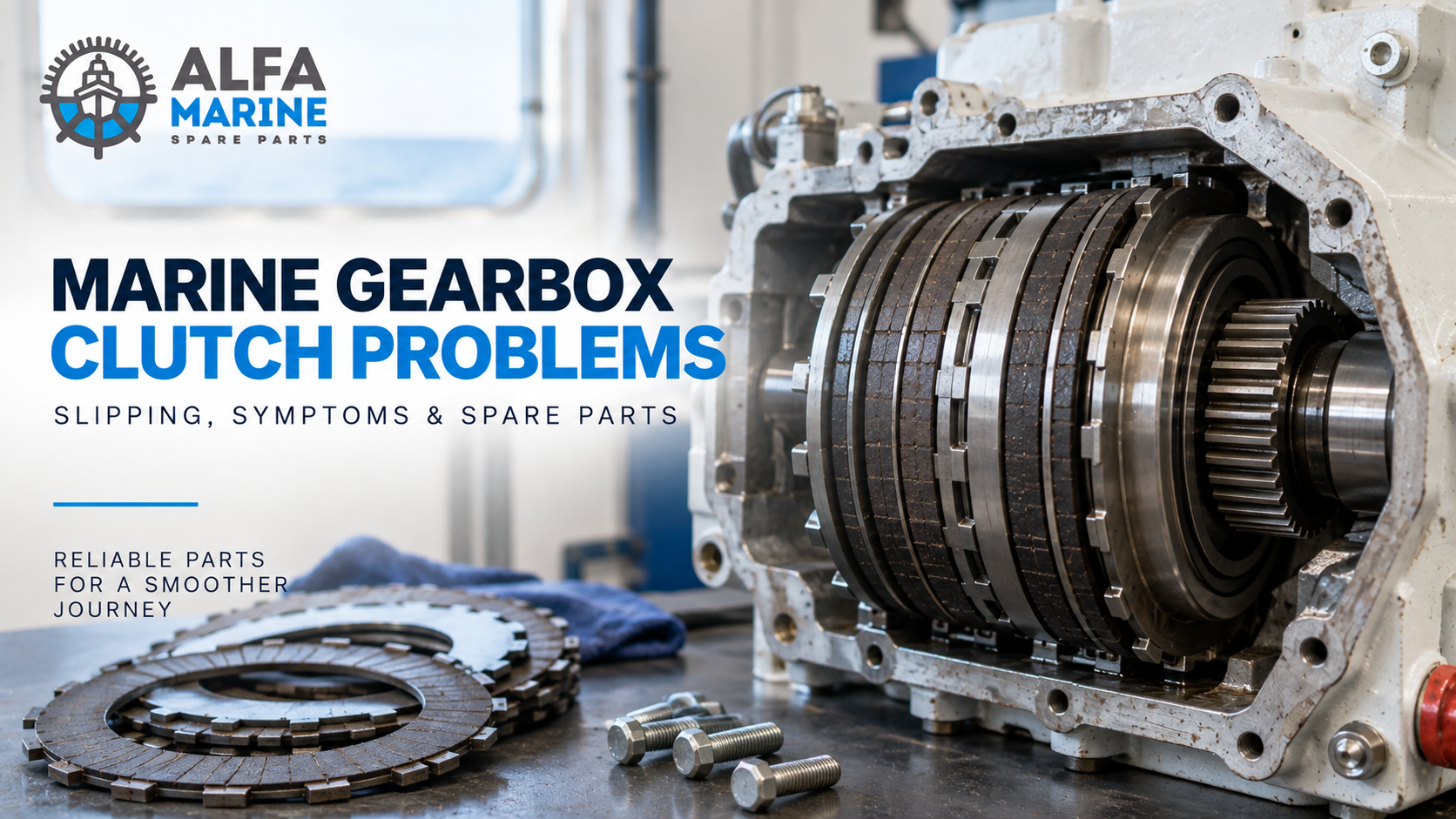
If the gearbox is eventually opened, the clutch may show clear evidence of excessive heat or wear.
Depending on the clutch design, technicians may find:
- Worn friction material
- Glazed friction surfaces
- Darkened plates
- Heat discoloration
- Distorted steel plates
- Burnt gearbox oil
- Friction material in the oil or filter
At that point, there is little doubt that the clutch has suffered damage.
But there is still an important question:
Did the clutch fail on its own, or did another fault cause the clutch to fail?
That question matters before the gearbox goes back together.
Don't Throw the Old Filter Away Without Looking at It
When a gearbox has been slipping, the oil filter or strainer can tell part of the story.
If the transmission design allows it, inspect what has been captured.
Material that appears to come from friction plates is relevant when clutch slip is already suspected.
Metallic debris can point toward additional internal wear involving bearings, gears, shafts or other parts.
Replacing the filter is good maintenance.
Looking at what was inside the old one can be good diagnosis.
Could the Oil Cooler Be Causing the Problem?
Usually not directly.
But this is where symptoms can become confusing.
If the oil cooler is restricted or cooling-water flow is insufficient, gearbox temperature can rise.
If the gearbox becomes excessively hot, an existing hydraulic weakness may become more noticeable.
On the other hand, a slipping clutch can itself generate enough heat to make everyone suspect the cooler.
So ask:
Is the gearbox hot because the cooling system isn't removing enough heat?
Or:
Is the gearbox hot because the clutch is generating too much heat?
A restricted seawater strainer, damaged impeller, reduced cooling-water flow or restricted oil cooler can produce a similar temperature complaint.
If the cooling side is under suspicion, see our Marine Gearbox Oil Cooler Problems: Symptoms, Cleaning & Replacement guide before replacing gearbox parts unnecessarily.
Replacing a perfectly good cooler will not fix a slipping clutch.
And replacing clutch plates will not fix a blocked cooling circuit.
Is It Definitely the Gearbox Clutch?
Not necessarily.
If the complaint is simply that the vessel is not reaching its normal speed, look at the complete propulsion system before dismantling the gearbox.
Poor performance can also be associated with:
- Propeller fouling
- Propeller damage
- Shaft problems
- Coupling problems
- Unusual vessel load
- Engine performance problems
- Other drivetrain faults
What makes clutch slip particularly interesting is when engine RPM increases without a corresponding increase in transmitted propulsion.
Even then, confirm the diagnosis rather than relying on one symptom.
Can You Continue Operating With a Slipping Marine Gearbox?
A gearbox that is clearly slipping under load should not become something the crew learns to work around.
Adding more throttle is particularly unhelpful.
If the clutch is already struggling to hold torque, increasing engine power asks it to hold even more.
Continued slipping can create additional heat and damage friction surfaces that may have been serviceable when the original problem first appeared.
A hydraulic or sealing fault can therefore turn into a much larger clutch repair.
If the gearbox is slipping badly, losing propulsion, producing burnt oil or running at abnormal temperature, follow the vessel's operating procedures and the gearbox manufacturer's guidance rather than trying to force normal operation.
Marine Gearbox Clutch Problem Symptom Guide
| What You NoticeWhere to Start Looking | |
| RPM rises but vessel does not accelerate normally | Clutch slip, hydraulic pressure, drivetrain |
| Slips only under heavy load | Clutch holding ability, hydraulic pressure, clutch wear |
| Works cold but slips hot | Internal leakage, clutch seals, pressure, oil condition |
| Ahead slips but astern is normal | Ahead clutch circuit, seals, valve or control |
| Astern slips but ahead is normal | Astern clutch circuit, seals, valve or control |
| Slip + high gearbox temperature | Clutch friction, pressure, lubrication and cooling |
| Slip + burnt-smelling oil | Excessive clutch heat, oil deterioration |
| Delayed engagement followed by slipping | Hydraulic pressure, seals, valves, internal leakage |
| Friction material in filter | Clutch wear or damage |
| Slip + low oil pressure | Oil level, filter, pump, regulation, internal leakage |
This is a troubleshooting starting point. The service procedure and pressure specifications for the installed gearbox should always take priority.
When Does a Marine Gearbox Clutch Actually Need an Overhaul?
There isn't one symptom that automatically means the gearbox needs a clutch overhaul.
If hydraulic pressure is correct but the clutch still cannot hold the required load, internal inspection may be necessary.
The same applies if there is significant friction material in the oil or filter, or if the clutch has been subjected to severe overheating.
Once the gearbox is opened, an overhaul may involve more than replacing friction plates.
Depending on the gearbox and what inspection reveals, requirements may include:
- Clutch friction plates
- Clutch steel plates
- Clutch seals
- O-rings
- Gaskets
- Bearings
- Bushings
- Pressure-control valves
- Shift valves
- Oil filters
- Other related overhaul parts
The parts list should come from the actual gearbox and inspection findings, not from a generic clutch kit.
Burnt Clutch Plates Are the Result. Find the Cause.
Imagine the gearbox is opened and the clutch plates are badly burnt.
There is obviously no point putting those plates back into service.
But replacing them only solves part of the problem.
Why did they burn?
Perhaps they simply reached the end of their service life.
But perhaps the clutch had been operating with low hydraulic pressure.
Maybe a clutch seal was leaking internally.
Maybe a valve wasn't supplying pressure correctly.
Maybe the gearbox had been repeatedly forced into gear at elevated RPM after developing delayed engagement.
If the cause remains inside the transmission, new clutch parts can be exposed to exactly the same conditions.
The damaged plates tell you what failed.
The diagnosis should tell you why it failed.
REINTJES, RENK, Twin Disc and ZF Marine Gearbox Clutch Parts
Alfa Marine Spare Parts supports parts inquiries for marine transmission applications including:
- REINTJES marine gearbox parts
- RENK marine gearbox parts
- Twin Disc marine transmission parts
- ZF marine gearbox parts
- Volvo Penta marine transmission parts
- Other marine gearbox systems
Clutch design varies between gearbox manufacturers, families and individual models.
A similar symptom does not mean different gearboxes use the same clutch design.
Friction plates, steel plates, seals, valves and hydraulic arrangements can differ significantly.
Do not order clutch parts based only on engine horsepower or vessel type.
Start with the gearbox identification.
Marine Gearbox Clutch and Overhaul Parts
Once the fault has been identified, requirements may include:
- Clutch friction plates
- Clutch steel plates
- Clutch seals
- Oil pumps
- Pressure-control valves
- Shift valves
- Shift solenoids
- Oil filters and strainers
- Shaft seals
- O-rings
- Gaskets
- Bearings
- Bushings
- Gears
- Shafts
- Pressure sensors
- Temperature sensors
- Related gearbox overhaul parts
Alfa Marine Spare Parts can assist with individual repair parts and larger gearbox overhaul requirements, subject to correct identification and availability.
If you already know the gearbox manufacturer, model, serial number and required part numbers, you can Request a Quote for Marine Gearbox Spare Parts and include the quantities and delivery destination.
What Should You Send When Looking for Marine Gearbox Clutch Parts?
Start with the gearbox nameplate.
Send:
- Gearbox manufacturer
- Exact gearbox model
- Complete serial number
- Reduction ratio
- Existing part numbers
- Required quantities
- Engine make and model
- Vessel type
- Delivery destination
Clear photographs of the gearbox nameplate and removed parts are useful.
If the gearbox has already been dismantled, photograph any visible part-number markings before cleaning or discarding the old parts.
For a larger overhaul, send the complete required-parts list together where possible.
Marine Gearbox Parts for Commercial Vessels and Yachts
Alfa Marine Spare Parts supports gearbox repair and overhaul requirements for commercial vessels, yachts, tugboats, workboats, fishing vessels, ferries, offshore vessels, dredgers, patrol vessels and other marine applications.
Understanding the symptoms before ordering parts can save considerable time.
A gearbox that slips and has low pressure should lead you toward the hydraulic system as well as the clutch.
A gearbox that slips and overheats requires you to determine whether the clutch is creating the heat or the cooling system is failing to remove it.
A gearbox that first develops delayed engagement and later starts slipping may have been showing signs of a hydraulic problem for some time.
And a gearbox with good pressure but a clutch that still cannot hold its rated load may require internal inspection.
That is why the complete operating history matters.
Alfa Marine Spare Parts is an independent marine spare parts supplier and is not an authorized dealer for the brands referenced in this article.
Frequently Asked Questions
My engine RPM goes up, but the boat doesn't accelerate properly. Is the gearbox clutch slipping?
It certainly can be. That difference between engine RPM and vessel response is one of the reasons to investigate the clutch. But I wouldn't order clutch plates based on that symptom alone. Check the propulsion system, gearbox oil and hydraulic pressure first. A clutch can slip because its plates are worn, but it can also slip because there isn't enough pressure applying them.
Why does my gearbox only start slipping after we've been running for an hour?
That detail is actually very useful. Once the oil warms up, internal hydraulic leakage through worn seals or increased clearances can become more noticeable. Compare how the gearbox behaves cold and hot and, where appropriate, compare hydraulic-pressure readings as well. If it consistently works cold and slips hot, tell the technician exactly that.
We found burnt clutch plates. Can't we just replace them and put the gearbox back together?
The damaged plates obviously need attention, but you still need to know why they burned. If a leaking clutch seal, low hydraulic pressure or valve problem caused the original slip, fitting new plates without correcting that fault can put the replacement clutch in the same situation. Fix the damaged parts, but also find the reason they became damaged.
Request a Quote for Marine Gearbox Clutch & Overhaul Parts
If you need marine gearbox clutch plates, clutch seals, valves, oil pumps, filters, bearings or overhaul parts, send us the gearbox identification and any existing part numbers.
For faster identification, include:
Manufacturer | Model | Serial Number | Reduction Ratio | Part Numbers | Quantities | Delivery Destination