
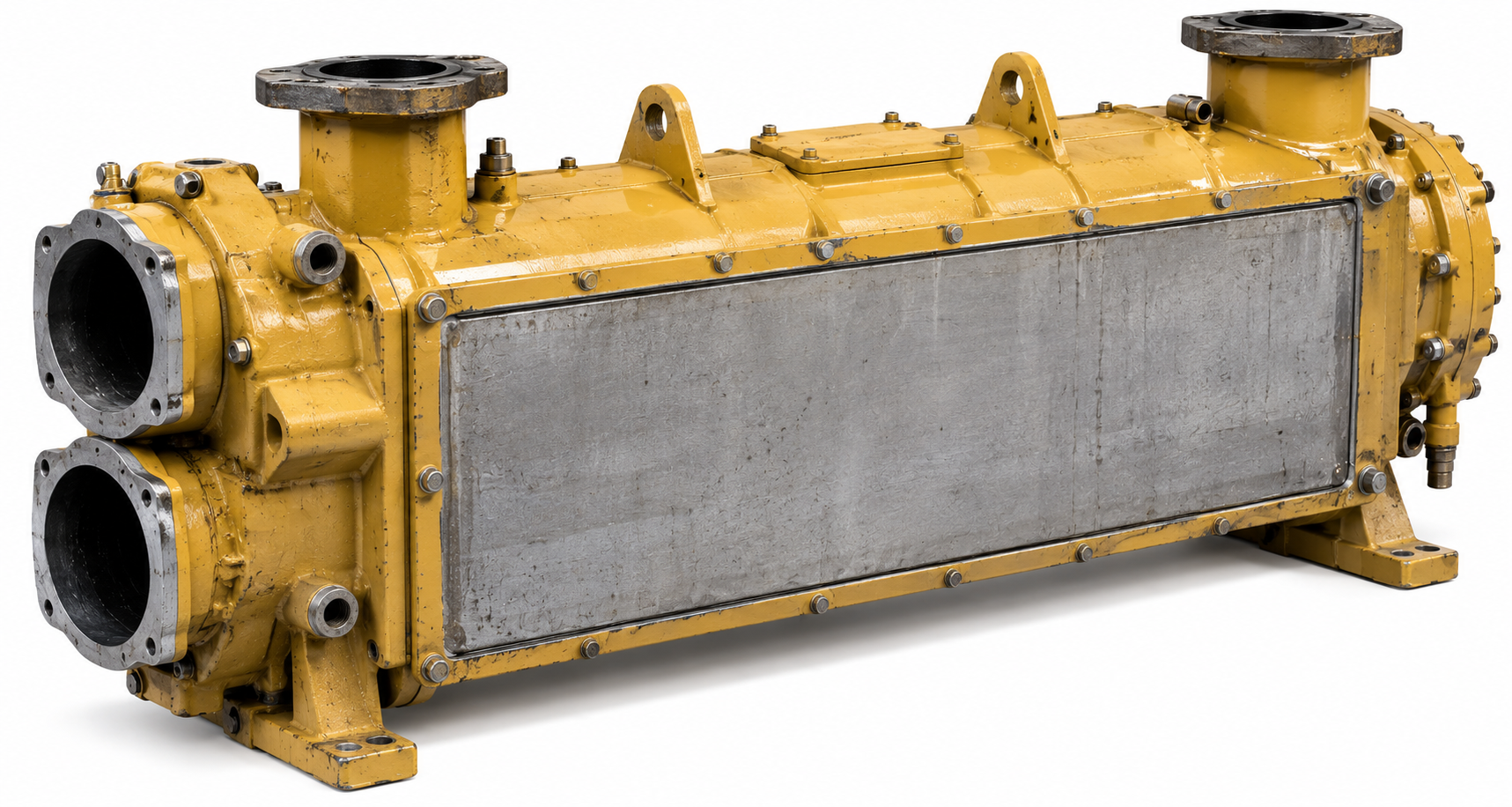
Caterpillar C15 Marine Heat Exchanger: Part Numbers, Problems & Replacement
A Caterpillar C15 can look perfectly healthy while the vessel is alongside.
Coolant temperature is normal.
No obvious leaks.
The engine sounds good.
Then the vessel leaves the harbor.
The throttles come up and the C15 starts working harder.
A few minutes later, the engineer notices something:
The coolant temperature is slowly climbing.
He pulls the engine back.
The temperature starts coming down.
He increases load again.
The temperature rises again.
That's usually when someone in the engine room says:
“I think the heat exchanger is blocked.”
Maybe.
But don't order a new heat exchanger yet.
A C15 that runs hot under load can have several causes.
The heat exchanger could be dirty or restricted, but the problem could also be poor seawater flow, a dirty sea strainer, a weak pump, damaged impeller, thermostat problem, trapped air or a restriction somewhere else in the cooling circuit.
And even when the heat exchanger really does need attention, another question appears:
Which part do you actually need?
Because:
“Caterpillar C15 heat exchanger”
doesn't always mean:
“complete heat exchanger.”
You may actually need an end plate, channel plate, tube, elbow, seal or another component from the assembly.
Important C15 heat-exchanger references include:
266-9513 / 2669513
266-9514 / 2669514
266-9515 / 2669515
along with other related cooling-system components.
So before ordering, start with:
Engine Serial Number + Arrangement Number + Existing Part Number
For other engine components, visit our Caterpillar C15 Marine Engine Parts page.
For the wider Caterpillar range, browse our Caterpillar Marine Engine Parts & Rebuild Kits catalogue.
Need help identifying the correct component? Request a Quote or email request@alfamarinespareparts.com.
Caterpillar C15 Heat Exchanger Part Numbers
Let's start with the numbers.
When a C15 heat exchanger is dismantled, these are some of the references you may encounter:
| Part NumberWithout HyphenComponent | ||
| 266-9513 | 2669513 | Heat Exchanger End Plate |
| 266-9514 | 2669514 | Heat Exchanger Channel Plate |
| 266-9515 | 2669515 | Heat Exchanger Channel Plate |
These numbers are important because they immediately tell us something:
The engineer may not need the entire heat exchanger.
Maybe the frame is still good.
Maybe the problem is inside the plate pack.
Maybe only a few plates are damaged.
Maybe the exchanger simply needs cleaning and new sealing components.
That's why the first question shouldn't always be:
“How much is a complete C15 heat exchanger?”
Sometimes the better question is:
“What actually failed?”
Caterpillar 266-9513 / 2669513 Heat Exchanger End Plate
One important C15 marine reference is:
266-9513 / 2669513
This is a heat exchanger end plate.
It forms part of the exchanger assembly and helps maintain separation between the fluid chambers.
So imagine the engineer sends purchasing a WhatsApp message:
“Need 2669513 urgently.”
If purchasing simply searches:
“C15 heat exchanger”
they may end up looking for a complete assembly.
But that isn't necessarily what the engineer needs.
He may only need the end plate.
A better conversation is:
“You need 266-9513. Is the exchanger already dismantled? Do you also need the channel plates and seals?”
That one question can completely change the parts requirement.
Caterpillar 266-9514 / 2669514 Heat Exchanger Channel Plate
Another important reference is:
266-9514 / 2669514
This is a heat exchanger channel plate used on applicable Caterpillar C15 marine arrangements.
The channel plate helps direct fluid through the exchanger while allowing heat to transfer across the plate surface.
Several plates work together inside the exchanger.
When those passages are clean, heat can transfer efficiently.
When they become fouled or restricted, cooling performance can suffer.
And if the plate itself becomes damaged or badly corroded, cleaning may no longer solve the problem.
Caterpillar 266-9515 / 2669515 Heat Exchanger Channel Plate
You may also find:
266-9515 / 2669515
This is another heat exchanger channel plate.
Here's where it's important not to make assumptions.
266-9514
and:
266-9515
are both channel plates.
That doesn't mean they are automatically interchangeable.
Different plates can occupy different positions or have different functions within the exchanger arrangement.
So if the engineer has the exchanger open on the workbench and says:
“This damaged plate is 2669515.”
keep that exact number on the RFQ.
Don't shorten the request to:
“C15 heat exchanger plate.”
The number matters.
“Do We Need the Whole Heat Exchanger or Just the Plates?”
This is one of the most useful questions to ask.
The engineer says:
“The C15 heat exchanger is bad.”
Purchasing immediately starts searching for a complete exchanger.
Then you speak with the engineer.
The exchanger is already apart.
The frame is fine.
The connections are fine.
Most of the plates are fine.
Only a few internal components are badly corroded.
Now the requirement may be:
266-9513
266-9514
266-9515
plus the correct seals.
That is a very different order.
And it may be a much more practical repair than replacing the complete assembly.
What Does the C15 Heat Exchanger Actually Do?
The basic job is simple.
The engine produces heat.
That heat has to leave the engine.
Hot coolant circulates through the engine cooling system.
The marine cooling arrangement then uses the heat exchanger to transfer heat away from that coolant.
On the other side, seawater carries the heat away.
So you can think of it like this:
Engine creates heat → Coolant carries heat → Heat exchanger transfers heat → Seawater carries heat away
The fluids remain separated.
They don't need to mix for heat to move between them.
When everything is clean and flowing properly, this happens quietly in the background.
You don't think about the heat exchanger.
Until the temperature starts rising.
Heat Exchanger or Aftercooler?
This causes plenty of confusion.
Both components remove heat.
But they aren't doing the same job.
The heat exchanger is part of the engine cooling system.
The aftercooler removes heat from the compressed intake air coming from the turbocharger.
So if somebody says:
“We need the C15 cooler.”
ask:
“Which cooler?”
Heat exchanger?
Aftercooler?
Oil cooler?
Something else?
That one question can save a lot of unnecessary parts searching.
For C15 aftercooler requirements, see our separate guide covering the 315-0047 / 3150047 core and older related references.
Follow the Cooling Circuit Before Blaming the Heat Exchanger
When the temperature starts rising, it's tempting to look at the largest cooling component and say:
“That must be blocked.”
But the heat exchanger is only one part of the cooling system.
Coolant needs to circulate through the engine correctly.
The temperature regulators need to control the coolant path properly.
The seawater side needs enough flow.
The exchanger itself needs clean heat-transfer surfaces.
If any part of that process is compromised, temperature can rise.
So instead of immediately asking:
“Is the heat exchanger bad?”
ask:
“Why isn't enough heat leaving the engine?”
That question leads to a much better diagnosis.
“The C15 Is Fine at Idle but Overheats Under Load”
This is one of the most useful symptoms.
At idle, the engine isn't producing the same amount of heat.
A partly restricted cooling system may still cope.
Then the vessel leaves the harbor.
Load increases.
Fuel delivery increases.
Combustion produces more heat.
The coolant has more heat to carry away.
Now the entire cooling system has to work harder.
If the exchanger is partly fouled, it may handle:
low load
but struggle with:
sustained high load
That's why the engineer may say:
“Temperature is perfect at the dock. It only goes up when we push the engine.”
That makes heat-exchanger restriction worth investigating.
But it still doesn't prove the exchanger is the cause.
Check the Seawater Flow First
Before replacing an expensive heat exchanger, ask:
“Do we actually have enough seawater flow?”
A brand-new exchanger cannot cool the engine properly if there isn't enough seawater passing through it.
Start at the beginning.
Depending on the installation, check:
Seawater intake
Seacock
Sea strainer
Seawater pump
Impeller
Hoses
Pipework
Heat-exchanger connections
Heat exchanger
Follow the water.
A restriction before the exchanger can make a perfectly serviceable exchanger look bad.
Real Situation: The New Heat Exchanger Doesn't Fix the Problem
The C15 starts overheating under load.
The heat exchanger is old.
Everybody looks at it and says:
“That's probably the problem.”
A replacement is ordered.
The engineer installs it.
The vessel heads out for sea trial.
Ten minutes later:
the temperature starts climbing again.
The heat exchanger wasn't the real problem.
Maybe the seawater pump wasn't producing enough flow.
Maybe the sea strainer was partly blocked.
Maybe the thermostat wasn't opening correctly.
Maybe pieces from an old impeller were still trapped somewhere in the cooling circuit.
This is why the better first question is:
“Do we have the correct coolant circulation and seawater flow?”
Not:
“How quickly can we buy a new heat exchanger?”
Don't Forget the Thermostat
The temperature regulator is another important part of the cooling circuit.
When the engine is cold, coolant needs to circulate correctly while the engine warms up.
As operating temperature rises, the cooling circuit changes so more heat can be rejected.
If the thermostat does not open correctly, the engine can run hot even if the exchanger is perfectly clean.
That makes this an expensive mistake:
High temperature → blame exchanger → replace exchanger → same problem
Before condemning the exchanger, make sure coolant is actually circulating through the correct path.
A C15 Can Have Coolant Flow and Still Overheat
Seeing coolant moving doesn't prove everything is okay.
The system may still have:
insufficient coolant circulation
insufficient seawater flow
a thermostat that isn't opening fully
partial heat-exchanger restriction
air trapped in the system
a weak pump
or:
several smaller problems happening at the same time
So don't ask only:
“Is coolant moving?”
Ask:
“Is enough coolant and seawater moving through the correct circuits when the engine is under load?”
That's a much more useful question.
What If the Impeller Has Missing Pieces?
The engineer opens the seawater pump.
The impeller looks terrible.
Three vanes are missing.
A new impeller is installed.
Problem solved?
Maybe.
But ask one more question:
“Where are the missing pieces?”
They may have travelled downstream.
Possible places include:
heat exchanger passages
hoses
pipe connections
aftercooler passages
If pieces are trapped inside the cooling circuit, fitting a new impeller doesn't remove them.
The pump may now be working perfectly while something downstream remains partially blocked.
What Can Block a C15 Heat Exchanger?
Marine cooling systems don't have an easy life.
Over time, you can find:
salt deposits
scale
marine growth
sand
mud
shell fragments
corrosion products
rubber impeller pieces
and:
general debris
The restriction doesn't have to happen overnight.
It may develop slowly over months or years.
The engine keeps running.
Cooling performance gradually becomes weaker.
Then one hot day, or one long period at high load, the system finally runs out of cooling margin.
Warm Seawater Can Expose a Marginal Cooling System
This can be a useful clue.
The C15 operates perfectly in colder water.
Then the vessel moves into warmer conditions.
Now the engine starts running hotter.
Nothing may have suddenly failed.
The cooling system may simply have been marginal already.
Warmer seawater means there is less temperature difference available for heat transfer.
A clean cooling system still has enough capacity.
A partly fouled exchanger has less reserve.
So:
“It only happens in warm water.”
is useful information.
Don't ignore it.
Can Scale Inside the Heat Exchanger Cause Overheating?
Yes.
Think of scale as insulation.
You still have hot coolant on one side.
You still have seawater on the other.
But now there is a layer of deposits between the fluid and the heat-transfer surface.
Heat doesn't move across as efficiently.
The exchanger may still cope at low load.
Then the engine starts working harder and the temperature climbs.
That's why a common complaint is:
“It's fine at 1200 rpm, but temperature rises when we run harder.”
That kind of information helps narrow the diagnosis.
Don't Ignore Air in the Cooling System
This is especially worth thinking about after maintenance.
If the cooling system has recently been:
drained
opened
repaired
overhauled
or:
refilled
and the temperature problem started afterward, trapped air deserves attention.
Air can interfere with coolant circulation and heat transfer.
So if the engine ran perfectly before the cooling system was opened and now suddenly runs hot, don't immediately assume a major component failed at exactly the same time.
Check the basics first.
Can the Heat Exchanger Leak Internally?
Yes.
And an internal problem isn't always obvious.
You may not see seawater spraying across the engine room.
You may not see coolant dripping onto the floor.
The coolant and seawater circuits are supposed to remain separated.
If an internal plate or sealing area fails, that separation can be compromised.
So if the engine is losing coolant and nobody can find an external leak, the heat exchanger is one component worth testing.
It may not be the cause.
But it deserves investigation.
Look Before You Clean
The exchanger comes off the engine.
The first instinct is often:
“Clean it.”
Wait.
Look at it first.
Take photographs.
Check:
where the deposits are concentrated
which plates look worst
whether one section is more heavily fouled
whether corrosion is localised
whether debris is trapped somewhere
whether there is evidence of leakage
whether the sealing areas are damaged
Why?
Because the dirty exchanger can tell you a story.
Once everything has been cleaned, some of that evidence disappears.
Clean It or Replace Parts?
A dirty exchanger isn't automatically a bad exchanger.
If the components are structurally sound and the problem is simply fouling or scale, cleaning may restore performance.
But cleaning doesn't repair:
cracked plates
heavy corrosion
damaged sealing surfaces
internal leakage
or:
physically damaged components
That's where the individual part numbers become useful.
Instead of replacing everything, the repair may involve:
266-9513 / 2669513 — End Plate
266-9514 / 2669514 — Channel Plate
266-9515 / 2669515 — Channel Plate
plus the appropriate sealing components.
Inspect first.
Then decide.
Don't Forget the Seals
This is where a relatively inexpensive part can delay an expensive repair.
The exchanger is dismantled.
The plates are cleaned.
Damaged parts are replaced.
Then the engineer starts putting everything back together and asks:
“Where are the new seals?”
Nobody ordered them.
Now the job stops.
So before placing the order, ask:
Which seals will be disturbed?
Which seals should be renewed?
Are all sealing surfaces still serviceable?
A freshly serviced heat exchanger that leaks because an old seal was reused isn't a successful repair.
Check the Zinc Protection While You're There
If the applicable exchanger arrangement uses sacrificial zinc protection, inspect it while the exchanger is open.
Zincs are there to sacrifice themselves to help protect more valuable cooling-system components from corrosion.
So if the zinc is heavily consumed, don't simply put everything back together and forget about it.
The exchanger is already open.
This is the time to inspect the protection components as well.
“Can We Just Replace the Bad Plate?”
Possibly.
That's one advantage of working with an exchanger that has individually serviceable components.
If the frame is good and only specific plates are damaged, replacing individual components may be possible.
But don't simply look at two similar plates and assume they are the same.
For example:
266-9514
and:
266-9515
are both channel plates.
They are still different part numbers.
Keep the exact number identified during disassembly.
If several plate types are involved, record their positions before taking the stack apart.
Photographs can be very useful here.
Why the Engine Serial Number Still Matters
The part number tells us a lot.
The engine information tells us even more.
Compare these two requests.
Request 1
“Need C15 heat exchanger parts.”
Request 2
Engine: Caterpillar C15
Serial Number: XXXXX
Serial prefix: XXXXX
Arrangement Number: XXXXX
Existing part number: 266-9514
Quantity: 6
Application: Marine propulsion
Delivery: Miami, USA
The second enquiry gives us something much more useful to work with.
For accurate parts identification, send:
Engine model
Engine Serial Number
Serial prefix
Arrangement Number
Existing part number
Part description
Quantity
Application
and:
delivery destination
whenever possible.
What If the Part Number Is Unreadable?
Don't guess.
Marine cooling components spend years around:
seawater
heat
paint
corrosion
and:
maintenance chemicals
Old markings aren't always easy to read.
If the number is unclear, send:
- Engine data-plate photograph
- Engine Serial Number
- Arrangement Number
- Photos of the complete exchanger
- Pictures of the connections
- Photos of the damaged plate
- Any partly readable numbers
- Old invoices
- Previous quotations
- Maintenance records
A partial number plus good engine information is better than a complete number somebody guessed.
Caterpillar C15 Heat Exchanger Part Number Summary
The main C15 heat-exchanger references covered in this guide are:
| Part NumberWithout HyphenComponent | ||
| 266-9513 | 2669513 | Heat Exchanger End Plate |
| 266-9514 | 2669514 | Heat Exchanger Channel Plate |
| 266-9515 | 2669515 | Heat Exchanger Channel Plate |
These parts are associated with applicable Caterpillar C15 marine heat-exchanger arrangements.
That doesn't mean every C15 uses every one of them.
Always confirm the actual engine and installed arrangement.
Caterpillar C15 Heat Exchanger FAQs
What is the Caterpillar C15 heat exchanger part number?
There isn't one universal complete heat-exchanger number that should be assumed for every C15 marine engine.
Important heat-exchanger component references include:
266-9513 / 2669513
266-9514 / 2669514
and:
266-9515 / 2669515
The exact requirement should be checked against the engine and existing exchanger.
What is Caterpillar 266-9513?
266-9513 / 2669513 is a heat exchanger end plate used on applicable Caterpillar C15 marine arrangements.
What is Caterpillar 266-9514?
266-9514 / 2669514 is a heat exchanger channel plate used on applicable C15 marine arrangements.
What is Caterpillar 266-9515?
266-9515 / 2669515 is another heat exchanger channel plate used on applicable C15 marine arrangements.
Do not automatically substitute it for 266-9514.
Is 2669514 the same as 266-9514?
Yes.
It is the same part number written without the hyphen.
Can a blocked C15 heat exchanger cause overheating under load?
Yes.
A partly restricted exchanger may still provide enough cooling at low load but struggle as engine heat output increases.
Can a weak seawater pump look like a heat exchanger problem?
Yes.
Insufficient seawater flow can create very similar symptoms.
Check the water supply before condemning the exchanger.
Can broken impeller pieces block the heat exchanger?
They can travel downstream and become trapped in the cooling circuit.
If an old impeller has missing pieces, investigate where they went.
Can I clean the C15 heat exchanger instead of replacing it?
Possibly.
If the exchanger is structurally sound and the problem is fouling or removable deposits, servicing may restore performance.
Damaged, leaking or badly corroded components may need replacement.
Should I replace seals when the exchanger is opened?
Any seals disturbed during disassembly should be inspected, and the correct replacement requirements should be confirmed before reassembly.
What information should I send when ordering C15 heat exchanger parts?
Send:
Engine model
Engine Serial Number
Serial prefix
Arrangement Number
Existing part number
Part description
Quantity
Application
and:
delivery destination
Photographs are particularly helpful when the existing part number cannot be read.
Request Caterpillar C15 Heat Exchanger Parts
Looking for Caterpillar C15 heat exchanger plates, end plates, seals or related cooling-system components?
You may be working with references such as:
266-9513 / 2669513
266-9514 / 2669514
266-9515 / 2669515
or another number from your existing exchanger.
Send us:
Engine model: Caterpillar C15
Engine Serial Number:
Serial prefix:
Arrangement Number:
Existing part number:
Part description:
Quantity:
Required condition: Genuine / OEM / Replacement
Vessel/application:
Delivery destination:
For other engine components, visit our Caterpillar C15 Marine Engine Parts page.
For the wider Caterpillar range, browse our Caterpillar Marine Engine Parts & Rebuild Kits catalogue.
If your C15 mainly overheats when the vessel comes under load, read our Caterpillar C15 Marine Overheating Under Load guide.
Email: request@alfamarinespareparts.com