
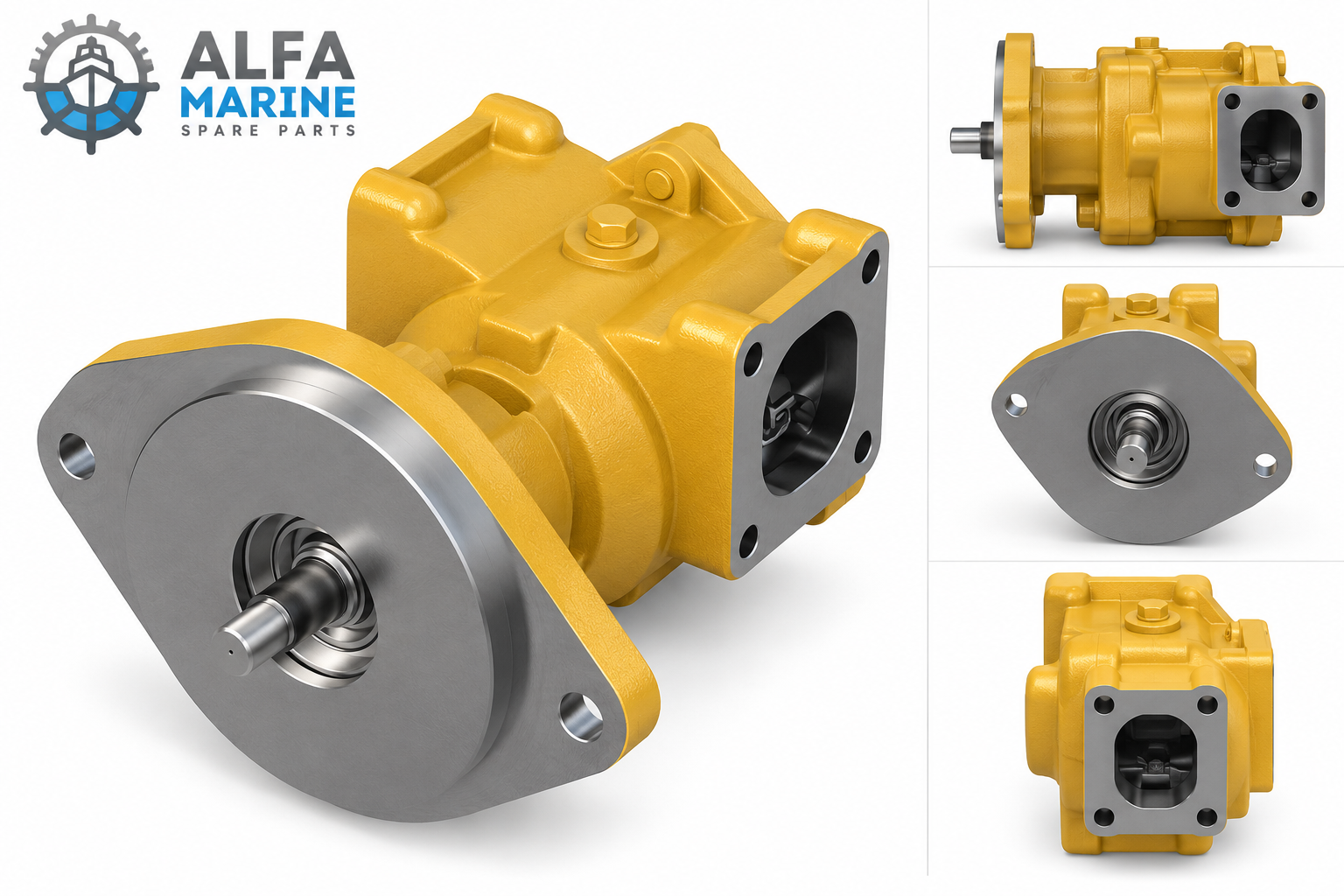
Caterpillar C9 Seawater Pump: Part Numbers, Problems & Replacement
Your Caterpillar C9 marine engine runs normally while you're leaving the harbor.
Temperature looks good. No alarms. Nothing unusual.
Then you bring the engine up to cruising RPM and, after a while, the temperature starts creeping higher.
You reduce the load and it comes back down.
Naturally, one of the first questions is:
“Is my CAT C9 seawater pump going bad?”
It could be, but don't order a pump just yet.
A worn seawater pump can reduce raw-water flow, but so can a dirty sea strainer, restricted intake, damaged hose, fouled aftercooler or partially blocked heat exchanger.
And if you do need a new pump, there's another question we hear regularly:
“Which seawater pump fits my C9?”
One important Caterpillar reference associated with C9 marine applications is:
353-7979 / 3537979 — Sea Water Auxiliary Pump
You may also come across:
20R-0753 / 20R0753 — Reman Auxiliary Sea Water Pump
The safest way to identify what you actually need is:
Engine Serial Number + Arrangement Number + Existing Pump Part Number
If you have that information, send us a quote request and we can help check the requirement.
You can also browse our Caterpillar C9 Marine Engine Parts page or the complete Caterpillar Marine Engine Parts & Rebuild Kits catalogue.
Which Seawater Pump Fits a Caterpillar C9?
Two numbers you may encounter when working on a C9 are:
| Part NumberSearch NumberDescription | ||
| 353-7979 | 3537979 | Sea Water Auxiliary Pump |
| 20R-0753 | 20R0753 | Reman Auxiliary Sea Water Pump |
Caterpillar identifies 353-7979 for marine-engine applications that include the C9.
20R-0753 is a Cat Reman auxiliary seawater-pump reference associated with C9 applications, although this Reman reference has been listed as discontinued.
There's an important point here.
Just because somebody tells you, “This pump fits a C9,” doesn't mean you should immediately order it.
C9 engines have been in service for many years. Pumps may have been replaced before, and the engine arrangement matters.
Check the engine information first.
What Does the C9 Seawater Pump Actually Do?
The seawater pump has a simple but critical job: keep raw cooling water moving through the marine cooling circuit.
Seawater enters through the vessel's intake and strainer. The pump keeps that water circulating through the applicable coolers before it eventually leaves the vessel again.
Depending on the installation, you'll be dealing with components such as:
- Sea strainer
- Seawater pump
- Aftercooler
- Heat exchanger
- Engine oil cooler
- Transmission oil cooler
- Hoses, pipes and connections
One thing that sometimes causes confusion is the difference between the seawater pump and jacket-water pump.
They're not the same thing.
The seawater pump handles raw water from outside the vessel.
The jacket-water pump circulates the coolant inside the engine.
If you're asking a supplier for a “C9 water pump,” tell them which one you mean.
Is the Caterpillar C9 Seawater Pump Gear Driven?
Yes. On the C9 ACERT marine configuration, Caterpillar uses a gear-driven auxiliary seawater pump.
That's worth knowing because people sometimes start looking for a belt-driven raw-water pump arrangement that simply isn't there.
It also means you shouldn't identify the replacement pump just by looking at a photograph of another C9 installation.
Use the actual engine and pump information.
My CAT C9 Runs Hot Under Load. Is the Pump Bad?
Maybe — but this is where it's easy to spend money on the wrong part.
A typical complaint sounds something like this:
“The engine is fine at 1,200 RPM, but when I bring it up to cruising speed the temperature starts climbing.”
That tells us something useful.
At lower load, the cooling system is managing the heat.
As the engine works harder and produces more heat, the cooling system can't keep up.
A weak seawater pump could cause that.
But so could:
- A dirty sea strainer
- A restricted seawater intake
- A suction hose collapsing internally
- Air entering before the pump
- A fouled aftercooler
- A restricted heat exchanger
- A partially blocked oil cooler
- Debris inside the seawater circuit
So don't immediately jump from “C9 overheating” to “I need a new seawater pump.”
First establish whether you actually have a flow problem, a restriction problem or both.
How Do I Know If My C9 Seawater Pump Is Wearing Out?
There isn't always one obvious sign.
Sometimes you'll see water leaking from the pump.
Sometimes you'll hear bearing noise.
Other times the first indication is simply that the engine doesn't cool as well under load as it used to.
Things worth checking include:
- Reduced seawater flow
- Temperature climbing at higher RPM
- Water leaking around the pump
- Salt deposits around the housing
- Corrosion
- Bearing noise
- Rough operation
- Shaft movement or play
- Repeated high-temperature alarms
And don't ignore salt deposits.
If you see dried salt around the pump, something has probably been leaking.
Cleaning it off might make the engine look better, but it doesn't fix the leak.
Find out where the seawater is coming from.
My C9 Seawater Pump Is Leaking. Do I Need a New One?
Not necessarily.
Before ordering a complete pump, find the exact source of the leak.
It could be coming from:
- Pump seal
- Housing
- Gasket
- O-ring
- Hose connection
- Elbow
- Pipe fitting
- Another cooling connection nearby
If the housing is still good, the shaft is serviceable and there isn't excessive bearing wear, repair may be possible.
On the other hand, if you're looking at heavy corrosion, shaft damage, excessive play and damaged sealing surfaces, putting a few new seals into an old pump may not be worthwhile.
That's when complete replacement starts making more sense.
Low Seawater Flow? Check These Before Buying a Pump
If we're dealing with a C9 that is running hot, we'd want the basic raw-water circuit checked before blaming one component.
Start at the water intake and work your way through the system.
Is the seacock fully open?
It sounds obvious, but check it.
Is the sea strainer clean?
Weed, plastic, shells and other debris can reduce flow considerably.
What condition is the suction hose in?
An older hose can sometimes collapse internally under suction even though it doesn't look terrible from the outside.
Is the pump leaking or noisy?
Look for salt deposits, shaft play and signs of corrosion.
When were the aftercooler and heat exchanger last inspected?
A pump can be perfectly capable of moving water while restricted cooler passages prevent enough water from flowing through the system.
Working through the circuit in order is usually much more productive than replacing components one by one.
What Is Caterpillar 353-7979?
353-7979 / 3537979 is a Caterpillar Sea Water Auxiliary Pump reference associated with C9 marine applications.
If the number on your existing pump is 353-7979, that's useful information.
But we'd still recommend sending the engine details with your enquiry.
For example:
Engine: Caterpillar C9
Serial Number: ABC12345
Arrangement Number: if available
Existing Pump: 353-7979
Quantity: 1
That gives us considerably more to work with than:
“Need CAT C9 pump urgently.”
If you have 353-7979 and need a replacement, send us your engine information.
What About Caterpillar 20R-0753?
You may also find 20R-0753 / 20R0753 in older records or searches.
This is a Cat Reman auxiliary seawater-pump reference associated with C9 applications.
The reference has been listed as discontinued, so if that's the number you have, send it to us together with your C9 engine information.
Don't assume you need to find another pump carrying exactly the same old Reman number.
The important thing is identifying the correct current supply option for the engine.
Can a Dirty Heat Exchanger Look Like a Bad Seawater Pump?
Yes, and this is why cooling problems can be misleading.
Imagine the pump is moving water, but the heat exchanger has become partially restricted.
The engine may still run normally at low load.
Once you ask for more power, however, the engine produces more heat and the cooling system can't transfer it quickly enough.
The result?
The temperature climbs.
That can look very similar to poor pump performance.
The same principle applies to a restricted aftercooler.
So when troubleshooting a C9 cooling problem, think about:
Water flow + restriction + heat transfer
rather than focusing only on the pump.
Is the C9 Seawater Pump the Same as the C9.3 Pump?
No — don't treat them as the same engine.
Caterpillar C9 and Caterpillar C9.3 are different engine platforms.
That means you shouldn't find a C9.3 seawater pump online and order it simply because the engine names look similar.
If the identification plate says C9, source the pump against the C9.
If it says C9.3, identify the parts against the C9.3.
For C9 components, see our Caterpillar C9 Marine Engine Parts page.
For other engines, browse our Caterpillar Marine Engine Parts catalogue.
Caterpillar C9 Seawater Pump FAQs
“My C9 is fine at idle but overheats when I'm cruising. Would you change the seawater pump?”
Not without checking a few things first.
We'd want to know whether seawater flow is actually low and whether the strainer, intake, aftercooler and heat exchanger have been checked.
If the pump is leaking, noisy or has excessive shaft play as well, then the pump becomes a much stronger suspect.
“I've found 353-7979 on the pump. Is that enough to order?”
It's a very good start.
Send us 353-7979 together with the engine serial number and, preferably, the arrangement number.
That gives us a much better basis for checking the requirement.
“I have 20R-0753. Can you still help?”
Yes.
Send us 20R-0753 / 20R0753 along with the C9 serial number and any other pump identification you have.
Because this Reman reference has been listed as discontinued, the current supply option needs to be checked.
“There's a little water coming from the pump. Can I keep running it?”
We wouldn't ignore a seawater leak.
Apart from the pump itself, saltwater can damage surrounding fasteners, electrical connections and other engine components.
Find the source of the leak and assess the pump condition before it develops into a larger problem.
“I cleaned the sea strainer but the C9 still runs hot. What should I check next?”
The pump is certainly one item to inspect, but also look at the suction hose, seawater flow, aftercooler, heat exchanger and applicable oil coolers.
If the temperature problem appears mainly under load, restrictions in the cooling circuit deserve particular attention.
“Can you identify my pump if I can't read the part number?”
Usually, the more information you send us, the better.
Start with the C9 engine serial number and arrangement number.
Then send clear photographs of the pump from several angles, including the inlet, outlet, mounting area and any numbers you can see.
Need a Caterpillar C9 Seawater Pump?
If your vessel is down and you need a Caterpillar C9 seawater pump, send us as much information as you have.
Ideally:
Engine: Caterpillar C9
Engine Serial Number:
Arrangement Number:
Existing Pump Number:
Quantity:
Delivery Location:
Don't have the pump number?
Send us photos of the engine identification plate and the existing pump instead.
Get a Quote for Your CAT C9 Seawater Pump
Request a Quote
or email us directly at:
request@alfamarinespareparts.com
You can also visit our Caterpillar C9 Marine Engine Parts page for other C9 components, or browse our complete Caterpillar Marine Engine Parts & Rebuild Kits catalogue.
Alfa Marine Spare Parts supplies Caterpillar C9 engine and cooling-system parts worldwide to vessel operators, shipyards, marine engineers, repair companies and yacht professionals.