
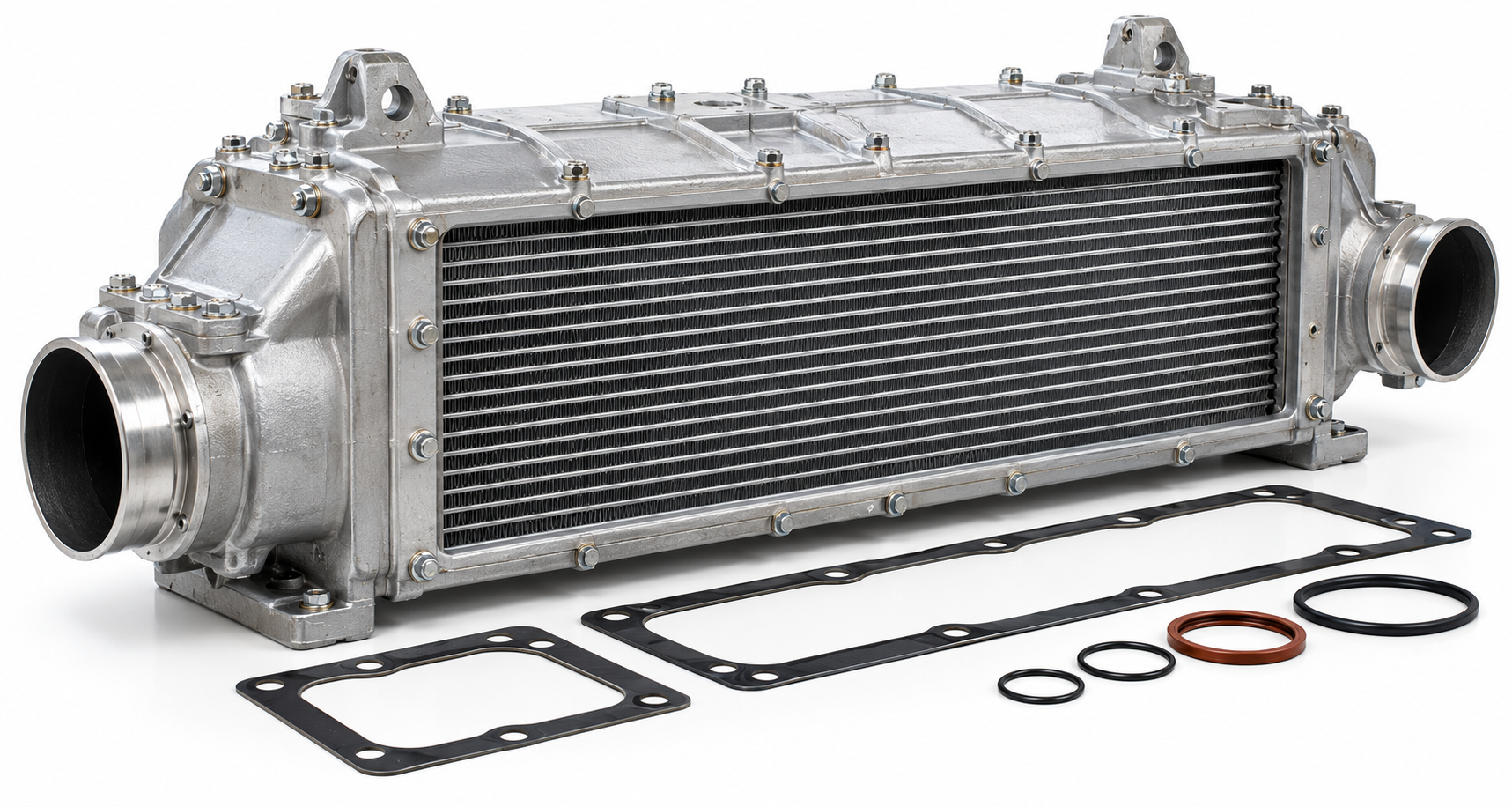
Caterpillar C15 Marine Aftercooler: Part Numbers, Old Numbers & Replacement
A Caterpillar C15 can run perfectly well around the harbor and still show problems once the vessel starts working harder.
At idle, everything looks normal.
No unusual smoke.
No obvious overheating.
No complaint from the engine.
Then the throttles come up.
The engine starts pulling harder.
And suddenly the engineer notices something isn't quite right.
Maybe the C15 feels slightly down on power.
Maybe black smoke appears under load.
Maybe charge-air temperature is higher than expected.
Or maybe there isn't a running problem at all.
The engine is already apart for maintenance and the message from the engine room is simply:
“We need another C15 aftercooler.”
Then purchasing asks the next question:
“What's the part number?”
That's where things can get interesting.
The number on the old core may be:
315-0047
It may be:
266-0053
Or somebody may find:
172-9364
in an old spare-parts record.
All three numbers can appear during the search.
The important thing is not to throw away the older numbers.
For selected Caterpillar C15 marine applications, one important current reference is:
315-0047 / 3150047 Caterpillar Aftercooler Core
An older Caterpillar reference you may also encounter is:
266-0053 / 2660053 Caterpillar Aftercooler Core
And in older records or historical searches you may also see:
172-9364 / 1729364
The safest way to identify the right replacement is still:
Old part number + Engine Serial Number + Arrangement Number
For other engine components, visit our Caterpillar C15 Marine Engine Parts page.
For the wider Caterpillar range, browse our Caterpillar Marine Engine Parts & Rebuild Kits catalogue.
Need help identifying the correct aftercooler? Request a Quote or email request@alfamarinespareparts.com.
Caterpillar C15 Aftercooler Part Numbers
Let's start with the numbers buyers are most likely to see.
| Part NumberWithout HyphenWhat You May Find It As | ||
| 315-0047 | 3150047 | Current aftercooler-core reference used on selected applications |
| 266-0053 | 2660053 | Older Caterpillar aftercooler-core reference |
| 172-9364 | 1729364 | Older/historical reference found in parts records and searches |
So one engineer may say:
“I need 3150047.”
Another may say:
“The old core says 266-0053.”
And somebody in purchasing may have:
1729364
written in an old maintenance file.
Those details are worth keeping.
They may help connect an older component to the correct current replacement.
For the two product references currently listed in our catalogue:
315-0047 / 3150047 Aftercooler Core
266-0053 / 2660053 Aftercooler Core
Why 315-0047 / 3150047 Matters
The main current number in this guide is:
315-0047 / 3150047
This is an aftercooler core.
You can view it here:
Caterpillar 315-0047 / 3150047 Aftercooler Core
The basic job of the aftercooler is simple.
The turbocharger compresses the intake air.
That compression creates heat.
The aftercooler removes some of that heat before the air reaches the cylinders.
The airflow looks roughly like this:
Air intake → Turbocharger → Aftercooler → Intake manifold → Cylinders
When everything is clean and working properly, the system does its job quietly.
When the cooler becomes restricted, dirty or damaged, the engine may only start showing symptoms once it is working hard.
Which Engines Use 315-0047 / 3150047?
This is one reason the part number can be confusing.
315-0047 / 3150047 is not associated with only one engine model.
For selected marine applications, the same part number can be found on:
Caterpillar C18
Caterpillar 3406E
That means someone searching online may see the same core described as:
C15 aftercooler
C18 aftercooler
or:
3406E aftercooler
That doesn't mean every C15, C18 and 3406E uses the same aftercooler.
It means this specific part number appears on selected configurations within those engine families.
So if somebody says:
“It's for a C18, so it must fit my C15.”
that's not enough.
The part number and engine details still need to match.
What About 266-0053 / 2660053?
This is another number worth knowing.
266-0053 / 2660053
It is an older Caterpillar aftercooler-core reference.
You can view it here:
Caterpillar 266-0053 / 2660053 Aftercooler Core
This is the kind of number that often appears on older components.
Imagine the engineer removes the cooler and sends a picture.
The number is clearly visible:
2660053
Purchasing searches it and finds that newer references also appear.
At that point, don't delete the old number.
Use it.
A good enquiry would say:
Old number: 266-0053 / 2660053
Engine model: Caterpillar C18
Engine Serial Number:
Arrangement Number:
That gives much more useful information than simply writing:
“Need C18 aftercooler.”
What About 172-9364 / 1729364?
This is the type of number that may show up in older documentation.
Maybe it's in:
- An old maintenance folder
- A vessel spare-parts list
- A previous supplier quotation
- An old invoice
- A handwritten engine-room record
If you find:
172-9364 / 1729364
don't ignore it.
Include it in the request.
A useful enquiry might look like:
Old reference: 172-9364 / 1729364
Current number being researched: 315-0047 / 3150047
Engine: Caterpillar C15
Serial Number:
Arrangement Number:
That gives the parts search some history.
And with older engines, that can be very useful.
Why Old Numbers Matter
Marine engines stay in service for a long time.
During that time, components get replaced.
Part numbers change.
Older references remain in manuals and vessel records.
An engineer may still be working from a document printed years ago.
That doesn't make the old number useless.
It may actually be the best clue available.
That's why all of these searches can matter:
315-0047
3150047
266-0053
2660053
172-9364
1729364
The key is to use the number as part of the identification process, not as the only piece of information.
What Else Might Be Needed With the Core?
This is where a small ordering mistake can stop a big repair.
The engineer asks for the aftercooler.
Purchasing orders the core.
The core arrives.
Then somebody asks:
“Where are the seals?”
Associated installation parts around applicable 315-0047 / 3150047 arrangements can include:
| Part NumberWithout HyphenDescription | ||
| 259-4600 | 2594600 | O-ring Seal |
| 150-4104 | 1504104 | Aftercooler Gasket |
| 201-4233 | 2014233 | Raw-Water Aftercooler-Lines Gasket |
These parts should still be checked against the actual engine arrangement.
The main lesson is simple:
Don't think only about the core.
Think about everything that has to come apart to replace it.
Real Situation: The New Core Is Onboard, but the Job Still Stops
The vessel is waiting.
The old cooler has been removed.
Purchasing orders:
1 × 315-0047 / 3150047 Aftercooler Core
The new part arrives.
Everyone thinks the job can continue.
Then the engineer says:
“I can't reuse this gasket.”
Now the vessel is waiting for a sealing part that costs far less than the aftercooler itself.
This is why it helps to ask before ordering:
Which gaskets are being disturbed?
Which O-rings should be renewed?
Are the connections still serviceable?
Does the engineer need the core only or the complete installation set?
Two minutes spent on those questions can save a lot of time later.
“I Have a C15. Isn't That Enough?”
Not really.
Two engines can both say:
Caterpillar C15
and still have differences in the installed equipment.
The exact arrangement can depend on the engine configuration, application and production version.
So a stronger enquiry looks like this:
Engine model: Caterpillar C15
Engine Serial Number:
Serial prefix:
Arrangement Number:
Existing part number:
Quantity:
Application:
Delivery destination:
If the old cooler is already removed, add photographs.
That gives much more confidence when identifying the right part.
Is the Aftercooler the Same as the Heat Exchanger?
No.
This confusion happens regularly because both components remove heat.
But they are doing different jobs.
The heat exchanger deals with the engine cooling circuit.
The aftercooler deals with the compressed intake air.
So if someone says:
“We need the C15 cooler.”
ask:
“Which cooler?”
That one question can save a lot of unnecessary searching.
“The Engine Runs Fine at Idle but Feels Weak at Sea”
This is where the aftercooler starts to become interesting.
At idle, the engine isn't moving or compressing the same amount of air.
The cooler doesn't have much work to do.
Then the vessel leaves the harbor.
The engine comes under load.
Turbo speed rises.
More air is compressed.
Charge-air temperature increases.
Fuel delivery increases.
Now the aftercooler has to work much harder.
A partially restricted cooler can look completely normal while the engine is idling.
The problem only becomes obvious when the C15 is asked to produce sustained power.
That doesn't mean the cooler is definitely bad.
It means it deserves inspection.
Can a Dirty Aftercooler Increase Charge-Air Temperature?
Yes.
If the heat-transfer surfaces are dirty or the cooling-water side is restricted, the cooler may not remove heat effectively.
But before replacing it, ask:
Is the core actually dirty?
Is there corrosion?
Is cooling water flowing properly?
Is something else restricting the circuit?
Is the turbocharger operating correctly?
A good aftercooler cannot perform properly without enough cooling flow.
Don't Replace the Cooler Before Checking Water Flow
This is an expensive mistake.
The engineer reports high charge-air temperature.
Everybody points at the aftercooler.
A new:
315-0047 / 3150047 Aftercooler Core
is ordered.
It gets installed.
The vessel goes for sea trial.
Same problem.
The actual fault was poor cooling-water flow.
The new cooler never had a chance to perform properly.
So the real question is:
Is the cooler bad?
or:
Is the cooler not receiving enough cooling water?
Those two problems can look very similar from the bridge.
Check the Wider Cooling System Too
If the problem appears under load, don't stop at the aftercooler.
Depending on the installation, check:
- Seawater intake
- Sea strainer
- Seawater pump
- Auxiliary pump
- Pump impeller
- Hoses
- Pipes
- Cooler passages
- Heat exchanger
- Aftercooler
If the complete engine is overheating under load, read our Caterpillar C15 Marine Overheating Under Load guide.
That article deals with the wider cooling problem.
What If the Impeller Is Missing Pieces?
This is something engineers know well.
You remove the seawater-pump impeller.
Several vanes are missing.
A new impeller is fitted.
The pump works again.
But where did the old pieces go?
They may have travelled downstream.
That can mean checking:
Heat exchanger
Aftercooler
Hoses
Cooler passages
Replacing the damaged impeller fixes the pump.
It doesn't automatically remove whatever has already moved into the cooling system.
Can an Aftercooler Problem Cause Black Smoke?
It can contribute.
But black smoke does not automatically mean:
“The aftercooler has failed.”
The engine needs the correct relationship between fuel and air.
If the engine is receiving fuel but the airflow isn't right, combustion can suffer.
So black smoke under load may also mean checking:
Air filter
Turbocharger
Boost pressure
Charge-air piping
Aftercooler
Exhaust
Fuel system
Injectors
Engine load
Think of smoke as evidence.
Not the final answer.
Don't Forget the Turbocharger
The turbocharger and aftercooler work as a team.
The turbo compresses the air.
The cooler removes the heat.
If the turbo isn't producing the correct boost, performance suffers.
If the turbo is fine but the cooler can't remove enough heat, performance can also suffer.
Follow the complete path:
Air filter → Turbocharger → Charge-air piping → Aftercooler → Intake manifold
That usually tells you more than looking at one component in isolation.
What If You Find Oil Inside the Aftercooler?
Don't just wash it out and put it back.
Ask:
“Where did the oil come from?”
The aftercooler may simply be where the oil collected.
The source could be somewhere else in the charge-air system.
Turbocharger condition is one area worth checking.
If you clean the cooler but don't find the cause, the oil may simply return.
Clean It or Replace It?
That depends on what you find.
A dirty but serviceable cooler is one thing.
A cooler with:
serious corrosion
internal leakage
damaged core surfaces
or:
damaged sealing faces
is another.
Sometimes cleaning makes sense.
Sometimes replacement makes more sense.
If replacement is required and the engine details confirm the number:
Caterpillar 315-0047 / 3150047 Aftercooler Core
If you're working from an older number:
Caterpillar 266-0053 / 2660053 Aftercooler Core
Inspect first.
Then decide.
Look at the Old Cooler Before Cleaning It
Before the cooler goes into the cleaning tank, take a good look at it.
Take photos.
Look at:
Where the deposits are
Where the corrosion is
Whether one section looks worse than another
Whether there is oil contamination
What the sealing surfaces look like
Sometimes the dirty cooler tells you something about the system.
Once everything is clean, some of that evidence disappears.
Core or Complete Aftercooler?
This is another common misunderstanding.
315-0047 / 3150047 is the aftercooler core.
So if the engineer says:
“Order the complete aftercooler.”
don't assume that one core is everything they need.
Ask:
Core only?
Core and seals?
Core and gaskets?
Additional fittings?
That little bit of clarification can prevent a second order.
Can I Use a C18 Aftercooler on a C15?
Don't make that decision from the engine name alone.
The same specific 315-0047 / 3150047 core is used on selected:
C15
C18
and:
3406E
marine applications.
But that doesn't mean every cooler across those engine families is interchangeable.
Work from the actual part number and engine configuration.
What If the Old Number Is Hard to Read?
Don't guess.
Send whatever you have.
That could be:
Engine Serial Number
Arrangement Number
Partial part number
Photographs
Connection details
Measurements
Old invoices
Maintenance records
Even part of a number can become useful when it is combined with the engine information.
Caterpillar Aftercooler Part Number Summary
These are the main numbers worth keeping together:
| Part NumberWithout HyphenDescription | ||
| 315-0047 | 3150047 | Current aftercooler-core reference for selected applications |
| 266-0053 | 2660053 | Older Caterpillar aftercooler-core reference |
| 172-9364 | 1729364 | Older/historical reference |
| 259-4600 | 2594600 | O-ring Seal |
| 150-4104 | 1504104 | Aftercooler Gasket |
| 201-4233 | 2014233 | Raw-Water Aftercooler-Lines Gasket |
Current Product
315-0047 / 3150047 Caterpillar Aftercooler Core
Older Product Reference
266-0053 / 2660053 Caterpillar Aftercooler Core
Older / Historical Reference
172-9364 / 1729364
Caterpillar C15 Aftercooler FAQs
What is the Caterpillar C15 aftercooler part number?
One important current reference for selected C15 marine engines is:
315-0047 / 3150047 Aftercooler Core
Is 3150047 the same as 315-0047?
Yes.
They are the same part number written with and without the hyphen.
What is 266-0053 / 2660053?
It is an older Caterpillar aftercooler-core reference.
You can view the product here:
266-0053 / 2660053 Caterpillar Aftercooler Core
What is 172-9364 / 1729364?
It is an older/historical reference you may find in previous engine records or parts searches.
Include it when requesting the current replacement.
Which marine engines use 315-0047 / 3150047?
Selected marine applications include:
Caterpillar C15
Caterpillar C18
Caterpillar 3406E
Exact compatibility should still be checked against the engine.
Is 315-0047 a complete aftercooler?
No.
It is an aftercooler core.
Additional installation parts may be required.
Can a dirty aftercooler cause power loss?
It can contribute to poor performance under load.
But the turbocharger, air intake, exhaust, cooling-water flow and fuel system should also be checked.
Can a bad aftercooler cause black smoke?
It can contribute to poor air conditions and black smoke.
But black smoke alone does not prove the aftercooler is faulty.
Can I order using only the engine model?
It is better to provide:
Engine Serial Number
Arrangement Number
and:
Existing part number
whenever possible.
Request Caterpillar C15 Aftercooler Parts
If you're looking for a Caterpillar C15 aftercooler core, older reference, gasket, O-ring or related cooling component, send us the information you already have.
You may be working with:
315-0047 / 3150047 Caterpillar Aftercooler Core
or:
266-0053 / 2660053 Caterpillar Aftercooler Core
You may also have an older reference such as:
172-9364 / 1729364
For accurate identification, send:
Engine model: Caterpillar C15 / C18 / 3406E
Engine Serial Number:
Serial prefix:
Arrangement Number:
Existing / old part number:
Part description:
Quantity:
Required condition: Genuine / OEM / Replacement / Reconditioned
Vessel/application:
Delivery destination:
For other C15 components, visit our Caterpillar C15 Marine Engine Parts page.
For the wider range, browse our Caterpillar Marine Engine Parts & Rebuild Kits catalogue.
If your C15 is overheating under load, read our Caterpillar C15 Marine Overheating Under Load guide.
Email: request@alfamarinespareparts.com