
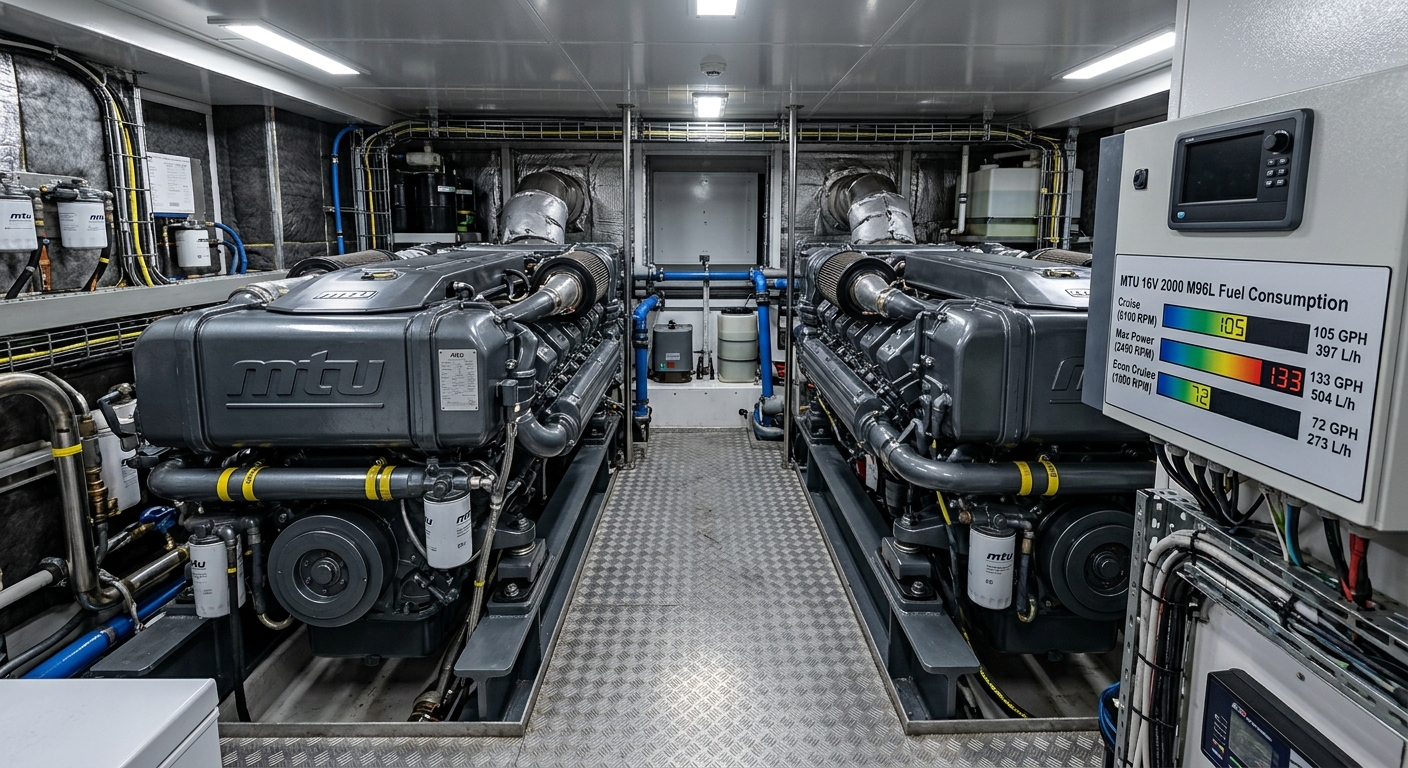
MTU 16V 2000 M96L Fuel Consumption: What Does It Really Burn?
If you have an MTU 16V 2000 M96L on board, sooner or later somebody is going to ask:
“How much fuel does this engine actually burn?”
And if your yacht has two of them, the question usually becomes:
“Are we really burning close to 1,000 litres an hour?”
At very high power, a twin-engine installation can get into that territory.
But that doesn't mean your yacht is burning anything close to 1,000 L/h every time it leaves the marina.
The MTU 16V 2000 M96L is a V16 marine diesel engine rated at 1,939 kW / 2,600 bhp at 2,450 rpm. Producing that level of power requires a lot of fuel, but there isn't one honest litres-per-hour figure that applies to every yacht fitted with this engine.
RPM matters.
Engine load matters.
Hull condition matters.
Propellers matter.
Vessel weight matters.
And how fast you're trying to push the yacht through the water matters enormously.
So instead of giving you one impressive-looking number, let's answer the questions yacht owners, captains and engineers actually ask about MTU 16V 2000 M96L fuel consumption.
For engine components and replacement parts, you can also browse our MTU Marine Engine Parts.
How Much Fuel Does an MTU 16V 2000 M96L Use Per Hour?
This is the obvious question.
It's also the one that's easiest to answer badly.
At very high engine output, fuel consumption can be around 500 litres per hour per engine as a broad reference.
But don't read that and assume:
M96L = 500 L/h.
That's not how it works.
At lower loads, consumption can be dramatically lower.
Think of it this way:
Low load → considerably lower fuel consumption
Cruising load → consumption rises
High load → much higher consumption
Near maximum output → consumption can approach roughly 500 L/h per engine
The important word is:
load.
Two M96Ls running at the same RPM aren't necessarily producing exactly the same power or burning exactly the same amount of fuel.
Can Twin MTU 16V 2000 M96L Engines Really Burn 1,000 Litres Per Hour?
Yes, at high output they can get close.
And this is where a real yacht example becomes much more useful than a generic engine number.
A published sea trial of a yacht powered by two MTU 16V 2000 M96L engines recorded approximately:
| Engine RPMYacht SpeedCombined Fuel Consumption | ||
| 1,189 rpm | 10 knots | 143 L/h |
| 1,313 rpm | 11 knots | 183 L/h |
| 1,454 rpm | 12 knots | 228 L/h |
| 1,611 rpm | 14 knots | 300 L/h |
| 1,818 rpm | 16 knots | 413 L/h |
| 2,063 rpm | 18 knots | 581 L/h |
| 2,281 rpm | 20 knots | 807 L/h |
| 2,449 rpm | 22 knots | 1,001 L/h |
Look at the difference.
At 10 knots, the two engines together were using approximately 143 L/h.
At 22 knots, the figure was approximately 1,001 L/h.
Same yacht.
Same engines.
But nowhere near the same fuel consumption.
That's why asking:
“How much fuel does an M96L burn?”
is only half the question.
The better question is:
“How much does it burn at the speed and load I actually intend to run?”
You can also read our MTU 16V 2000 Fuel Consumption & Cruising Speed Guide.
Will My Yacht Use the Same Amount?
Probably not exactly.
This is where online fuel-consumption numbers can become misleading.
Those sea-trial figures belong to one yacht under a particular set of test conditions.
Your yacht may be heavier.
The hull may be different.
Your propellers may be different.
Your gearbox ratio may be different.
You may be carrying more fuel, freshwater, tenders, equipment or stores.
Your hull and running gear may also be in a different condition.
Weather and sea state change things too.
So treat published sea-trial data as a real-world reference, not a promise of what your own yacht will consume.
How Much Does One M96L Use at 20 Knots?
There's a catch with this question.
Knots describe the yacht's speed, not the engine's load.
In the published twin-engine example, the yacht recorded approximately:
20 knots
2,281 rpm
807 L/h combined
If you simply divide that combined figure equally between two engines, you get approximately:
403.5 L/h per engine
Useful?
Yes.
A universal M96L fuel-consumption figure at 20 knots?
No.
Another yacht may require more or less propulsion power to maintain exactly the same 20-knot speed.
That's why vessel-specific performance data is so valuable.
What Happens If I Slow Down to 10 Knots?
This is where the numbers become interesting.
The same yacht recorded approximately:
10 knots
1,189 rpm
143 L/h combined
Divided equally, that's approximately:
71.5 L/h per engine
Now compare that with the consumption recorded near the highest test point.
The difference is enormous.
For an owner planning a long passage, this matters.
If arrival time is less important than range and fuel consumption, slowing down can completely change the voyage calculation.
How Much Fuel Does the M96L Use Per Nautical Mile?
Litres per hour tells you how quickly fuel is leaving the tanks.
But for voyage planning, another number can be even more interesting:
How much fuel are we using to travel one nautical mile?
The calculation is simple:
Fuel consumption in L/h ÷ vessel speed in knots = litres per nautical mile
Using the same yacht example:
At 10 knots:
143 ÷ 10 = approximately 14.3 L/nm
At 20 knots:
807 ÷ 20 = approximately 40.4 L/nm
At 22 knots:
1,001 ÷ 22 = approximately 45.5 L/nm
That's quite a difference.
At the higher speeds, you're not only burning more fuel every hour.
You're also burning considerably more fuel for every nautical mile travelled.
For an owner looking at range rather than maximum speed, that distinction matters.
Why Does Fuel Consumption Rise So Quickly When the Yacht Goes Faster?
Because pushing a large yacht faster through the water requires increasing propulsion power.
More resistance means the engines have to work harder.
More engine power means more fuel.
This is why adding a few knots to cruising speed can produce a surprisingly large increase in fuel consumption.
It also explains why there isn't one universal:
“best cruising speed for an MTU 16V 2000 M96L.”
The engine is only part of the equation.
The yacht matters just as much.
Does RPM Tell Me Exactly How Much Fuel I'm Burning?
No.
RPM is useful, but it doesn't tell the whole story.
Imagine two yachts with M96Ls both running around 2,000 rpm.
One has:
A clean hull.
Clean propellers.
Relatively light operating displacement.
The other has:
Hull fouling.
More weight.
Different propellers.
More resistance through the water.
Both engines can be turning at roughly the same RPM while operating under different loads.
For useful performance monitoring, look at the relationship between:
RPM + engine load + actual fuel rate + vessel speed
That's far more informative than RPM alone.
“My M96L Is Suddenly Using More Fuel Than Last Season”
Now we have a different question.
Don't immediately blame the injectors.
First make sure you're comparing like with like.
Is the yacht travelling at the same speed?
At approximately the same engine RPM?
At a similar engine load?
With similar displacement?
Under reasonably similar sea conditions?
If the answer is yes and fuel consumption has genuinely increased, start investigating why.
Can a Dirty Hull Increase M96L Fuel Consumption?
Yes.
And sometimes the answer to an engine-performance question is sitting underneath the yacht.
Marine growth on the hull, shafts, propellers and other underwater surfaces increases resistance.
The engines then have to produce more power to maintain the same vessel speed.
Imagine the yacht normally cruises at a particular speed and engine load.
A few months later, maintaining that speed requires noticeably more load.
Before assuming something expensive has failed inside the MTUs, look at the entire vessel.
The problem might be underwater rather than inside the engine room.
“We Cleaned the Hull and Fuel Consumption Dropped”
That's valuable information.
It tells you the engines were previously being asked to overcome additional resistance.
This is why historical yacht data can be so useful.
If you know:
- Normal RPM
- Engine load
- Fuel rate
- Vessel speed
when the hull and propulsion system are clean, you have a baseline.
Several months later, you can compare against it.
Without that baseline, an owner may simply notice:
“We're filling the tanks more often.”
With the data, the engineer has something measurable to investigate.
Can Dirty Fuel Filters Make an M96L Burn More Fuel?
A restricted fuel filter is more likely to cause fuel-supply and performance problems than simply produce a predictable increase in litres per hour.
You may see symptoms such as:
- Difficulty reaching expected power
- Reduced performance
- Unstable operation
- Fuel-pressure problems
- Problems that become more noticeable at higher load
If the engine isn't producing normal power, fuel filtration is one of the basic areas worth checking.
But don't diagnose an M96L from fuel consumption alone.
What About the Fuel Injectors?
Injectors naturally come up whenever fuel consumption changes.
And yes, injection-system condition can affect combustion and engine performance.
But:
Higher fuel consumption does not automatically mean bad injectors.
Before considering sixteen replacement injectors, ask:
Are both engines consuming more fuel?
Or only one?
Is there unusual smoke?
Has vessel speed dropped at the same RPM?
Has engine load increased?
Is port behaving differently from starboard?
Are there relevant engine faults?
Those questions are much cheaper than replacing parts to see what happens.
If you're trying to identify an existing injector, see our MTU Fuel Injector Part Number Identification Guide.
Port Uses More Fuel Than Starboard. Is That Normal?
A small difference doesn't automatically indicate a problem.
But if two MTU 16V 2000 M96L engines are operating under comparable conditions and one consistently shows a substantial difference in load or fuel rate, we'd want to know why.
This is one of the advantages of a twin-engine yacht.
You have a comparison engine sitting a few metres away.
Suppose:
Port: 2,000 rpm, normal historical fuel rate and load
Starboard: 2,000 rpm, noticeably different load or fuel rate
Don't immediately change parts.
Compare the engines systematically.
What's different?
Fuel supply?
Air supply?
Boost?
Temperature?
Engine load?
Propulsion load?
Fault information?
The difference itself becomes a diagnostic clue.
What If Both Engines Are Burning More Fuel?
Now think beyond the engines.
If both M96Ls suddenly require more fuel to maintain the same yacht speed, consider things both engines share.
Hull condition.
Propeller condition.
Vessel loading.
Fuel quality.
Sea conditions.
Changes made during a yard period.
It's possible for both engines to develop problems, of course.
But don't overlook the yacht itself.
Can Turbocharger or Charge-Air Problems Affect Performance?
They can.
The M96L depends on its air, fuel, cooling and electronic systems working together correctly.
A problem affecting air supply or charge-air performance can influence combustion and engine output.
But again, avoid the parts-lottery approach:
Fuel consumption changed → replace injectors.
Didn't work → replace turbocharger.
Still didn't work → replace sensors.
That's an expensive way to troubleshoot a yacht.
Use engine data and physical inspection to narrow down the cause first.
“The Yacht Is Slower at the Same RPM”
That's another useful observation.
If you previously achieved a particular speed at a known RPM and now the yacht is slower, don't look only at fuel consumption.
Ask:
Has engine load changed?
Has fuel rate changed?
Are both engines behaving similarly?
Is the hull clean?
Are the propellers clean and undamaged?
Has vessel displacement increased?
A speed change at the same RPM can tell you something about the propulsion system and vessel condition that litres per hour alone cannot.
How Should I Track M96L Fuel Consumption?
You don't need to make this complicated.
Build a simple performance record for your yacht.
At several normal operating points, record:
- Engine RPM
- Port engine load
- Starboard engine load
- Port fuel rate
- Starboard fuel rate
- Vessel speed
- Sea conditions
- Approximate vessel loading
- Hull/propeller condition
Repeat it periodically.
Now you have something much more valuable than:
“The internet says an M96L burns X litres per hour.”
You have a performance baseline for your own vessel.
If something starts changing, you'll see it.
What's the Difference Between the MTU 16V 2000 M96 and M96L?
This is worth mentioning because the model names are easy to confuse.
Both are Series 2000 V16 marine engines, but they are different ratings.
| EngineRated PowerRated Speed | ||
| MTU 16V 2000 M96 | 1,790 kW / 2,400 bhp | 2,450 rpm |
| MTU 16V 2000 M96L | 1,939 kW / 2,600 bhp | 2,450 rpm |
So when you're researching consumption, parts or performance information, make sure you're looking at the M96L rather than assuming every 16V 2000 specification applies to it.
What MTU 16V 2000 M96L Parts Can Affect Engine Performance?
There isn't one “fuel-consumption part.”
Engine performance depends on multiple systems working correctly.
Depending on the actual fault, maintenance and repair enquiries can involve:
- Fuel filters
- Oil filters
- Fuel injectors
- Fuel-system components
- Turbocharger components
- Charge-air cooling components
- Seawater pumps
- Coolant pumps
- Sensors
- Engine-control components
- Gaskets and seals
- Cylinder-head components
- Pistons and liners
- Bearings
- Overhaul components
But don't use that as a shopping list.
Identify the problem first.
Then identify the component.
Then verify the part number.
You can browse our MTU Series 2000 Engine Parts and Marine Spare Parts Catalogue.
Ordering M96L Parts? Don't Send Only the Engine Model
Suppose you've diagnosed the problem and now need a replacement component.
A message saying:
“Need MTU 16V2000 M96L injector.”
is a start.
But we would rather receive:
Engine: MTU 16V 2000 M96L
Engine serial number: XXXXX
Existing part number: XXXXX
Quantity: XXXXX
Delivery destination: XXXXX
Photographs of the existing component can also help when identification is uncertain.
Series 2000 components shouldn't be assumed interchangeable simply because they look similar or are advertised online as fitting an M96L.
Request an MTU Parts Quote.
So What Is Normal MTU 16V 2000 M96L Fuel Consumption?
There isn't one universal litres-per-hour figure.
That's probably the most useful answer in this entire article.
The MTU 16V 2000 M96L is rated at 1,939 kW / 2,600 bhp at 2,450 rpm, and fuel consumption rises considerably as engine output increases.
A twin-engine yacht can approach 1,000 L/h combined at very high output, while the same yacht can consume dramatically less when operated slowly.
So instead of asking:
“How many litres per hour does an M96L burn?”
ask:
“How much does my M96L burn at this RPM, this load and this vessel speed?”
That's the number that actually matters.
Frequently Asked Questions
How much fuel does an MTU 16V 2000 M96L use?
Fuel consumption varies substantially with engine load and vessel operating conditions. At very high output, consumption can approach roughly 500 L/h per engine as a broad reference, while consumption at lower loads can be dramatically lower.
Can twin M96L engines burn 1,000 litres per hour?
They can approach that level at high output. In the real-world sea-trial example discussed above, combined consumption reached approximately 1,001 L/h at 2,449 rpm and 22 knots.
Does an M96L always burn around 500 L/h?
No. That would be misleading. Fuel consumption changes significantly with engine load and vessel operating conditions.
How much did the twin M96Ls consume at 20 knots?
In the example discussed above, combined consumption was approximately 807 L/h at 2,281 rpm.
Divided evenly, that would be approximately 403.5 L/h per engine, but it should not be treated as a universal 20-knot consumption figure.
What about at 10 knots?
The same yacht recorded approximately 143 L/h combined at 1,189 rpm and 10 knots.
Why is my M96L using more fuel than before?
Start by comparing current performance against historical vessel data. Check RPM, engine load, actual fuel rate and vessel speed, while also considering hull condition, propellers, vessel loading, sea conditions and engine condition.
Can dirty propellers increase fuel consumption?
Yes. Fouling or other conditions that increase propulsion resistance can require more engine power to maintain a given vessel speed.
Can M96L injectors affect fuel consumption?
Fuel-injection condition can affect combustion and engine performance, but increased fuel consumption alone does not prove that the injectors are faulty.
Should port and starboard M96Ls use exactly the same amount of fuel?
Not necessarily exactly. However, a significant and persistent difference under comparable operating conditions deserves investigation.
What information should I provide when ordering M96L parts?
Provide the complete MTU engine designation, engine serial number, existing part number, required quantity and delivery destination.
Need MTU 16V 2000 M96L Spare Parts?
If your fuel-consumption investigation eventually identifies an engine component that needs replacement, Alfa Marine Spare Parts can assist with sourcing MTU 16V 2000 M96L spare parts for maintenance, repair and overhaul requirements.
The important thing is not to order a component simply because it appears on a list of possible causes.
First diagnose the problem.
Then identify the component.
Then confirm the correct part against the engine information.
For a quotation, send:
Engine: MTU 16V 2000 M96L
Engine serial number
Existing part number
Required quantity
Delivery destination
Request an MTU Parts Quote
Email: request@alfamarinespareparts.com
Browse MTU Marine Engine Parts.
Browse MTU Series 2000 Engine Parts.
Browse our Marine Spare Parts Catalogue.
The useful question isn't simply:
“How much fuel does an M96L burn?”
It's:
“Is my yacht consuming what it normally should for the speed, load and conditions we're operating in?”