
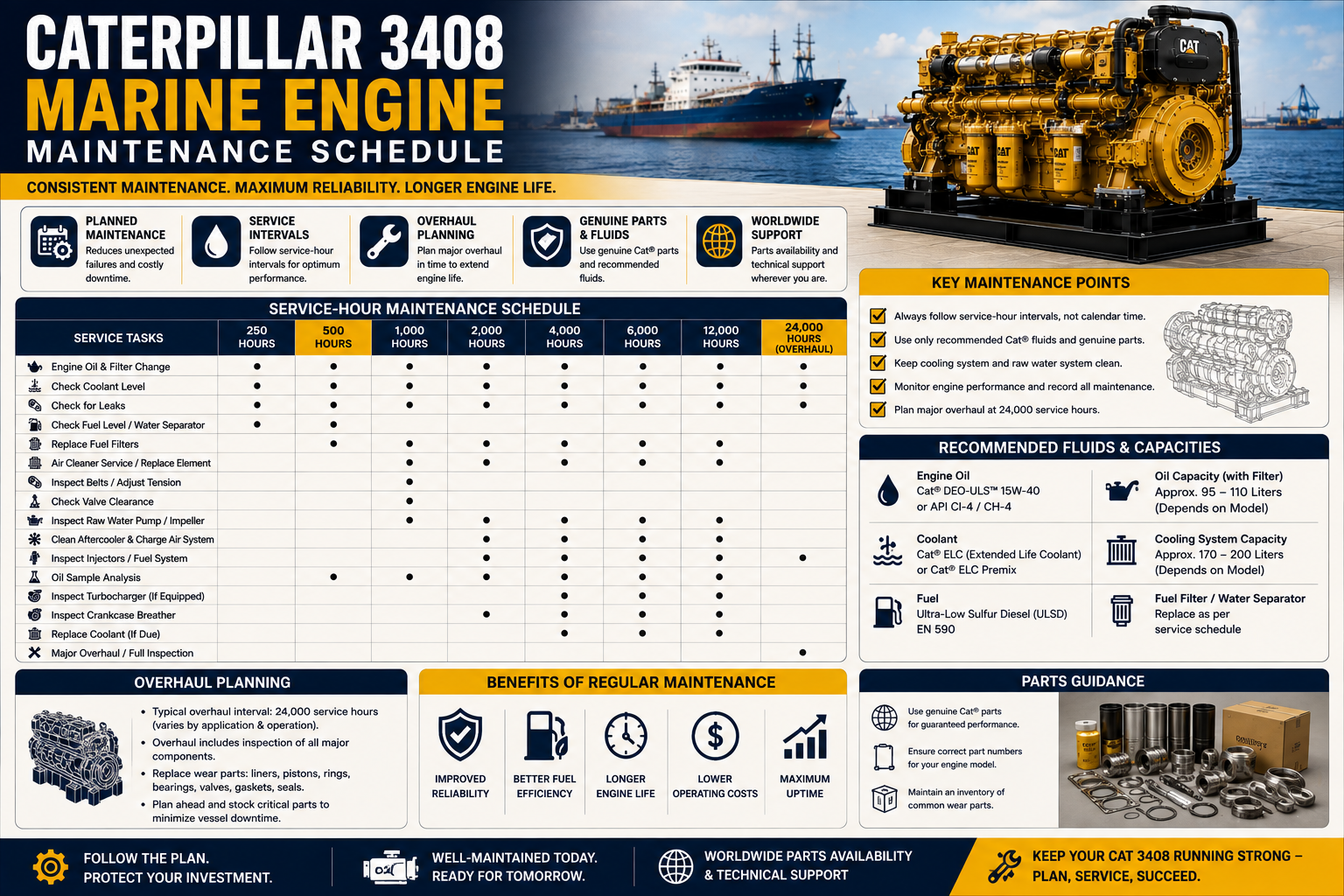
Caterpillar 3408 Marine Engine Maintenance Schedule: Turning Service Hours Into a Practical Fleet Plan
The Caterpillar 3408 marine engine is an older mechanical Caterpillar diesel that is still found in working vessels around the world. Although newer Caterpillar engine families have replaced it in production, many 3408 marine engines remain in service, which makes accurate maintenance planning and spare-parts identification especially important.
For an engineer, the maintenance manual talks in operating hours, fuel consumption and calendar time.
For a fleet manager, purchasing department or vessel owner, it is often easier to ask:
“How many months until we reach that service?”
That is what this guide is designed to answer.
The Caterpillar marine maintenance schedule reviewed for this article specifically covers 3408 Marine Engines at all rated rpm and instructs operators to use fuel consumption, service hours or time interval—whichever occurs first.
For our planning examples, we'll use:
Low Usage: 3,000 operating hours/year
High Usage: 5,000 operating hours/year
The calculation is:
Maintenance interval ÷ annual operating hours × 12 = approximate months
These calendar conversions are for planning. The Caterpillar maintenance manual and the exact engine serial number remain the controlling references.
Caterpillar 3408 Marine Engine: Why Identification Matters
Before creating a maintenance schedule, identify exactly which engine you have.
A useful fleet record should include:
Manufacturer: Caterpillar
Engine: 3408 Marine
Engine configuration: V8 diesel
Serial number: __________
Arrangement number: __________
Rated rpm: __________
Standard or deep oil sump: __________
Propulsion / auxiliary application: __________
Current hours: __________
This is especially important because the 3408, 3408B and 3408C should not automatically be treated as identical engines.
Caterpillar's separate high-performance marine documentation covers the 3408C together with the 3412, 3412C and 3412D, showing why engine-generation identification matters.
Quick Caterpillar 3408 Hour-to-Month Conversion
⚙️ CATERPILLAR 3408 FLEET PLANNING
| Service HoursLow Usage 3,000 h/yearHigh Usage 5,000 h/year | ||
| 50 h | 0.2 month | 0.12 month |
| 125 h | 0.5 month | 0.3 month |
| 250 h | 1 month | 0.6 month |
| 500 h | 2 months | 1.2 months |
| 1,000 h | 4 months | 2.4 months |
| 3,000 h | 12 months | 7.2 months |
| 5,000 h | 20 months | 12 months |
| 6,000 h | 24 months | 14.4 months |
Important: These are calendar conversions. Only use an interval where it actually applies to the specific Caterpillar maintenance task.
Daily Caterpillar 3408 Marine Checks
🟦 DAILY / BEFORE OPERATION
Interval: Every operating day
Low Usage: Daily
High Usage: Daily
Caterpillar-listed checks include:
- Walk-around inspection
- Check engine for leaks and loose connections
- Engine crankcase oil level
- Cooling-system coolant level
- Marine gear oil level
- Air-starter lubricator oil where fitted
- Air-cleaner service indicator
- Clutch shift-collar lubrication where applicable
Engineer Focus: Look for what changed since the previous watch.
These daily items are included in Caterpillar's 3408 marine maintenance schedule.
A daily walk-around may seem basic, but this is where many developing problems first appear.
Look for:
- Fresh oil stains
- Coolant residue
- Fuel seepage
- Loose clamps
- Unusual vibration
- Exhaust-color changes
- Higher temperatures
- Different operating noises
A small change today may prevent a large repair later.
Every 50 Service Hours
🟦 50-HOUR MAINTENANCE
Interval: 50 operating hours
Low Usage: approximately 0.2 month
High Usage: approximately 0.12 month
Verified Caterpillar task:
Zinc rods — inspect / replace
Engineer Focus: Treat sacrificial anodes as part of cooling-system protection, not as insignificant consumables.
Caterpillar specifies zinc-rod inspection/replacement every 2,550 liters of fuel or 50 operating hours in the referenced 3408 marine schedule.
On a high-use vessel, 50 hours passes extremely quickly.
That means zinc inspection is essentially a routine engine-room job.
Why Zinc Rods Matter
Seawater is aggressive.
Sacrificial zincs help protect marine cooling-system components against corrosion.
Neglect can contribute to deterioration of:
- Heat exchangers
- Coolers
- Water passages
- Pump housings
- Associated marine cooling components
When inspecting a zinc, don't only ask:
“Is there still some zinc left?”
Also ask:
“Is the consumption rate changing?”
Abnormally fast or slow deterioration may tell you something about conditions inside the cooling system.
Every 125 Service Hours
The Caterpillar 3408 schedule also contains an interval specifically related to optional drivetrain equipment.
🟦 125-HOUR MAINTENANCE
Low Usage: approximately 0.5 month
High Usage: approximately 0.3 month
Where fitted:
- PTO main shaft — lubricate
- Shift lever — lubricate
- Pilot bearing — lubricate
- Clutch — check / adjust
Engineer Focus: Only apply this section where the installation contains the relevant equipment.
Caterpillar lists this at 6,375 liters of fuel or 125 operating hours.
The 250-Hour Service
For the Caterpillar 3408 marine engine, the 250-hour point is one of the most important routine maintenance intervals.
🟩 250-HOUR MAINTENANCE
Interval: 250 hours or yearly, with fuel consumption also specified
Low Usage: approximately 1 month
High Usage: approximately 0.6 month
Caterpillar-listed work includes:
- Scheduled Oil Sampling / SOS
- Engine oil and filters on applicable standard-sump engines
- Drain water and sediment from fuel tank
- Replace final fuel filter
- Clean primary fuel filter
- Test conventional coolant additive concentration
- Service coolant additive system where fitted
- Clean crankcase breathers
- Inspect batteries
- Check / adjust / replace belts
- Inspect hoses and clamps
- Clean / replace air-cleaner elements
- Valve lash at first oil change
Engineer Focus: This is a complete condition-check opportunity, not merely an oil change.
These tasks are identified in Caterpillar's marine 3408 maintenance schedule at 13,000 liters of fuel, 250 operating hours, or the applicable yearly limit.
Caterpillar 3408 Oil Change: Standard Sump vs. Deep Sump
This is one of the most important details in the entire article.
Caterpillar's 3408 marine schedule specifically states that oil-change timing is influenced by fuel consumption and sump capacity.
For the referenced schedule:
🟩 STANDARD SUMP — 250-HOUR OIL SERVICE
Oil & filter interval: 250 hours
Low Usage: approximately 1 month
High Usage: approximately 0.6 month
Fleet implication at 5,000 h/year: potentially around 20 oil-service cycles per year
Engineer Focus: Confirm sump capacity before assigning the interval.
🟩 DEEP SUMP — 500-HOUR OIL SERVICE
Oil & filter interval: 500 hours
Low Usage: approximately 2 months
High Usage: approximately 1.2 months
Fleet implication at 5,000 h/year: potentially around 10 oil-service cycles per year
Engineer Focus: Don't assume every 3408 uses the 250-hour interval.
Caterpillar explicitly states in the referenced 3408 schedule that standard sump capacity requires oil and filter changes at 250 hours, while deep sump capacity allows 500 hours, with fuel consumption and Scheduled Oil Sampling used to confirm the interval.
This is exactly why a fleet record should include:
Sump type: standard / deep
Why Fuel Consumption Matters for Oil Changes
Two Caterpillar 3408 engines can each run 250 hours.
But one may operate heavily loaded while the other spends much more time lightly loaded.
The engines have accumulated the same number of hours.
They have not necessarily consumed the same amount of fuel or experienced the same combustion loading.
Caterpillar specifically says fuel consumption is the preferred indicator for the 3408 oil-change interval, with oil analysis used to confirm it.
That is a very useful engineering lesson:
Track hours and fuel consumption together.
Oil Analysis
At the routine maintenance interval, Caterpillar includes Scheduled Oil Sampling.
For a 3408 fleet, trend:
- Iron
- Copper
- Lead where applicable
- Aluminium
- Chromium
- Silicon
- Fuel dilution
- Water
- Coolant contamination
- Viscosity
- Oxidation
Do not look at one oil report in isolation.
Imagine:
Sample 1 — normal iron
Sample 2 — slightly higher
Sample 3 — higher again
Sample 4 — continues upward
The important information is the direction of the trend.
Fuel Filter Maintenance
The referenced 250-hour maintenance schedule includes fuel-system service.
🟩 FUEL-SYSTEM SERVICE — 250 HOURS
Low Usage: approximately 1 month
High Usage: approximately 0.6 month
Caterpillar-listed work includes:
- Drain water and sediment from fuel tank
- Replace final fuel filter
- Clean primary fuel filter
Engineer Focus: Clean fuel protects the injection equipment and keeps combustion more consistent between cylinders.
Do not wait for a fuel restriction or injector complaint before thinking about filtration.
Air Cleaner Maintenance
Air cleaners are also included in the Caterpillar 3408 routine maintenance schedule.
🟩 AIR CLEANER — 250-HOUR SERVICE
Interval: Included in referenced 250-hour maintenance
Inspect / clean / replace elements as required
Engineer Focus: Restricted air supply can look like a fuel-system or turbocharger problem.
Poor airflow can contribute to:
- Black smoke
- Higher exhaust temperature
- Reduced power
- Increased fuel consumption
- Turbocharger stress
Valve Lash at the First Oil Change
🟦 FIRST OIL CHANGE — VALVE LASH
Task: Check / adjust valve lash
When: First applicable oil-change service
Engineer Focus: Record the actual measurement by cylinder before adjusting.
Caterpillar includes valve lash at the first oil-change maintenance in the 3408 schedule.
Don't simply record:
“Valves adjusted.”
Write:
Cylinder 1 intake: ___
Cylinder 1 exhaust: ___
and continue through the engine.
Those records become useful when valve lash is revisited later.
1,000-Hour Maintenance
🟦 1,000-HOUR SERVICE
Interval: 1,000 operating hours
Low Usage: approximately 4 months
High Usage: approximately 2.4 months
Verified Caterpillar tasks:
- Engine protective devices — inspect / check
- Magnetic pickup — inspect / adjust
Engineer Focus: A mechanically healthy engine still depends on working protection systems.
The Caterpillar 3408 marine schedule specifies these items at 51,000 liters of fuel or 1,000 operating hours.
Protective devices are easy to forget because they may do almost nothing during normal operation.
They become extremely important when something goes wrong.
Why Protection Devices Deserve Maintenance
An engine shutdown device or alarm that has worked perfectly for ten years without operating may give the crew confidence.
But has it actually been tested?
Protective systems may include monitoring for conditions such as:
- High coolant temperature
- Low oil pressure
- Overspeed
- Other engine-specific protection parameters
The exact devices depend on installation.
The important point is that protection systems need inspection before the emergency occurs.
3,000-Hour Maintenance
The Caterpillar 3408 3,000-hour interval is a substantial service event.
🟥 3,000-HOUR MAINTENANCE
Interval: 3,000 operating hours
Low Usage — 3,000 h/year: approximately 12 months
High Usage — 5,000 h/year: approximately 7.2 months
Caterpillar-listed tasks include:
- Fuel ratio control — check / adjust
- Set point and low idle — check / adjust
- Engine mounts — inspect
- Crankcase vibration damper — inspect
- Long-life coolant extender — add where applicable
- Water temperature regulators / thermostats — replace
- Conventional cooling system — clean / flush / change coolant
- PAR analysis — obtain
- Valve lash — check / adjust
- Valve rotators — inspect
Engineer Focus: Start preparing for this service months before the hour meter reaches 3,000.
Caterpillar lists these maintenance requirements at 153,000 liters of fuel or 3,000 operating hours.
Thermostat Replacement
🟥 3,000 HOURS — WATER TEMPERATURE REGULATORS
Low Usage: approximately 12 months
High Usage: approximately 7.2 months
Caterpillar task: Replace water-temperature regulators / thermostats.
Engineer Focus: Cooling-system control is as important as coolant quantity.
A thermostat that does not control temperature correctly can influence:
- Warm-up
- Operating temperature
- Combustion
- Lubricating-oil behavior
- Cooling efficiency
Valve Lash at 3,000 Hours
Valve lash appears again in the 3,000-hour maintenance block.
This is where the value of your earlier records becomes clear.
Compare:
first oil-change readings
with
3,000-hour readings.
If one cylinder changes much more than the others, investigate rather than simply resetting the clearance.
Possible causes may include:
- Valve wear
- Valve-seat wear
- Valve rotator condition
- Rocker components
- Combustion differences
Vibration Damper Inspection
🟥 3,000 HOURS — VIBRATION DAMPER
Task: Inspect crankcase/crankshaft vibration damper
Low Usage: approximately 12 months
High Usage: approximately 7.2 months
Engineer Focus: Do not treat the damper as a passive component that never requires attention.
Caterpillar includes vibration-damper inspection in the 3,000-hour 3408 maintenance scope.
A crankshaft torsional-vibration problem can be vastly more expensive than the damper itself.
5,000-Hour Maintenance
This is one of the largest scheduled component-maintenance points before overhaul.
🟥 5,000-HOUR MAINTENANCE
Interval: 5,000 operating hours
Low Usage: approximately 20 months
High Usage: approximately 12 months
Caterpillar-listed components:
- Fuel nozzles — test / exchange
- Alternator — inspect / rebuild / exchange
- Air compressor where fitted — inspect / rebuild / exchange
- Starting motors — inspect / rebuild / exchange
- Turbocharger — inspect / rebuild / exchange
- Jacket-water pump — inspect / rebuild / exchange
- Raw-water pump — inspect / rebuild / exchange
Engineer Focus: This should be treated as a planned component-overhaul package.
Caterpillar specifies these items at 256,000 liters of fuel or 5,000 operating hours.
At 5,000 annual operating hours, this becomes approximately an annual major maintenance event.
Caterpillar 3408 Raw Water Pump
The raw-water pump deserves particular attention because it is part of the 5,000-hour component-maintenance group.
🌊 5,000 HOURS — RAW WATER PUMP
Low Usage: approximately 20 months
High Usage: approximately 12 months
Caterpillar action: Inspect / rebuild / exchange
Inspect:
- Pump housing
- Shaft
- Bearings
- Seals
- Corrosion
- Erosion
- Pumping element
- Suction condition
- Cooling-water flow
Engineer Focus: Don't inspect the pump without checking the complete seawater circuit.
A new pump cannot overcome:
- Blocked sea strainer
- Collapsed hose
- Fouled heat exchanger
- Restricted inlet
- Marine growth
Jacket-Water Pump
💧 5,000 HOURS — JACKET-WATER PUMP
Low Usage: approximately 20 months
High Usage: approximately 12 months
Caterpillar action: Inspect / rebuild / exchange
Engineer Focus: Distinguish the jacket-water circuit from the raw-water circuit.
Caterpillar includes the jacket-water pump at the same 5,000-hour component-maintenance point.
The two pumps perform different jobs.
That distinction becomes very important when troubleshooting overheating.
Turbocharger at 5,000 Hours
🌀 5,000 HOURS — TURBOCHARGER
Low Usage: approximately 20 months
High Usage: approximately 12 months
Caterpillar action: Inspect / rebuild / exchange
Monitor before the interval:
- Boost pressure
- Oil leakage
- Compressor cleanliness
- Turbine deposits
- Bearing noise
- Shaft condition
- Exhaust-temperature trends
Do not wait for obvious power loss.
Gradual turbocharger deterioration may first show up as changes in:
- Smoke
- Exhaust temperature
- Fuel consumption
- Engine response
Fuel Nozzles at 5,000 Hours
⛽ 5,000 HOURS — FUEL NOZZLES
Caterpillar action: Test / exchange
Engineer Focus: Compare combustion condition cylinder by cylinder.
A deteriorating nozzle can affect:
- Combustion quality
- Exhaust temperature
- Smoke
- Piston deposits
- Fuel consumption
- Cylinder-head thermal loading
6,000-Hour Cooling-System Maintenance
🟥 6,000 HOURS / 4 YEARS
Low Usage by hours: approximately 24 months
High Usage by hours: approximately 14.4 months
Caterpillar-listed task:
Long-life coolant / antifreeze — drain, flush and replace
Rule: Follow the applicable hour, fuel or calendar trigger.
Engineer Focus: Low-hour vessels cannot ignore the calendar limit.
Caterpillar's 3408 marine schedule lists long-life coolant replacement at 306,000 liters of fuel, 6,000 operating hours, or four years.
What About the Caterpillar 3408 Major Overhaul?
This is where the schedule becomes especially interesting.
Caterpillar does not provide one single universal hour value in this referenced schedule.
Instead, overhaul fuel quantity depends on rated engine speed.
🟥 CATERPILLAR 3408 MAJOR OVERHAUL
1250–1350 rpm engines:
1,140,000 L / 300,000 gal fuel
1800 rpm engines:
874,000 L / 230,000 gal fuel
2100 rpm engines:
570,000 L / 150,000 gal fuel
Important: Rated rpm and fuel consumption matter. Do not assign one generic overhaul-hour figure to every Caterpillar 3408.
Caterpillar notes that the fuel amounts used in the maintenance schedule are based on an average fuel consumption of approximately 51 L/hour (13.5 gal/hour).
Using that historical assumption only as a rough planning conversion gives approximately:
- 1250–1350 rpm: ~22,350 operating hours
- 1800 rpm: ~17,140 operating hours
- 2100 rpm: ~11,180 operating hours
These are derived estimates from Caterpillar's fuel quantities, not standalone Caterpillar overhaul-hour specifications.
What Is Included in a Caterpillar 3408 Major Overhaul?
The referenced maintenance schedule calls for substantial inspection, rebuilding or replacement work.
🔧 MAJOR OVERHAUL COMPONENTS
Inspect / rebuild / exchange as applicable:
- Cylinder heads
- Connecting rods
- Pistons
- Cylinder liners
- Turbocharger
- Oil pump
- Spacer plate
- Fuel ratio control
- Cam followers
- Fuel transfer pump
- Timing advance
Replace / renew as specified:
- Piston rings
- Main bearings
- Connecting-rod bearings
- Valve rotators
- Crankshaft seals
Test / inspect:
- Fuel nozzles
- Fuel injection pump
- Crankshaft
- Camshaft
- Cam bearings
- Damper
- Governor
Clean / test:
- Oil cooler
- Aftercooler core
Also: Obtain coolant analysis.
This overhaul scope is explicitly described in Caterpillar's 3408 marine maintenance schedule.
Engine Room Reality: Don't Throw the Old Parts Away Too Quickly
During a 3408 overhaul, the removed components contain information.
Before cleaning or discarding them, inspect:
Main Bearings
Look for:
- Scoring
- Edge wear
- Wiping
- Embedded debris
- Heat discoloration
Connecting-Rod Bearings
Compare every cylinder position.
If seven look similar and one is dramatically different, ask why.
Pistons
Photograph the crowns before cleaning.
Different deposits may point toward:
- Injector problems
- Oil consumption
- Valve issues
- Air distribution
- Cooling differences
Cylinder Heads
Compare:
- Exhaust valves
- Intake valves
- Deposits
- Sealing surfaces
- Cooling passages
An overhaul should not simply make the engine new again.
It should tell you why the old components wore the way they did.
Caterpillar 3408 Maintenance Summary
⚙️ QUICK 3408 MAINTENANCE BLOCK
| IntervalLow Usage 3,000 h/yearHigh Usage 5,000 h/yearMain Maintenance | |||
| Daily | Daily | Daily | Fluids, leaks, air cleaner and general inspection |
| 50 h | 0.2 mo | 0.12 mo | Zinc rods |
| 125 h | 0.5 mo | 0.3 mo | PTO / clutch service where fitted |
| 250 h | 1 mo | 0.6 mo | SOS, fuel filters, breathers, air cleaner, belts, hoses |
| 250 h | 1 mo | 0.6 mo | Standard-sump oil/filter interval |
| 500 h | 2 mo | 1.2 mo | Deep-sump oil/filter interval |
| 1,000 h | 4 mo | 2.4 mo | Protection devices and magnetic pickup |
| 3,000 h | 12 mo | 7.2 mo | Valves, thermostats, damper, mounts and cooling system |
| 5,000 h | 20 mo | 12 mo | Nozzles, turbo, pumps, alternator and starter overhaul/inspection |
| 6,000 h / 4 yr | 24 mo | 14.4 mo | Long-life coolant replacement |
| Major Overhaul | RPM/fuel dependent | RPM/fuel dependent | Full internal inspection and overhaul |
The underlying service points are taken from Caterpillar's 3408 marine maintenance schedule for all rated rpm.
What About the Caterpillar 3408C?
The 3408C High Performance Marine Engine requires its own maintenance schedule and should not automatically inherit every 3408 interval above.
For example, the separate 3408C/3412 high-performance marine documentation identifies:
⚙️ 3408C EXAMPLE
50 hours: Seawater strainer + zinc rods
First 250 hours: Engine valve lash
6,000 hours / 3 years: ELC extender
12,000 hours / 6 years: ELC coolant change
This is a perfect example of why your fleet database should say:
3408
or
3408C
rather than simply:
CAT V8.
Real Marine Maintenance Scenario
Imagine a commercial vessel operating a Caterpillar 3408 around 5,000 hours per year.
The superintendent looks at the schedule and sees:
5,000-hour component maintenance.
That may initially sound like something far into the future.
But:
⏱️ 5,000 HOURS AT 5,000 HOURS/YEAR
Approximate time: 12 months
Now the parts department potentially needs to plan every year for inspection or overhaul of:
- Turbocharger
- Raw-water pump
- Jacket-water pump
- Alternator
- Starting motors
- Fuel nozzles
- Air compressor where fitted
Suddenly this isn't only an engineering schedule.
It is an annual procurement plan.
Engineer's Toolbox
CATERPILLAR 3408 FLEET MAINTENANCE RECORD
Vessel: __________________
Engine: Caterpillar 3408 Marine
Serial Number: __________________
Arrangement Number: __________________
Rated RPM: __________________
Standard / Deep Sump: __________________
Current Engine Hours: __________________
Total Fuel Consumption: __________________
Annual Operating Hours: __________________
Next 250-Hour Service: __________________
Next Oil Change: __________________
Next 1,000-Hour Inspection: __________________
Next 3,000-Hour Service: __________________
Next 5,000-Hour Component Service: __________________
Next Coolant Renewal: __________________
Projected Overhaul: __________________
Last Oil Analysis: __________________
Last Coolant Analysis: __________________
Parts Ordered: __________________
Open Technical Observations: __________________
Marine Engineer Tip
On a Caterpillar 3408, record three things beside the engine model: rated rpm, sump type and fuel consumption.
Those three details can materially affect maintenance planning.
Caterpillar itself differentiates:
- oil-change interval by sump capacity; and
- overhaul planning by rated rpm and fuel consumption.
Common Caterpillar 3408 Maintenance Planning Mistakes
Avoid:
- Treating the 3408 and 3408C as identical.
- Ignoring the engine serial number.
- Ignoring rated rpm.
- Assuming every 3408 has a 250-hour oil interval.
- Forgetting the deep-sump 500-hour option.
- Tracking hours but not fuel consumption.
- Waiting until 5,000 hours to start sourcing pump or turbocharger parts.
- Changing valve lash without recording measurements.
- Replacing the raw-water pump without checking the entire seawater circuit.
- Ignoring zinc condition.
- Throwing bearings away before examining wear patterns.
- Assuming one overhaul-hour figure applies to every 3408.
Frequently Asked Questions
What is the Caterpillar 3408 marine maintenance philosophy?
The referenced Caterpillar schedule specifies using fuel consumption, operating hours or time interval—whichever occurs first.
How often should the oil be changed on a Caterpillar 3408 marine engine?
In the referenced schedule:
Standard sump: 250 hours
Deep sump: 500 hours
Caterpillar also says fuel consumption should be used as the preferred indicator and the interval confirmed by Scheduled Oil Sampling.
When should the fuel filters be serviced?
The referenced 250-hour maintenance includes cleaning the primary fuel filter and replacing the final fuel filter.
When is valve lash checked?
Valve lash is checked at the first oil change and appears again in the 3,000-hour maintenance scope.
When is the Caterpillar 3408 raw-water pump overhauled?
The raw-water pump is listed for inspection, rebuild or exchange at 5,000 operating hours in the referenced marine schedule.
When is the jacket-water pump serviced?
The jacket-water pump is also included at the 5,000-hour component-maintenance point.
When is the turbocharger overhauled?
The referenced Caterpillar schedule lists the turbocharger for inspection, rebuild or exchange at 5,000 hours.
When does a Caterpillar 3408 need overhaul?
Caterpillar's referenced schedule bases major overhaul primarily on fuel consumption and rated rpm, rather than one universal engine-hour value. Lower-rated engines receive a larger cumulative fuel allowance than 2,100-rpm engines.
Can I use this schedule for a 3408C?
Not automatically. Caterpillar published separate high-performance marine maintenance information for the 3408C.
Caterpillar 3408 Marine Spare Parts
Alfa Marine Spare Parts can assist with sourcing parts for Caterpillar 3408 marine maintenance and overhaul projects, including:
- Oil filters
- Fuel filters
- Air filters
- Fuel nozzles
- Fuel-injection components
- Turbochargers
- Raw-water pumps
- Jacket-water pumps
- Water-pump repair components
- Oil pumps
- Oil coolers
- Aftercooler components
- Thermostats
- Cylinder heads
- Intake valves
- Exhaust valves
- Valve rotators
- Pistons
- Piston rings
- Cylinder liners
- Connecting rods
- Main bearings
- Connecting-rod bearings
- Crankshaft components
- Camshaft components
- Crankshaft seals
- Engine mounts
- Gaskets
- O-rings
- Complete overhaul components
For a legacy engine such as the 3408, part-number verification is particularly important.
Caterpillar's Parts Store advises using the engine/equipment serial number when identifying parts and parts diagrams.
Related Caterpillar Engine Pages
- Caterpillar 3406 Marine Engine Spare Parts
- Caterpillar 3408 Marine Engine Spare Parts
- Caterpillar 3408B Marine Engine Spare Parts
- Caterpillar 3408C Marine Engine Spare Parts
- Caterpillar 3412 Marine Engine Spare Parts
- Caterpillar 3412C Marine Engine Spare Parts
- Caterpillar C15 Marine Engine Spare Parts
- Caterpillar C18 Marine Engine Spare Parts
- Caterpillar C32 Marine Engine Spare Parts
- Caterpillar 3508 Marine Engine Spare Parts
Worldwide Caterpillar Marine Spare Parts Supply
Alfa Marine Spare Parts supports:
- Shipyards
- Ship repair companies
- Marine engineers
- Chief engineers
- Technical superintendents
- Fleet operators
- Commercial fishing companies
- Offshore operators
- Government fleets
- Maritime contractors
- Boat builders
- Marine service companies
- Marine equipment distributors
For an accurate Caterpillar 3408 quotation, provide:
Engine model + serial number + arrangement number + existing part number + quantity + photographs where available.
Browse Our Complete Catalog
Website:
https://alfamarinespareparts.com
Marine Spare Parts Catalog:
https://alfamarinespareparts.com/spareparts
Why Choose Alfa Marine Spare Parts?
With a legacy engine such as the Caterpillar 3408, sourcing often requires more than typing an engine model into a catalog.
A request may begin with:
“Need CAT 3408 seawater pump.”
The useful questions are:
Which 3408?
Which serial number?
Which arrangement?
What part number is installed now?
Is the customer preparing for the 5,000-hour service or responding to a failure?
Alfa Marine Spare Parts helps customers source genuine, OEM, aftermarket, remanufactured and reconditioned Caterpillar marine engine components, depending on availability and application.
The objective is to have the correct component identified before vessel downtime turns normal maintenance into an emergency.
Contact Alfa Marine Spare Parts
Email: request@alfamarinespareparts.com
Website:
https://alfamarinespareparts.com
Catalog:
https://alfamarinespareparts.com/spareparts
Contact Alfa Marine Spare Parts for Caterpillar 3408 oil and fuel filters, raw-water pumps, jacket-water pumps, fuel nozzles, turbochargers, cylinder heads, pistons, liners, bearings, crankshaft components, gasket sets and overhaul parts with worldwide supply.
One Final Thought
The Caterpillar 3408 Marine Engine Maintenance Schedule shows why operating hours alone do not tell the complete maintenance story.
On a high-use vessel operating 5,000 hours per year:
250 hours = approximately 0.6 month
500 hours = approximately 1.2 months
1,000 hours = approximately 2.4 months
3,000 hours = approximately 7.2 months
5,000 hours = approximately 12 months
But Caterpillar also tells us to consider fuel consumption, sump capacity, rated rpm and calendar time.
So the most useful maintenance question is not simply:
“How many hours are on our Caterpillar 3408?”
It is:
“What rated configuration are we operating, how much fuel has the engine consumed, which service event is coming next, and do we already have the correct parts ready?”