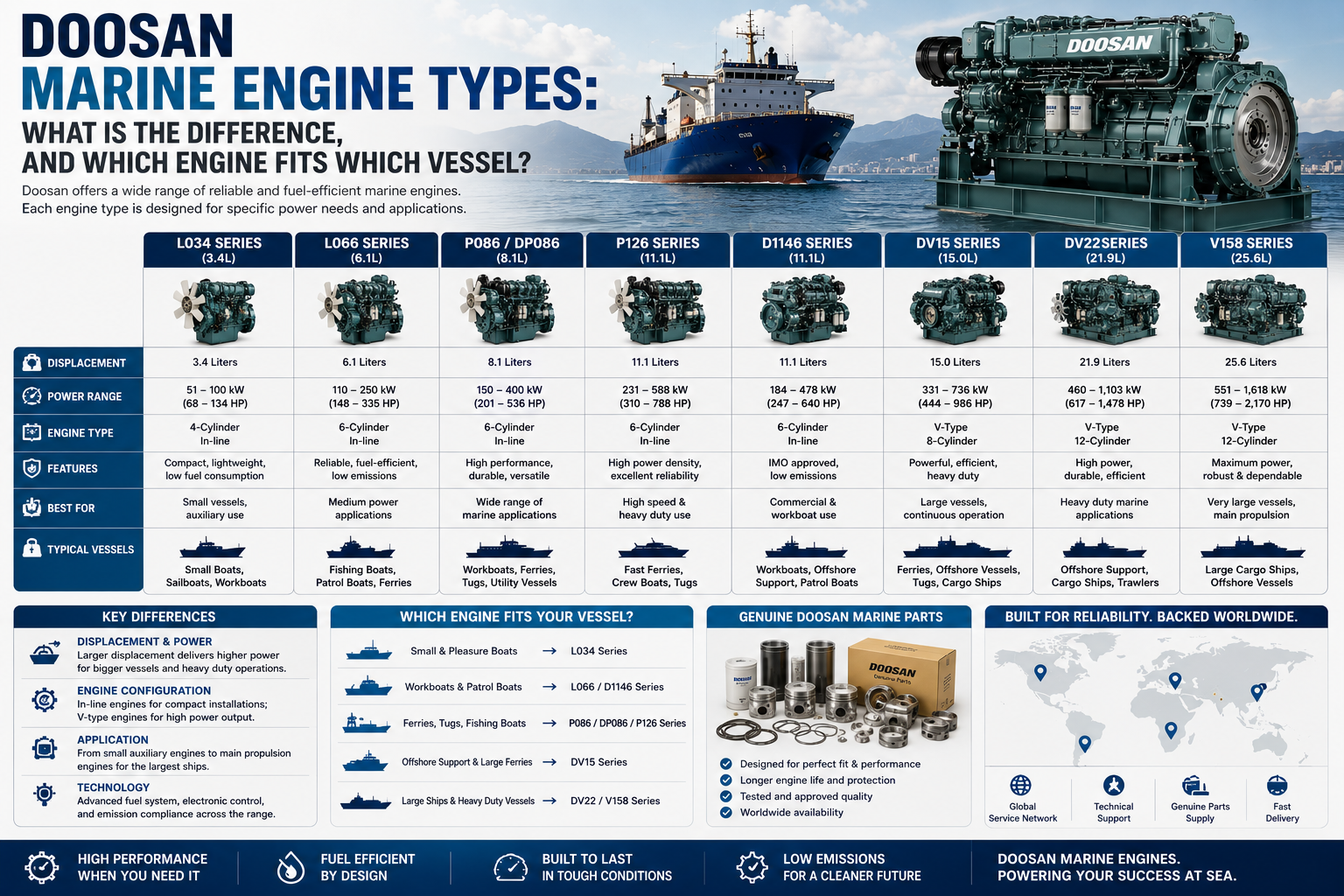
Doosan Marine Engine Types: What Is the Difference, and Which Engine Fits Which Vessel?
When somebody says:
“I have a Doosan marine engine.”
That still leaves a lot of questions.
Do they mean a smaller L034 or L066?
A six-cylinder L086TI?
A heavier-duty L126TI?
A V-type V158TI, V180TI or V222TI?
Or one of the related base-engine families such as D1146, DV15 or DV22?
Doosan has produced marine engines for a wide range of vessels, from fishing boats and workboats to yachts and larger commercial craft. The current engine business, now under HD Construction Equipment, still describes its marine engines as being used in fishing trawlers, yachts, pleasure boats and cruise liners.
That makes Doosan interesting because there is no single “typical” Doosan marine engine.
Some models are relatively compact inline engines.
Others are large V-engines designed for substantially more power.
Some are naturally aspirated.
Others are turbocharged and intercooled.
And, perhaps most importantly, the same basic engine family can sometimes be offered in heavy-duty, medium-duty and light-duty ratings.
So which Doosan engine belongs in which boat?
That is what we are going to look at.
First: Understanding the Main Doosan Marine Engine Families
Historical Doosan Infracore marine documentation lists a broad propulsion range built around engine families such as:
- L034
- L066
- L086TI
- L126TI
- L136
- L136T
- L136TI
- MD196T / MD196TI
- 4L126TI
- V158TI
- 4V158TI
- V180TI
- V222TI
- 4V222TI
Doosan's marine brochure shows that different versions were offered for heavy-duty, medium-duty and light-duty operation, with power changing according to the intended duty.
That distinction is critical.
A fishing trawler operating long hours should not necessarily use the same rating as a pleasure boat that spends much less time at maximum power.
Why Duty Rating Matters So Much
Imagine two boats using engines from the same basic family.
One is a commercial fishing vessel.
It operates almost every day, runs long hours and may spend significant time under heavy load.
The other is a pleasure boat.
It may operate only on weekends and use maximum power mainly during acceleration.
Those are completely different operating lives.
This is why Doosan marine brochures distinguish between:
Heavy Duty
Medium Duty
and
Light Duty
For example, the L086TI family was offered as:
L086TIH — Heavy Duty
L086TIM — Medium Duty
L086TIL — Light Duty
with progressively higher rated power as the permitted duty became lighter. The historical Doosan brochure lists approximately 285 PS, 315 PS and 360 PS respectively.
That means the letters at the end of the model are not decoration.
They tell you something important about how the engine was intended to work.
Doosan L034: Compact Marine Diesel Power
The Doosan L034 sits toward the smaller end of the traditional Doosan marine range.
It has appeared in compact marine installations and continues to show up in the used and spare-parts market. Current listings still identify the L034 specifically as a marine diesel engine.
Where Does the L034 Make Sense?
Think about smaller applications such as:
- Small fishing boats
- Harbor craft
- Small workboats
- Auxiliary propulsion
- Marine generator installations
- Repower projects where engine-room space is limited
The attraction of an engine in this class is usually not enormous horsepower.
It is:
compact dimensions + manageable weight + straightforward commercial diesel power.
For a small working vessel, that can be exactly what is needed.
Doosan L066: A Step Up for Small Commercial Boats
The L066 moves upward in output while remaining in a relatively compact inline-engine class.
Current marine-engine listings still show L066 propulsion engines around 180 hp, demonstrating that this family remains relevant in the replacement and repower market.
Which Vessels Suit an L066?
Potential applications include:
- Fishing boats
- Small workboats
- Passenger launches
- Utility vessels
- Patrol-type craft
- Small commercial repowers
An L066 can make sense when an owner has outgrown the smallest engine but does not need the power, size and fuel consumption of a large six-cylinder or V-engine.
L034 vs. L066: What Is the Practical Difference?
Think of it simply:
Doosan L034
Character: Smaller and more compact
Good fit: Light commercial craft and auxiliary applications
Why choose it: Installation size and modest power requirement
Doosan L066
Character: More power while staying relatively compact
Good fit: Fishing boats, workboats and heavier small-vessel applications
Why choose it: Greater propulsion capability without moving into a much larger engine family
The correct choice still depends on displacement, gearbox, propeller and duty cycle.
Doosan L086TI: One Engine Family, Three Different Jobs
The L086TI is one of the more interesting Doosan marine families because the duty-rating system is very clear.
Doosan's historical brochure identifies:
L086TIH — 285 PS / 210 kW — Heavy Duty
L086TIM — 315 PS / 232 kW — Medium Duty
L086TIL — 360 PS / 265 kW — Light Duty
The base engine listed is the D1146TIB.
Which One Should a Commercial Fisherman Choose?
For a vessel operating many hours annually, the heavy-duty rating is the natural place to start evaluating.
Why?
Because the lower heavy-duty output is intended to give the engine a more conservative operating life under sustained use.
What About a Pleasure Boat?
A lighter-duty version can deliver more rated power because the operating profile assumes the engine will not remain at maximum load continuously.
This is an important lesson:
More horsepower from the same engine does not automatically mean “better.”
Sometimes it means:
less continuous-duty capability.
Doosan L136: Simple Commercial Marine Power
The L136 is a six-cylinder inline marine engine based on the D1146 family.
Doosan's marine documentation lists the L136 at approximately 160 PS / 118 kW at 2,200 rpm in heavy-duty configuration, using the D1146 base engine.
The underlying D1146 is an inline six-cylinder, four-stroke, water-cooled diesel of approximately 8.1 liters.
What Kind of Vessel Fits an L136?
Think:
- Fishing boats
- Workboats
- Small commercial vessels
- Displacement craft
- Marine auxiliaries
The naturally aspirated L136 is particularly interesting for operators who value simplicity.
No turbocharger means one less major air-system component.
Of course, the tradeoff is lower power density.
Doosan L136T: Add a Turbocharger, Add More Power
The L136T uses the same broad D1146 family but adds turbocharging.
Doosan listed heavy- and light-duty versions at approximately 200 PS and 240 PS depending on configuration and rated speed.
That changes the personality of the engine.
The turbocharger allows more air into the cylinders.
More air allows more fuel to be burned efficiently.
More fuel and air mean more power.
But now maintenance also has to consider:
- Turbocharger bearings
- Compressor cleanliness
- Oil supply
- Exhaust-side deposits
- Boost pressure
So the engine becomes more powerful, but slightly more complex.
Doosan L136TI: Turbocharged and Intercooled
The L136TI goes another step further.
Doosan's marine brochure lists approximately 230 PS / 169 kW at 2,200 rpm for its heavy-duty version.
The “TI” configuration adds intercooling to the turbocharged system.
Why cool the compressed air?
Because compressed air becomes hot.
Cooling it increases air density, allowing the engine to breathe more effectively.
Where Does an L136TI Fit?
Good candidates can include:
- Commercial fishing boats
- Workboats
- Patrol vessels
- Utility craft
- Small passenger vessels
It makes sense where the vessel needs more power than a naturally aspirated L136 can provide but still wants a conventional inline commercial-diesel layout.
L136 vs. L136T vs. L136TI
This is a very useful comparison.
L136
Naturally aspirated
Simpler engine
Lower specific power
Fewer turbocharging components
L136T
Turbocharged
More power
Greater air-system complexity
Turbocharger maintenance becomes important
L136TI
Turbocharged + intercooled
Higher-performance air system
Better charge-air control
Additional cooler and associated maintenance
For an engineer, those three models show how one base-engine idea can be developed for very different output requirements.
Doosan L126TI: Moving Into Heavier Work
The L126TI family provides significantly more output.
Doosan's marine brochure lists heavy- and medium-duty variants at approximately:
360 PS / 265 kW
and
400 PS / 294 kW.
What Kind of Vessel Uses an L126TI?
Think:
- Larger fishing vessels
- Commercial workboats
- Passenger craft
- Offshore utility vessels
- Tug-support applications
- Heavy marine auxiliaries
At this level, the engine is no longer simply a small boat diesel.
It is becoming a substantial commercial propulsion unit.
Doosan 4L126TI: More Breathing for More Performance
The 4L126TI uses four-valve cylinder-head technology.
Four valves per cylinder can improve airflow compared with simpler two-valve arrangements.
Better breathing can support:
- Higher output
- Improved combustion
- Better air movement through the cylinder
That makes the 4L126TI interesting where power density matters more.
It also means the cylinder head and valve train are more involved than on simpler engines.
Doosan MD196T and MD196TI
The MD196 family appears in Doosan's heavier inline marine range.
The Doosan marine brochure identifies the MD196T as a heavy-duty engine around 280 PS / 206 kW.
These engines have appeared in commercial propulsion where reliability and sustained torque matter.
Typical applications can include:
- Fishing vessels
- Workboats
- Utility vessels
- Commercial passenger craft
- Auxiliary propulsion
The MD196 name is also still seen in the used marine-parts market, which is important for fleets operating older vessels.
Doosan V158TI: Moving Into V-Engine Territory
Once we reach the V158TI, the character of the engine changes significantly.
This is a larger V-type, turbocharged and intercooled marine engine.
Doosan's marine brochure lists the V158TI family across multiple duty classes, with outputs from roughly 480 PS to 680 PS, depending on version.
A V158TI is also described in marine-engine service material as a turbocharged and intercooled mechanical engine.
Which Boats Suit a V158TI?
Think:
- Larger fishing vessels
- Commercial workboats
- Tugboats
- Offshore vessels
- Passenger craft
- Larger yachts
- High-output commercial propulsion
This is no longer small-workboat territory.
Why Move From an Inline Engine to a V-Engine?
A V-engine allows more cylinders to be packaged into a shorter overall engine length.
That can be very useful in a vessel.
Compare:
long inline engine
with
shorter but wider V-engine
Depending on the engine room, the V-layout may provide a better packaging solution.
The tradeoff is that you now have two cylinder banks.
That means more:
- Cylinder heads
- Exhaust manifolds
- Intake components
- Valve gear
- Access considerations
Doosan 4V158TI: Four-Valve High-Output Development
The 4V158TI builds on the V158 concept using four-valve cylinder-head architecture.
Doosan's marine brochure lists versions of the 4V158TI family from approximately 530 PS to 800 PS, depending on duty and configuration.
This makes it relevant where vessels want more power from a relatively compact V-engine package.
Typical applications may include:
- Fast commercial boats
- Patrol boats
- Offshore support vessels
- High-power fishing vessels
- Passenger craft
Doosan V180TI: Larger V-Engine Commercial Power
The V180TI moves another step upward.
Doosan's historical marine range lists power approximately from 600 PS to 820 PS, depending on duty rating.
This is the kind of engine you consider when the vessel requires serious propulsion output but still wants a relatively compact high-speed marine diesel.
Applications can include:
- Tugboats
- Offshore craft
- Large fishing vessels
- Fast commercial vessels
- Passenger vessels
- Larger yachts
Doosan V222TI: Heavy Marine Power
The V222TI is among the larger traditional Doosan marine engine families.
The marine brochure lists versions from approximately 720 PS to 1,000 PS, depending on duty rating.
Now we are clearly in larger commercial-vessel territory.
Potential uses include:
- Tugs
- Offshore support vessels
- Large fishing boats
- Commercial passenger vessels
- Patrol and government craft
- Larger displacement vessels
At this power level, maintenance planning becomes a much bigger operation.
You may be managing:
- Multiple cylinder heads
- Turbochargers
- Intercoolers
- Large water pumps
- Fuel injection components
- Main and connecting-rod bearings
- Pistons and liners
- Major gasket packages
Doosan 4V222TI: More Airflow, More Output
The 4V222TI represents a four-valve development of the larger V222 family.
Four-valve architecture can improve cylinder breathing and support higher-performance combustion.
This type of engine is suited to installations where power density matters.
But naturally, the overhaul also becomes more complex.
More valves mean:
- More valve seats
- More guides
- More springs
- More components per cylinder head
The performance advantage comes with additional maintenance detail.
Quick Doosan Marine Engine Comparison
| Doosan EngineGeneral CharacterTypical Marine Fit | ||
| L034 | Compact smaller marine diesel | Small fishing boats, auxiliaries, small workboats |
| L066 | Compact higher-output engine | Fishing boats, workboats, launches |
| L086TI | Turbo/intercooled with several duty ratings | Fishing, workboats, commercial craft |
| L136 | Naturally aspirated inline six | Commercial boats, displacement craft, auxiliaries |
| L136T | Turbocharged L136 development | Workboats, fishing vessels |
| L136TI | Turbocharged and intercooled | Heavier commercial work |
| L126TI | Higher-output inline engine | Larger fishing and commercial boats |
| 4L126TI | Four-valve high-output inline | Faster or more heavily loaded commercial vessels |
| MD196T/TI | Heavy-duty inline commercial engine | Fishing, utility and workboat propulsion |
| V158TI | Mid-to-large V-engine | Tugs, fishing, offshore, larger yachts |
| 4V158TI | Higher-output four-valve V-engine | Fast commercial and patrol craft |
| V180TI | Larger V-engine | Offshore, tugs, passenger and fishing vessels |
| V222TI | High-output commercial V-engine | Larger tugs, fishing and offshore vessels |
| 4V222TI | Four-valve high-output V-engine | High-demand commercial propulsion |
The original Doosan marine catalog confirms the broad progression from smaller inline engines through larger turbocharged/intercooled V-type engines and different duty ratings.
Which Doosan Engine Makes Sense for a Fishing Boat?
Fishing vessels are an excellent match for Doosan's traditional marine philosophy.
They often need:
- Long operating hours
- Strong torque
- Straightforward mechanical servicing
- Good parts availability
- Reliable cooling
- Conservative continuous-duty output
Depending on vessel size, engines such as:
L066
L086TIH
L136 / L136TI
L126TI
V158TI
may all be relevant.
For a vessel operating many hours each year, always examine the heavy-duty rating first.
The highest horsepower version isn't automatically the best commercial choice.
Which Doosan Engine Makes Sense for a Workboat?
Workboats can cover a huge range.
A small harbor utility craft may be perfectly suited to an L066 or L086TI.
A 20-meter commercial workboat may need substantially more power.
A UK workboat builder using Doosan engines reports fitting them across vessels from roughly 10 to 24 meters, selecting the engine according to the specific vessel.
That is exactly the right philosophy.
Don't ask:
“What Doosan fits a workboat?”
Ask:
“Which workboat?”
Which Doosan Engine Makes Sense for a Tugboat?
A tug needs very different engine behavior from a pleasure boat.
Important characteristics include:
- Continuous torque
- Heavy-load capability
- Rapid load changes
- Reliable cooling
- Commercial-duty rating
Depending on tug size, engines toward the larger part of the Doosan marine range can be more relevant:
- V158TI
- 4V158TI
- V180TI
- V222TI
- 4V222TI
Again, the duty rating is crucial.
A tug should not be selected around a light-duty rating merely because it gives the highest advertised horsepower.
Which Doosan Engine Makes Sense for a Yacht?
Doosan engines have also been installed in yachts and pleasure craft, and the current company describes its marine engines as serving everything from fishing trawlers to yachts and pleasure boats.
For a yacht, the priorities may shift toward:
- Higher power-to-weight
- Compact dimensions
- Smooth operation
- Reduced engine-room space
- Higher intermittent output
That can make medium- or light-duty versions attractive where the actual operating profile permits them.
But a yacht that operates commercially or accumulates very high annual hours should be treated differently.
“Yacht” does not automatically mean “light duty.”
Which Doosan Engine Is Good for a Marine Generator?
Doosan's underlying diesel-engine business has produced engines not only for propulsion but also for marine auxiliary power and power generation.
Families based on engines such as:
- D1146
- DV-type engines
- DP-series engines
- Other Doosan industrial platforms
have been used in generator applications.
For a generator, the priorities are different from propulsion.
The engine must maintain stable speed while electrical load changes.
Important concerns include:
- Generator frequency
- Continuous rating
- Cooling
- Load acceptance
- Fuel consumption
- Service accessibility
What About Doosan Engines in Construction Machines?
This is where it is important to distinguish Doosan marine engine names from the broader Doosan/HD engine business.
The same company heritage also produced engines for:
- Excavators
- Construction equipment
- Industrial machinery
- Generators
- Agricultural equipment
- Pumps
- Power units
The current HD Construction Equipment engine division continues to supply engines for multiple industrial markets.
So an engine block may have relatives outside the marine industry.
But that does not mean a construction-engine version can automatically replace a marine engine.
Marine versions can have different:
- Cooling systems
- Exhaust manifolds
- Turbocharger arrangements
- Fuel ratings
- Flywheel housings
- Mounts
- Seawater pumps
- Heat exchangers
- Control systems
What About the D1146?
The D1146 is important because it is the base-engine family behind several Doosan marine models.
The D1146 itself is an inline six-cylinder, four-stroke, water-cooled diesel with approximately 8.1 liters displacement in published Doosan generator-drive data.
Marine developments include engines such as:
- L136
- L136T
- L136TI
- L086TI variants
depending on turbocharging and marine configuration.
This is why a customer may sometimes search for:
D1146 marine parts
while another searches for:
L136 parts.
They can be talking about related engine architecture from different naming perspectives.
What About DV15 and DV22?
The DV-series belongs to Doosan's larger V-engine heritage.
Names such as DV15 and DV22 are still encountered in the engine and parts market, especially in older installations and related industrial or marine applications.
These families sit naturally in the heavier end of Doosan engine work, where V-layouts provide greater total output without requiring an extremely long inline engine.
For a vessel owner, the most important thing is to identify the exact marine model and serial information rather than ordering purely from the base-engine family.
Inline Doosan vs. V-Type Doosan: Which Is Better?
Neither is automatically better.
Inline Engine Advantages
Examples:
- L066
- L086TI
- L126TI
- L136
- MD196
They may offer:
- Straightforward cylinder-bank access
- One cylinder head bank
- Simpler exhaust layout
- Familiar commercial-engine arrangement
The drawback is engine length.
V-Engine Advantages
Examples:
- V158TI
- V180TI
- V222TI
A V-layout allows more cylinders in a shorter package.
That can give:
- Higher power
- Better power density
- Shorter overall engine length
But it also brings:
- Two cylinder banks
- More complicated access
- More exhaust components
- Larger overhaul scope
The engine room often decides which layout is more practical.
Naturally Aspirated vs. Turbocharged vs. Intercooled
This is another easy way to understand the range.
Naturally Aspirated
Example:
L136
Air enters without turbocharger boost.
Advantages:
- Simpler
- Fewer components
- Lower turbocharger-related maintenance
Disadvantage:
- Lower power density
Turbocharged
Example:
L136T
A turbocharger compresses intake air.
Advantages:
- More power
- Better use of engine displacement
Additional maintenance:
- Turbocharger
- Oil supply
- Exhaust system
Turbocharged and Intercooled
Examples:
L136TI
L086TI
L126TI
V158TI
Compressed air is cooled before entering the cylinders.
Advantages:
- Denser intake air
- Better power potential
- Improved thermal control
Additional maintenance:
- Intercooler
- Cooling circuit
- More hoses and connections
Two-Valve vs. Four-Valve Doosan Engines
Another important difference appears in models such as:
L126TI vs. 4L126TI
and
V158TI vs. 4V158TI
The “4” versions use four-valve cylinder-head architecture.
Why?
Better airflow.
More air can support better combustion and higher power.
But at overhaul time, four-valve heads also mean more:
- Valves
- Seats
- Guides
- Springs
- Stem seals
So the high-output engine can also require a more involved cylinder-head rebuild.
Which Doosan Marine Engine Is Easiest to Work On?
Many experienced mechanics appreciate older mechanically controlled Doosan engines because they tend to use conventional diesel-engine architecture.
That can mean troubleshooting with:
- Fuel pressure
- Injection timing
- Compression
- Valve clearance
- Turbocharger inspection
- Cooling-system checks
- Mechanical measurements
rather than relying completely on electronic diagnostic systems.
For commercial operators in remote ports, that simplicity can be valuable.
But age matters.
A simple engine with decades of corrosion and poor maintenance history can be harder to own than a newer engine with good support.
Which Doosan Engine Is Best for Remote Commercial Operation?
A conservative heavy-duty mechanical engine can be attractive when:
- The vessel works far from major service centers
- Local workshops understand conventional diesels
- Electronic diagnostic support is limited
- Repairability matters
- Continuous duty matters more than maximum horsepower
That is one reason Doosan engines became popular in workboat and fishing applications.
The company and its marine distributors have historically emphasized robust commercial-duty operation rather than only recreational performance.
Heavy Duty vs. Medium Duty vs. Light Duty
This deserves its own simple block.
HEAVY DUTY
Best suited to vessels operating many hours and carrying sustained load.
Think:
Fishing vessels
Workboats
Commercial vessels
Some tug applications
MEDIUM DUTY
Appropriate where annual hours and high-load operation are more moderate.
Think:
Passenger craft
Utility boats
Mixed commercial use
LIGHT DUTY
Allows higher rated output when maximum power is used less continuously.
Think:
Pleasure craft
Some fast recreational vessels
Lower annual-hour installations
This is the same principle demonstrated by Doosan's L086TI range, where heavy-, medium- and light-duty versions of the same engine family carry different power ratings.
Marine Engineer Tip
Don't choose the highest horsepower version just because it fits the engine room.
Check:
Annual operating hours
Continuous load
Duty rating
Rated rpm
Gearbox ratio
Propeller requirement
Vessel displacement
Cooling capacity
Engine-room ventilation
Parts availability
A lower-rated heavy-duty engine can be the better choice for a hard-working commercial boat.
Which Doosan Engine Would You Choose for Different Vessels?
Small Fishing Boat
Consider engine classes such as:
L034
L066
depending on vessel size and required power.
Larger Fishing Vessel
Possible families include:
L086TI
L136TI
L126TI
V158TI
depending on displacement and duty.
Workboat
Depending on size:
L066 → L086TI → L126TI → V158TI
can represent a natural progression in required power.
Tugboat
Larger V-type engines become more relevant:
V158TI
V180TI
V222TI
depending on bollard-pull and propulsion requirements.
Yacht
Potentially:
L086TI
L126TI
V158TI
or other suitable medium/light-duty variants depending on yacht size.
Marine Generator
Base-engine families such as D1146 and related Doosan power-generation engines can be relevant depending on required electrical output.
Doosan Marine Engine “Personalities”
If we describe them the way an engineer might remember them:
L034
The little worker.
Compact and suited to modest power requirements.
L066
The small commercial all-rounder.
Enough power for many fishing and workboat applications without becoming a large engine.
L086TI
The flexible one.
Same basic family, but heavy-, medium- and light-duty ratings let it serve very different boats.
L136
The simple six-cylinder.
Naturally aspirated and straightforward.
L136TI
The stronger six.
Turbocharging and intercooling add useful commercial power.
L126TI
The serious inline workhorse.
A step toward larger commercial propulsion.
V158TI
The compact V-engine heavyweight.
More power where a long inline engine becomes inconvenient.
V180TI
The bigger commercial V-engine.
Built for vessels needing another step upward in output.
V222TI
The big traditional Doosan.
High-output commercial propulsion for larger vessels.
Common Doosan Marine Spare Parts
Across these engine families, common maintenance and overhaul requirements can include:
- Oil filters
- Fuel filters
- Air filters
- Fuel injectors
- Injection pumps
- Fuel transfer pumps
- Turbochargers
- Intercoolers
- Seawater pumps
- Freshwater pumps
- Heat exchangers
- Thermostats
- Water-cooled exhaust components
- Cylinder heads
- Intake valves
- Exhaust valves
- Valve guides
- Valve seats
- Pistons
- Piston rings
- Cylinder liners
- Connecting rods
- Main bearings
- Connecting-rod bearings
- Crankshafts
- Camshafts
- Oil pumps
- Gaskets
- O-rings
- Oil seals
- Complete overhaul components
Why Exact Doosan Engine Identification Matters
A request saying:
“I need a Doosan injector.”
is not enough.
Even:
“I need an L086 injector.”
can require more information.
Is it:
L086TIH?
L086TIM?
L086TIL?
Which base-engine configuration?
Which serial number?
For a useful parts request, provide:
Engine model: __________________
Duty designation: H / M / L where applicable
Engine serial number: __________________
Existing part number: __________________
Quantity: __________________
Photographs: Recommended
This becomes particularly important with older Doosan engines, where multiple marine and industrial versions may share basic architecture.
Frequently Asked Questions
What boats use Doosan marine engines?
Doosan/HD's marine-engine business describes installations ranging from fishing trawlers and yachts to pleasure boats and cruise liners.
What is the difference between L086TIH, L086TIM and L086TIL?
They represent heavy-, medium- and light-duty versions of the L086TI family. The historical Doosan brochure lists them at approximately 285 PS, 315 PS and 360 PS respectively.
Is the L136 turbocharged?
The basic L136 is naturally aspirated. The L136T adds turbocharging, while the L136TI adds turbocharging and intercooling. Doosan's marine brochure lists all three versions.
What is the D1146?
The D1146 is an inline six-cylinder, water-cooled base-engine family of approximately 8.1 liters, used as the foundation for several Doosan applications.
What is the difference between L126TI and 4L126TI?
The 4L126TI uses a four-valve cylinder-head design, allowing improved airflow and higher-performance potential compared with simpler valve arrangements.
Is the V158TI a V-engine?
Yes. It belongs to Doosan's V-type turbocharged/intercooled marine family and was offered across several duty ratings.
What is the largest traditional Doosan marine engine in this range?
The V222TI / 4V222TI families sit toward the upper end of the historical Doosan marine propulsion range covered here, with the brochure listing V222TI outputs up to approximately 1,000 PS depending on duty.
Is the highest-power Doosan version always the best choice?
No. Higher light-duty ratings assume a different operating profile from heavy-duty commercial use. Annual hours and sustained load should be considered before selecting an engine rating.
Doosan Marine Engine Spare Parts
Alfa Marine Spare Parts can assist customers working with Doosan marine engines and related base-engine families, including models such as:
- Doosan L034
- Doosan L066
- Doosan L086TI
- Doosan L126TI
- Doosan 4L126TI
- Doosan L136
- Doosan L136T
- Doosan L136TI
- Doosan MD196
- Doosan V158TI
- Doosan 4V158TI
- Doosan V180TI
- Doosan V222TI
- Doosan 4V222TI
- Doosan D1146
- Selected DV-series engines
Depending on application and availability, parts requirements can include genuine, OEM, aftermarket, remanufactured or reconditioned components.
Related Doosan Engine Pages
- Doosan L034 Marine Engine Spare Parts
- Doosan L066 Marine Engine Spare Parts
- Doosan L086TI Marine Engine Spare Parts
- Doosan L126TI Marine Engine Spare Parts
- Doosan 4L126TI Marine Engine Spare Parts
- Doosan L136 Marine Engine Spare Parts
- Doosan L136T Marine Engine Spare Parts
- Doosan L136TI Marine Engine Spare Parts
- Doosan MD196 Marine Engine Spare Parts
- Doosan V158TI Marine Engine Spare Parts
- Doosan 4V158TI Marine Engine Spare Parts
- Doosan V180TI Marine Engine Spare Parts
- Doosan V222TI Marine Engine Spare Parts
- Doosan 4V222TI Marine Engine Spare Parts
- Doosan D1146 Marine Engine Spare Parts
Why Choose Alfa Marine Spare Parts?
Doosan engines are a good example of why engine identification matters.
A customer might ask for:
“Doosan L086 parts.”
But before sourcing the component, we want to know:
Which L086TI version?
Heavy, medium or light duty?
What is the serial number?
What part number is currently installed?
Is the engine marine propulsion, auxiliary or another configuration?
Alfa Marine Spare Parts supports marine engineers, shipyards, ship repairers, fleet operators, fishing companies, tug operators and other marine customers with Doosan engine spare-parts requirements.
The objective is simple:
identify the exact engine first, then identify the correct component.
Worldwide Doosan Marine Spare Parts Supply
Alfa Marine Spare Parts supports:
- Shipyards
- Ship repair companies
- Marine engineers
- Chief engineers
- Technical superintendents
- Fishing fleets
- Workboat operators
- Tug operators
- Yacht managers
- Passenger-vessel operators
- Offshore operators
- Maritime contractors
- Marine service companies
- Marine equipment distributors
For a Doosan parts inquiry, send:
Engine model + duty designation + serial number + existing part number + quantity + photos where possible.
Contact Alfa Marine Spare Parts
Email: request@alfamarinespareparts.com
Website:
https://alfamarinespareparts.com
Marine Spare Parts Catalog:
https://alfamarinespareparts.com/spareparts
One Final Thought
There really is no single typical Doosan marine engine.
An L034 belongs naturally around smaller boats and lower-power applications.
An L086TI is interesting because one basic engine family can be configured for heavy-, medium- or light-duty operation.
An L136 gives you straightforward naturally aspirated six-cylinder power.
An L136TI adds turbocharging and intercooling.
The L126TI moves into more serious commercial propulsion.
And the V158TI, V180TI and V222TI families take Doosan into substantially larger commercial-vessel power ranges.
So when somebody asks:
“Which Doosan marine engine is best?”
the useful answer is:
Best for which vessel, which duty cycle and how many hours per year?
Because a fishing trawler, yacht, workboat, tug and marine generator do not need the same engine—and choosing the right duty rating can be just as important as choosing the engine family itself.