MTU 20V 8000 M91L Lubrication System: What Marine Engineers Should Watch Before Oil Pressure Becomes a Problem
The MTU 20V 8000 M91L belongs to the MTU Series 8000 marine engine family, a large high-output platform used in demanding marine propulsion applications. MTU continues to list the 20V 8000 M91L within its commercial-marine portfolio, and the Series 8000 lubrication system is designed as a complete engine-integrated system rather than simply an oil pump and sump.
For a marine engineer, the lubrication system deserves special attention because almost every major rotating or loaded component depends on it.
A bearing can be perfectly manufactured.
A crankshaft can be perfectly aligned.
A turbocharger can be in excellent condition.
But if the lubricating oil reaching those components is too hot, contaminated, aerated, insufficient, or delayed during starting, the rest of the engine becomes vulnerable very quickly.
That makes the MTU 20V 8000 M91L Lubrication System one of the most important systems to understand on the entire engine.
Where Does the MTU 20V 8000 M91L Belong?
In simple terms:
Manufacturer: MTU
Engine family: MTU Series 8000
Engine model: MTU 20V 8000 M91L
Configuration: V20 marine diesel engine
System discussed: Lubrication oil system
MTU's Series 8000 is designed for high-output marine propulsion, and the 20V 8000 M91L appears across commercial-marine applications including specialized vessels, offshore vessels, tugs and workboats.
What Is Included in the MTU 20V 8000 M91L Lubrication System?
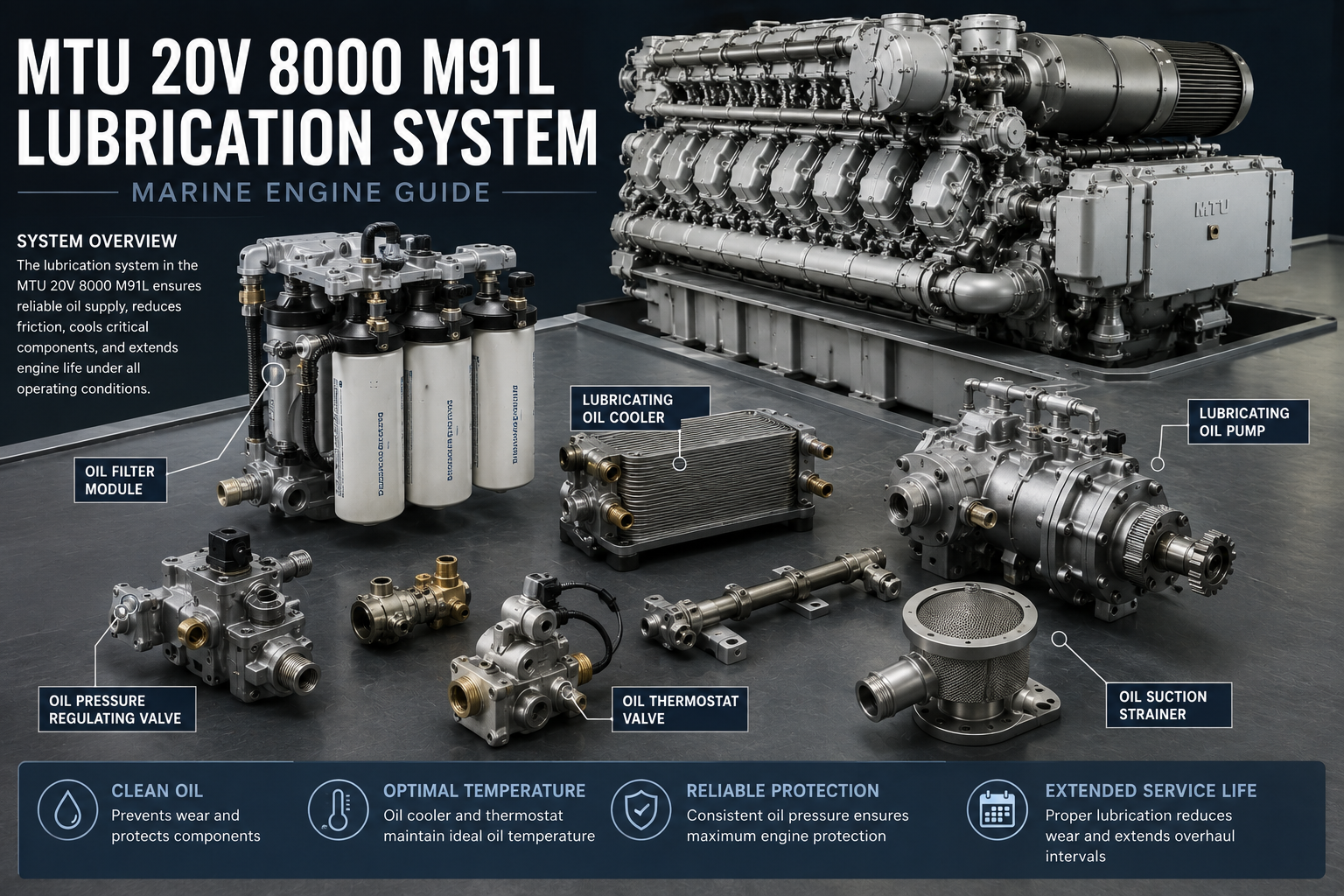
MTU's Series 8000 technical information describes an engine-mounted lubrication system that includes:
- Attached lubricating-oil pump
- Lubricating-oil cooler
- Duplex oil filtration
- Oil priming before engine start
- Optional automatic oil replenishment
- Deep oil pan options for high vessel inclinations
MTU also highlights low oil consumption as one of the Series 8000 system benefits.
The specific 20V 8000 M91L specification adds further detail, identifying:
- Lube-oil pump
- Automatic filter with backflushing
- Centrifugal oil filter
- Lube-oil heat exchanger
- Lube-oil priming pump
- Oil-level monitoring and replenishment system
- Switchboxes associated with priming and replenishment pumps
These components work together as one lubrication-management system.
Engineering Lesson: Oil Pressure Is Only One Part of the Story
One of the easiest mistakes in the engine room is to think:
"Oil pressure is normal, therefore the lubrication system is healthy."
Not necessarily.
Oil pressure tells you something important, but not everything.
A healthy lubrication system also depends on:
- Correct oil viscosity
- Adequate oil temperature control
- Clean filtration
- Sufficient oil quantity
- Correct priming
- Absence of fuel dilution
- Absence of water contamination
- Proper oil circulation
- Reliable monitoring
An engine can show apparently acceptable pressure while another lubrication problem is beginning to develop.
Chief Engineer's Notebook
"Pressure tells you that oil is moving. Condition tells you whether that oil is still protecting the engine."
That distinction matters on a large high-output engine.
Why Oil Priming Before Start Matters
MTU specifically identifies oil priming before engine start as part of the Series 8000 lubrication concept.
Why?
When an engine has been stopped, oil drains away from some galleries and bearing areas.
Starting immediately under load before adequate oil distribution can briefly expose components to reduced lubrication.
The priming system helps establish oil availability before full engine rotation and combustion loading begin.
The specific M91L specification also lists a dedicated lube-oil priming pump.
For engineers, this means the priming pump isn't an optional accessory to ignore during inspection.
Its condition can directly affect start-up protection.
What Does the Main Lube-Oil Pump Do?
The attached lubricating-oil pump supplies oil throughout the engine under pressure.
Its job is not simply to "move oil."
It must maintain sufficient circulation across changing:
- Engine speeds
- Loads
- Temperatures
- Oil viscosities
- Operating conditions
If pump performance begins to decline, symptoms may include:
- Lower oil pressure
- Slow pressure build-up
- Abnormal bearing temperatures
- Increased wear metals
- Pressure instability
The pump should therefore be evaluated together with the entire oil circuit.
Automatic Backflushing Oil Filter
One interesting feature listed for the MTU 20V 8000 M91L is an automatic filter with backflushing.
This is particularly useful on a large marine engine because continuous filtration is important during long operating periods.
Backflushing helps manage accumulated contamination without relying solely on frequent manual filter intervention.
But an automatic filter should not become invisible to the maintenance team.
Engineers should still monitor:
- Differential pressure
- Backflush performance
- Contamination
- Filter condition
- Associated valves
- Alarm history
Automatic doesn't mean maintenance-free.
Centrifugal Oil Filter
The M91L specification also identifies a centrifugal oil filter.
Centrifugal filtration uses rotational force to separate fine contaminants from the lubricating oil.
For a marine engineer, the condition of the collected deposits can sometimes provide useful clues.
Ask:
- Is contamination normal?
- Is deposit quantity increasing?
- Is metallic material visible?
- Has the cleaning interval shortened?
Changes over time deserve attention.
Lubricating-Oil Heat Exchanger
The lubricating-oil heat exchanger is essential because oil viscosity depends heavily on temperature.
Oil that becomes too hot may thin excessively.
Oil that remains too cold may be too viscous for ideal circulation.
MTU includes the lube-oil cooler/heat exchanger as an integral part of the Series 8000 lubrication arrangement.
Inspect for:
- Fouling
- Internal restriction
- Leakage
- Temperature changes
- Coolant-side contamination
- Oil-side contamination
A temperature problem can become a lubrication problem long before oil pressure reaches an alarm threshold.
Oil-Level Monitoring and Replenishment
The M91L specification includes lube-oil level monitoring/replenishment.
This is especially valuable on a large marine propulsion engine because maintaining correct oil volume supports:
- Pressure stability
- Temperature management
- Deaeration
- Reliable lubrication under vessel movement
But automated replenishment can also hide a developing leak if engineers only watch the level.
If the system is repeatedly adding oil, ask:
Why?
Possible causes include:
- External leakage
- Oil consumption
- Turbocharger-related oil loss
- Internal combustion-related consumption
- Seal deterioration
A stable displayed oil level doesn't automatically mean oil consumption is stable.
Engine Room Reality: Track Oil Added, Not Just Oil Remaining
This is a very useful operational habit.
Suppose the automatic replenishment system keeps the sump level perfect.
The engineer sees the correct level every day.
Everything looks fine.
But the system may have added a significant amount of oil during the previous month.
Unless replenishment quantity is recorded, increasing oil consumption can go unnoticed.
So keep a trend of:
Operating hours + oil added + oil analysis + oil pressure + oil temperature
Together, these values tell a much better story.
What Components Depend on Lubrication?
On a large diesel engine, lubricating oil protects multiple critical components.
Typical areas include:
- Main bearings
- Connecting-rod bearings
- Crankshaft journals
- Camshaft components
- Valve-train components
- Turbocharger-related systems
- Piston cooling
MTU documentation for related large-engine lubrication systems describes forced-feed lubrication supporting bearings and piston cooling, illustrating how lubrication and thermal management are closely connected on high-output MTU engines.
Piston Cooling Is Easy to Forget
Lubricating oil doesn't only prevent friction.
It can also carry heat away from highly loaded internal components.
On a large marine diesel, piston cooling is particularly important because piston crowns are exposed directly to combustion heat.
If oil flow is reduced, the problem may therefore influence both:
lubrication
and
temperature control.
That is why low oil-flow concerns deserve immediate investigation.
Early Warning Signs of Lubrication-System Problems
Watch for:
Slow Oil-Pressure Build-Up After Start
This may justify inspection of priming, pump condition, oil level or oil circuit integrity.
Gradually Falling Pressure at Operating Temperature
Compare it under similar engine speed, load and oil temperature.
Rising Oil Temperature
Investigate heat-exchanger performance and cooling.
Increasing Oil Consumption
Track actual replenishment quantity.
Metal in Filters
Never discard contaminated filter material without looking at it.
Increasing Wear Metals in Oil Analysis
Trend results rather than relying on one sample.
Abnormal Bearing Temperature
A localized change can sometimes provide more information than overall oil pressure.
Oil Analysis: What Should Engineers Watch?
Iron
May indicate wear from:
- Crankshaft-related surfaces
- Gears
- Cylinder liners
- Camshaft components
A rising trend deserves investigation.
Copper
Copper can be associated with bearings and bushings.
Compare it with historical results.
Lead
Depending on bearing construction, lead can provide an indication of bearing-material deterioration.
Aluminium
May indicate piston or other aluminium-component wear.
Silicon
Often associated with dirt ingress.
Air-filtration condition should be considered.
Fuel Dilution
Fuel lowers oil viscosity and weakens the lubricating film.
Increasing fuel dilution should not be ignored.
Water
Water can reduce lubrication quality and promote corrosion.
The source should be identified immediately.
Viscosity
Viscosity that moves away from specification can influence oil-film strength and circulation.
Real Marine Maintenance Scenario
Imagine an MTU 20V 8000 M91L propulsion engine operating on a large high-speed vessel.
No alarms are active.
Oil pressure is still within operating limits.
But the Chief Engineer notices:
- Slightly lower hot oil pressure than six months earlier
- More frequent automatic oil replenishment
- Slowly rising oil temperature
- Higher copper levels in laboratory analysis
None of these values alone indicates immediate failure.
Together, however, they deserve investigation.
The maintenance team checks:
- Lube-oil heat exchanger
- Automatic filter
- Centrifugal filter
- Oil pump performance
- Oil consumption records
- Bearing condition
- Replenishment-system history
The heat exchanger is partially fouled, and filtration deposits are greater than normal.
Cleaning the heat exchanger and investigating the contamination restores temperature control while the abnormal oil-analysis trend prompts a planned bearing inspection.
No emergency shutdown occurs.
That's predictive maintenance.
Engineer's Toolbox: MTU 20V 8000 M91L Lubrication Inspection
Check:
- Lube-oil pump
- Priming pump
- Oil pressure
- Oil temperature
- Automatic backflushing filter
- Centrifugal filter
- Lube-oil heat exchanger
- Oil level
- Automatic replenishment
- External leakage
- Oil consumption records
- Oil analysis
- Alarm history
- Bearing temperature trends
And compare current readings with historical operating data.
Marine Engineer Tip
Don't judge oil consumption by the dipstick alone if the engine has automatic replenishment.
Record how much oil the replenishment system is actually adding.
A perfectly stable oil level can hide steadily increasing consumption.
Common Lubrication-System Maintenance Mistakes
Avoid:
- Watching pressure but ignoring oil temperature.
- Ignoring slow pressure build-up after starting.
- Failing to test the priming system.
- Assuming automatic filtration needs no inspection.
- Ignoring centrifugal-filter deposits.
- Failing to track automatic replenishment quantities.
- Delaying oil analysis.
- Treating a single laboratory result as more important than the trend.
- Ignoring bearing-temperature differences.
- Replacing oil without investigating repeated contamination.
Frequently Asked Questions
Is the MTU 20V 8000 M91L part of the MTU Series 8000?
Yes. The MTU 20V 8000 M91L belongs to the MTU Series 8000 engine family and is listed in MTU's commercial-marine product portfolio.
What components are included in the MTU 20V 8000 M91L lubrication system?
The published M91L specification lists a lube-oil pump, automatic backflushing filter, centrifugal filter, lube-oil heat exchanger, priming pump, oil-level monitoring and replenishment system, plus associated control equipment.
Does the Series 8000 prime the lubrication system before starting?
Yes. MTU describes oil priming before engine start as part of the Series 8000 lubrication system.
Why is the oil cooler important?
It helps maintain oil temperature and therefore appropriate viscosity. Excessive oil temperature can weaken the protective oil film and increase component stress.
Why does the engine use more than one type of oil filter?
The M91L specification combines automatic backflushing and centrifugal filtration, providing different approaches to contamination control within the lubrication system.
Can Alfa Marine Spare Parts supply MTU 20V 8000 M91L lubrication-system components?
Alfa Marine Spare Parts can assist with sourcing genuine, OEM, aftermarket, remanufactured and reconditioned MTU marine engine components depending on the specific part, configuration and availability.
MTU 20V 8000 M91L Lubrication-System Parts
Depending on maintenance scope, related parts may include:
- Lube-oil pumps
- Priming pumps
- Oil filters
- Filter elements
- Centrifugal-filter components
- Oil heat exchangers
- Oil coolers
- Pressure sensors
- Temperature sensors
- Oil-level monitoring components
- Replenishment-system components
- Gaskets
- O-rings
- Bearings
- Oil seals
- Associated piping and fittings
For exact identification, always provide the engine serial number and existing component number.
Explore MTU Series 8000 Engines & Spare Parts
Because the MTU 20V 8000 M91L belongs to the MTU Series 8000 family, engineers and purchasing departments can explore related MTU engine and spare-parts information here:
MTU Marine Engines & Spare Parts – Alfa Marine Spare Parts
Related Engine Pages
- MTU 16V 8000 Marine Engine Spare Parts
- MTU 20V 8000 Marine Engine Spare Parts
- MTU 20V 8000 M71 Marine Engine Spare Parts
- MTU 20V 8000 M71L Marine Engine Spare Parts
- MTU 20V 8000 M91L Marine Engine Spare Parts
- MTU Series 8000 Marine Engine Spare Parts
Related Products
For Series 8000 lubrication maintenance, related components can include:
- MTU lube-oil pumps
- MTU oil coolers
- MTU oil filters
- MTU priming pumps
- MTU main bearings
- MTU connecting-rod bearings
- MTU crankshaft components
- MTU pressure sensors
- MTU temperature sensors
- MTU gasket and seal kits
Worldwide MTU Marine Spare Parts Supply
Alfa Marine Spare Parts supports:
- Shipyards
- Ship repairers
- Marine engineers
- Chief engineers
- Technical superintendents
- Fleet operators
- Ferry operators
- Offshore operators
- Government fleets
- Maritime contractors
- Marine service companies
- Marine equipment distributors
We support customers in major maritime locations across Europe, the United States, Canada, the Middle East, Africa, Asia, Australia and other international ports.
Browse Our Complete Catalog
For an MTU 20V 8000 M91L lubrication-system inquiry, provide:
Engine model + serial number + existing part number + required quantity + photos where available.
Browse MTU Marine Engines & Spare Parts
Why Choose Alfa Marine Spare Parts?
On a Series 8000 engine, lubrication-system components should not be identified from the words "MTU 8000 oil pump" alone.
The exact engine model, serial number and component number matter.
Alfa Marine Spare Parts assists marine customers with sourcing genuine, OEM, aftermarket, remanufactured and reconditioned MTU components, depending on application and availability.
For the MTU 20V 8000 M91L Lubrication System, our goal is to help identify the correct pump, filter, cooler, seal, sensor or related component before international shipping is arranged.
Contact Alfa Marine Spare Parts
Email: request@alfamarinespareparts.com
MTU Marine Engines & Spare Parts
Contact Alfa Marine Spare Parts for MTU 20V 8000 M91L oil pumps, filters, coolers, priming-system components, bearings, gaskets, seals and other Series 8000 marine engine spare parts.
One Final Thought
The MTU 20V 8000 M91L Lubrication System does far more than maintain oil pressure.
It manages oil supply, filtration, temperature, priming and replenishment around one of MTU's largest marine propulsion engines.
For an engineer, the most useful question therefore isn't simply:
"Is the oil pressure normal?"
It's:
"Is the oil arriving clean, at the correct temperature, in the correct quantity, at the right time—and is that condition changing?"
That broader question is often what separates routine lubrication maintenance from an expensive bearing or crankshaft repair.