
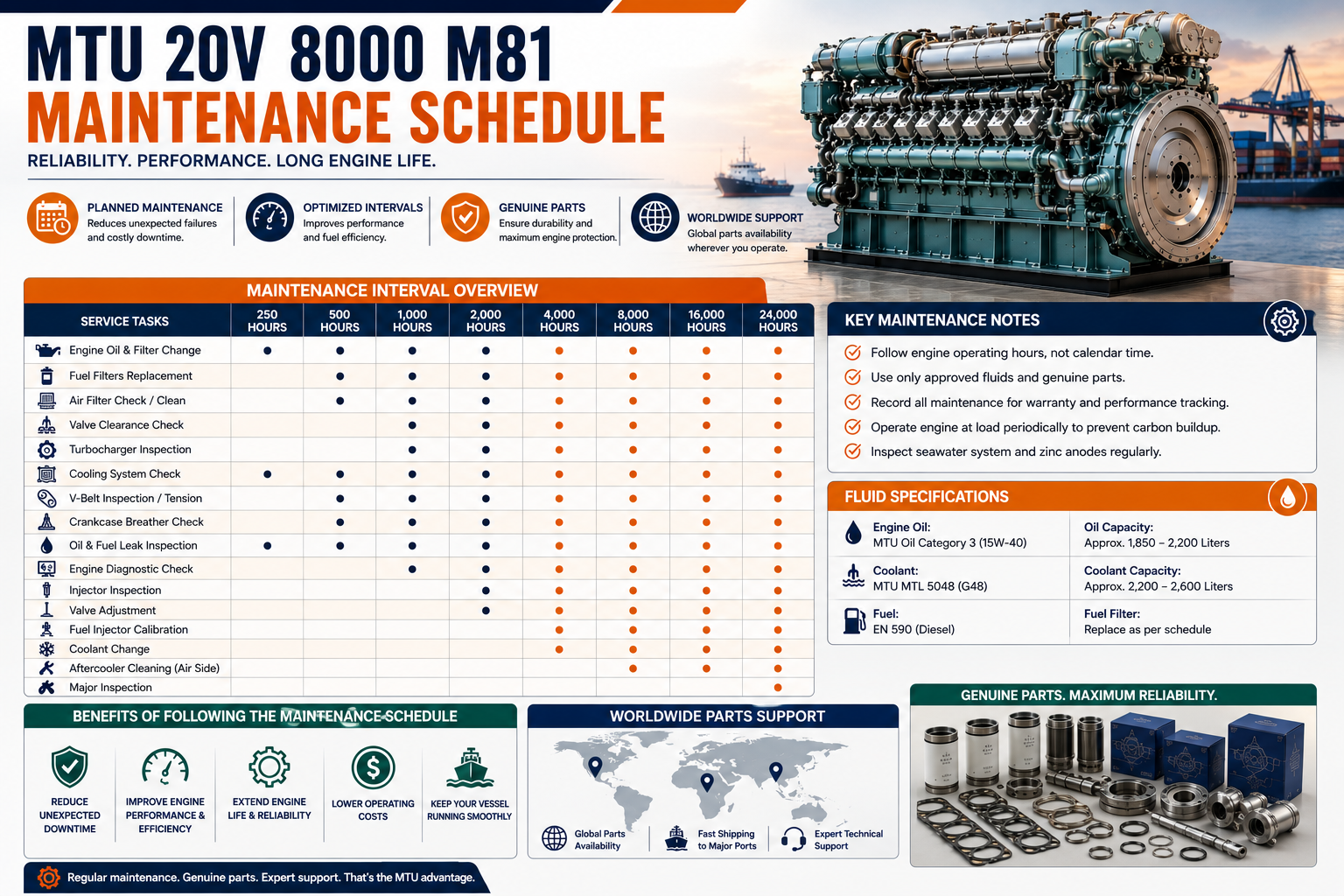
MTU 20V 8000 M81 Maintenance Schedule: How to Turn Engine Hours Into Real Fleet Planning
The MTU 20V 8000 M81 belongs to the MTU Series 8000 marine engine family, a large high-power V20 propulsion platform developed for demanding marine service. Historical MTU material lists the 20V 8000 M81 at 8,200 kW and 1,150 rpm, placing it among the most powerful conventional high-speed marine diesel engines of its generation.
For a fleet manager or Chief Engineer, however, knowing the power rating is only the beginning.
The more practical questions are:
When will the next major maintenance event arrive?
Which parts should already be on order?
Which components deserve inspection before they fail?
How much vessel downtime should be reserved?
With an engine of this size, maintenance is not simply an engine-room task. It becomes a coordination exercise involving engineering, purchasing, workshop capacity, logistics, vessel operations, and sometimes classification requirements.
This guide uses the same practical fleet-planning approach as before, but adapted specifically to the MTU 20V 8000 M81.
There is one important accuracy point: I could verify the M81 model, power, Series 8000 architecture, fluids requirements, and MTU's equipment-specific maintenance philosophy from MTU and related technical sources, but I could not verify a complete public M81 maintenance schedule containing every exact hour interval. MTU itself states that its technical documentation is tailored to the specific equipment.
Therefore, I will not invent maintenance hours. Where a task must use the engine-specific MTU schedule, the table says so clearly.
Where Does the MTU 20V 8000 M81 Belong?
Manufacturer: MTU
Engine Family: MTU Series 8000
Engine Model: MTU 20V 8000 M81
Configuration: V20 marine diesel engine
Rated Speed: 1,150 rpm
Historical Rated Power: approximately 8,200 kW / 10,995 bhp
Primary Use: High-power marine propulsion
Historical MTU sales-program material specifically identifies both the 20V 8000 M81 and M81R within the Series 8000 marine range.
The Series 8000 was engineered around long service intervals and maintainability, which MTU literature highlights as part of the engine family's availability and life-cycle-cost strategy.
Why Convert MTU Maintenance Hours Into Months?
Operating hours are useful to engineers.
Calendar months are useful to everybody else.
Imagine two vessels powered by the same MTU engine.
Vessel A
Runs 3,000 hours per year.
Vessel B
Runs 5,000 hours per year.
If a verified MTU maintenance task were due at 2,000 hours, Vessel A would reach it in about:
8 months
while Vessel B would reach it in:
4.8 months
The calculation is:
Maintenance interval ÷ annual operating hours × 12 = approximate months
This is useful for budgeting and parts planning.
But the actual maintenance interval must come from the correct MTU documentation for that engine and serial number. MTU states that its technical documents are equipment-specific.
MTU 20V 8000 M81 Component Maintenance Planning
⚙️ MTU 20V 8000 M81 Maintenance Planning Block
Engine Family: MTU Series 8000
Engine Type: MTU 20V 8000 M81
Configuration: V20
Low Usage Example: 3,000 hours/year
High Usage Example: 5,000 hours/year
| Component / TaskMaintenance BasisLow-Usage PlanningHigh-Usage PlanningEngineer's Notes | ||||
| Engine Oil Level & Condition | Daily / operational checks | Daily | Daily | Watch level, temperature, pressure, contamination and consumption |
| Engine Oil & Filters | M81-specific MTU schedule + fluids specification | Convert verified interval | Convert verified interval | Series 8000 oil selection and use are subject to MTU fluids requirements |
| Fuel Filters | M81-specific schedule | Plan from verified interval | Plan from verified interval | Track restriction, contamination and water |
| Air Filters | Schedule + condition | Calendar/condition may dominate | Heavy use may shorten practical interval | Restriction affects turbocharger airflow |
| Coolant | MTU fluids specification + engine schedule | Calendar and condition | Hours and calendar | Maintain correct chemistry and corrosion protection |
| Fuel Injectors | Engine-specific inspection / replacement schedule | Long-term planning | High-use fleets reach interval sooner | Compare cylinder performance and exhaust-temperature trends |
| Valve Train | Engine-specific schedule | Planned inspection | More frequent calendar occurrence under high hours | Watch clearances, rocker components and cylinder differences |
| Turbochargers | Schedule + condition | Planned overhaul | High-priority long-lead item | Monitor boost, oil leakage, deposits and bearing condition |
| Charge-Air Coolers | Inspection / cleaning schedule | Planned cleaning | More frequent under demanding operation | Fouling raises intake and exhaust temperatures |
| Cylinder Heads | Major maintenance / condition | Plan before docking | Parts and workshop lead time become critical | Inspect valves, seats, guides, sealing surfaces and cooling passages |
| Pistons & Rings | Major overhaul | Multi-year planning | Operating hours accumulate rapidly | Study deposits, ring condition and piston cooling |
| Cylinder Liners | Major overhaul / measurement | Measure during scheduled work | Earlier forecasting under high utilization | Inspect wear, scoring, liner seating and surface condition |
| Main Bearings | Major overhaul / condition | Long-term critical-spares planning | High-use fleets should forecast early | Compare wear patterns and oil-analysis history |
| Connecting-Rod Bearings | Major overhaul / condition | Planned inspection | Critical overhaul item | Keep every bearing identified by position |
| Crankshaft | Major inspection | Specialist planning | Specialist planning | Inspect journals, runout, cracks and alignment |
| Camshaft & Timing Gear | Major maintenance | Engine-specific | Engine-specific | Series 8000 uses a centrally located camshaft architecture |
| Lubricating-Oil Pump | Schedule + performance | Trend-based | Trend-based | Watch hot oil pressure and pressure build-up |
| Oil Priming System | Operational / scheduled inspection | Test regularly | Test regularly | Series 8000 requires proper oil priming practices |
| Oil Cooler / Heat Exchanger | Cleaning / condition | Planned | High-use engines may foul sooner | Oil temperature strongly influences viscosity |
| Cooling Pumps | Schedule + condition | Planned | High priority | Seals, bearings, leakage and flow |
| Gaskets & Seals | Replace as specified when disturbed | Keep common stock | Include complete overhaul sets | Do not reuse questionable sealing elements |
| Major Engine Overhaul | M81-specific MTU maintenance plan + condition | Long-range budget | Earlier calendar occurrence | Coordinate workshop, lifting, parts and vessel downtime |
Why the Lubrication System Deserves Special Attention
The Series 8000 is a large, heavily loaded engine, and its lubrication system is critical to crankshaft, bearings, camshaft, piston cooling, and other moving components.
MTU's Series 8000 fluids documentation specifies additional requirements for some SAE 40 oils, including oil preheating and oil priming with oil above 30°C before use in the engine.
That tells us something important:
Oil condition is not just about quantity.
Engineers should monitor:
- Oil pressure
- Oil temperature
- Oil viscosity
- Oil analysis
- Priming performance
- Filter condition
- Oil consumption
- Water contamination
- Fuel dilution
Engine Room Reality: Stable Oil Pressure Does Not Guarantee Healthy Lubrication
Suppose the M81 shows normal oil pressure.
Does that mean the lubrication system is perfect?
Not necessarily.
Oil may still be:
- Too hot
- Too cold
- Contaminated
- Fuel diluted
- Aerated
- Oxidized
- Carrying excessive wear metals
The pressure gauge tells you one part of the story.
Oil analysis and trend monitoring tell you much more.
Oil Analysis Should Be Part of Every M81 Maintenance Plan
For a large Series 8000 engine, track at least:
Iron
Can indicate wear associated with liners, crankshaft-related surfaces, gears, and other ferrous components.
Copper
May reflect bearing or bushing wear.
Lead
Can indicate bearing-material deterioration depending on bearing construction.
Aluminium
Can be associated with piston or other aluminium-component wear.
Silicon
Can indicate airborne contamination.
Fuel Dilution
Lowers viscosity and reduces oil-film strength.
Water
Can promote corrosion and damage lubrication performance.
Viscosity
Shows whether the oil is still behaving within the intended range.
The most useful result is not one laboratory report.
It is the trend across several reports.
Turbocharger Maintenance
A high-output engine like the 20V 8000 M81 depends heavily on turbocharging.
Turbocharger condition influences:
- Airflow
- Combustion
- Exhaust temperature
- Fuel efficiency
- Cylinder loading
Monitor:
- Boost-pressure trends
- Oil leakage
- Compressor cleanliness
- Turbine deposits
- Bearing condition
- Unusual noise
- Exhaust-temperature balance
A turbocharger that is gradually losing efficiency may show up as a combustion problem before it ever creates an obvious turbocharger alarm.
Charge-Air Cooler Maintenance
Charge-air coolers are just as important.
Restricted heat transfer can result in:
- Higher intake-air temperature
- Higher combustion temperatures
- Reduced air density
- Higher exhaust temperatures
- Increased thermal loading
For fleet managers, cooler cleaning should be planned rather than waiting for high-temperature symptoms.
Cylinder Head Maintenance
The M81's V20 configuration means the engine contains twenty cylinders and therefore twenty opportunities for cylinder-to-cylinder comparison.
When cylinder-head work is performed, inspect:
- Intake valves
- Exhaust valves
- Valve seats
- Valve guides
- Valve stem seals
- Cooling passages
- Sealing surfaces
- Combustion deposits
- Fuel-injection-related condition
The important question is not simply:
“Is this cylinder head damaged?”
Ask:
“Why does this cylinder head look different from the other nineteen?”
Piston and Cylinder-Liner Inspection
During major maintenance, photograph piston crowns before cleaning.
Compare all twenty.
Look for:
- Different deposit patterns
- Signs of overheating
- Oil-related deposits
- Scuffing
- Ring-groove wear
- Abnormal combustion marks
Then inspect cylinder liners for:
- Scoring
- Polishing
- Surface wear
- Corrosion
- Seating condition
Measurements matter more than appearance alone.
Main Bearings and Connecting-Rod Bearings
Never discard removed bearings before inspecting them.
A bearing wear pattern can reveal:
- Oil starvation
- Contamination
- Misalignment
- Edge loading
- Crankshaft-journal problems
- Abnormal cylinder loading
On a V20 engine, comparison is extremely powerful.
If nineteen bearing positions show similar wear and one does not, that unusual bearing deserves attention.
Crankshaft Inspection
The crankshaft is one of the most valuable assemblies in the engine.
During major overhaul, inspect as required for:
- Journal condition
- Scoring
- Surface finish
- Cracks
- Heat discoloration
- Runout
- Alignment
- Axial condition
A new bearing cannot correct a damaged crankshaft journal.
Camshaft and Timing System
Series 8000 technical literature describes a single centrally located camshaft as part of the engine architecture. This helps create a compact, rigid design despite the engine's very large output.
During major inspection, the camshaft and timing system deserve attention for:
- Lobe wear
- Bearing condition
- Oil supply
- Gear condition
- Timing alignment
- End-float
- Abnormal surface wear
Timing work should always follow M81-specific MTU procedures.
Cooling System Maintenance
A lubrication or combustion problem can sometimes begin as a cooling problem.
Fleet managers should track:
- Coolant condition
- Coolant temperature
- Heat exchanger performance
- Freshwater pump condition
- Raw-water-side condition where applicable
- Charge-air cooler efficiency
- Leakage
- Corrosion
Poor heat rejection can shorten the life of cylinder heads, pistons, valves, seals, and lubricating oil.
Low Usage vs. High Usage
Because I do not have a verified public M81 task-by-task hour schedule, it would be misleading to populate invented hour values.
But once the correct interval is taken from the applicable MTU M81 maintenance schedule, the conversion is straightforward.
If the task is 500 hours
3,000 hours/year → 2 months
5,000 hours/year → 1.2 months
If the task is 1,000 hours
3,000 hours/year → 4 months
5,000 hours/year → 2.4 months
If the task is 2,000 hours
3,000 hours/year → 8 months
5,000 hours/year → 4.8 months
If the task is 4,000 hours
3,000 hours/year → 16 months
5,000 hours/year → 9.6 months
If the task is 8,000 hours
3,000 hours/year → 32 months
5,000 hours/year → 19.2 months
These are calendar-planning conversions only—not claimed M81 maintenance intervals.
Engineer's Toolbox
MTU 20V 8000 M81 Fleet Maintenance Record
Engine: MTU 20V 8000 M81
Engine Family: MTU Series 8000
Serial Number: __________________
Current Operating Hours: __________________
Annual Operating Hours: __________________
Applicable MTU Maintenance Schedule: __________________
Next Scheduled Service: __________________
Next Major Inspection: __________________
Last Oil Analysis: __________________
Turbocharger Status: __________________
Cylinder Condition Notes: __________________
Bearing Inspection History: __________________
Parts Ordered: __________________
Long-Lead Components Outstanding: __________________
Planned Vessel Downtime: __________________
Marine Engineer Tip
For a large Series 8000 engine, don't wait until dismantling begins to discover that one major component has a six-week lead time.
Build a preliminary parts list before docking.
Then separate the requirements into:
Parts definitely required
and
Parts to be ordered only after inspection.
That avoids both delays and unnecessary purchases.
What Should Fleet Managers Keep in Stock?
Routine parts may include:
- Filters
- Gaskets
- O-rings
- Sealing washers
- Sensors
- Common service seals
- Maintenance consumables
Depending on fleet size and vessel criticality, shared fleet stock may include:
- Fuel-injection components
- Pumps
- Control components
- Turbocharger service components
- Specialized seals
Major assemblies are often better handled through planned supplier support.
Major Parts That Need Early Planning
For an M81 overhaul, long-lead items can potentially include:
- Cylinder heads
- Pistons
- Cylinder liners
- Main bearings
- Connecting-rod bearings
- Connecting rods
- Crankshaft components
- Camshaft components
- Turbochargers
- Large pumps
- Heat exchangers
- Complete gasket and seal sets
Exact part numbers must be verified against the engine serial number and BOM.
Common MTU 20V 8000 M81 Maintenance Planning Mistakes
Avoid:
- Using a generic Series 8000 interval without confirming the M81 schedule.
- Copying a Series 2000 or Series 4000 maintenance table.
- Planning only from engine hours and ignoring engine condition.
- Ignoring oil-analysis trends.
- Waiting until dismantling to order every part.
- Discarding bearings before analyzing wear patterns.
- Cleaning pistons before documenting deposits.
- Failing to track turbocharger performance.
- Ignoring cooler fouling.
- Ordering expensive parts without serial-number verification.
- Using M71L or M91L maintenance values as if they automatically apply to the M81.
Frequently Asked Questions
Is the MTU 20V 8000 M81 part of the MTU Series 8000?
Yes. Historical MTU marine documentation identifies the 20V 8000 M81 and M81R as Series 8000 marine propulsion engines.
How powerful is the MTU 20V 8000 M81?
Historical MTU material lists the M81 at approximately 8,200 kW / 10,995 bhp at 1,150 rpm.
Is the M81 still in MTU's current new-engine commercial portfolio?
MTU's current public commercial-marine product list highlights later Series 8000 variants such as the M71, M71L and M91L rather than the older M81. This indicates the M81 is a legacy Series 8000 variant in today's service market.
Can I use the M91L maintenance schedule for an M81?
Do not assume so. The engines belong to the same Series 8000 family, but maintenance requirements can vary by model, application and serial number. MTU explicitly describes its technical documentation as equipment-specific.
Does the Series 8000 require oil priming?
MTU Series 8000 fluids guidance includes oil-priming requirements in connection with certain approved engine oils, showing that correct pre-lubrication practice is important on this family.
How should I calculate maintenance months?
Take the verified MTU maintenance interval, divide it by expected annual operating hours, then multiply by 12.
Can Alfa Marine Spare Parts supply MTU 20V 8000 M81 components?
Alfa Marine Spare Parts can assist with sourcing genuine, OEM, aftermarket, remanufactured, and reconditioned MTU Series 8000 components depending on application and availability.
Related MTU 20V 8000 M81 Parts
Maintenance and overhaul projects may involve:
- Oil filters
- Fuel filters
- Air filters
- Fuel injectors
- Turbocharger components
- Cylinder heads
- Intake and exhaust valves
- Pistons
- Piston rings
- Cylinder liners
- Connecting rods
- Main bearings
- Connecting-rod bearings
- Crankshaft components
- Camshaft components
- Timing gears
- Oil pumps
- Cooling pumps
- Heat exchangers
- Charge-air coolers
- Gasket sets
- O-rings and seals
Explore MTU Series 8000 Engines & Spare Parts
The MTU 20V 8000 M81 belongs to the Series 8000 family, and Alfa Marine Spare Parts supports customers maintaining both current and legacy MTU marine engines.
MTU Marine Engines:
https://alfamarinespareparts.com/engines/mtu
Complete Spare Parts Catalog:
https://alfamarinespareparts.com/spareparts
Worldwide MTU Marine Spare Parts Supply
Alfa Marine Spare Parts supports:
- Shipyards
- Ship repairers
- Marine engineers
- Chief engineers
- Technical superintendents
- Fleet operators
- Offshore operators
- Government fleets
- Ferry operators
- Marine service companies
- Maritime contractors
- Marine equipment distributors
We support customers across Europe, the United States, Canada, the Middle East, Africa, Asia, Australia, and major international ports.
Why Choose Alfa Marine Spare Parts?
A request saying:
“Need parts for MTU 20V 8000.”
may not be specific enough.
For an M81 inquiry, provide:
Engine: MTU 20V 8000 M81
Serial Number: ______
Existing Part Number: ______
Component Position: ______
Quantity: ______
Photos: Recommended
Alfa Marine Spare Parts helps customers source genuine, OEM, aftermarket, remanufactured, and reconditioned MTU marine engine parts while verifying the exact engine configuration before shipping high-value components.
Contact Alfa Marine Spare Parts
Email: request@alfamarinespareparts.com
MTU Marine Engines:
https://alfamarinespareparts.com/engines/mtu
Complete Catalog:
https://alfamarinespareparts.com/spareparts
Contact Alfa Marine Spare Parts for MTU 20V 8000 M81 filters, injectors, turbochargers, cylinder heads, pistons, liners, bearings, crankshaft components, camshaft parts, pumps, heat exchangers, gaskets and complete overhaul requirements.
One Final Thought
The MTU 20V 8000 M81 Maintenance Schedule should not be reduced to a list of guessed hour intervals.
On an engine of this size, accurate planning starts with the correct MTU documentation.
Then convert those verified intervals into calendar time.
Combine them with:
Oil-analysis trends.
Cylinder-condition monitoring.
Turbocharger performance.
Bearing history.
Parts lead times.
And planned vessel downtime.
That is how a maintenance schedule becomes useful to the entire fleet—not just the engine room.