MTU Marine Engine Types: What Is the Difference, and Which Engine Fits Which Vessel?
When somebody says:
“I have an MTU marine engine.”
that could mean a relatively compact 8V 2000 installed in a fast workboat, a powerful 16V 4000 in a superyacht or patrol vessel, or a huge 20V 8000 delivering several megawatts in a large ferry or naval application.
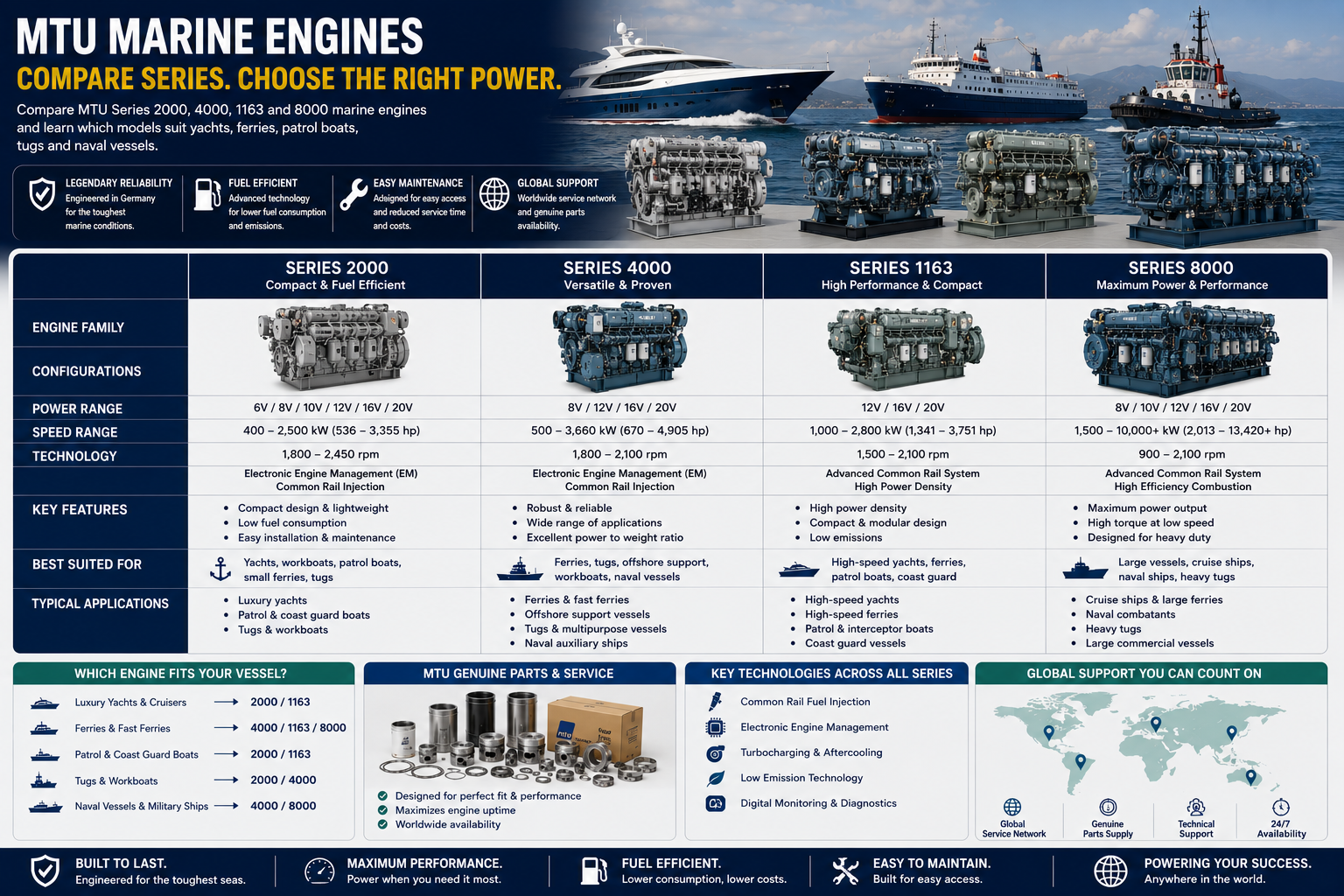
MTU's marine range spans several very different engine families. Current MTU commercial-marine information highlights the Series 2000, Series 4000, Series 1163 and Series 8000, with power extending from hundreds of kilowatts into the 10 MW class.
That means there is no single “best MTU marine engine.”
The useful question is:
Which MTU engine is best for the vessel, operating profile and required power?
Understanding the Main MTU Marine Engine Families
A practical way to understand MTU marine engines is to divide them into four major groups:
| MTU FamilyTypical Cylinder ConfigurationsGeneral CharacterTypical Marine Fit | |||
| Series 2000 | 8V, 10V, 12V, 16V | Compact, high-speed, high power-to-weight | Yachts, ferries, patrol boats, workboats |
| Series 4000 | 8V, 12V, 16V, 20V | Larger heavy-duty high-performance engine | Yachts, ferries, tugs, naval and commercial craft |
| Series 1163 | 16V, 20V | Large high-performance marine engine | Naval vessels, ferries and large fast craft |
| Series 8000 | 16V, 20V | Very large high-output marine propulsion | Ferries, naval vessels and major high-speed ships |
MTU's current commercial marine information lists Series 2000 from 720 to 1,939 kW and Series 4000 from 746 to 4,300 kW. MTU also states that Series 1163 and 8000 engines are available in 16V and 20V versions covering approximately 4,800 to 10,000 kW.
That is an enormous range.
MTU Series 2000: Compact Power for Fast Boats
The MTU Series 2000 is one of the best-known modern MTU marine engine families.
MTU describes it as light and compact, particularly well suited to small engine rooms and high-speed vessels. It is available in 8V, 10V, 12V and 16V configurations.
This family is particularly interesting because it can appear in vessels that are completely different from one another.
You may find Series 2000 engines in:
- Fast ferries
- Motor yachts
- Patrol boats
- Police craft
- Fire-fighting vessels
- Fast workboats
- Government craft
- Military vessels
MTU itself specifically identifies Series 2000 applications including fast yachts, patrol boats, police craft and fire-fighting vessels.
Common MTU Series 2000 Marine Models
Depending on generation and application, marine engineers may encounter models such as:
8V 2000 M72
8V 2000 M84
8V 2000 M94
10V 2000 M72
10V 2000 M84
10V 2000 M86
10V 2000 M94
10V 2000 M96 / M96L
12V 2000 M72
12V 2000 M84
12V 2000 M86
12V 2000 M94
12V 2000 M96 / M96L / M96X
16V 2000 M72
16V 2000 M84
16V 2000 M91
16V 2000 M93
16V 2000 M94
16V 2000 M96 / M96L
16V 2000 M97 / M97L
Not every designation is intended for the same duty, market or emissions level.
That final M-number matters.
What Is the Difference Between an M72, M84, M86 and M96?
This is where many customers become confused.
They see:
12V 2000
and assume all 12V 2000 engines are more or less the same.
They are not.
The complete designation tells you the generation, rating family and application characteristics.
For example, current MTU information lists the 12V 2000 M72 at 1,080 kW and 2,250 rpm, while the 12V 2000 M86 is listed around 1,268 kW at 2,450 rpm in relevant marine configurations.
So even with:
12 cylinders
and
Series 2000
the engines can differ significantly in power, speed, duty and components.
M72: Commercial High-Load Work
The M72 is associated with MTU Application Group 1B, used for continuous operation with variable, relatively high loading.
Models include:
- 8V 2000 M72
- 10V 2000 M72
- 12V 2000 M72
- 16V 2000 M72
These engines make sense for vessels such as fast ferries, commercial craft and other high-hour applications where the engine must repeatedly work rather than simply provide occasional maximum speed.
M84 and M86: Medium-Load Fast Vessel Applications
The M84 and M86 families move toward another operating profile.
You may find these engines in:
- Fast workboats
- Patrol vessels
- Police boats
- Government craft
- Fast passenger vessels
- Some yacht applications
For example, MTU lists the 10V 2000 M86 at 1,015 kW / 1,360 hp and 2,450 rpm, while the 12V version is listed at approximately 1,268 kW / 1,700 hp.
The important lesson is that the model suffix and duty group matter just as much as cylinder count.
M94, M96 and M97: More Power for Performance-Oriented Vessels
Higher-output Series 2000 versions are particularly relevant in yacht and performance applications.
Models such as:
- 10V 2000 M94
- 12V 2000 M94
- 16V 2000 M94
- 10V 2000 M96L
- 12V 2000 M96L
- 16V 2000 M96L
- 16V 2000 M97L
represent increasingly high-output developments of the family.
MTU has supplied the 16V 2000 M97L at 1,939 kW / 2,600 bhp for yacht propulsion with an integrated SCR system for IMO III compliance.
This gives a good example of how far Series 2000 has developed.
A family that includes commercial M72 engines also reaches into high-performance superyacht propulsion.
Why the MTU Series 2000 Works So Well in Yachts
A yacht engine room values:
- Compact dimensions
- Low weight
- High output
- Smooth operation
- Electronic control
- Good power-to-weight ratio
Those are precisely areas where the Series 2000 architecture is attractive.
MTU describes these engines as compact and particularly well suited to small engine rooms.
That is why a large fast yacht may use a Series 2000 even though much larger MTU families exist.
Bigger isn't automatically better.
MTU Series 4000: When Series 2000 Is Not Enough
Move upward and you reach the MTU Series 4000.
This is one of MTU's most important large-engine families.
Current MTU commercial-marine information lists Series 4000 output from approximately 746 to 4,300 kW, with 8V, 12V, 16V and 20V cylinder configurations.
Compared with Series 2000, the Series 4000 provides substantially more displacement and power.
Think:
larger vessel
heavier commercial duty
more sustained power
or
much higher propulsion requirement.
Common MTU Series 4000 Marine Configurations
Marine engineers may encounter:
- 8V 4000
- 12V 4000
- 16V 4000
- 20V 4000
with many different M-designations depending on generation and duty.
Examples include:
8V 4000 M70
12V 4000 M70
12V 4000 M90
12V 4000 M53
12V 4000 M54
12V 4000 M55R
16V 4000 M53
16V 4000 M73
16V 4000 M90
20V 4000 M73
20V 4000 M73L
and newer variants.
MTU describes Series 4000 as one of its most successful heavy-duty engine families, designed around life-cycle cost, performance and ease of maintenance.
Series 2000 vs. Series 4000: What Is the Main Difference?
A simple way to remember them:
MTU SERIES 2000
Character: Compact and high-speed.
Best fit: Yachts, patrol boats, fast ferries and smaller fast commercial craft.
Advantage: High power-to-weight ratio and compact engine-room installation.
MTU SERIES 4000
Character: Bigger and more powerful heavy-duty engine.
Best fit: Larger yachts, ferries, tugs, naval craft and substantial commercial vessels.
Advantage: Much greater total output and heavy-duty capability.
The Series 4000 can reach more than twice the output of the current commercial Series 2000 range.
Why Series 4000 Became Such an Important MTU Engine
The Series 4000 was an important technological step for MTU.
MTU states that Series 4000 engines were the first engines of their type to feature common-rail fuel injection, and the family has been used across marine, rail, power-generation and industrial applications.
Common rail allows fuel injection to be controlled electronically and independently of basic mechanical injection timing.
For marine operation, this can help with:
- Combustion control
- Fuel efficiency
- Smoke reduction
- Engine response
- Electronic monitoring
- Emissions control
But it also changes maintenance.
Fuel cleanliness becomes extremely important.
Which Boats Suit an MTU Series 4000?
Depending on rating and model:
- Superyachts
- Fast ferries
- Patrol vessels
- Naval craft
- Offshore vessels
- Tugs
- Windfarm support vessels
- Commercial passenger vessels
- Government craft
MTU's hybrid propulsion portfolio also integrates Series 4000 engines into hybrid systems for yachts, ferries, tugs and windfarm vessels.
That shows how flexible the family has become.
MTU Series 1163: Large High-Speed Marine Power
The MTU Series 1163 is very different from a Series 2000 yacht engine.
This is a large marine propulsion engine intended for significantly higher power requirements.
Current MTU information states that Series 1163 engines are available in:
16V
and
20V
configurations.
Together with Series 8000 engines, they cover approximately 4,800 to 10,000 kW and are available with SCR systems for IMO III compliance.
This is no longer small-workboat territory.
Common MTU 1163 Marine Engines
You may encounter designations such as:
- 16V 1163 TB73
- 16V 1163 TB73L
- 16V 1163 M74
- 20V 1163 TB73
- 20V 1163 TB73L
- 20V 1163 M74
- 20V 1163 M84
- 20V 1163 M94
These engines are associated with high-power marine applications where reliability and power density are essential.
Which Vessels Suit the MTU 1163?
Think:
- Naval vessels
- Fast ferries
- Large government craft
- Large high-speed commercial vessels
- Specialized military applications
A 1163 is not simply a “big yacht engine.”
It belongs much closer to ship propulsion engineering.
MTU Series 8000: The Big One
Then we reach the MTU Series 8000.
This is one of MTU's largest high-speed marine diesel families.
Current MTU information states that Series 8000 engines are available in 16V and 20V variants and, together with Series 1163, operate in the 4,800–10,000 kW range.
That means a single engine can produce power measured in multiple megawatts.
Common MTU Series 8000 Marine Models
Examples include:
- 16V 8000 M71
- 16V 8000 M71L
- 20V 8000 M71
- 20V 8000 M71L
- 20V 8000 M81
- 20V 8000 M91
- 20V 8000 M91L
The exact model matters because power rating, configuration and intended duty vary.
Which Ships Use MTU Series 8000 Engines?
The Series 8000 belongs naturally in applications such as:
- Fast ferries
- Large naval vessels
- Large patrol vessels
- High-speed commercial craft
- Specialized government vessels
MTU describes Series 8000 as a benchmark for speed, efficiency and reliability in large marine propulsion.
Series 4000 vs. Series 8000
This comparison makes the scale difference easier to understand.
SERIES 4000
Current commercial marine range up to approximately 4,300 kW.
Available as 8V, 12V, 16V and 20V.
Suitable for yachts and substantial commercial vessels.
SERIES 8000
Large-engine range extending toward 10,000 kW.
Available as 16V and 20V.
Intended for major high-speed marine propulsion.
A 20V 8000 is therefore not simply the next size after a 20V 4000.
It belongs in another power class.
Why Cylinder Count Matters
MTU model numbers often make cylinder count very easy to understand.
8V = V8
10V = V10
12V = V12
16V = V16
20V = V20
As cylinder count rises, total engine output can increase.
But so does the potential overhaul scope.
Compare an 8V 2000 and a 20V 4000.
A major overhaul can involve dramatically different quantities of:
- Fuel injectors
- Pistons
- Cylinder liners
- Connecting rods
- Cylinder heads
- Intake valves
- Exhaust valves
- Bearings
- Gaskets and seals
That matters when budgeting.
Which MTU Engine Makes Sense for a Yacht?
For most yacht applications, the main families to understand are:
Series 2000
and
Series 4000.
MTU specifically uses both families in yacht propulsion and has approved major Series 2000 and Series 4000 yacht engines for EN15940 synthetic diesel fuels.
For a smaller or faster yacht where installation space is tight, Series 2000 can be very attractive.
For a large superyacht requiring substantially more power, Series 4000 becomes more relevant.
Which MTU Engine Makes Sense for a Fast Ferry?
Fast ferries need:
- High power-to-weight
- Strong acceleration
- High sustained speed
- Reliability
- Compact installation
MTU describes Series 2000 as a market-leading engine family for the high-speed ferry market.
Depending on ferry size, power requirements may progress through:
Series 2000
to
Series 4000
and on larger high-speed installations toward:
Series 1163 or Series 8000.
Which MTU Engine Makes Sense for a Patrol Boat?
Patrol boats frequently need rapid acceleration and high maximum speed.
Series 2000 is particularly suitable for smaller and medium fast patrol craft.
MTU itself identifies Series 2000 for fast patrol boats, police craft and fire-fighting vessels.
Larger naval or government vessels can move into Series 4000, 1163 or 8000 territory.
Which MTU Engine Makes Sense for a Tug?
Tugs require a different type of performance.
Maximum vessel speed is less important than:
- Torque
- Load response
- Long working hours
- Reliability
- Commercial duty
Series 4000 can be especially relevant in this type of application, including hybrid systems. MTU's hybrid portfolio specifically references tugs among supported vessel categories.
Which MTU Engine Makes Sense for a Naval Vessel?
MTU has a major history in naval propulsion.
Depending on vessel size, the relevant families can include:
- Series 2000
- Series 4000
- Series 1163
- Series 8000
The smaller families suit fast patrol and coastal craft.
As vessel displacement and required propulsion power increase, the 1163 and 8000 families become more relevant.
MTU's current defense product information includes Series 2000 and Series 4000 configurations, while its large-engine information specifically highlights 1163 and 8000 for marine use.
Which MTU Engines Can Be Used for Marine Generator Power?
MTU engines are not used only for direct propulsion.
Series 2000 and Series 4000 engines also form the basis of generator and diesel-electric applications.
MTU's commercial marine product list includes Series 4000 engines for onboard power and electric propulsion, while its broader power-generation portfolio uses both Series 2000 and Series 4000 platforms.
This is useful on vessels where the diesel engine drives an alternator rather than directly turning the propeller shaft.
Direct Mechanical Propulsion vs. Diesel-Electric
This distinction is important.
Mechanical Propulsion
The engine connects through a gearbox to the propeller shaft or other propulsion system.
This is common on:
- Yachts
- Workboats
- Patrol boats
- Ferries
- Tugs
Diesel-Electric
The engine drives a generator.
Electric motors then provide propulsion.
This can be useful for:
- Specialized commercial vessels
- Hybrid systems
- Vessels with highly variable operating profiles
- Applications requiring flexible machinery layout
MTU offers complete hybrid propulsion systems combining Series 2000 or 4000 diesel power with electric motors and batteries.
Older MTU vs. Modern MTU
An older MTU marine engine may rely more heavily on mechanical systems and earlier electronic controls.
Modern Series 2000 and 4000 engines use sophisticated common-rail fuel injection, digital engine management and extensive monitoring.
That changes troubleshooting.
An engineer working on an older engine may spend more time with:
- Mechanical pressure readings
- Fuel-system checks
- Valve adjustments
- Turbocharger inspection
- Cooling-system measurements
On a modern MTU installation, technicians may also work extensively with:
- ECU/MDEC systems
- Sensors
- Fault codes
- Wiring
- Data logging
- Electronic injection
- Emissions aftertreatment
Neither generation removes the need for mechanical knowledge.
Modern electronics simply give the engineer more information.
What About IMO III and SCR?
Modern vessels operating in emission-control areas may need to comply with IMO Tier III requirements.
MTU provides SCR exhaust-aftertreatment solutions on multiple marine engines.
Current MTU information states that Series 1163 and Series 8000 engines are available with SCR systems for IMO III, while Series 2000 and 4000 marine configurations are also available in emissions-compliant versions depending on model and market.
SCR adds another system for engineers to maintain.
Now maintenance may include:
- DEF/urea supply
- Dosing equipment
- Sensors
- Catalyst system
- Exhaust-temperature monitoring
- Electronic controls
The engine itself may be mechanically healthy while an emissions-system fault still limits operation.
Can MTU Marine Engines Run on HVO?
Yes, but approval depends on the particular engine configuration.
MTU has approved major Series 2000 and Series 4000 yacht engines for EN15940 synthetic diesel fuels, and in 2024 Rolls-Royce announced approval of Series 1163 and 8000 engines for sustainable fuels such as HVO.
This is increasingly relevant for vessel operators trying to reduce lifecycle carbon emissions without replacing the entire propulsion plant.
MTU Marine Engine Families Compared
| MTU FamilyCurrent/Referenced Power ClassTypical CharacterTypical Vessel | |||
| Series 2000 | 720–1,939 kW | Compact, light, fast-response | Yachts, patrol boats, ferries, fast workboats |
| Series 4000 | 746–4,300 kW | Heavy-duty high-performance | Superyachts, ferries, tugs, government vessels |
| Series 1163 | Large-engine class | High-output fast marine propulsion | Naval, ferry and large fast-vessel applications |
| Series 8000 | Up to about 10,000 kW family range | Very high-output marine engine | Large ferries, naval and high-speed commercial vessels |
The Series 2000 and 4000 ranges come from MTU's current commercial marine program, while the 1163/8000 large-engine range is stated by Rolls-Royce as approximately 4,800–10,000 kW across the two families.
MTU Marine Engine “Personalities”
Sometimes the easiest way to remember the families is to give them a character.
Series 2000 — The Athlete
Compact, lightweight and designed to deliver a lot of power from a relatively small engine room.
Think yachts, patrol boats and fast ferries.
Series 4000 — The Heavy-Duty Performer
More displacement and much more total output while still retaining a high-performance marine character.
Think superyachts, ferries, workboats and military vessels.
Series 1163 — The Large Fast-Vessel Engine
High-output propulsion when Series 4000 power is no longer enough.
Think naval and major fast commercial applications.
Series 8000 — The Megawatt Machine
A large marine V16/V20 built for vessels requiring several megawatts of propulsion power.
Think large ferries and major naval craft.
Which MTU Engine Would You Choose for Different Vessels?
Fast Yacht
Start with:
Series 2000
For a larger superyacht:
Series 4000
Patrol Boat
Depending on size:
Series 2000 → Series 4000
High-Speed Ferry
Depending on required power:
Series 2000 → Series 4000 → Series 1163 / 8000
Tug
Typically look toward:
Series 4000
with hybrid options increasingly relevant.
Large Naval Vessel
Depending on vessel design:
Series 4000 → Series 1163 → Series 8000
Marine Generator / Diesel-Electric
Series 2000 and Series 4000 configurations can both be relevant depending on required electrical output.
Why the Full MTU Engine Model Matters
Consider these two engine names:
16V 2000 M72
and
16V 2000 M97L
Both are:
- MTU
- Series 2000
- V16
But that does not make them interchangeable.
Their ratings, rpm, duty cycles, fuel-system components, turbochargers, cooling arrangements and maintenance requirements can differ significantly.
The same applies to:
16V 4000 M73
versus
16V 4000 M90
or
20V 8000 M81
versus
20V 8000 M91L.
The final model designation matters.
Why Engine Serial Number Matters Even More
For parts identification, even the full engine model may not always be sufficient.
A strong parts inquiry should include:
Engine: MTU 16V 2000 M91
Engine Serial Number: __________
Current Part Number: __________
Application: Marine propulsion
Quantity: __________
Photographs: Recommended
Production changes can occur within the same engine model.
This is especially important for expensive components such as:
- Turbochargers
- Fuel injectors
- High-pressure pumps
- Cylinder heads
- Water pumps
- Electronic control modules
- Crankshaft components
Common MTU Series 2000 Spare Parts
Typical requirements include:
- Oil filters
- Fuel filters
- Air filters
- Fuel injectors
- High-pressure fuel pumps
- Turbochargers
- Raw-water pumps
- Engine coolant pumps
- Intercoolers
- Oil coolers
- Fuel coolers
- Thermostats
- Cylinder heads
- Intake valves
- Exhaust valves
- Pistons
- Piston rings
- Cylinder liners
- Connecting-rod bearings
- Main bearings
- Gasket sets
- O-rings and seals
- Sensors
- ECU/MDEC components
Common MTU Series 4000 Spare Parts
Typical maintenance and overhaul requirements can include:
- Fuel injectors
- Common-rail system components
- High-pressure pumps
- Turbochargers
- Cylinder heads
- Valve components
- Pistons
- Piston rings
- Cylinder liners
- Connecting rods
- Main bearings
- Connecting-rod bearings
- Crankshaft components
- Camshafts
- Oil pumps
- Water pumps
- Aftercooler components
- Heat exchangers
- Gaskets
- Seals
- Electronic control modules
Because Series 4000 engines can have 8, 12, 16 or 20 cylinders, the quantity required during an overhaul can change dramatically.
MTU Series 1163 and 8000 Spare Parts
At this level, maintenance becomes major-engine engineering.
Possible requirements include:
- Complete cylinder heads
- Fuel injectors
- High-pressure fuel components
- Turbochargers
- Pistons
- Cylinder liners
- Connecting rods
- Main and connecting-rod bearings
- Crankshaft components
- Camshaft components
- Large cooling pumps
- Oil pumps
- Charge-air cooling components
- Exhaust-system parts
- SCR components where fitted
- Complete gasket and seal packages
A full V20 overhaul can represent a major procurement project.
Why a 20-Cylinder Engine Changes Everything
Compare:
8V 2000
with
20V 8000.
Both are MTU marine engines.
But an overhaul on the larger engine may require dramatically more:
- Labor
- Lifting equipment
- Workshop space
- Replacement components
- Parts logistics
- Downtime planning
Twenty injector positions alone make the scale obvious.
This is why fleet planning becomes increasingly important as engine size grows.
Mechanical Condition Still Matters More Than Model Reputation
It is easy to say:
“MTU Series 4000 is a great engine.”
But engine family reputation cannot replace maintenance history.
A neglected Series 4000 may be a much worse engine to own than a carefully maintained older Series 2000.
Before purchasing a vessel or used engine, look at:
- Engine hours
- Load history
- Maintenance records
- Oil-analysis history
- Coolant condition
- Injector history
- Turbocharger history
- Cylinder-head history
- Alarm history
- Previous overheating
- Previous major overhaul
The model tells you what the engine is.
The records tell you what happened to it.
Marine Engineer Tip
Don't choose an MTU engine only by maximum horsepower.
Check:
Application group
Annual operating hours
Average load
Rated rpm
Gearbox
Propeller
Cooling arrangement
Engine-room dimensions
Emissions requirements
Future overhaul access
Parts availability
A lower-rated commercial configuration may be much better for a high-hour vessel than a higher-output yacht rating.
Frequently Asked Questions
What are the main MTU marine engine series?
The major marine diesel families discussed here are Series 2000, Series 4000, Series 1163 and Series 8000. MTU's current commercial-marine portfolio specifically lists the Series 2000 and Series 4000, while Rolls-Royce continues to support Series 1163 and 8000 large marine engines.
What cylinder configurations are available in MTU Series 2000?
MTU currently lists 8V, 10V, 12V and 16V Series 2000 marine configurations.
What cylinder configurations are available in Series 4000?
MTU lists 8V, 12V, 16V and 20V configurations.
Which MTU engine is commonly used for yachts?
Series 2000 and 4000 are both important yacht engine families. Series 2000 is especially attractive for compact, high-performance installations, while Series 4000 suits larger yachts requiring more power.
Which MTU engine is good for a fast ferry?
The Series 2000 is specifically described by MTU as a market-leading engine family for high-speed ferries. Larger ferry applications can move into Series 4000, 1163 or 8000 power classes.
How powerful is the MTU Series 2000?
MTU's current commercial marine range is approximately 720–1,939 kW, depending on model.
How powerful is the MTU Series 4000?
The current commercial marine range extends approximately 746–4,300 kW.
What is the difference between Series 2000 and Series 4000?
Series 2000 is generally smaller and lighter, while Series 4000 offers substantially more total power and is suited to larger and heavier-duty marine installations. Both use modern electronically controlled diesel technology.
What are Series 1163 and Series 8000 used for?
They are large high-output marine engine families suited to vessels such as naval ships and large high-speed commercial craft. Current 16V and 20V configurations across these families span approximately 4,800–10,000 kW.
Can MTU marine engines use HVO?
Approved configurations can. Rolls-Royce has approved major Series 2000 and 4000 yacht engines and Series 1163/8000 large engines for compatible sustainable fuels such as EN15940/HVO.
Are MTU engines available with IMO III emissions systems?
Yes. Multiple modern MTU marine configurations are available with SCR systems, including Series 1163 and 8000 engines.
MTU Marine Engine Spare Parts
Alfa Marine Spare Parts can assist with spare-parts requirements for MTU marine engines including:
MTU Series 2000
MTU Series 4000
MTU Series 1163
MTU Series 8000
Depending on engine type and availability, components may include:
- Fuel injectors
- Fuel filters
- Oil filters
- Air filters
- Turbochargers
- High-pressure fuel pumps
- Raw-water pumps
- Coolant pumps
- Oil pumps
- Intercoolers
- Oil coolers
- Heat exchangers
- Cylinder heads
- Intake and exhaust valves
- Pistons
- Piston rings
- Cylinder liners
- Connecting rods
- Main bearings
- Connecting-rod bearings
- Crankshaft components
- Camshaft components
- Sensors
- MDEC/ECU components
- Gaskets
- O-rings
- Seals
- Overhaul components
Related MTU Marine Engine Pages
- MTU 8V 2000 Marine Engine Spare Parts
- MTU 10V 2000 Marine Engine Spare Parts
- MTU 12V 2000 Marine Engine Spare Parts
- MTU 16V 2000 Marine Engine Spare Parts
- MTU 8V 4000 Marine Engine Spare Parts
- MTU 12V 4000 Marine Engine Spare Parts
- MTU 16V 4000 Marine Engine Spare Parts
- MTU 20V 4000 Marine Engine Spare Parts
- MTU 16V 1163 Marine Engine Spare Parts
- MTU 20V 1163 Marine Engine Spare Parts
- MTU 16V 8000 Marine Engine Spare Parts
- MTU 20V 8000 Marine Engine Spare Parts
Why Choose Alfa Marine Spare Parts?
MTU is a good example of why precise engine identification matters.
A customer may write:
“I need an MTU Series 2000 cylinder head.”
But we still need to know:
8V, 10V, 12V or 16V?
M72, M84, M86, M91, M94, M96 or another version?
What is the engine serial number?
Which part number is currently installed?
The same applies to Series 4000, 1163 and 8000 engines.
Alfa Marine Spare Parts supports marine engineers, shipyards, chief engineers, technical superintendents, fleet operators, yacht managers, ferry operators and marine service companies with MTU marine diesel spare-parts requirements.
The goal is straightforward:
identify the exact engine first, then identify the correct component.
Worldwide MTU Marine Spare Parts Supply
Alfa Marine Spare Parts supports:
- Shipyards
- Ship repair companies
- Marine engineers
- Chief engineers
- Technical superintendents
- Yacht managers
- Ferry operators
- Patrol-vessel operators
- Workboat companies
- Offshore operators
- Government fleets
- Naval support companies
- Maritime contractors
- Marine service companies
- Marine equipment distributors
For an inquiry, provide:
Full MTU engine model + engine serial number + existing part number + quantity + photographs where possible.
Contact Alfa Marine Spare Parts
Email: request@alfamarinespareparts.com
MTU Marine Engines:
https://alfamarinespareparts.com/engines/mtu
Marine Spare Parts Catalog:
https://alfamarinespareparts.com/spareparts
One Final Thought
The easiest way to understand MTU marine engines is not to memorize every M-number.
Think about what each family was built to do.
The Series 2000 is the compact athlete—high power in a relatively small package for yachts, patrol boats and fast ferries.
The Series 4000 is the heavy-duty performer—more displacement, more cylinders and up to roughly 4,300 kW for larger yachts and commercial vessels.
The Series 1163 moves into major high-speed ship propulsion.
And the Series 8000 sits at the top end of MTU's high-speed diesel world, with 16V and 20V engines forming part of a large-engine range reaching approximately 10 MW.
So when someone asks:
“Which MTU marine engine is best?”
the answer should begin with:
For which vessel?
Because the right MTU for a 25-meter fast yacht, a patrol boat, a commercial ferry and a large naval vessel will never be the same.