Volvo Penta Marine Engine Types: What Is the Difference, and Which Engine Fits Which Vessel?
When somebody says:
“I have a Volvo Penta marine engine.”
that still leaves a lot of possibilities.
It might be a small D1 installed in a sailing yacht.
It could be a D2 powering a larger cruiser.
A D4 or D6 might be installed in a fast motor yacht, patrol boat or commercial craft.
Move upward and you may find a D8, D11 or D13 powering substantial yachts and working vessels.
Then there is another important question:
Is it a conventional inboard engine, an Aquamatic sterndrive installation, or a Volvo Penta IPS system?
Volvo Penta's current marine portfolio covers propulsion, auxiliary and generator applications, with diesel engines ranging from compact sailboat power to large commercial and yacht propulsion systems.
So the useful question is not simply:
“Which Volvo Penta engine is best?”
It is:
“Which Volvo Penta engine, drive system and rating best match the boat?”
Understanding the Main Volvo Penta Marine Engine Families
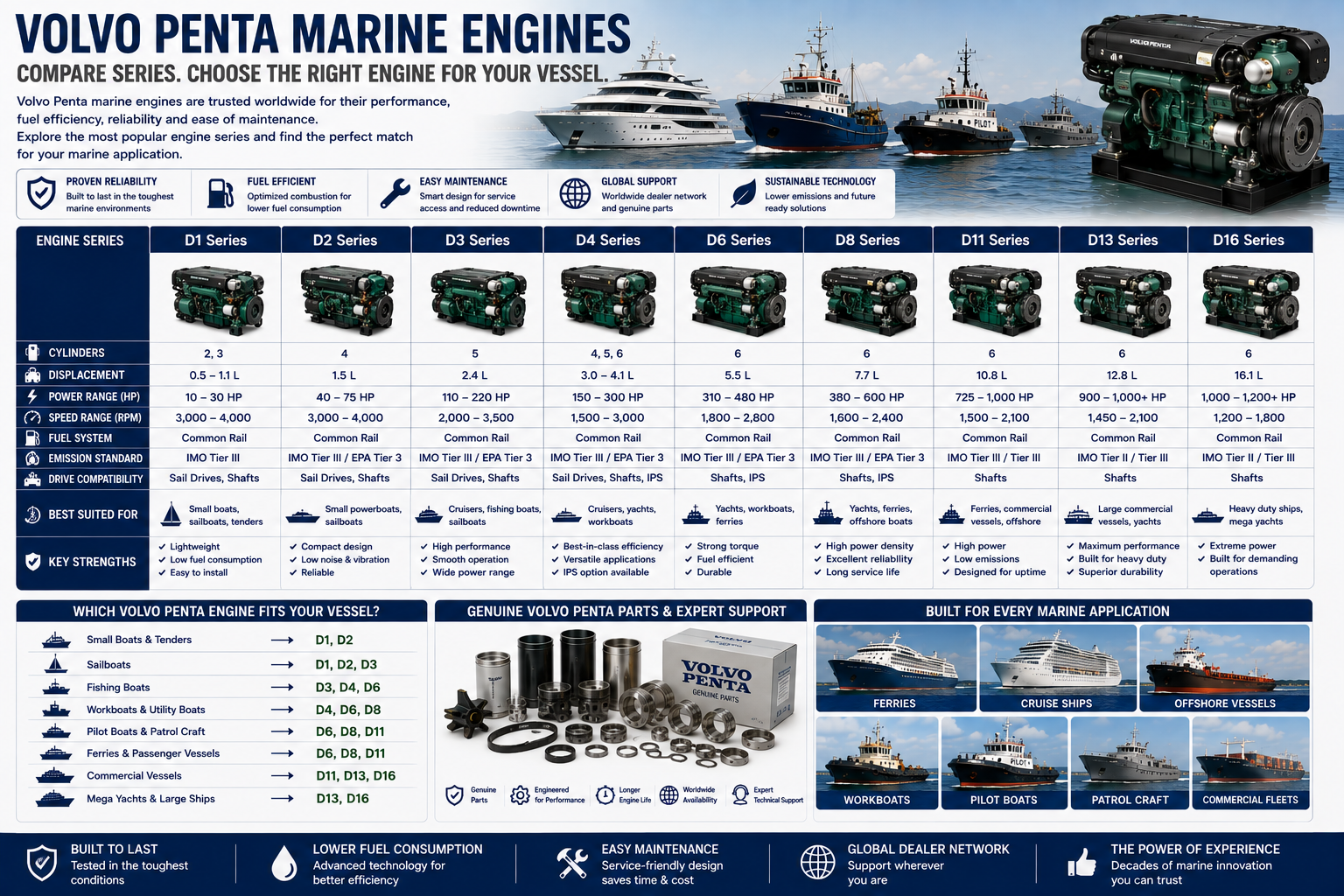
A simple way to understand the current diesel range is:
| Volvo Penta FamilyApprox. SizeGeneral CharacterTypical Marine Fit | |||
| D1 | 0.5–1.1 L class | Compact sailboat diesel | Small sailing yachts |
| D2 | 2.2 L | Larger compact yacht diesel | Sailing yachts, displacement craft |
| D4 | 3.7 L | High-output inline four | Motor yachts, fast boats, commercial craft |
| D6 | 5.5 L | Powerful inline six | Yachts, sportboats, patrol and workboats |
| D8 | 7.7 L | Commercial-capable inline six | Yachts, workboats, passenger and patrol vessels |
| D11 | 10.8 L | Larger high-output inline six | Large yachts and commercial craft |
| D13 | 12.8 L | Heavy high-output inline six | Large yachts, workboats, ferries, commercial vessels |
| D16 | 16.1 L class | Heavy-duty commercial propulsion | Larger working vessels |
Volvo Penta's current inboard range lists the D1 at approximately 12.2–27 hp, D2 at 50–75 hp, D4 at 145–320 hp, D6 at 300–480 hp, D8 at 450–600 hp, D11 at 510–725 hp, D13 at 700–1,000 hp, and D16 MH at 500–850 hp, depending on model and rating.
That immediately shows how broad the family is.
Volvo Penta D1: The Small Sailboat Engine
At the bottom of the range sits the D1.
These engines belong naturally in sailing boats where the diesel is not expected to be the vessel's main source of speed.
The sails do most of the work.
The engine is there for:
- Harbor maneuvering
- Leaving and entering marinas
- Motoring through calm weather
- Charging systems depending on installation
- Emergency propulsion
Volvo Penta currently lists D1 inboard engines from approximately 12.2 to 27 hp.
Which Boats Suit a D1?
Think:
- Small sailing yachts
- Day cruisers
- Small displacement boats
- Auxiliary propulsion
D1 Personality
The Little Sailor
Compact, simple in purpose and designed for boats where dependable auxiliary propulsion matters more than speed.
Volvo Penta D2: More Power for Larger Sailing Yachts
The D2 takes the same basic role and increases the available power.
Current D2 inboard versions reach approximately 50–75 hp.
That makes the D2 much more appropriate for:
- Larger sailing yachts
- Heavy displacement sailboats
- Motor sailers
- Cruising catamarans
- Small displacement motorboats
A 60-foot cruising sailboat may need considerably more propulsion power than a small 30-foot yacht, even though both spend much of their life under sail.
D1 vs. D2: What Is the Practical Difference?
Volvo Penta D1
Smaller and lighter.
Better for modest auxiliary propulsion requirements.
Volvo Penta D2
More displacement and more available power.
Better for larger cruising yachts and heavier displacement boats.
The correct choice depends on:
- Vessel displacement
- Hull form
- Propeller
- Gearbox
- Expected cruising conditions
Bigger is not automatically better.
An oversized diesel operating continually at very low load can be just as undesirable as an undersized engine working constantly at maximum output.
Volvo Penta D3: The Compact High-Output Generation
Many owners and workshops will also know the D3 family.
Although the current Volvo Penta range increasingly focuses on other platforms, D3 engines remain important in the installed fleet and Volvo Penta still lists D3-related components and compatibility in its parts and accessories documentation.
The D3 became popular because it offered relatively high output from a compact diesel package.
Typical applications include:
- Small motor yachts
- Sport boats
- Repower projects
- Recreational cruisers
When sourcing parts for an older D3, the complete designation and serial number are particularly important because production generations and drive configurations can differ.
Volvo Penta D4: Four Cylinders With Serious Power
The D4 is where the Volvo Penta diesel range starts becoming particularly interesting.
Volvo Penta describes the current D4 as an:
inline four-cylinder
3.7-liter
diesel engine using:
- Common-rail fuel injection
- Double overhead camshafts
- Turbocharging.
Current inboard D4 ratings range approximately from 145 to 320 hp.
That is substantial output from four cylinders.
Which Boats Suit a Volvo Penta D4?
The D4 fits naturally in:
- Motor yachts
- Fast cruisers
- Sport boats
- Patrol boats
- Small passenger craft
- Commercial workboats
- Twin-engine pleasure craft
Its compact size is especially useful where engine-room volume matters.
D4 Personality
The Compact Performer
Four cylinders, relatively small displacement and enough output for vessels that need considerably more performance than a traditional sailboat diesel.
Why Can a 3.7-Liter Engine Produce More Than 300 hp?
Modern diesel engineering.
The D4 combines:
- Turbocharging
- Common rail
- Electronic engine control
- Four-valve-type modern breathing architecture
- Sophisticated cooling
That allows much more power to be produced from a relatively small displacement.
But there is a tradeoff.
Higher specific output means systems such as:
fuel injection
turbocharging
charge-air cooling
and
engine cooling
must all remain in excellent condition.
Volvo Penta D6: One of the Most Recognizable Marine Diesels
The D6 is one of Volvo Penta's best-known marine engine families.
Current inboard models cover approximately 300–480 hp from 5.5 liters.
The D6 has also been extensively offered with Volvo Penta's sterndrive systems, and earlier high-performance D6 versions helped establish the family in powerful diesel sportboat applications.
Where Does a D6 Fit?
Think:
- Motor yachts
- Sport cruisers
- Sportfishing boats
- Fast passenger boats
- Patrol vessels
- Commercial workboats
- Rescue craft
- Twin-engine installations
The D6 represents a very useful middle ground.
It has considerably more displacement than the D4 but remains compact compared with a D8, D11 or D13.
D4 vs. D6: Which Makes More Sense?
Volvo Penta D4
3.7 L inline four
Up to approximately 320 hp
More compact and lighter.
Volvo Penta D6
5.5 L inline six
Up to approximately 480 hp
More displacement, smoother six-cylinder operation and considerably more propulsion capability.
For a smaller boat, a D4 may be ideal.
For a larger cruiser or commercial boat requiring more sustained torque, the D6 may make more sense.
Why the D4 and D6 Became So Important
Volvo Penta developed D4 and D6 not simply as engines but as parts of an integrated propulsion system.
They can be combined with:
- Conventional shaft drives
- Aquamatic sterndrives
- Electronic Vessel Control
- Joystick systems
- Integrated helm functions
This is an important part of the Volvo Penta philosophy:
engine + transmission + controls + propeller system
are designed to work together.
That makes correct parts identification especially important.
A D6 inboard and a D6 sterndrive installation may share the base engine but have important differences in marine equipment.
What Is Volvo Penta Aquamatic?
Aquamatic is Volvo Penta's sterndrive propulsion concept.
Instead of mounting a conventional shaft directly through the hull, the engine drives an outdrive mounted through the transom.
The drive combines functions associated with:
- Transmission
- Steering
- Propeller
- Trim
Aquamatic systems are especially common on:
- Fast cruisers
- Sport boats
- Motor yachts
- Planing hulls
Many D4 and D6 installations use Aquamatic.
Why Would You Choose a Sterndrive?
Potential advantages include:
- Efficient propeller thrust direction
- Trim adjustment
- Compact engine-room layout
- Good maneuverability
- Strong performance on planing boats
But the drive itself becomes another important maintenance system.
Now engineers must also consider:
- Gear oil
- Bellows
- Seals
- Steering
- Trim
- Propeller shafts
- Anodes
- Corrosion
- Drive-leg condition
A perfect diesel engine cannot compensate for a neglected sterndrive.
Volvo Penta D8: Moving Into Bigger Commercial Power
The D8 moves considerably upward.
Volvo Penta describes the D8 as an:
inline six-cylinder
7.7-liter
diesel engine using common-rail fuel injection and turbocharging.
Current inboard output is approximately 450–600 hp.
That puts the D8 squarely into serious yacht and commercial-vessel territory.
Which Boats Suit a Volvo Penta D8?
Potential applications include:
- Large motor yachts
- Workboats
- Patrol boats
- Passenger vessels
- Pilot boats
- Fast ferries
- Government craft
- Fishing vessels
- Commercial auxiliaries
The D8 is also available in IPS configurations. Volvo Penta describes D8-IPS as an integrated package built around the 7.7-liter inline-six D8 and pod drive.
D8 Personality
The Commercial Crossover
Large enough to work seriously but compact enough to fit fast yachts and sophisticated pod-drive installations.
Volvo Penta D11: The Bigger Inline-Six
The D11 moves to approximately 10.8 liters.
Current Volvo Penta inboard ratings span roughly 510–725 hp.
The D11 is also available as an IPS package.
Volvo Penta describes D11-IPS as combining a 10.8-liter inline-six common-rail diesel with a pod drive and Electronic Vessel Control.
Where Does the D11 Fit?
Think:
- Large yachts
- Large sportfishing vessels
- Commercial passenger boats
- Patrol craft
- Pilot boats
- Workboats
- Multi-engine IPS installations
It gives operators more displacement and torque than the D8 while retaining inline-six service characteristics.
Volvo Penta D13: Up to 1,000 hp in an Inline Six
The D13 sits near the upper end of Volvo Penta's mainstream high-output marine diesel range.
Volvo Penta describes it as an:
inline six-cylinder
12.8-liter
engine with:
- High-pressure fuel injection
- Overhead camshaft
- Twin-entry turbocharger
- Water-cooled exhaust manifold.
Current inboard versions span approximately 700–1,000 hp / 515–735 kW.
That is substantial power without moving to a V8 or V12 engine.
Which Boats Suit a D13?
Think:
- Large motor yachts
- Commercial workboats
- Passenger craft
- Fast ferries
- Patrol vessels
- Large pilot boats
- Government vessels
- Commercial propulsion systems
The D13 is also central to Volvo Penta's larger IPS systems.
D13 Personality
The Big Straight-Six
Nearly 13 liters, up to approximately 1,000 hp and enough power for substantial yachts and commercial boats without requiring a V-engine layout.
Why Stay With an Inline Six at 1,000 hp?
There are practical advantages.
An inline six offers:
- One cylinder bank
- Straightforward cylinder-head access
- Relatively narrow engine width
- Smooth power delivery
- Familiar service arrangement
The downside is engine length.
But in vessels where longitudinal engine-room space is available, the layout can be very attractive.
Volvo Penta D16: Heavy Commercial Power
Volvo Penta also offers the D16 MH in the current inboard marine range.
It is a 16.1-liter commercial propulsion engine with current ratings around 500–850 hp, depending on specification.
This may look strange at first.
Why would a larger 16-liter engine sometimes produce less headline horsepower than a D13?
Because maximum horsepower is not the whole story.
The D16 MH belongs more naturally to heavy commercial duty.
A larger-displacement engine operating at a conservative rating can be preferable when:
- Annual hours are very high
- Load is sustained
- Vessel speed is lower
- Commercial durability matters more than maximum power-to-weight ratio
D13 vs. D16: Bigger Does Not Always Mean More Horsepower
This is a useful marine-engine lesson.
D13
Up to approximately 1,000 hp
Higher-output applications.
Strong yacht and fast-commercial fit.
D16 MH
Approximately 500–850 hp
Larger displacement and commercial-duty character.
Better suited where sustained operation matters more than peak power.
This is why choosing a marine engine from a horsepower table alone can be a mistake.
Volvo Penta IPS: More Than an Engine
One of the things that most distinguishes Volvo Penta from many competing marine engine brands is IPS.
IPS stands for Inboard Performance System.
Instead of a conventional:
engine → gearbox → shaft → propeller
arrangement, IPS uses steerable pod drives mounted underneath the hull.
The pods use twin counter-rotating propellers and are integrated with the engine and Electronic Vessel Control. Volvo Penta describes this combination as improving maneuverability, onboard comfort and range while reducing fuel consumption and emissions compared with traditional solutions in suitable applications.
Which Engines Are Used With IPS?
Current Volvo Penta IPS configurations include engines such as:
- D8
- D11
- D13
with different pod-drive packages depending on required output.
Volvo Penta also markets its larger IPS propulsion systems for yacht applications using D8, D13 and other D-series configurations.
Why Do Yacht Builders Like IPS?
IPS can provide several practical advantages.
Better Maneuverability
The pods steer.
With joystick control, low-speed docking can become much easier.
Packaging
The propulsion layout can free up space elsewhere in the vessel.
Propeller Efficiency
The counter-rotating propellers are designed as part of the integrated system.
Electronic Integration
Engine, controls, steering and propulsion communicate through Volvo Penta's electronic architecture.
But there is a tradeoff.
IPS means the propulsion package becomes more integrated.
Maintenance is not just about the engine anymore.
What Needs Maintenance on an IPS System?
Think beyond:
oil + filters + injectors.
You also need to consider:
- Pod oil
- Propellers
- Propeller shafts
- Seals
- Steering
- Corrosion protection
- Anodes
- Electronic controls
- Clutches/gears
- Drive lubrication
An IPS-equipped D13 should therefore be treated as:
D13 engine + IPS pod + Electronic Vessel Control
rather than only “a D13.”
IPS vs. Conventional Shaft Drive
This is one of the most important choices when looking at Volvo Penta propulsion.
SHAFT DRIVE
Traditional and mechanically familiar.
Engine drives a gearbox and propeller shaft.
Common in commercial and displacement vessels.
IPS
Integrated pod propulsion.
Strong maneuverability and installation flexibility.
Particularly popular in modern yachts and fast commercial vessels.
Neither is automatically better.
The correct answer depends on:
- Hull design
- Vessel speed
- Draft
- Maintenance environment
- Redundancy requirements
- Installation space
- Owner/operator preference
Volvo Penta Commercial Marine Engines
Volvo Penta is not only a leisure-yacht brand.
The company's commercial marine business covers vessels that need:
- Propulsion
- Auxiliary power
- Variable-speed generator systems
- Integrated professional IPS propulsion.
Potential applications include:
- Pilot boats
- Patrol vessels
- Passenger vessels
- Fishing boats
- Workboats
- Rescue craft
- Ferries
- Government boats
- Offshore-support craft
This is where engines such as D8, D11, D13 and D16 become particularly relevant.
Volvo Penta for Sailing Yachts
At the other end of the range, Volvo Penta remains strongly associated with sailing yachts.
The D1 and D2 fit naturally here.
For a sailing boat, priorities often include:
- Compact size
- Low noise
- Low vibration
- Easy maintenance
- Good low-speed control
- Saildrive compatibility depending on installation
The engine spends much of its life as auxiliary propulsion rather than continuously pushing the vessel at high speed.
That is a completely different mission from a D13 in a fast motor yacht.
Volvo Penta Saildrive Systems
Volvo Penta has a long history with saildrives.
A saildrive combines the transmission and underwater drive into a compact leg mounted through the hull.
It is especially common in:
- Sailing yachts
- Catamarans
- Production cruisers
Potential advantages include:
- Compact installation
- Efficient propeller alignment
- Reduced shaft-alignment complexity
- Flexible engine placement
But saildrives also need their own maintenance.
Important areas include:
- Gear oil
- Diaphragm/sealing system
- Propeller
- Anodes
- Corrosion
- Drive seals
Again:
engine and drive should be considered as one system.
Volvo Penta for Motor Yachts
For motor yachts, the likely progression is very different.
Depending on vessel size:
D4
↓
D6
↓
D8
↓
D11
↓
D13
can represent increasingly powerful propulsion options.
Current inboard shaft ratings span from approximately 145 hp for smaller D4 versions to 1,000 hp for the D13.
With twin, triple or quadruple engines, total installed yacht power can become substantial.
Which Volvo Penta Engine Fits a Sportfishing Boat?
Sportfishing boats often value:
- Fast acceleration
- High cruise speed
- Compact twin-engine installation
- Good range
- Strong low-speed maneuverability
Depending on vessel size, engines such as:
- D6
- D8
- D11
- D13
can become relevant.
IPS can also be attractive because maneuverability is useful when backing down or positioning the vessel.
The best solution still depends on the hull and builder's design.
Which Volvo Penta Engine Fits a Pilot Boat?
Pilot boats have demanding operating profiles.
They often:
- Accelerate rapidly
- Run at high cruise speeds
- Operate repeatedly throughout the day
- Maneuver alongside large ships
- Work in poor weather
That can make:
D8
D11
or
D13
particularly relevant depending on vessel size.
For commercial operation, the correct rating matters as much as maximum horsepower.
Which Volvo Penta Engine Fits a Workboat?
Workboats come in every size.
A small harbor workboat might be suited to a D4.
A larger utility craft may need a D6 or D8.
A substantial fast commercial vessel may move to D11 or D13.
A heavier continuous-duty vessel might benefit from a D16 MH configuration.
The word workboat by itself does not tell you enough.
Ask:
How much does it displace?
How fast must it go?
How many hours per year?
How much time at high load?
Volvo Penta Marine Generator and Auxiliary Engines
Not every Volvo Penta engine onboard drives a propeller.
Volvo Penta's marine portfolio also includes:
- Genset engines
- Auxiliary engines
- Variable-speed generator applications.
An auxiliary engine may drive:
- Generator
- Hydraulic system
- Pumps
- Deck machinery
- Other onboard equipment
Its operating profile may therefore be completely different from the main propulsion engine.
Propulsion vs. Generator Duty
A propulsion engine sees:
- Variable rpm
- Variable load
- Acceleration
- Propeller demand
A conventional generator engine typically needs to maintain stable speed as electrical load changes.
That changes:
- Engine calibration
- Cooling requirements
- Governor/control strategy
- Maintenance planning
So never assume that two D-series engines with similar displacement have identical auxiliary equipment.
Common Rail and Electronic Control
Modern Volvo Penta engines such as the D4 and D8 use electronically controlled common-rail injection.
This provides precise fuel control.
Potential advantages include:
- Improved combustion
- Faster engine response
- Lower smoke
- Better efficiency
- Electronic diagnostics
But it also introduces greater sensitivity to:
- Fuel contamination
- Water in fuel
- Poor filtration
- Sensor failures
- Wiring faults
Modern diesel maintenance therefore requires both mechanical and electronic understanding.
Electronic Vessel Control
Volvo Penta's integrated systems use Electronic Vessel Control, especially with IPS packages.
This system helps connect:
- Engine
- Transmission
- Steering
- Helm controls
- Joystick
- Displays
This can make the boat much easier to operate.
But it also means troubleshooting may involve communication networks rather than only mechanical components.
Older Volvo Penta vs. Modern Volvo Penta
The installed fleet includes many older Volvo Penta engines.
Some owners may recognize names such as:
- MD series
- TAMD series
- KAD series
- AQ series
- Older D3 generations
Volvo Penta's remanufacturing and parts documentation continues to include support references for many older marine-engine families.
These engines can be much more mechanically straightforward than current D-series products.
That gives the owner a choice when considering repower:
repair the older mechanical engine
or
move to a newer electronically controlled propulsion system.
Why Some Owners Keep Older Volvo Penta Engines
Reasons can include:
- Familiarity
- Mechanical simplicity
- Existing engine mounts
- Existing gearbox
- Lower repair cost than repower
- Parts availability for certain families
But older engines can also suffer from:
- Corrosion
- Obsolete electronics
- Aging cooling components
- Worn turbochargers
- Fuel-system wear
- Limited parts availability for certain models
Age alone does not decide whether to rebuild or replace.
Condition does.
Volvo Penta IMO III Engines
For commercial vessels operating in IMO Tier III emission-control areas, Volvo Penta offers compliant packages.
The D13 IMO III solution reaches up to approximately 735 kW for applicable inboard and auxiliary installations.
Volvo Penta also offers D13 IPS IMO III, combining the D13 with IPS propulsion and emissions equipment.
This adds another system for engineers to maintain.
What Changes With IMO III?
Depending on engine package, emissions compliance can add systems such as:
- SCR
- Urea/DEF dosing
- Exhaust sensors
- Catalyst modules
- Additional controls
The engine can be mechanically healthy while an emissions-system problem still affects operation.
This is why modern engine-room diagnostics increasingly involve both:
diesel mechanics
and
emissions/electronic systems.
Quick Volvo Penta Marine Engine Comparison
| EngineApprox. DisplacementCurrent Inboard PowerTypical Application | |||
| D1 | 0.5–1.1 L | 12.2–27 hp | Small sailboats |
| D2 | 2.2 L | 50–75 hp | Sailing yachts, displacement boats |
| D4 | 3.7 L | 145–320 hp | Motor yachts, workboats, fast craft |
| D6 | 5.5 L | 300–480 hp | Yachts, patrol, commercial craft |
| D8 | 7.7 L | 450–600 hp | Larger yachts and workboats |
| D11 | 10.8 L | 510–725 hp | Large yachts and commercial vessels |
| D13 | 12.8 L | 700–1,000 hp | Large yachts, ferries, workboats |
| D16 MH | 16.1 L | 500–850 hp | Heavy-duty commercial propulsion |
These figures are current Volvo Penta inboard ranges and can vary by rating, market and emissions configuration.
Volvo Penta Marine Engine “Personalities”
D1 — The Little Sailor
Small, compact and perfectly comfortable spending much of its life waiting while the sails do the work.
D2 — The Cruiser
More power for larger sailing yachts and displacement craft.
D4 — The Compact Performer
Up to roughly 320 hp from a 3.7-liter four-cylinder package.
D6 — The Marine All-Rounder
Enough power for serious yachts and commercial vessels while remaining relatively compact.
D8 — The Commercial Crossover
A 7.7-liter six that fits both larger yacht and workboat worlds.
D11 — The Bigger Six
More displacement and torque for substantial vessels without moving to a huge engine.
D13 — The 1,000-hp Straight Six
Nearly 13 liters and up to approximately 1,000 hp in current inboard configuration.
D16 MH — The Heavy Worker
Bigger displacement with a more commercial-duty personality.
Which Volvo Penta Engine Would You Choose for Different Boats?
Small Sailing Yacht
Look toward:
D1
Larger Sailing Yacht
Look toward:
D2
Small Motor Yacht
Possible options:
D4
D6
Medium Motor Yacht
Consider:
D6
D8
Large Yacht
Depending on size:
D8
D11
D13
with shaft or IPS propulsion.
Fast Workboat
Potentially:
D6
D8
D11
D13
Heavy Commercial Workboat
Look more closely at:
D8
D13
D16 MH
depending on actual duty.
Pilot or Patrol Boat
Common power classes naturally fall around:
D6 → D8 → D11 → D13
depending on vessel size.
Why Exact Volvo Penta Engine Identification Matters
A customer may say:
“I need a Volvo Penta D6 seawater pump.”
That is useful.
But it may not be enough.
We still need to know:
Which D6?
Which serial number?
Inboard or Aquamatic?
Which drive?
Which production generation?
Which current part number?
Volvo Penta itself advises owners to search using the engine serial number, because engines can have several variants and installed parts may differ.
That is exactly why serial-number identification is so important.
A Good Volvo Penta Parts Inquiry
A useful inquiry looks like:
Manufacturer: Volvo Penta
Engine Model: D6-________
Serial Number: __________
Drive: Inboard / Aquamatic / IPS
Drive Model: __________
Existing Part Number: __________
Quantity: __________
Photos: Attached
For IPS installations, include the pod serial information where relevant as well.
Common Volvo Penta Marine Spare Parts
Depending on engine family and installation, common requirements may include:
- Engine oil filters
- Fuel filters
- Air filters
- Fuel injectors
- Common-rail pumps
- Fuel feed pumps
- Turbochargers
- Charge-air coolers
- Seawater pumps
- Raw-water impellers
- Coolant pumps
- Heat exchangers
- Oil coolers
- Thermostats
- Exhaust elbows
- Water-cooled exhaust manifolds
- Cylinder heads
- Intake valves
- Exhaust valves
- Valve guides
- Pistons
- Piston rings
- Cylinder liners where applicable
- Connecting rods
- Main bearings
- Connecting-rod bearings
- Crankshaft components
- Camshafts
- Oil pumps
- Alternators
- Starters
- Sensors
- Electronic control modules
- Wiring harnesses
- Gaskets
- O-rings
- Seals
- Overhaul components
For sterndrive and IPS installations, requirements can also include:
- Propellers
- Drive seals
- Gear components
- Clutches
- Steering components
- Anodes
- Pod/drive service components
Volvo Penta's current aftermarket system contains more than 200,000 genuine parts for marine and industrial applications.
Cooling-System Maintenance Matters
A marine diesel can only produce full power safely if it can reject heat.
Typical Volvo Penta installations may include:
- Seawater pump
- Heat exchanger
- Charge-air cooler
- Oil cooler
- Thermostat
- Freshwater pump
- Raw-water hoses
- Sea strainer
A restriction in one part of this system can appear as:
- High coolant temperature
- Reduced power
- Exhaust overheating
- Alarm activation
Do not immediately blame the engine's internal components.
Always check the cooling circuit.
Raw-Water Impellers
On applicable systems, raw-water impellers deserve particular attention.
They can fail because of:
- Age
- Dry running
- Debris
- Long storage
- Heat
- Repeated flexing
If blades break off, find the missing pieces.
They can travel downstream and partially block:
- Heat exchangers
- Oil coolers
- Charge-air coolers
- Hoses
Simply installing a new impeller does not necessarily restore full water flow.
Turbocharger Maintenance
Turbocharger performance becomes increasingly important as you move from D4 through D13.
A deteriorating turbo can contribute to:
- Loss of boost
- Smoke
- Poor acceleration
- High exhaust temperature
- Higher fuel consumption
- Reduced maximum rpm
Check:
- Compressor condition
- Oil leakage
- Shaft condition
- Turbine deposits
- Boost pressure
On modern electronically controlled engines, compare mechanical findings with fault and performance data.
Fuel Cleanliness Is Critical
Modern D4, D6, D8 and other D-series engines use sophisticated high-pressure injection technology.
This improves:
- Fuel control
- Efficiency
- Response
- Emissions
But contaminants can damage expensive components.
Pay close attention to:
- Fuel filtration
- Water separators
- Tank cleanliness
- Water contamination
- Filter-change intervals
A dirty fuel system can turn into an expensive injector or high-pressure pump problem.
Buying a Used Volvo Penta Marine Engine
Before buying a used D4, D6, D8 or D13, ask for:
- Full engine model
- Serial number
- Engine hours
- Service history
- Previous overhaul
- Fault-code history
- Cold-start video
- Running video
- Oil pressure
- Coolant temperature
- Smoke under load
- Turbocharger history
- Injector history
- Cooling-system maintenance
- Drive or IPS service history
- Reason for removal
For an IPS engine, inspect the propulsion system as seriously as the engine.
A beautiful D13 connected to a neglected pod is not a healthy propulsion package.
Maintenance Accessibility Matters
When repowering or choosing a boat, ask whether the engineer can actually reach:
- Oil filters
- Fuel filters
- Seawater pump
- Starter
- Alternator
- Turbocharger
- Injectors
- Heat exchanger
- Charge-air cooler
- ECU connections
On a twin or triple engine installation, this becomes even more important.
A component that takes 30 minutes to replace on an engine stand can become a several-hour job when squeezed between engines.
Marine Engineer Tip
Don't identify a Volvo Penta propulsion system by engine horsepower alone.
Confirm:
Complete engine model
Serial number
Rated horsepower
Commercial or leisure application
Shaft / saildrive / Aquamatic / IPS
Drive serial number
Engine hours
Current part number
Maintenance history
On Volvo Penta installations, the drive system can be just as important as the engine model.
Frequently Asked Questions
What Are the Main Volvo Penta Marine Diesel Engines?
The current range includes D1, D2, D4, D6, D8, D11, D13 and D16-class marine engines across propulsion and related applications.
Which Volvo Penta Engine Is Common in Sailing Yachts?
The smaller D1 and D2 families are particularly suited to sailboat and displacement-vessel auxiliary propulsion. Volvo Penta's current inboard range starts at approximately 12.2 hp with the D1.
How Powerful Is the Volvo Penta D4?
Current inboard D4 models span approximately 145–320 hp from a 3.7-liter inline four-cylinder engine.
How Powerful Is the Volvo Penta D6?
Current inboard D6 versions span approximately 300–480 hp.
What Is the Volvo Penta D8?
The D8 is a 7.7-liter inline six-cylinder common-rail diesel, currently available around 450–600 hp in inboard versions.
How Powerful Is the D11?
Current inboard D11 models span approximately 510–725 hp.
How Powerful Is the Volvo Penta D13?
Current D13 inboard versions span approximately 700–1,000 hp from a 12.8-liter inline-six engine.
What Is Volvo Penta IPS?
IPS is Volvo Penta's integrated pod-drive propulsion system using steerable pods, twin counter-rotating propellers and Electronic Vessel Control.
Which Engines Are Available With IPS?
Current IPS installations include D8, D11 and D13-based packages, depending on required propulsion power.
Does Volvo Penta Make Commercial Marine Engines?
Yes. Volvo Penta has a dedicated commercial marine range covering propulsion, auxiliary, generator and professional IPS applications.
Does Volvo Penta Offer IMO Tier III Engines?
Yes. Volvo Penta's D13 IMO III solutions are available up to approximately 735 kW in applicable configurations.
Why Is the Engine Serial Number Important?
Volvo Penta specifically recommends using the engine serial number to find the correct parts because different variants within the same engine family may use different components.
Volvo Penta Marine Engine Spare Parts
Alfa Marine Spare Parts can assist with spare-parts inquiries for Volvo Penta marine engine families including:
- Volvo Penta D1 Marine Engine
- Volvo Penta D2 Marine Engine
- Volvo Penta D3 Marine Engine
- Volvo Penta D4 Marine Engine
- Volvo Penta D6 Marine Engine
- Volvo Penta D8 Marine Engine
- Volvo Penta D11 Marine Engine
- Volvo Penta D13 Marine Engine
- Volvo Penta D16 Marine Engine
- Volvo Penta Aquamatic installations
- Volvo Penta IPS propulsion systems
- Selected older Volvo Penta marine engines
Depending on the exact engine and availability, requirements can include genuine, OEM, aftermarket, remanufactured or reconditioned components.
Common Volvo Penta Parts We Can Help Identify
Parts requirements may include:
- Fuel injectors
- Fuel pumps
- Oil filters
- Fuel filters
- Air filters
- Turbochargers
- Seawater pumps
- Impellers
- Coolant pumps
- Heat exchangers
- Charge-air coolers
- Oil coolers
- Exhaust elbows
- Exhaust manifolds
- Cylinder heads
- Pistons
- Piston rings
- Connecting rods
- Bearings
- Crankshaft components
- Camshaft components
- Sensors
- ECU components
- Gaskets
- O-rings
- Seals
- Starters
- Alternators
- Sterndrive components
- IPS service parts
- Propellers
- Anodes
- Overhaul components
Related Volvo Penta Marine Engine Pages
- Volvo Penta D1 Marine Engine Spare Parts
- Volvo Penta D2 Marine Engine Spare Parts
- Volvo Penta D3 Marine Engine Spare Parts
- Volvo Penta D4 Marine Engine Spare Parts
- Volvo Penta D6 Marine Engine Spare Parts
- Volvo Penta D8 Marine Engine Spare Parts
- Volvo Penta D11 Marine Engine Spare Parts
- Volvo Penta D13 Marine Engine Spare Parts
- Volvo Penta D16 Marine Engine Spare Parts
- Volvo Penta IPS Spare Parts
- Volvo Penta Aquamatic Spare Parts
Why Choose Alfa Marine Spare Parts?
Volvo Penta is an excellent example of why engine identification alone may not be enough.
A customer may ask:
“Need parts for Volvo Penta D6.”
We may still need to know:
Which D6 version?
What is the engine serial number?
Shaft drive or Aquamatic?
Which sterndrive?
What is the current part number?
And with IPS:
Which IPS drive and serial number?
Volvo Penta itself notes that engines can have multiple variants and advises identifying parts through the serial number.
Alfa Marine Spare Parts assists yacht engineers, marine engineers, shipyards, workshops, commercial vessel operators and technical superintendents sourcing Volvo Penta marine engine and propulsion components.
The objective is straightforward:
identify the engine and propulsion system correctly before identifying the part.
Worldwide Volvo Penta Marine Spare Parts Supply
Alfa Marine Spare Parts supports:
- Shipyards
- Yacht repair companies
- Marine engineers
- Chief engineers
- Technical superintendents
- Yacht managers
- Sailing-yacht operators
- Sportfishing boats
- Workboat operators
- Pilot boats
- Patrol vessels
- Passenger craft
- Fishing vessels
- Commercial marine fleets
- Marine service companies
- Marine equipment distributors
For an inquiry, send:
Volvo Penta engine model + serial number + drive type + drive serial number where applicable + existing part number + quantity + photographs.
Contact Alfa Marine Spare Parts
Email: request@alfamarinespareparts.com
Website:
https://alfamarinespareparts.com
Marine Spare Parts Catalog:
https://alfamarinespareparts.com/spareparts
One Final Thought
Volvo Penta marine engines become much easier to understand when you look at both the engine size and the propulsion system.
The D1 and D2 belong naturally in the sailing-yacht world.
The D4 is the compact high-output four-cylinder, reaching approximately 320 hp.
The D6 is one of the great Volvo Penta all-rounders, with enough power for fast yachts and commercial craft.
The D8 and D11 move into larger yacht and workboat territory.
The D13 reaches approximately 1,000 hp from a 12.8-liter inline six and can be paired with conventional shaft propulsion or advanced IPS installations.
And the D16 MH demonstrates another important lesson: sometimes a larger engine is chosen not to produce the highest possible horsepower, but to provide the displacement and operating characteristics required for heavier commercial service.
But Volvo Penta adds another dimension that many engine families do not:
Saildrive, Aquamatic and IPS.
So when somebody asks:
“Which Volvo Penta marine engine is best?”
the answer should start with:
What kind of boat, what duty cycle, and how will the engine transfer its power to the water?
Because the right Volvo Penta installation for a sailing yacht, sport cruiser, IPS motor yacht, pilot boat and heavy commercial workboat will never be exactly the same.