
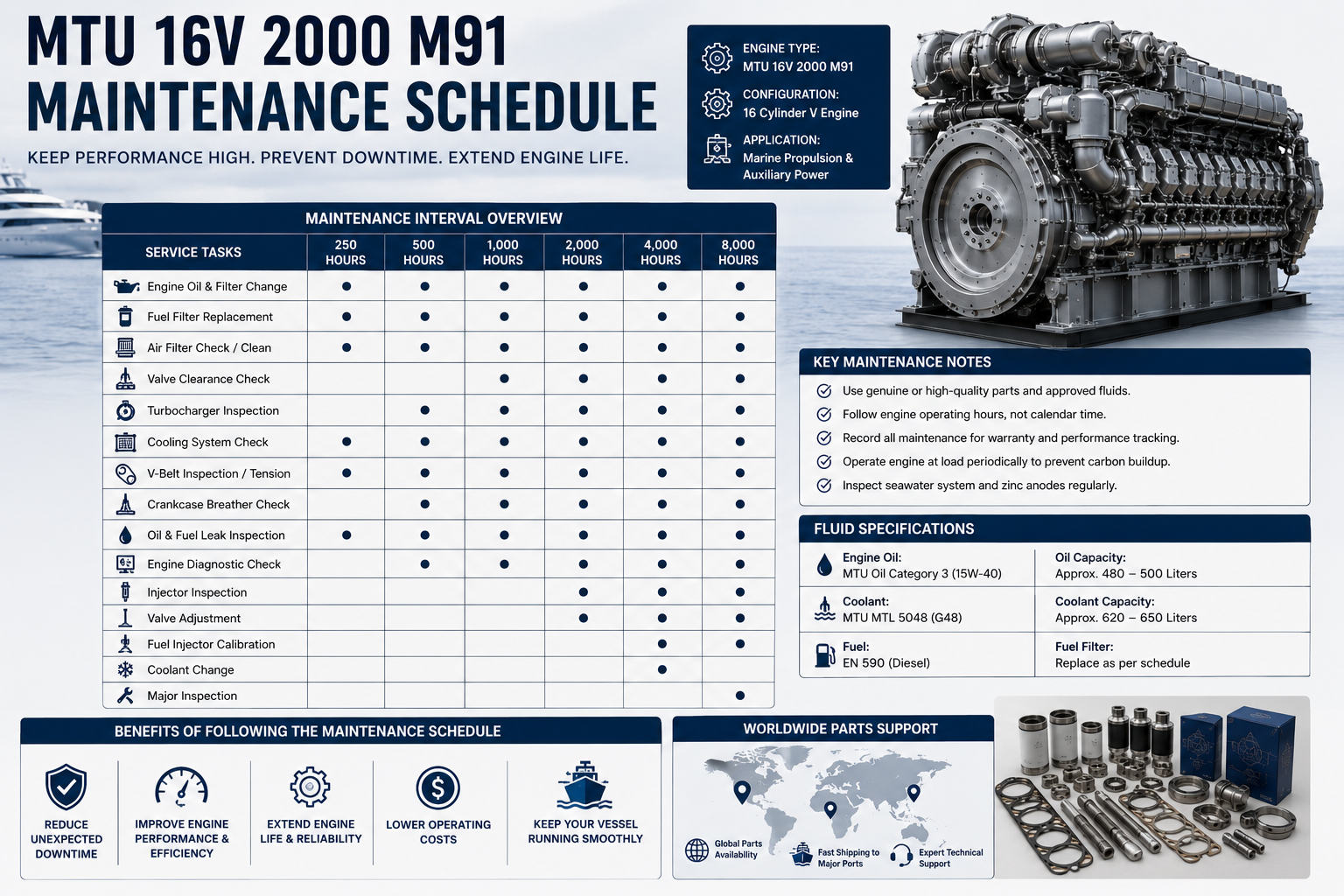
MTU 16V 2000 M91 Maintenance Schedule: What the Service Hours Really Mean for a Working Vessel
An engine manual normally gives maintenance in operating hours.
A fleet manager often thinks in months.
That difference sounds small, but it can make maintenance planning much easier.
Suppose your MTU 16V 2000 M91 marine engine operates 3,000 hours per year. A 2,000-hour service task arrives roughly every eight months.
Put the same engine into an intensive operation accumulating 5,000 hours annually, and that 2,000-hour task arrives in less than five months.
Suddenly, a maintenance interval becomes something that purchasing, vessel management and engineering can actually put on a calendar.
This article takes the maintenance philosophy used in fleet-planning tables and applies it specifically to the MTU 16V 2000 M91, which belongs to the MTU Series 2000 marine engine family.
More importantly, the maintenance hours below are not copied from another engine manufacturer. They are based on an MTU maintenance schedule covering the 12V2000M91 and 16V2000M91, Application Group 1DS. That schedule describes the M91 as continuous-operation, variable-load, low-utilization duty and uses operating-hour and time limits, with whichever comes first governing the maintenance requirement.
Why Convert MTU Operating Hours Into Months?
Because 500 hours does not mean the same thing to every vessel.
A yacht running a relatively modest annual schedule may take months to accumulate those hours.
A workboat or other heavily utilized vessel can reach the same interval surprisingly quickly.
For this planning example, we'll use:
Low Usage: 3,000 operating hours per year
High Usage: 5,000 operating hours per year
The calculation is:
Maintenance interval ÷ annual operating hours × 12 = approximate months
These month figures are planning estimates only. MTU states that maintenance is governed by both operating-hour and time limits, and whichever limit is reached first applies. Difficult operating or environmental conditions can also require additional work or changed intervals.
MTU 16V 2000 M91 Component Lifetime in Months
⚙️ MTU 16V 2000 M91 Maintenance Planning Block
Engine Family: MTU Series 2000
Engine Type: MTU 16V 2000 M91
Application referenced: 1DS
Low Usage: 3,000 hours/year
High Usage: 5,000 hours/year
| Component / Maintenance TaskMTU IntervalLow UsageHigh UsageEngineer's Notes | ||||
| Engine Operating Inspection | Daily | Daily | Daily | Check oil level, leaks, abnormal noises, exhaust color, vibration and other basic engine conditions. |
| Engine Oil Filter | With every engine-oil change | Oil-dependent | Oil-dependent | MTU specifies replacement whenever engine oil is changed and no later than the applicable time limit. |
| Crankcase Ventilation | 500 hours | 2 months | 1.2 months | Clean ventilation wire meshes and inspect condition. |
| Fuel Filter | 500 hours | 2 months | 1.2 months | Replace fuel filter/element to maintain clean fuel delivery. |
| Centrifugal Oil Filter | 500 hours | 2 months | 1.2 months | Check contamination layer and clean as required; MTU also connects servicing with oil changes. |
| Valve Gear / Valve Clearance | 500 hours | 2 months | 1.2 months | Check valve clearance and adjust when required. |
| Belt Drive | 2,000 hours | 8 months | 4.8 months | Inspect belt condition and tension; replace when necessary. |
| Air Filters | 2,000 hours | 8 months | 4.8 months | Replace air filters according to the referenced schedule. |
| Fuel Injectors | 2,000 hours | 8 months | 4.8 months | Referenced schedule calls for replacement of injection valves/injectors. |
| Combustion Chambers | 2,000 hours | 8 months | 4.8 months | Inspect cylinder/combustion chambers using an endoscope. |
| Fuel Injection Pumps | 2,000 hours | 8 months | 4.8 months | Referenced M91 schedule lists replacement at this interval. |
| Pressure Pipe Neck | 2,000 hours | 8 months | 4.8 months | Replace the pressure-pipe neck/bayonet in the cylinder head. |
| Turbocharger Overhaul | 4,000 hours | 16 months | 9.6 months | Included in MTU's component-maintenance scope. |
| Intercooler | 4,000 hours | 16 months | 9.6 months | Clean and inspect for leakage. |
| Engine Coolant Cooler | 4,000 hours | 16 months | 9.6 months | Clean and inspect for leaks. |
| Engine Oil Heat Exchanger | 4,000 hours | 16 months | 9.6 months | Clean and leak-test as part of component maintenance. |
| Engine Coolant Pump | 4,000 hours | 16 months | 9.6 months | Overhaul under the referenced maintenance program. |
| Raw-Water Pump | 4,000 hours | 16 months | 9.6 months | Overhaul and inspect the seawater-side cooling system. |
| Cylinder Heads | 4,000 hours | 16 months | 9.6 months | Overhaul cylinder heads and inspect piston crowns and cylinder-liner running patterns. |
| Piston Rings | 4,000 hours* | 16 months | 9.6 months | Included in the referenced QL4 extended component-maintenance scope. |
| Connecting-Rod Bearings | 4,000 hours* | 16 months | 9.6 months | Replacement is included in the referenced complete-disassembly maintenance scope. |
| Crankshaft Bearings | 4,000 hours* | 16 months | 9.6 months | Included in the referenced extended component-maintenance scope. |
| Cylinder Liners | 4,000 hours* | 16 months | 9.6 months | Referenced QL4 schedule includes liner replacement. |
| Complete Extended Component Maintenance | 4,000 hours* | 16 months | 9.6 months | Complete engine disassembly, inspection and repair/replacement as necessary. |
*Important: These 4,000-hour QL4 items come from the specific 2020 12V/16V2000M91 Application Group 1DS schedule reviewed for this article. They should not be applied automatically to every 16V 2000 M91 installation. Verify the latest maintenance schedule for your engine serial number, rating and duty profile before planning an overhaul. MTU itself states that intervals are linked to load profile and operational experience.
The 500-Hour Point Is More Important Than It Looks
For the referenced MTU 16V 2000 M91, several important maintenance tasks come together at 500 hours.
These include:
- Crankcase ventilation
- Fuel filtration
- Centrifugal oil filtration
- Valve-clearance inspection
MTU's schedule specifically calls for cleaning the crankcase ventilation meshes, replacing the fuel filter, checking/cleaning the centrifugal oil filter and checking valve clearance every 500 hours.
For a vessel operating 5,000 hours annually, 500 hours represents only about 1.2 months.
That changes the maintenance conversation.
A high-use vessel may require this inspection approximately ten times per year based purely on operating hours.
Why Valve Clearance Deserves Regular Attention
Valve clearance can tell an engineer a great deal.
A single adjustment may simply be routine.
But if the same cylinder repeatedly requires correction, it is worth asking why.
Possible areas for further investigation can include:
- Valve condition
- Valve seat
- Rocker components
- Valve bridge
- Pushrod
- Combustion behavior
- Cylinder temperature
MTU's referenced M91 schedule calls for checking and adjusting the valve gear at 500-hour intervals.
Don't treat that task as simply:
Check → adjust → close cover.
Record the values.
Trend them.
The 2,000-Hour Maintenance Point
At 2,000 hours, the referenced M91 schedule becomes more involved.
MTU lists work involving:
- Belt drive
- Air filters
- Fuel injectors
- Combustion chamber inspection
- Fuel injection pumps
- Pressure-pipe necks in the cylinder heads
The combustion chambers are specifically scheduled for endoscopic inspection.
For fleet managers, 2,000 hours converts approximately to:
3,000 hours/year → 8 months
5,000 hours/year → 4.8 months
This is why parts planning matters.
A heavily used vessel could arrive at this maintenance point more than twice within a single year.
Why Endoscopic Inspection Is So Valuable
One of the best things about an endoscope is that it allows engineers to see inside a cylinder without immediately dismantling the entire engine.
During inspection, look for unusual differences between cylinders.
You may observe:
- Carbon deposits
- Piston crown appearance
- Oil-related deposits
- Surface abnormalities
- Possible combustion differences
The important question isn't necessarily:
“Does this cylinder look perfect?”
It's:
“Does this cylinder look different from the other fifteen?”
Comparison is one of the most useful tools available to a marine engineer.
The 4,000-Hour Maintenance Point Is a Major Event
The referenced MTU schedule lists substantial QL3 component maintenance at 4,000 hours.
Tasks include:
- Checking rocker arms, valve bridges, pushrods and ball joints
- Overhauling turbochargers
- Inspecting the vibration damper
- Cleaning air pipework
- Cleaning and leak-testing the intercooler
- Cleaning the fuel cooler
- Cleaning and leak-testing the engine coolant cooler
- Cleaning and checking the engine-oil heat exchanger
- Checking engine alignment
- Replacing sealing material on disassembled components
- Overhauling the engine coolant pump
- Overhauling the raw-water pump
It separately lists cylinder-head overhaul at the same 4,000-hour point.
For a vessel operating 5,000 hours per year, 4,000 operating hours represent only around 9.6 months.
That is no longer an occasional maintenance event.
It becomes part of annual fleet planning.
MTU 16V 2000 M91 Cylinder Head Maintenance
The cylinder head deserves particular attention.
At the referenced 4,000-hour maintenance point, MTU calls for cylinder-head overhaul together with visual examination of piston crowns and cylinder-liner running patterns.
During cylinder-head work, engineers should pay attention to:
- Intake valves
- Exhaust valves
- Valve seats
- Valve guides
- Valve stem seals
- Cylinder-head gasket
- Cooling passages
- Combustion deposits
- Sealing surfaces
And again:
label everything by cylinder number.
If Cylinder 7 looks different from the other fifteen, you want to know that after the components reach the workshop.
Turbocharger Maintenance
The turbocharger is included in the referenced 4,000-hour component-maintenance scope.
Don't wait until you experience obvious boost loss.
Useful observations include:
- Compressor cleanliness
- Oil leakage
- Shaft/bearing condition
- Turbine deposits
- Exhaust-temperature trends
- Boost behavior
A deteriorating turbocharger can influence combustion across an entire engine bank.
Raw-Water Pump Maintenance
One particularly useful difference between this MTU schedule and the generic example is the raw-water pump.
For the referenced M91 schedule, MTU calls for raw-water pump overhaul at 4,000 hours, rather than simply applying a generic 500- or 1,000-hour replacement rule from another engine family.
This demonstrates exactly why manufacturer-specific maintenance data matters.
During raw-water pump maintenance, examine:
- Impeller or pumping element as applicable
- Shaft
- Bearings
- Seals
- Pump housing
- Corrosion
- Cooling-water passages
- Suction and discharge condition
The complete seawater circuit matters, not only the pump.
Engine Oil Filter: Why There Isn't a Fixed Hour Number in This Table
You may notice that the oil-filter row does not simply say 250 hours.
That's deliberate.
The referenced MTU M91 schedule states that the engine oil filters are replaced whenever the engine oil is changed, or no later than the applicable time limit. It then directs users to the relevant MTU Fluids and Lubricants Specifications for fluid-change intervals.
That's much more accurate than copying a fixed oil interval from another diesel-engine table.
Engine Room Reality: The Calendar Can Beat the Hour Meter
Consider an MTU-powered yacht operating only 400 hours annually.
A maintenance task may have an operating-hour limit that looks years away.
That doesn't necessarily mean you wait years.
MTU explicitly states that maintenance tasks are specified using operating hours and time limits, with whichever comes first applying.
For low-hour vessels, calendar limits can therefore become extremely important.
What MTU Means by Preventive Maintenance
The M91 maintenance schedule describes MTU's maintenance system as preventive, designed to make operational planning possible while maintaining high equipment availability. It also notes that additional maintenance or changed intervals may be needed under difficult operating or ambient conditions.
That philosophy is important.
Maintenance should happen before the engineer already knows the component has failed.
Low Usage vs. High Usage: What Changes?
Vessel A — Low Usage
Annual Hours: 3,000
Approximate planning:
500-hour tasks: every 2 months
2,000-hour tasks: every 8 months
4,000-hour tasks: every 16 months
Calendar limits can still occur first.
Vessel B — High Usage
Annual Hours: 5,000
Approximate planning:
500-hour tasks: every 1.2 months
2,000-hour tasks: every 4.8 months
4,000-hour tasks: every 9.6 months
Now the engineering department may need major scheduled maintenance within a single operating year.
Same engine.
Completely different maintenance logistics.
What Should Fleet Managers Stock?
For an MTU 16V 2000 M91, planned maintenance inventory may include:
- Fuel filters
- Oil-filter elements
- Air filters
- Gaskets
- O-rings
- Sealing materials
- Valve-train service components
- Injector-related components
- Cooling-system seals
- Raw-water pump components
- Coolant-pump components
Major scheduled maintenance may additionally require:
- Cylinder-head parts
- Turbocharger components
- Piston rings
- Main bearings
- Connecting-rod bearings
- Cylinder liners
- Complete sealing packages
Don't necessarily keep every expensive component onboard.
But know the lead time before the maintenance date arrives.
Engineer's Toolbox
MTU 16V 2000 M91 Planning Record
Engine: MTU 16V 2000 M91
Series: MTU Series 2000
Serial Number: __________
Application Group: __________
Current Hours: __________
Annual Operating Hours: __________
Next 500-Hour Maintenance: __________
Next 2,000-Hour Maintenance: __________
Next Major Maintenance: __________
Last Oil Analysis: __________
Parts Ordered: __________
Parts Outstanding: __________
Technical Observations: __________
If this information is updated monthly, planning becomes much easier.
Marine Engineer Tip
Don't just record that valve clearance was checked. Record the actual measurements before adjustment.
At the next inspection, compare them.
A maintenance task becomes much more valuable when it creates trend data.
Common Maintenance Planning Mistakes
Avoid:
- Copying another manufacturer's maintenance intervals.
- Using another MTU Series 2000 variant's schedule without verification.
- Ignoring the engine's application group.
- Planning only from operating hours and forgetting calendar limits.
- Waiting until the 4,000-hour service to order major parts.
- Discarding removed components before inspecting wear.
- Failing to keep cylinder-specific records.
- Ignoring changes in operating profile.
- Assuming high-use and low-use vessels need identical purchasing strategies.
Frequently Asked Questions
Is the MTU 16V 2000 M91 part of the MTU Series 2000?
Yes. The MTU 16V 2000 M91 belongs to the MTU Series 2000 engine family. The maintenance document reviewed specifically covers both the 12V2000M91 and 16V2000M91.
How often is valve clearance checked on the referenced MTU 16V 2000 M91 schedule?
The reviewed Application Group 1DS schedule specifies a 500-hour valve-gear check, with adjustment when necessary.
When are the air filters replaced?
The referenced schedule lists air-filter replacement at 2,000 operating hours.
When are the injectors replaced?
For this particular 2020 M91 Application Group 1DS maintenance schedule, fuel injection valves/injectors are listed at 2,000 hours.
When is the raw-water pump overhauled?
The referenced schedule places raw-water pump overhaul within the 4,000-hour component-maintenance scope.
When are the cylinder heads overhauled?
The same schedule lists cylinder-head overhaul at 4,000 hours, together with visual inspection of the piston crowns and cylinder-liner running patterns.
Does every MTU 16V 2000 M91 use exactly this schedule?
Do not assume so. The document referenced here applies specifically to Application Group 1DS, and MTU notes that maintenance intervals depend on load profile and operating conditions. Always check the latest applicable schedule for the specific engine.
Related MTU 16V 2000 M91 Parts
Alfa Marine Spare Parts can assist with sourcing components such as:
- Oil filters
- Fuel filters
- Air filters
- Fuel injectors
- Fuel-injection components
- Turbocharger components
- Cylinder heads
- Cylinder-head gaskets
- Valve-train components
- Raw-water pump parts
- Engine coolant pumps
- Oil heat exchangers
- Intercooler components
- Piston rings
- Cylinder liners
- Main bearings
- Connecting-rod bearings
- Gaskets
- O-rings
- Complete overhaul components
Correct part numbers should always be checked against the engine serial number and configuration.
Related MTU Series 2000 Engine Pages
- MTU 8V 2000 M72 Marine Engine Spare Parts
- MTU 8V 2000 M84 Marine Engine Spare Parts
- MTU 8V 2000 M94 Marine Engine Spare Parts
- MTU 10V 2000 M72 Marine Engine Spare Parts
- MTU 10V 2000 M84 Marine Engine Spare Parts
- MTU 10V 2000 M86 Marine Engine Spare Parts
- MTU 10V 2000 M94 Marine Engine Spare Parts
- MTU 10V 2000 M96L Marine Engine Spare Parts
- MTU 12V 2000 M72 Marine Engine Spare Parts
- MTU 12V 2000 M86 Marine Engine Spare Parts
- MTU 12V 2000 M96L Marine Engine Spare Parts
- MTU 12V 2000 M96X Marine Engine Spare Parts
- MTU 16V 2000 M91 Marine Engine Spare Parts
- MTU 16V 2000 M93 Marine Engine Spare Parts
- MTU 16V 2000 M94 Marine Engine Spare Parts
- MTU 16V 2000 M96L Marine Engine Spare Parts
- MTU 16V 2000 M97 Marine Engine Spare Parts
- MTU 16V 2000 M97L Marine Engine Spare Parts
Browse MTU Marine Engines & Spare Parts
Alfa Marine Spare Parts supports MTU Series 2000 maintenance, repair and overhaul requirements.
Browse the MTU Marine Engines & Spare Parts section on Alfa Marine Spare Parts for related engine families, parts and maintenance components.
For a quotation, provide:
MTU engine model + serial number + existing part number + quantity + photographs where available.
Worldwide MTU Marine Spare Parts Supply
Alfa Marine Spare Parts supports:
- Shipyards
- Ship repairers
- Marine engineers
- Chief engineers
- Technical superintendents
- Fleet operators
- Yacht operators
- Marine service companies
- Commercial vessel operators
- Offshore operators
- Government fleets
- Maritime contractors
- Boat builders
- Marine equipment distributors
We support customers across Europe, the United States, Canada, the Middle East, Africa, Asia, Australia and other major marine markets.
Why Choose Alfa Marine Spare Parts?
For an MTU maintenance project, supplying a filter or gasket is only part of the job.
Correct identification matters.
An inquiry saying:
“Need parts for MTU Series 2000.”
may not be enough.
A better request contains:
Engine: MTU 16V 2000 M91
Serial number: ______
Application / duty: ______
Required part: ______
Existing part number: ______
Quantity: ______
Alfa Marine Spare Parts helps marine customers source genuine, OEM, aftermarket, remanufactured and reconditioned MTU marine engine components, depending on application and availability.
Contact Alfa Marine Spare Parts
Email: request@alfamarinespareparts.com
Contact Alfa Marine Spare Parts for MTU 16V 2000 M91 maintenance parts, filters, injectors, cylinder heads, turbocharger components, raw-water pumps, bearings, liners, gaskets and overhaul components with worldwide supply.
One Final Thought
Looking at the MTU 16V 2000 M91 Maintenance Schedule in operating hours is useful.
Turning those hours into months makes the schedule much easier to manage.
A 500-hour maintenance task may sound distant—until a heavily used vessel reaches it every five or six weeks.
A 4,000-hour major maintenance event may sound like something for the future—until a vessel operating 5,000 hours per year reaches it in less than ten months.
That is why good maintenance planning combines:
MTU's correct maintenance schedule.
The vessel's actual annual operating hours.
Calendar limits.
Condition monitoring.
And parts availability.
When those five things are managed together, maintenance becomes much more predictable—and unexpected downtime becomes much less likely.