MAN Marine Engines: Understanding the Different Types and Which Vessel They Suit Best
When somebody says:
“I have a MAN marine engine.”
that is only the beginning of the conversation.
Is it an inline-six D2676 in a workboat?
A D2868 V8 in a yacht?
A D2862 V12 pushing a large sportfishing boat?
Or one of MAN's new V12X engines producing as much as 2,200 hp?
MAN marine engines cover everything from yachts and sportfishing boats to ferries, pilot boats, fishing vessels, tugs and cargo vessels. The same basic engine family may also be offered at very different power ratings depending on its intended duty cycle.
That makes MAN particularly interesting from an engineering point of view.
The important question isn't simply:
“How much horsepower does the engine have?”
It is:
“What engine family is it, what rating does it have, and what type of vessel was that rating designed for?”
The Main MAN Marine Engine Families
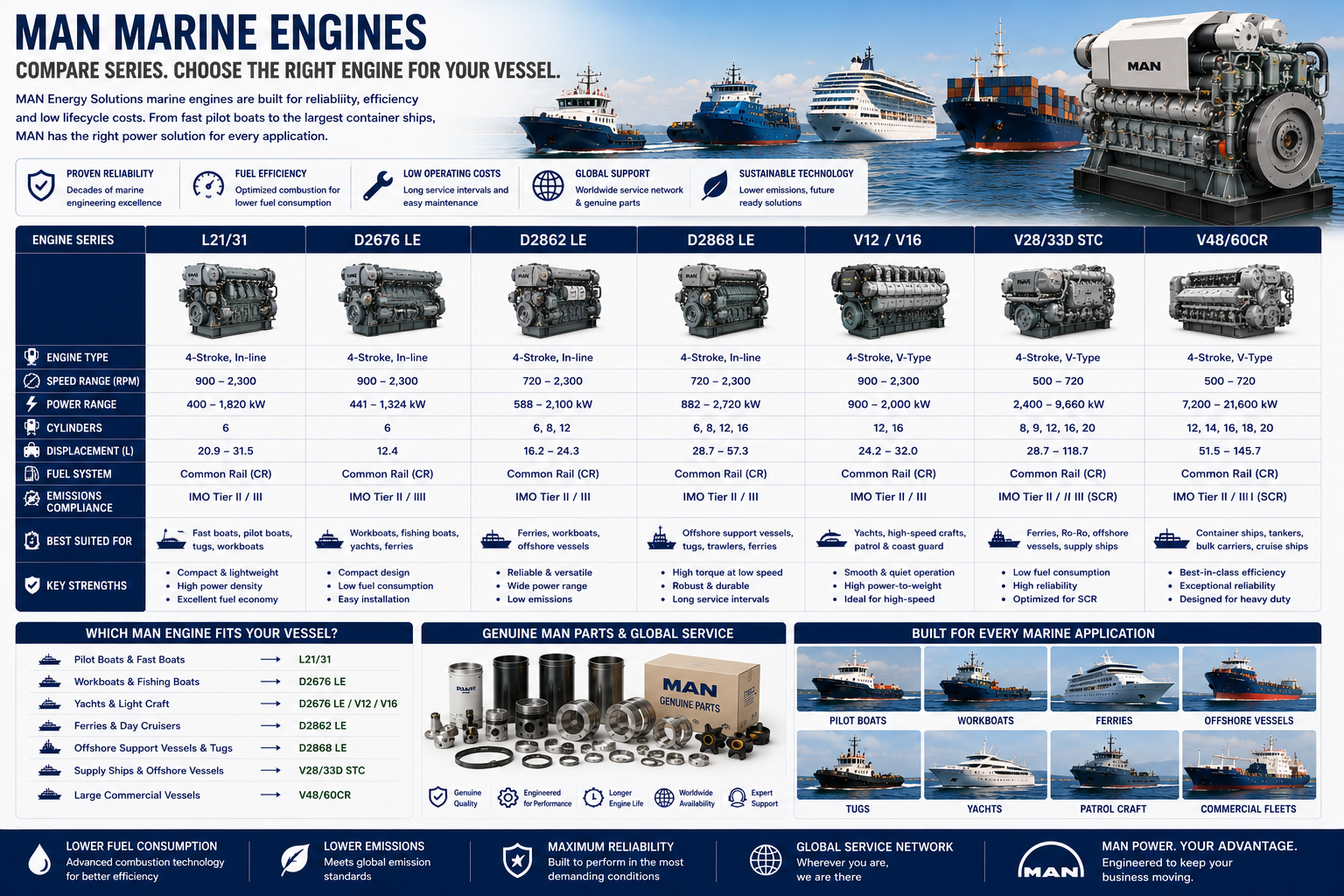
For current MAN marine applications, these are some of the most important engine families to understand:
| MAN EngineConfigurationDisplacementMarine Role | |||
| D2676 | Inline 6 | 12.4 L | Yachts, pilot boats, ferries, fishing and workboats |
| D2868 | V8 | 16.2 L | Yachts and commercial vessels |
| D2862 | V12 | 24.2 L | Large yachts, sportfishing and heavy commercial applications |
| V12X / D3872 family | V12 | 29.6 L | High-performance yachts and larger marine applications |
| E3262 | V12 | 25.8 L | Auxiliary/genset applications |
MAN currently offers yacht engines from 730 hp up to 2,200 hp, while its commercial range uses different ratings based on light-, medium- and heavy-duty operation.
Let's look at why that difference matters.
MAN D2676 Marine Engine: The Compact Inline-Six
The MAN D2676 is a very interesting starting point.
It is a:
12.4-liter
inline six-cylinder
marine diesel.
In current yacht specifications, MAN offers D2676-based engines at:
- i6-730 — 730 hp
- i6-800 — 800 hp
- i6-850 — 850 hp
For commercial applications, however, MAN rates the D2676 very differently depending on operating profile.
D2676 Personality
The Compact Workhorse
Six cylinders, relatively compact dimensions and enough flexibility to serve both fast recreational boats and serious commercial vessels.
Which Boats Suit the MAN D2676?
MAN specifically identifies applications such as:
- Passenger ferries
- Pilot boats
- Fishing boats
- Lifeboats
and the engine family is also suitable for yacht and other workboat applications.
This is one of the advantages of the inline-six layout.
Compared with a V8 or V12, it is relatively narrow and mechanically straightforward.
But Here Is Something Important About the D2676
A D2676 does not always have the same horsepower.
For commercial shipping, MAN currently lists approximately:
Light Duty: 730–850 hp
Medium Duty: 560–650 hp
Heavy Duty: 300–520 hp
The displacement remains 12.4 liters.
So why can the same basic engine family be rated at 850 hp in one vessel and around 500 hp or less in another?
Because the expected workload is completely different.
This Is the Key to Understanding MAN Marine Engines
MAN divides commercial applications into different operating profiles.
LIGHT-DUTY OPERATION
Up to approximately 1,000 operating hours annually
Full-load share up to 20%
Average utilization up to 50%
Examples include patrol, escort, ambulance and police boats.
MEDIUM-DUTY OPERATION
Up to approximately 3,000 operating hours annually
Full-load share up to 50%
Average utilization up to 70%
Examples include passenger ships, ferries and fishing boats.
HEAVY-DUTY OPERATION
Unlimited annual operating hours
Up to 100% full-load share
Up to 100% average utilization
Examples include tugs, trawlers, cargo vessels and other working vessels.
These are MAN's current definitions for its commercial marine engine range.
This explains something marine engineers already understand:
Horsepower alone doesn't tell you how tough an engine application is.
850 hp Doesn't Automatically Mean “Better” Than 500 hp
Imagine two D2676 engines.
One produces approximately:
850 hp
and another is rated:
500 hp.
Someone unfamiliar with marine engines might assume the 850-hp version is automatically superior.
Not necessarily.
The lower-rated engine may be configured for much more demanding continuous operation.
A recreational yacht might run a few hundred hours annually.
A commercial vessel might run thousands.
That is why:
engine rating + operating hours + load profile
must be considered together.
MAN D2868: Moving Into V8 Territory
Next comes the D2868.
This is a:
16.2-liter
90-degree V8
marine diesel.
For current yacht applications, MAN lists:
- V8-1000 — 1,000 hp
- V8-1200 — 1,200 hp
- V8-1300 — 1,300 hp
That makes it a strong choice for larger yachts and sportfishing vessels where high power needs to fit into a relatively compact engine room.
D2868 Personality
The Compact V8
More displacement and considerably more power than the inline-six without immediately moving into V12 dimensions.
Where Does the MAN D2868 Fit?
Think:
- Motor yachts
- Sportfishing boats
- Fast recreational vessels
- Passenger craft
- Commercial vessels
- Patrol craft
- Workboats
Again, the exact rating depends on the application.
MAN's current commercial range lists D2868 output at approximately:
1,000–1,300 hp light duty
800–900 hp medium duty
600–680 hp heavy duty.
That difference is substantial.
D2676 vs. D2868
MAN D2676
12.4 L
Inline six
Narrower package
Excellent for smaller yachts and workboats.
MAN D2868
16.2 L
V8
More cylinders and displacement
Up to approximately 1,300 hp in current yacht specification.
For a vessel needing 600 hp continuously, the engineering decision is very different from a yacht requiring 1,300 hp for short periods.
MAN D2862: The Famous V12
The D2862 is probably one of the most recognizable modern MAN marine engine families.
It uses:
12 cylinders
90-degree V configuration
24.2-liter displacement
with a 128 mm bore and 157 mm stroke.
In yacht applications, MAN currently offers the 24.2-liter V12 at:
- V12-1400
- V12-1550
- V12-1650
- V12-1800
- V12-1900
- V12-2000
That means the same general displacement class covers an enormous range of yacht propulsion requirements.
D2862 Personality
The V12 Powerhouse
Compact for its output, powerful enough for substantial yachts and available in lower-output ratings for hard commercial service.
Which Boats Suit the MAN D2862?
Depending on rating, the D2862 can be found in applications such as:
- Luxury yachts
- Sportfishing boats
- Fast passenger vessels
- Ferries
- Commercial fishing vessels
- Workboats
- Tugs
- Cargo vessels
The last two are particularly important.
A D2862 installed in a yacht and a D2862 installed in a tug may have very different ratings.
A 2,000-hp Yacht Engine Can Become a 1,000-hp Workboat Engine
This is one of the most interesting comparisons in the MAN range.
In current yacht specification, the 24.2-liter V12 reaches:
2,000 hp.
But MAN also offers the D2862 for heavy-duty commercial operation at up to 1,000 hp.
The D2862 LE44x is rated at:
735 kW / 1,000 hp
1,800 rpm
24.24 L
V12
Unlimited annual operating hours at 100% full-load share
MAN specifically identifies applications such as tugs and cargo vessels.
That comparison teaches an important lesson:
Maximum horsepower and maximum durability under continuous load are not the same engineering objective.
What Is Inside a Modern MAN D2862?
The heavy-duty D2862 specification provides a useful picture of the engine architecture.
It includes:
- Common-rail injection
- High-pressure fuel pump
- Electronic engine control
- Turbocharging
- Charge-air cooling
- Plate-type heat exchanger
- Marine cooling system
- Direct-injection four-stroke diesel architecture
The D2862 LE44x also uses a seawater-cooled charge-air cooler.
This means technicians working on modern MAN engines need to understand much more than basic mechanical diesel systems.
Common Rail Changes Marine Engine Maintenance
Older marine diesels were often dominated by mechanical fuel systems.
Modern MAN engines rely heavily on electronic common-rail injection.
That provides precise control of:
- Injection timing
- Injection quantity
- Fuel pressure
- Combustion
But it makes fuel cleanliness extremely important.
Contaminated fuel can damage expensive components such as:
- Injectors
- High-pressure pumps
- Control valves
Good filtration isn't optional.
MAN V12X: The Next Generation
Above the traditional 24.2-liter V12 sits MAN's newer V12X generation.
This is a substantially redesigned platform.
The V12X has approximately:
29.6 liters displacement
and is available in current yacht specifications as:
V12X-2000
and
V12X-2200.
The V12X-2200 produces:
2,200 hp / 1,618 kW
with approximately:
7,350 Nm torque
from:
29.6 liters
of displacement.
V12X Personality
The Yacht Heavyweight
Nearly 30 liters of V12 displacement and 2,200 hp for large, high-performance yacht installations.
Why Did MAN Increase Displacement?
This is an interesting engineering decision.
Instead of simply forcing even more output from the existing 24.2-liter V12, MAN developed the next-generation engine around approximately 30 liters.
More displacement can help provide:
- High torque
- Strong power delivery
- Better output without relying solely on increasing specific engine loading
- Greater flexibility for large-vessel applications
The V12X-2200 produces approximately 74.3 hp per liter according to MAN.
MAN Yacht Engines: Quick Comparison
| EngineCylindersDisplacementCurrent Yacht Output | |||
| i6-730 | 6 | 12.4 L | 730 hp |
| i6-800 | 6 | 12.4 L | 800 hp |
| i6-850 | 6 | 12.4 L | 850 hp |
| V8-1000 | 8 | 16.2 L | 1,000 hp |
| V8-1200 | 8 | 16.2 L | 1,200 hp |
| V8-1300 | 8 | 16.2 L | 1,300 hp |
| V12-1400 | 12 | 24.2 L | 1,400 hp |
| V12-1550 | 12 | 24.2 L | 1,550 hp |
| V12-1650 | 12 | 24.2 L | 1,650 hp |
| V12-1800 | 12 | 24.2 L | 1,800 hp |
| V12-1900 | 12 | 24.2 L | 1,900 hp |
| V12-2000 | 12 | 24.2 L | 2,000 hp |
| V12X-2000 | 12 | 29.6 L | 2,000 hp |
| V12X-2200 | 12 | 29.6 L | 2,200 hp |
These are current MAN yacht-engine specifications.
Which MAN Engine Fits a Yacht?
For yacht applications, a useful progression is:
i6 → V8 → V12 → V12X
as vessel power requirements increase.
Smaller Performance Yacht
Consider the:
i6-730 / i6-800 / i6-850
Medium-to-Large Yacht
The:
V8-1000 / V8-1200 / V8-1300
may become relevant.
Large Performance Yacht
The:
V12-1400 through V12-2000
moves into serious high-output propulsion.
Very Large High-Performance Yacht
The:
V12X-2000 / V12X-2200
represents MAN's newest high-output yacht class.
Of course, vessel designers must consider much more than horsepower, including displacement, propeller requirements, gearbox ratio, engine-room space and expected duty cycle.
Which MAN Engine Fits a Sportfishing Boat?
Sportfishing vessels are an excellent application for high-output MAN engines.
These boats often require:
- Fast acceleration
- High cruise speed
- High power-to-weight ratio
- Strong torque
- Twin-engine reliability
- Compact engine-room packaging
Depending on vessel size, this makes:
D2676
D2868
and
D2862
particularly interesting.
MAN specifically lists sportfishing boats among the operating examples for its yacht-engine rating.
Which MAN Engine Fits a Pilot Boat?
Pilot boats operate differently.
They may make repeated high-speed runs throughout the day.
They need:
- Rapid acceleration
- Reliability
- High cruise speed
- Strong load response
MAN identifies pilot boats as one of the applications for its D2676 workboat engine.
Depending on boat size and annual hours, a D2676 or larger MAN engine may be appropriate.
But the commercial duty rating should always be considered.
Which MAN Engine Fits a Ferry?
Ferries can accumulate substantial operating hours.
This means the highest horsepower rating may not be appropriate.
MAN's medium-duty classification specifically includes:
passenger ships
ferries
and
fishing boats.
Medium-duty engines are designed around higher annual utilization than yacht engines.
That can make a lower horsepower rating the correct engineering choice.
Which MAN Engine Fits a Tug?
Now we enter a completely different operating environment.
Tugs can spend significant time under very high load.
For this kind of work, MAN's heavy-duty ratings become important.
The heavy-duty category allows:
unlimited annual operating hours
and:
100% full-load share.
The D2862 LE44x reaches 1,000 hp in this heavy-duty class, and MAN specifically lists tugs among its applications.
That is a very different engine life from a 2,000-hp yacht version.
MAN Engines for Fishing Vessels
Fishing vessels vary enormously.
A fast sportfishing boat might use a high-output yacht rating.
A commercial fishing vessel operating daily may need medium duty.
A trawler operating continuously under substantial propeller load may require heavy duty.
So asking:
“Which MAN engine is best for a fishing boat?”
isn't enough.
Ask:
Sportfishing or commercial fishing?
How many annual hours?
How much time at full load?
What cruising speed?
What hull type?
Those answers determine the correct engine rating.
MAN Commercial Marine Engine Comparison
MAN's current commercial range illustrates the difference clearly:
| EngineLight DutyMedium DutyHeavy Duty | |||
| D2676 | 730–850 hp | 560–650 hp | 300–520 hp |
| D2868 | 1,000–1,300 hp | 800–900 hp | 600–680 hp |
| D2862 | 1,400–2,000 hp | 1,019–1,450 hp | 749–1,000 hp |
All three families are deliberately derated as operating severity increases.
This table is one of the most useful ways to understand the MAN marine range.
What About MAN Hybrid Marine Propulsion?
MAN is also developing its marine engines as part of integrated hybrid propulsion systems.
The MAN Smart HYBRID Experience can use:
- D2676 inline-six
- D2868 V8
- D2862 V12
diesel engines combined with an electric motor/generator, clutch and gearbox.
MAN states that electric motor/generator modules can provide rated outputs of 200 or 400 kW, with efficiencies of up to 96%.
This opens up different operating strategies.
Why Use Hybrid Propulsion?
Depending on the vessel and installation, hybridization can allow:
- Diesel propulsion
- Electric propulsion
- Generator operation
- Different combinations of diesel and electric power
Potentially useful applications include:
- Passenger vessels
- Ferries
- Workboats
- Vessels with changing load profiles
The key is the duty cycle.
A hybrid system makes most sense when its operating modes actually match how the vessel works.
MAN Hydrogen Dual Fuel
MAN also offers a D2862 hydrogen dual-fuel marine engine for workboats.
The system is based on the V12 D2862 diesel engine.
Hydrogen is introduced into the charge air, while a small quantity of diesel is still used to initiate combustion according to the diesel principle. MAN describes the pilot diesel requirement as approximately 5%.
This shows where commercial marine propulsion is heading:
diesel engines are increasingly becoming part of broader propulsion and energy systems.
MAN Auxiliary and Generator Engines
Not every MAN marine engine drives the propeller.
MAN also supplies marine auxiliary engines.
Current auxiliary families include:
- D2676
- D2862
- D3872
- E3262
with output ranges extending from approximately 190 kW to 960 kW, depending on model and generator frequency.
These engines may support:
- Electrical generation
- Pumps
- Hydraulic systems
- Hotel loads
- Deck equipment
- Emergency or auxiliary systems
Propulsion Engine vs. Auxiliary Engine
This distinction matters when ordering parts.
Two engines may share the same family name but have different:
- Calibration
- Cooling arrangements
- Flywheel housing
- Fuel system configuration
- Exhaust equipment
- Electronic control
- Auxiliary equipment
So:
“MAN D2862”
still may not be enough information for a spare-parts inquiry.
Common MAN Marine Engine Components
Depending on the engine family, common service and overhaul components can include:
- Oil filters
- Fuel filters
- Air filters
- Fuel injectors
- Common-rail components
- High-pressure fuel pumps
- Turbochargers
- Charge-air coolers
- Seawater pumps
- Coolant pumps
- Heat exchangers
- Oil coolers
- Thermostats
- Exhaust manifolds
- Cylinder heads
- Intake valves
- Exhaust valves
- Valve guides
- Pistons
- Piston rings
- Cylinder liners
- Connecting rods
- Main bearings
- Connecting-rod bearings
- Crankshafts
- Camshafts
- Oil pumps
- Gaskets
- O-rings
- Seals
- Sensors
- Electronic control components
- Starters
- Alternators
- Overhaul kits
The exact part should always be verified against the engine's complete identification.
Cooling-System Maintenance on MAN Marine Engines
A high-output marine diesel produces enormous amounts of heat.
The cooling system therefore deserves just as much attention as the fuel system.
The heavy-duty D2862, for example, uses a marine cooling arrangement including a seawater-cooled charge-air cooler and plate-type heat exchanger.
Important areas can include:
- Seawater pump
- Coolant pump
- Heat exchanger
- Charge-air cooler
- Oil cooler
- Thermostats
- Hoses
- Seawater strainers
Reduced seawater flow can create much bigger problems than a simple temperature alarm.
Why Charge-Air Cooler Condition Matters
Turbocharging compresses intake air.
Compressed air becomes hot.
The charge-air cooler removes part of that heat before the air enters the engine.
If cooling efficiency deteriorates because of:
- Fouling
- Scale
- Seawater restriction
- Internal contamination
- Corrosion
intake-air temperature can increase.
That can affect engine performance and thermal loading.
On a highly rated V8 or V12, this deserves serious attention.
Turbocharger Condition
Turbochargers are critical to MAN's high-output marine engines.
A deteriorating turbocharger may contribute to:
- Reduced boost
- Black smoke
- Slow acceleration
- Increased exhaust temperature
- Higher fuel consumption
- Reduced maximum rpm
Inspection should consider:
- Compressor condition
- Turbine condition
- Oil leakage
- Shaft condition
- Deposits
- Boost pressure
Don't replace a turbocharger simply because an engine is smoking.
Confirm the cause first.
Fuel-System Cleanliness
Modern MAN common-rail systems operate at high pressure and close tolerances.
Fuel contamination can be extremely expensive.
Pay attention to:
- Primary filtration
- Secondary filtration
- Water separation
- Tank cleanliness
- Fuel quality
- Water contamination
A relatively inexpensive filter can protect components worth thousands.
Buying a Used MAN Marine Engine
Before purchasing a used:
D2676
D2868
D2862
or V12
ask for more than photographs.
Request:
- Complete engine designation
- Serial number
- Rated horsepower
- Rated rpm
- Engine hours
- Duty rating
- Service history
- Overhaul history
- Cold-start video
- Running video
- Oil pressure
- Coolant temperature
- Fault history
- Injector history
- Turbocharger history
- Cooling-system service history
- Reason for removal
And one question is especially important:
What vessel did the engine come from?
A yacht engine with 2,000 hours and a commercial engine with 20,000 hours have lived very different lives.
Don't Confuse Yacht Rating With Commercial Rating
This deserves repeating.
A MAN D2862 may appear in a yacht at:
2,000 hp
while a heavy-duty D2862 may be rated around:
1,000 hp.
If you are replacing an engine, don't assume:
same displacement = same application.
Check the complete engine designation and rating.
MAN Marine Engine “Personalities”
D2676 — The Compact Six
12.4 liters, six cylinders and flexible enough for yachts, pilot boats, ferries and fishing vessels.
D2868 — The Powerful V8
16.2 liters and up to approximately 1,300 hp in current yacht configuration.
D2862 — The Marine V12
24.2 liters with ratings ranging from heavy-duty commercial power to approximately 2,000 hp in yacht applications.
V12X — The Next Generation
29.6 liters and up to 2,200 hp for large high-performance yachts.
Which MAN Marine Engine Would You Choose?
Yacht
Look at:
D2676 → D2868 → D2862 → V12X
depending on size and performance.
Sportfishing Boat
Commonly relevant:
D2676
D2868
D2862
depending on vessel size.
Pilot Boat
The D2676 is particularly interesting, with larger engines appropriate as power requirements increase.
Ferry
Look carefully at medium-duty ratings rather than simply selecting maximum horsepower.
Commercial Fishing Boat
D2676, D2868 or D2862 may be appropriate depending on size, operating hours and load.
Tug
Look toward heavy-duty commercial ratings, especially where high continuous load is expected.
Cargo or Working Vessel
Again, heavy-duty operation and lifecycle requirements should take priority over maximum power-to-weight ratio.
Marine Engineer Tip
Never order MAN marine engine parts using horsepower alone.
Record:
Complete engine model
Engine serial number
LE designation
Rated horsepower/kW
Rated rpm
Duty rating
Existing part number
Vessel application
Quantity required
For example:
D2862 LE44A
is much more useful than:
“MAN V12 1000 hp.”
Frequently Asked Questions
What Are the Main Current MAN Marine Engine Families?
Important current propulsion families include the D2676 inline-six, D2868 V8, D2862 V12 and newer 29.6-liter V12X/D3872 generation, depending on yacht, commercial or auxiliary application.
How Powerful Is the MAN D2676?
Current yacht versions range from approximately 730 to 850 hp. Commercial ratings are lower for medium- and heavy-duty applications.
How Powerful Is the MAN D2868?
Current yacht versions are rated at approximately 1,000, 1,200 and 1,300 hp.
How Powerful Is the MAN D2862?
Current yacht versions extend from approximately 1,400 to 2,000 hp, while commercial versions use different ratings depending on operating duty.
What Is the MAN V12X?
The V12X is MAN's newer 29.6-liter V12 yacht-engine platform. The V12X-2200 produces 2,200 hp / 1,618 kW.
What Is the Difference Between Light, Medium and Heavy Duty?
MAN bases the categories on annual operating hours, full-load share and average utilization. Heavy-duty operation permits unlimited annual hours and up to 100% full-load operation, while light-duty operation is intended for much lower annual utilization.
Does MAN Make Marine Engines for Tugs?
Yes. MAN specifically identifies tugs among heavy-duty applications, including the D2862 LE44x rated at 1,000 hp.
Does MAN Make Engines for Ferries?
Yes. MAN identifies passenger ships and ferries among its medium-duty commercial applications.
Does MAN Make Hybrid Marine Systems?
Yes. MAN's Smart HYBRID Experience can combine D2676, D2868 or D2862 engines with electric motor/generator units and marine gearboxes.
Does MAN Have a Hydrogen Marine Engine?
Yes. MAN has developed a hydrogen dual-fuel version of the D2862 V12 for workboat applications.
MAN Marine Engine Spare Parts
Alfa Marine Spare Parts can assist with inquiries for MAN marine engine families including:
- MAN D2676 Marine Engine
- MAN D2868 Marine Engine
- MAN D2862 Marine Engine
- MAN V8 Marine Engines
- MAN V12 Marine Engines
- MAN V12X Marine Engines
- MAN commercial marine engines
- MAN yacht engines
- MAN auxiliary engines
- Selected older MAN marine engine models
Depending on engine type and availability, requirements can include genuine, OEM, aftermarket, remanufactured and reconditioned components.
Related MAN Marine Engine Pages
- MAN D2676 Marine Engine Spare Parts
- MAN D2868 Marine Engine Spare Parts
- MAN D2862 Marine Engine Spare Parts
- MAN V8 Marine Engine Spare Parts
- MAN V12 Marine Engine Spare Parts
- MAN V12X Marine Engine Spare Parts
- MAN Yacht Engine Spare Parts
- MAN Commercial Marine Engine Spare Parts
Why Choose Alfa Marine Spare Parts?
MAN engines demonstrate why correct engine identification is essential.
If someone asks for:
“MAN V12 injectors”
we still need more information.
Which V12?
Which D2862 version?
What LE number?
What serial number?
What horsepower rating?
What emission configuration?
What existing injector part number?
Alfa Marine Spare Parts assists shipyards, yacht engineers, marine engineers, chief engineers, technical superintendents, workshops, fleet operators and commercial vessel operators with MAN marine spare-parts inquiries.
The objective is simple:
identify the exact engine before identifying the exact part.
Worldwide MAN Marine Spare Parts Supply
Alfa Marine Spare Parts supports customers operating:
- Luxury yachts
- Sportfishing vessels
- Pilot boats
- Patrol craft
- Passenger vessels
- Ferries
- Fishing vessels
- Tugs
- Workboats
- Cargo vessels
- Commercial fleets
- Marine service companies
- Shipyards
Parts can be sourced for customers across major marine markets and seaports in Europe, the Middle East, North America, Africa and other international shipping regions.
Contact Alfa Marine Spare Parts
Email: request@alfamarinespareparts.com
Website: Alfa Marine Spare Parts
For a MAN marine engine inquiry, send:
engine model + serial number + LE designation + existing part number + quantity + photographs where available.
One Final Thought
MAN marine engines are a perfect example of why horsepower should never be considered by itself.
A 12.4-liter D2676 can be a compact high-output yacht engine or a lower-rated commercial workhorse.
The 16.2-liter D2868 moves into V8 territory and reaches around 1,300 hp in yacht applications.
The 24.2-liter D2862 is even more interesting: MAN currently offers the family up to approximately 2,000 hp for yachts, yet heavy-duty versions are deliberately rated much lower for vessels expected to operate continuously under demanding loads.
Then there is the V12X, with 29.6 liters and up to 2,200 hp, representing MAN's newer generation of high-performance yacht propulsion.
So when somebody asks:
“Which MAN marine engine is best?”
the first question should be:
For a yacht, ferry, fishing boat, pilot boat, tug—or something else?
Because with MAN marine engines, the vessel's job determines not only which engine you need, but how that engine should be rated.