
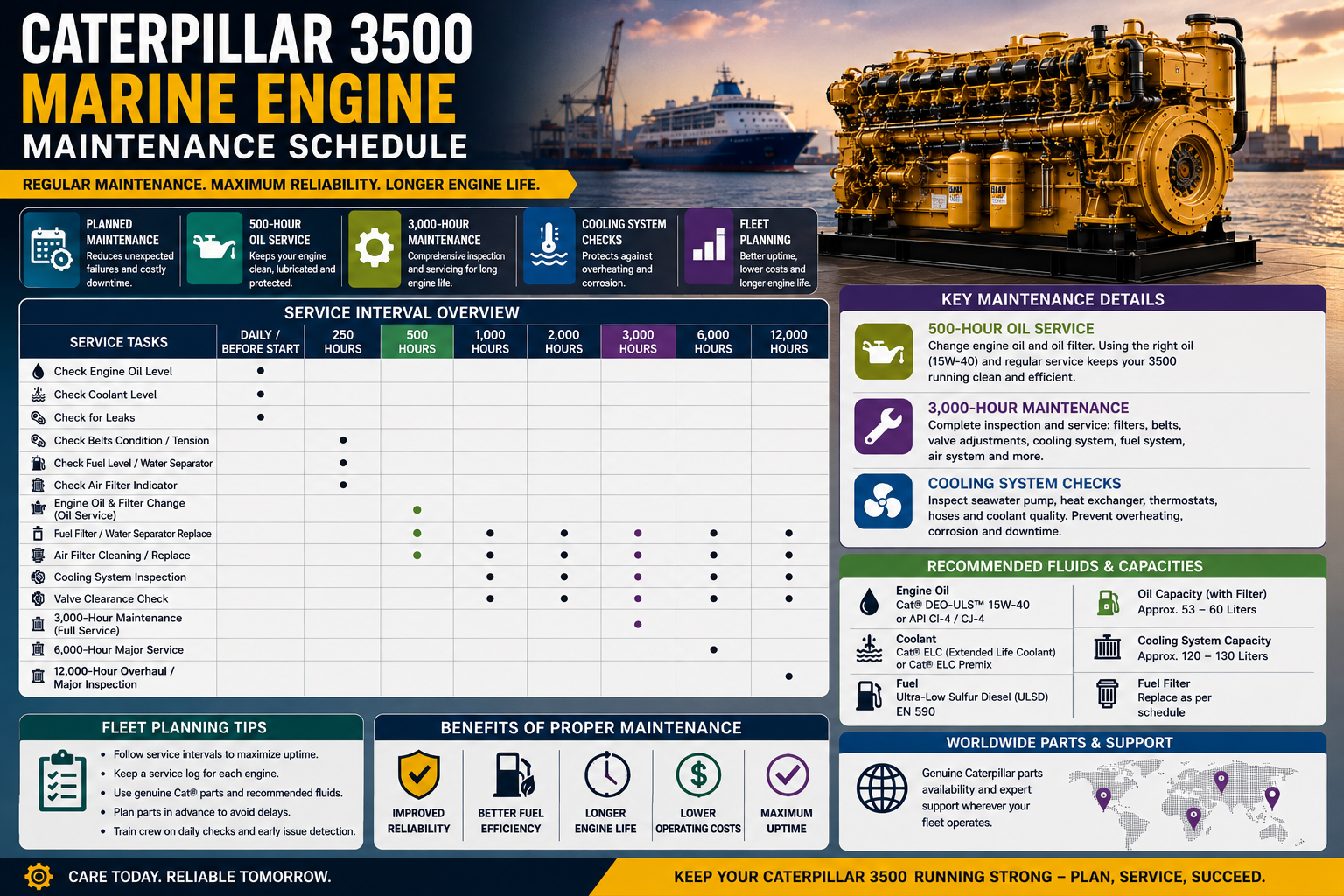
Caterpillar 3500 Marine Engine Maintenance Schedule: 3508, 3512 & 3516 Series Guide
When someone in an engine room says:
"We have a Cat 3500."
That actually doesn't tell us enough.
The Caterpillar 3500 family includes several major marine engine configurations and generations.
Among the important marine versions are:
- Caterpillar 3508
- Caterpillar 3508B
- Caterpillar 3508C
- Caterpillar 3512
- Caterpillar 3512B
- Caterpillar 3512C
- Caterpillar 3512E
- Caterpillar 3516
- Caterpillar 3516B
- Caterpillar 3516C
- Caterpillar 3516E
Some variants have been used for propulsion, others for auxiliary power, generator sets, offshore applications, or multiple duties.
For example, Caterpillar currently markets the 3512C, 3512E, 3516C and 3516E in marine applications, while Caterpillar's parts information continues to recognize older 3508B, 3512, 3512B, 3516 and 3516B marine installations.
That is why a proper maintenance plan should never be based only on the words:
"3500 Series."
You need the exact engine.
Understanding the Caterpillar 3500 Marine Family
The numbers themselves provide an easy starting point.
Caterpillar 3508
8-cylinder V engine
Caterpillar 3512
12-cylinder V engine
Caterpillar 3516
16-cylinder V engine
Then you have the different generations—such as B, C and E—which incorporate changes in fuel systems, electronics, emissions systems, ratings and other engine technologies.
The maintenance philosophy may be similar across the family, but that does not mean every service task, part number or interval can automatically be transferred from one model to another.
Which Caterpillar 3500 Marine Engines Does This Guide Cover?
| Engine FamilyImportant Marine VariantsTypical Marine Role | ||
| 3508 | 3508, 3508B, 3508C | Propulsion, auxiliary/generator and offshore applications depending on version |
| 3512 | 3512, 3512B, 3512C, 3512E | Propulsion, auxiliary, generator and offshore applications |
| 3516 | 3516, 3516B, 3516C, 3516E | Heavy marine propulsion, auxiliary, generator and offshore applications |
For example, Caterpillar currently describes the 3512 and 3516 as heavy-duty 3500 Series propulsion engines for larger fishing vessels.
The 3500 family has also had an important role in offshore power. Caterpillar lists 3508B, 3508C, 3512B, 3512C, 3516B and 3516C among its offshore drilling and production generator platforms.
Converting Caterpillar 3500 Service Hours Into Months
For easier fleet planning, we'll use the same system as our other maintenance guides.
Low Usage
3,000 operating hours per year
High Usage
5,000 operating hours per year
Calculation:
Maintenance Hours ÷ Annual Operating Hours × 12 = Approximate Months
This gives us:
| Operating HoursAt 3,000 h/yearAt 5,000 h/year | ||
| 50 h | 0.2 month | 0.12 month |
| 250 h | 1 month | 0.6 month |
| 500 h | 2 months | 1.2 months |
| 1,000 h | 4 months | 2.4 months |
| 2,000 h | 8 months | 4.8 months |
| 3,000 h | 12 months | 7.2 months |
| 4,000 h | 16 months | 9.6 months |
| 6,000 h | 24 months | 14.4 months |
These are calendar conversions, not a claim that every 3500 model requires the same task at each interval.
Caterpillar's older dedicated 3508/3512/3516 marine maintenance documentation includes daily maintenance and maintenance levels at 50, 250, 1,000, 2,000, 3,000, 4,000 and 6,000 service hours, along with top-overhaul requirements.
Exact applicability must be checked against your engine's Operation & Maintenance Manual.
Daily Caterpillar 3500 Marine Checks
🟦 DAILY / BEFORE OPERATION
Interval: Every operating day
Applies broadly to: 3508 / 3512 / 3516 families
Check:
- Engine oil level
- Coolant level
- Fuel system
- Fuel/water separation
- Engine leaks
- Coolant leaks
- Exhaust condition
- Instrument readings
- Engine alarms
- Unusual vibration
- Unusual noise
Engineer Focus: Look for changes rather than waiting for an alarm.
A large 3500 engine rarely develops every problem overnight.
Often there are earlier clues.
A new vibration.
A small coolant leak.
Higher exhaust temperature on one cylinder.
Different oil consumption.
Slightly lower oil pressure.
These observations belong in the engine log.
50-Hour Maintenance
🟦 50 SERVICE HOURS
Low Usage: approximately 0.2 month
High Usage: approximately 0.12 month
Historical 3500 marine schedule: Contains maintenance tasks at this interval.
Marine Focus: Frequent inspections of systems exposed to the marine environment.
Important: Check the exact 3508/3512/3516 OMM for the applicable task list.
The historical Caterpillar 3500 marine maintenance documentation specifically includes a 50-hour maintenance level.
For engines accumulating thousands of hours annually, this effectively becomes part of routine engine-room maintenance.
250-Hour Maintenance
🟩 250 SERVICE HOURS
Low Usage: approximately 1 month
High Usage: approximately 0.6 month
Historical 3500 marine schedule: 250-hour maintenance level
Planning Focus:
- Lubrication condition
- Filtration
- Fuel system
- Cooling system
- Belts/hoses where applicable
- General engine inspection
Engineer Focus: Use this point for condition monitoring as well as scheduled work.
At 5,000 annual hours, 250 hours arrive in only around 18 days.
That tells fleet managers something important:
Small recurring maintenance requirements can create a surprisingly large annual demand for filters, oils, seals and consumables.
3500 Series Oil Service: Don't Assume One Interval
This is particularly important.
Modern 3500 variants can have different oil-sump configurations.
For example, Caterpillar's current 3512C Marine Propulsion Engine documentation lists:
250-hour sump
500-hour sump
1,000-hour sump
options.
So:
🟨 ENGINE OIL INTERVAL
Do NOT write: "Every Caterpillar 3500 gets an oil change at 250/500/1,000 hours."
Correct approach: Identify the exact engine and sump configuration.
Check:
- 3508 / 3512 / 3516
- Generation
- Serial number
- Oil sump
- Duty
- Oil specification
- Caterpillar OMM
Engineer Focus: Sump configuration belongs in the maintenance record.
This is exactly why generic maintenance schedules can become dangerous.
If Your Oil Interval Is 250 Hours
🟩 250-HOUR OIL INTERVAL
Low Usage: approximately 1 month
High Usage: approximately 0.6 month
Annual services at 5,000 h/year: approximately 20
Planning Focus: Oil inventory and filter stock become significant.
If Your Oil Interval Is 500 Hours
🟩 500-HOUR OIL INTERVAL
Low Usage: approximately 2 months
High Usage: approximately 1.2 months
Annual services at 5,000 h/year: approximately 10
If Your Oil Interval Is 1,000 Hours
🟩 1,000-HOUR OIL INTERVAL
Low Usage: approximately 4 months
High Usage: approximately 2.4 months
Annual services at 5,000 h/year: approximately 5
These boxes make it easy to see why identifying the sump is important for purchasing.
Oil Analysis on a Caterpillar 3500
With engines this size, oil analysis should be viewed as an engineering tool rather than simply paperwork.
Track trends in:
- Iron
- Copper
- Lead where applicable
- Aluminium
- Chromium
- Silicon
- Fuel dilution
- Water
- Coolant contamination
- Viscosity
- Oxidation
Do not look at only one report.
Compare the results over time.
If iron gradually rises over five consecutive samples, that trend tells you much more than whether the most recent sample remains inside a generic limit.
Fuel-System Maintenance
Modern 3500 generations can use electronically controlled unit-injection systems.
For example, Caterpillar's 3512C uses electronically controlled unit injectors and duplex fuel filters.
🟨 FUEL-SYSTEM MAINTENANCE
Interval: Verify by exact engine model and OMM
Monitor:
- Primary filtration
- Secondary filtration
- Water contamination
- Fuel pressure
- Fuel transfer pump
- Injector performance
- Fuel consumption
- Exhaust-temperature balance
Engineer Focus: Protect the injectors by controlling contamination before it reaches them.
1,000-Hour Maintenance
🟦 1,000 SERVICE HOURS
Low Usage: approximately 4 months
High Usage: approximately 2.4 months
Historical Caterpillar 3500 marine schedule: Includes a 1,000-hour maintenance level.
Planning Focus: Medium-term engine inspection and condition assessment.
At 5,000 hours per year, this maintenance point arrives about five times annually.
This is where fleet maintenance stops being occasional work and becomes continuous planning.
Turbocharger Condition
The turbocharging system deserves careful trending across the entire 3500 family.
Caterpillar's current 3516C, for example, uses a standard marine twin-turbocharger configuration.
🟦 TURBOCHARGER INSPECTION
Monitor:
- Boost pressure
- Compressor cleanliness
- Turbine deposits
- Oil leakage
- Shaft condition
- Bearing noise
- Exhaust temperature
- Acceleration response
Engineer Focus: A turbocharger can deteriorate gradually without immediately failing.
Don't wait until the engine produces heavy smoke or loses significant power.
Aftercooler System
The charge-air system is another important part of 3500 maintenance.
For example, Caterpillar's current 3512C uses a separate-circuit aftercooler core with corrosion-resistant coating on the air side.
🟦 AFTERCOOLER
Inspect:
- Core cleanliness
- Air-side contamination
- Cooling performance
- Coolant circulation
- Leakage
- Charge-air temperature
Engineer Focus: Poor aftercooling can look like a fuel or turbocharger problem.
Cooling System
A 3500 engine rejects a large amount of heat.
Cooling-system condition therefore deserves the same attention as lubrication.
The 3512C, for example, incorporates an oil cooler, thermostats, a gear-driven centrifugal jacket-water pump and an auxiliary freshwater pump in its cooling arrangement.
🟦 COOLING-SYSTEM INSPECTION
Monitor:
- Jacket-water temperature
- Coolant level
- Coolant chemistry
- Jacket-water pump
- Auxiliary water pump
- Oil cooler
- Heat exchanger where fitted
- Aftercooler circuit
- Hoses and connections
Engineer Focus: Compare temperature trends at equivalent engine loads.
2,000-Hour Maintenance
🟧 2,000 SERVICE HOURS
Low Usage: approximately 8 months
High Usage: approximately 4.8 months
Historical 3500 marine schedule: Contains a 2,000-hour maintenance level.
Planning Level: Significant scheduled inspection.
Engineer Focus: Begin preparing parts well before reaching the interval.
3,000-Hour Maintenance
🟥 3,000 SERVICE HOURS
Low Usage: approximately 12 months
High Usage: approximately 7.2 months
Historical 3508 / 3512 / 3516 marine schedule: Includes a 3,000-hour maintenance level.
Planning Focus: Larger scheduled maintenance package.
At 5,000 annual hours, 3,000 hours arrive in just over seven months.
For a commercial vessel, that means a major service event may need to be budgeted, purchased and scheduled well inside a single operating year.
4,000-Hour Maintenance
🟥 4,000 SERVICE HOURS
Low Usage: approximately 16 months
High Usage: approximately 9.6 months
Historical Caterpillar 3500 marine schedule: Includes a 4,000-hour maintenance level.
Engineer Focus: Review component condition and maintenance history before automatically replacing expensive components.
6,000-Hour Maintenance
🟥 6,000 SERVICE HOURS
Low Usage: approximately 24 months
High Usage: approximately 14.4 months
Historical Caterpillar 3500 marine schedule: Includes a 6,000-hour maintenance level.
Fleet Focus: Long-lead parts should be identified well before this point.
On a heavily utilized engine, 6,000 hours can arrive in less than a year and a half.
That is not far away when parts may need international sourcing, machining or rebuilding.
Top Overhaul
The historical Caterpillar 3508/3512/3516 marine schedule also includes a top-overhaul maintenance category.
🟥 TOP OVERHAUL
Timing: Confirm against exact engine configuration and Caterpillar OMM
Typical areas requiring assessment may include:
- Cylinder heads
- Intake valves
- Exhaust valves
- Valve guides
- Valve seats
- Valve springs
- Fuel injectors
- Rocker gear
- Turbocharger condition
- Aftercooler condition
- Gaskets and seals
Engineer Focus: Use measurements and inspection results to establish the actual parts requirement.
A top overhaul does not necessarily mean rebuilding the entire engine.
The focus is primarily on the upper engine components.
Major Overhaul Planning
A complete overhaul moves much deeper into the engine.
🟥 MAJOR OVERHAUL — 3500 SERIES
Interval: Engine-, rating-, duty- and condition-specific
Possible components:
- Cylinder heads
- Fuel injectors
- Pistons
- Piston rings
- Cylinder liners
- Connecting rods
- Connecting-rod bearings
- Main bearings
- Crankshaft
- Camshafts
- Camshaft bearings
- Turbochargers
- Oil pump
- Water pumps
- Oil cooler
- Aftercooler
- Heat exchanger
- Gaskets
- O-rings
- Seals
Engineer Focus: Do not order the entire overhaul package using only "3516" as the identification.
The serial number and arrangement are essential.
Caterpillar 3508 Marine Engine
The 3508 is the eight-cylinder member of the family.
Older 3508 engines remain installed in marine and offshore equipment, and Caterpillar's current parts ecosystem continues to identify 3508B in marine and auxiliary applications.
Important maintenance areas include:
- Cylinder heads
- Injectors
- Turbocharging
- Cooling
- Lubrication
- Main and rod bearings
- Pistons and liners
- Crankshaft
- Fuel system
Caterpillar 3508B Marine Engine
The 3508B remains especially relevant in offshore and auxiliary installations.
Caterpillar currently lists the 3508B among its offshore drilling and production generator platforms and describes these 3500 systems as serving main, essential-service and emergency power aboard offshore vessels and platforms.
Caterpillar 3512 Marine Engine
Moving to twelve cylinders brings the 3512.
This engine family has seen extensive service in:
- Commercial vessels
- Fishing vessels
- Tugboats
- Workboats
- Offshore applications
- Generator installations
Caterpillar 3512B Marine Engine
The 3512B is another widely installed 3500-generation engine.
Even where a particular version is no longer a headline new-production propulsion engine, maintenance demand continues because engines remain operational for many years.
For spare-parts sourcing, never assume a 3512B part automatically fits a 3512C.
Caterpillar 3512C Marine Engine
The 3512C remains a current Caterpillar commercial propulsion offering.
Caterpillar describes it as a hard-working marine propulsion engine with a wide range of ratings, electronic injection control and no required aftertreatment for the listed IMO II/China Stage II configuration.
Its equipment includes:
- Dual Caterpillar A6 electronic engine control
- Electronic unit injectors
- Duplex fuel filters
- Separate-circuit aftercooling
- Gear-type oil pump
- Jacket-water pump
- Auxiliary freshwater pump
- Multiple sump options
That last point is particularly important for maintenance scheduling.
Caterpillar 3512E Marine Engine
The 3512E represents a newer generation of the 3500 platform.
Caterpillar currently offers the 3512E marine propulsion engine with ratings designed to meet U.S. EPA Tier 4 Final and IMO III requirements using an SCR aftertreatment solution.
That means maintenance planning extends beyond the basic mechanical engine.
Depending on configuration, technicians also need to understand:
- Electronic controls
- Sensors
- Emissions systems
- SCR components
- DEF system
- Wiring
- Monitoring systems
This is a good example of why an old 3512 maintenance checklist should not simply be copied to a 3512E.
Caterpillar 3516 Marine Engine
The 3516 is the 16-cylinder member of the 3500 family and has been widely used where significantly more power is required.
Maintenance planning becomes particularly important because the engine has more:
- Cylinder heads
- Pistons
- Liners
- Connecting rods
- Injectors
- Valves
than the 3508 or 3512.
A complete overhaul package can therefore represent a major procurement project.
Caterpillar 3516B Marine Engine
The 3516B remains relevant in the installed marine and offshore fleet.
Caterpillar's current parts information continues to associate 3516B with marine-engine and marine-auxiliary applications.
When sourcing parts, identify it specifically as:
3516B
not simply:
3516
Caterpillar 3516C Marine Engine
The 3516C remains a current Caterpillar commercial propulsion engine.
Caterpillar positions it for hard-working applications such as tugs, government vessels and other workboats, and describes the marine version as using a standard twin-turbocharger configuration.
That makes:
- Turbocharger condition
- Charge-air cooling
- Fuel injection
- Exhaust temperature
- Cooling performance
particularly important areas for trend monitoring.
Caterpillar 3516E Marine Engine
The 3516E is among Caterpillar's current large marine propulsion engines.
Caterpillar lists the standard 3516E commercial propulsion range at 2,501–3,386 bhp (1,865–2,525 bkW) with ratings at 1,600–1,800 rpm, meeting U.S. EPA Tier 4 Final and IMO III requirements.
There is also a 3516E High Output version. Caterpillar says this version produces 19% more rated power than the previous 3516E while improving acceleration and reducing ambient heat rejection.
So even saying:
"3516E"
may require another question:
Standard or High Output?
Quick Caterpillar 3500 Family Reference
⚙️ 3500 MARINE ENGINE IDENTIFICATION
3508 → 8-cylinder
3512 → 12-cylinder
3516 → 16-cylinder
B / C / E → Different generations/configurations
Never order major components using only "3500 Series."
Quick Caterpillar 3500 Maintenance Planning Block
⚙️ OPERATING HOURS → APPROXIMATE MONTHS
| Hours3,000 h/year5,000 h/year | ||
| 50 | 0.2 mo | 0.12 mo |
| 250 | 1 mo | 0.6 mo |
| 500 | 2 mo | 1.2 mo |
| 1,000 | 4 mo | 2.4 mo |
| 2,000 | 8 mo | 4.8 mo |
| 3,000 | 12 mo | 7.2 mo |
| 4,000 | 16 mo | 9.6 mo |
| 6,000 | 24 mo | 14.4 mo |
Important: These month figures are planning conversions. Exact tasks and intervals must come from the applicable Caterpillar OMM for the particular 3508, 3512 or 3516 configuration.
Real Engine-Room Example
Imagine a fleet operating several Caterpillar 3500 engines.
One vessel has:
3512B
Another:
3512C
And a newer vessel:
3512E
A purchasing department could easily think:
"They're all Caterpillar 3512 engines. We can use one maintenance list."
That is exactly what should be avoided.
The fundamental engine architecture may be related, but the generations can differ in:
- Fuel injection
- Electronics
- Emissions equipment
- Sensors
- Turbocharging
- Cooling
- Lubrication arrangements
- Part numbers
- Service requirements
The engine model should be the beginning of identification—not the end.
Engineer's Toolbox
CATERPILLAR 3500 FLEET MAINTENANCE RECORD
Vessel: __________________
Engine: 3508 / 3512 / 3516
Generation: Standard / B / C / E
Complete Model: __________________
Serial Number: __________________
Arrangement Number: __________________
Propulsion / Auxiliary / Generator: __________________
Rating: __________________
Oil Sump: __________________
Cooling Configuration: __________________
Current Hours: __________________
Annual Operating Hours: __________________
Next Oil Service: __________________
Next Major Scheduled Service: __________________
Last Oil Analysis: __________________
Last Coolant Analysis: __________________
Turbocharger Condition: __________________
Cylinder Head History: __________________
Parts Ordered: __________________
Open Technical Issues: __________________
Marine Engineer Tip
When working with a Caterpillar 3500 engine, don't write:
"Main engine — 3516."
Write something closer to:
"CAT 3516C Marine Propulsion — Serial No. ______ — Arrangement ______ — Current Hours ______."
That information makes future maintenance records much more useful and parts identification considerably safer.
Caterpillar 3500 Marine Spare Parts
Alfa Marine Spare Parts can assist with sourcing components for the 3508, 3512 and 3516 families, including:
- Cylinder heads
- Cylinder-head components
- Intake valves
- Exhaust valves
- Valve guides
- Valve seats
- Fuel injectors
- Fuel pumps
- Fuel filters
- Oil filters
- Air filters
- Turbochargers
- Aftercooler components
- Heat exchangers
- Jacket-water pumps
- Seawater pumps
- Oil pumps
- Pistons
- Piston rings
- Cylinder liners
- Connecting rods
- Connecting-rod bearings
- Main bearings
- Crankshafts
- Camshafts
- Vibration dampers
- Thermostats
- Sensors
- Gasket sets
- O-rings
- Seals
- Overhaul kits
Related Caterpillar 3500 Engine Pages
Caterpillar 3508 Marine Engine Spare Parts
Caterpillar 3508B Marine Engine Spare Parts
Caterpillar 3508C Marine Engine Spare Parts
Caterpillar 3512 Marine Engine Spare Parts
Caterpillar 3512B Marine Engine Spare Parts
Caterpillar 3512C Marine Engine Spare Parts
Caterpillar 3512E Marine Engine Spare Parts
Caterpillar 3516 Marine Engine Spare Parts
Caterpillar 3516B Marine Engine Spare Parts
Caterpillar 3516C Marine Engine Spare Parts
Caterpillar 3516E Marine Engine Spare Parts
Frequently Asked Questions
What engines belong to the Caterpillar 3500 marine family?
The core family includes the 3508, 3512 and 3516, with later generations including variants such as 3508B/C, 3512B/C/E and 3516B/C/E. Caterpillar's historical marine maintenance documentation specifically groups the 3508, 3512 and 3516 together.
What is the difference between 3508, 3512 and 3516?
The basic distinction is cylinder count:
3508 = V8
3512 = V12
3516 = V16
Generation and configuration create further differences.
Can I use the same maintenance schedule for every 3500 engine?
No. The maintenance philosophy may be similar, but the exact interval and task must be checked against the engine model, serial number, configuration and Caterpillar OMM.
Does every Caterpillar 3500 have a 500-hour oil interval?
No. Caterpillar's current 3512C documentation alone demonstrates why assumptions are risky: it lists 250-, 500- and 1,000-hour sump options.
Is the Caterpillar 3512C still used for marine propulsion?
Yes. Caterpillar currently lists the 3512C as a commercial marine propulsion engine.
Is the Caterpillar 3516C still available as a marine engine?
Yes. Caterpillar currently markets the 3516C for commercial propulsion, including demanding tug, government and workboat applications.
What is different about the 3512E and 3516E?
The E-generation engines incorporate newer electronic and emissions technologies. Current Caterpillar 3512E and 3516E marine propulsion versions are offered for U.S. EPA Tier 4 Final and IMO III applications with SCR aftertreatment.
Is there a higher-output 3516E?
Yes. Caterpillar offers a 3516E High Output version and states that it delivers 19% more rated power than the previous 3516E.
Worldwide Caterpillar 3500 Marine Spare Parts Supply
Alfa Marine Spare Parts supports shipyards, ship repairers, marine engineers, chief engineers, technical superintendents, fleet operators, commercial fishing companies, offshore operators, government fleets, maritime contractors, boat builders, marine service companies and marine equipment distributors.
For accurate identification, send:
Complete engine model + serial number + arrangement number + existing part number + quantity + photographs where available.
This is particularly important for the 3500 family because a component for a 3512B should never automatically be assumed to fit a 3512C or 3512E.
Browse Our Complete Catalog
Alfa Marine Spare Parts
Browse Alfa Marine Spare Parts
Contact Alfa Marine Spare Parts
Email: request@alfamarinespareparts.com
Alfa Marine Spare Parts
For Caterpillar 3508, 3512 and 3516 marine engines, Alfa Marine Spare Parts can assist with genuine, OEM, aftermarket, remanufactured and reconditioned components depending on application and availability.
One Final Thought
The Caterpillar 3500 Marine Engine Maintenance Schedule should never be treated as one universal checklist.
The family spans multiple engines and generations.
A 3508B, 3512C and 3516E may all belong to the 3500 family, but they are not the same engine.
The most useful maintenance question therefore isn't:
"When do we service our Caterpillar 3500?"
It is:
"Which 3500 engine and generation do we have, what does its specific Caterpillar maintenance schedule require next, and do we already have the correct parts ready?"