
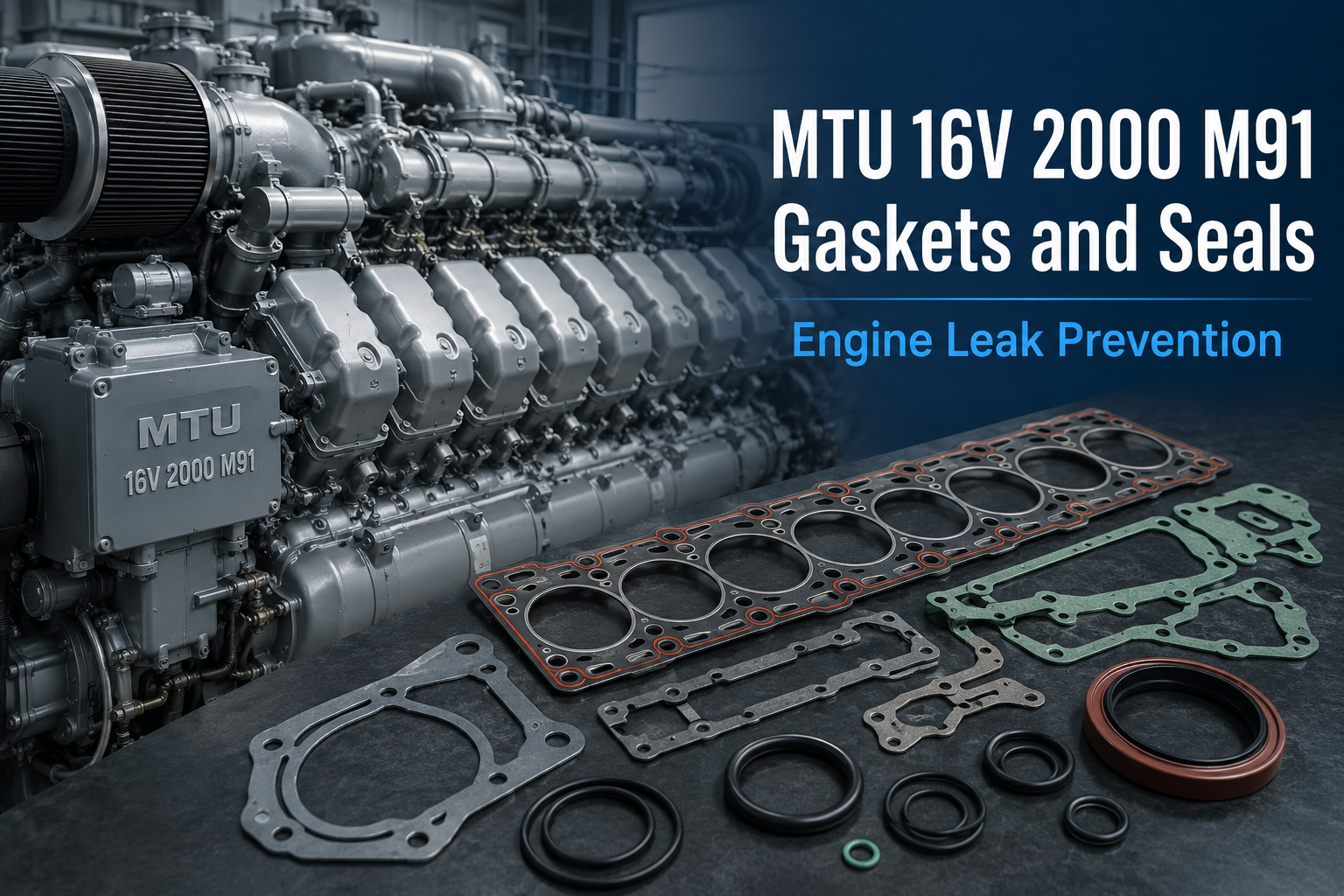
MTU 16V 2000 M91 Gaskets and Seals: Small Parts That Protect a Very Expensive Marine Engine
When an MTU 16V 2000 M91 marine engine is running correctly, engineers naturally pay attention to oil pressure, coolant temperature, exhaust temperature, turbocharger performance and engine load.
But some of the components protecting all of those systems cost only a fraction of the major parts they protect.
We're talking about gaskets and seals.
A small O-ring that has hardened, a cylinder-head-cover gasket that has lost compression, or a sealing ring damaged during assembly can eventually result in oil leakage, coolant loss, contamination or pressure loss.
That's why MTU 16V 2000 M91 Gaskets and Seals deserve much more attention than simply replacing them when something starts leaking.
Why Are Gaskets and Seals So Important on the MTU 16V 2000 M91?
The 16V 2000 M91 is a high-performance marine diesel engine. In marine installations, it is commonly found in large yachts and other high-performance applications; contemporary vessel specifications show installations rated around 2,000 hp.
Inside and around such an engine are several different fluids and gases that must remain separated:
- Lubricating oil
- Engine coolant
- Fuel
- Intake air
- Exhaust gases
- Combustion gases
Gaskets, O-rings and other sealing elements create those boundaries.
When one boundary begins to fail, the first symptom may only be a stain.
But that stain can be valuable information.
Engineering Lesson: Don't Clean a Leak Before Understanding It
This is one of the simplest but most useful engine-room habits.
Imagine you find a small amount of oil on the side of your MTU 16V 2000 M91.
The instinct is often:
Clean it.
That's fine—but inspect it first.
Ask:
Where is the highest wet point?
Oil travels downward.
Airflow can move it sideways.
Engine vibration can spread it across several components.
The component covered in oil is therefore not necessarily the component leaking.
Before cleaning:
- Find the highest visible wet area.
- Check the sealing joint above it.
- Look for oil around fasteners.
- Inspect hoses and connections.
- Clean the area.
- Run the engine.
- Reinspect with good lighting.
This simple approach can prevent unnecessary component replacement.
Chief Engineer's Notebook
"The location of the oil isn't always the location of the leak."
That is especially useful on compact marine installations where multiple components are positioned close together.
Important MTU 16V 2000 M91 Gasket and Seal Part Numbers
Part numbers must always be checked against the engine serial number and exact configuration before ordering.
However, MTU parts-catalog documentation gives us some useful examples.
MTU 5410160421 – Gasket
Part Number: 5410160421
MTU parts-catalog material identifies 5410160421 specifically as a gasket for the 16V 2000 M91 in the cylinder-head-cover assembly.
This is exactly the kind of inexpensive sealing component that deserves attention whenever the corresponding cover is removed.
Reusing a compressed gasket to save a small amount of money makes little sense when another leak could require the engine to be opened again.
MTU 700429036001 – O-Ring
Part Number: 700429036001
The same MTU catalog material lists 700429036001 as an O-ring in the cylinder-head-cover arrangement, with a listed dimension of 36 × 5.
An O-ring may look perfectly serviceable when removed.
But appearance alone doesn't tell you:
- How much elasticity remains.
- Whether compression set has developed.
- Whether heat has hardened the material.
- Whether microscopic surface damage exists.
For that reason, seals disturbed during major maintenance deserve careful consideration before reuse.
MTU 5410110059 – Sealing Ring
Part Number: 5410110059
MTU 16V2000 family parts documentation lists 5410110059 as a sealing ring in the crankcase/cylinder-liner arrangement.
This illustrates an important point:
Not every engine seal is preventing an external oil leak.
Some sealing elements maintain separation inside the engine, where failure can potentially be much more serious.
MTU 0229974948 – Lower Liner Sealing Ring
Part Number: 0229974948
MTU 16V2000 parts documentation also identifies 0229974948 as a lower cylinder-liner sealing ring.
Cylinder-liner sealing deserves particular attention during overhaul because proper sealing around the liner is critical to maintaining separation between engine systems.
A technician should therefore inspect not just the new seal, but also:
- Seal grooves
- Liner surfaces
- Crankcase seating areas
- Corrosion
- Deposits
- Installation damage
A perfect new seal installed against a damaged sealing surface may still leak.
MTU 007603014102 – Sealing Washer
Another example from MTU 16V2000 parts documentation is:
007603014102 – sealing washer
The catalog identifies it as a copper sealing washer used with a threaded plug in the crankcase arrangement.
This demonstrates how many different sealing technologies exist on one engine.
It's not just "gaskets."
You may encounter:
- O-rings
- Flat gaskets
- Copper sealing washers
- Liner sealing rings
- Shaft seals
- Sealing caps
- Specialized molded seals
Each has a different job.
Important Part-Number Reminder
The examples above should not be treated as a universal shopping list for every 16V 2000 M91.
MTU engine configurations and parts revisions can differ.
When requesting parts, provide:
Engine model: MTU 16V 2000 M91
Engine serial number: ______
Existing part number: ______
Component location: ______
Photo: Recommended
That allows the supplier to confirm compatibility before shipping.
Why Do Marine Engine Seals Start Leaking?
Heat
Repeated heating and cooling gradually changes sealing materials.
A gasket that was flexible when installed can become hard after years of service.
Compression Set
O-rings and elastomeric seals remain compressed for long periods.
Eventually they may no longer return to their original shape.
Vibration
Marine engines continuously experience vibration.
Even minor movement between mating surfaces can affect long-term sealing.
Corrosion
The marine environment introduces:
- Salt
- Moisture
- Humidity
- Condensation
Corrosion around a sealing surface can eventually create a leakage path.
Incorrect Installation
Many premature seal failures begin during installation.
Typical causes include:
- Twisted O-rings
- Pinched seals
- Dirty grooves
- Incorrect lubrication during assembly
- Damaged sealing surfaces
- Incorrect tightening sequence
- Incorrect torque
- Reusing old seals
Engine Room Reality: A New Gasket Cannot Repair a Bad Surface
This deserves its own section.
Suppose an engineer replaces a leaking gasket.
The engine is reassembled.
Several operating hours later:
the leak returns.
The immediate reaction may be:
"Bad gasket."
Possibly.
But inspect the mating surfaces.
Look for:
- Scratches
- Corrosion
- Pitting
- Old gasket material
- Distortion
- Incorrect surface finish
- Debris
The gasket can only compensate for what it was designed to compensate for.
It cannot repair damaged metal.
Why Over-Tightening Can Make a Leak Worse
More torque does not automatically create a better seal.
Excessive tightening can:
- Crush a gasket.
- Distort a cover.
- Damage threads.
- Extrude an O-ring.
- Create uneven sealing pressure.
Correct tightening procedures and specifications matter.
This is especially important on covers and housings that can distort.
Look at the Entire System Around the Leak
If you find oil leaking from a cover gasket, ask whether crankcase pressure is normal.
If coolant is leaking, inspect cooling-system pressure and temperature.
If a shaft seal fails repeatedly, inspect shaft condition and bearing movement.
If an O-ring repeatedly extrudes, verify:
- Groove dimensions
- Correct part
- Pressure
- Installation
- Mating surfaces
A repeat leak often means the seal isn't the root cause.
Real Marine Maintenance Scenario
Consider a yacht powered by twin MTU 16V 2000 M91 engines.
During the morning engine-room inspection, the engineer notices a small oil film below one cylinder-head cover.
There is:
- No alarm.
- No measurable oil-pressure loss.
- No abnormal engine temperature.
- No unusual noise.
It would be easy to wipe it away and continue operating.
Instead, the engineer cleans the area and inspects it again after the engine reaches operating temperature.
A small amount of fresh oil appears along the cover joint.
During planned maintenance, the cover is removed.
Inspection reveals:
- Hardened gasket.
- Slight contamination in the sealing groove.
- No damage to the cover.
- No abnormal crankcase pressure.
The gasket is replaced, the sealing surfaces are carefully cleaned, and the engine is monitored after reassembly.
No further leakage occurs.
A small observation during a routine walk-around prevented the leak from developing into a larger maintenance problem.
Engineer's Toolbox: What to Inspect When Replacing a Gasket or Seal
Don't just inspect the old seal.
Check:
- Sealing groove
- Mating surfaces
- Fasteners
- Cover flatness
- Shaft condition where applicable
- Corrosion
- Pressure behind the seal
- Nearby hoses
- Drain or weep holes
- Evidence of previous sealant
- Correct replacement part number
Then ask one final question:
Why did the original seal fail?
That question is often more valuable than the replacement itself.
Marine Engineer Tip
When you remove a failed O-ring, don't throw it away immediately.
Look at its shape.
A flattened seal may indicate ageing or compression set.
A cut seal can suggest installation damage.
An extruded seal may indicate excessive clearance or pressure.
A hardened seal may indicate heat or age.
The old component can tell you something about the failure.
Common Maintenance Mistakes
Avoid:
- Automatically reusing old O-rings.
- Installing new gaskets on dirty surfaces.
- Scratching sealing surfaces during gasket removal.
- Using excessive sealant.
- Assuming more bolt torque will stop a leak.
- Ignoring small leaks.
- Replacing seals without investigating system pressure.
- Ordering parts without checking the engine serial number.
- Assuming every 16V2000 uses identical sealing components.
Frequently Asked Questions
What do gaskets and seals do on an MTU 16V 2000 M91?
They maintain separation between oil, coolant, fuel, intake air, exhaust gases and other engine systems while preventing external and internal leakage.
What is MTU part number 5410160421?
MTU parts-catalog documentation identifies 5410160421 as a gasket associated specifically with the 16V 2000 M91 cylinder-head-cover arrangement.
What is MTU part number 700429036001?
It is identified in MTU catalog documentation as an O-ring, listed as 36 × 5 in the relevant cylinder-head-cover assembly.
Should an O-ring always be reused if it looks good?
Visual condition alone doesn't confirm remaining elasticity or compression characteristics. Follow the appropriate service instructions and replace seals where specified.
Why can a new gasket start leaking?
Possible causes include incorrect installation, damaged mating surfaces, excessive pressure, distortion, incorrect torque, contamination or an incorrect component.
Can Alfa Marine Spare Parts supply MTU 16V 2000 M91 gaskets and seals?
Yes. Alfa Marine Spare Parts can assist with genuine, OEM, aftermarket and other suitable MTU marine replacement components, subject to part-number and engine-configuration verification.
Related Products
For an MTU 16V 2000 M91 maintenance project, related components may include:
- Cylinder-head-cover gaskets
- O-rings
- Cylinder-liner seals
- Copper sealing washers
- Oil seals
- Cooling-system seals
- Complete gasket sets
- Cylinder-head components
- Pistons and piston rings
- Cylinder liners
- Bearings
- Water pumps
- Fuel-system components
- Turbocharger components
Worldwide MTU Marine Spare Parts Supply
Alfa Marine Spare Parts supports shipyards, ship repairers, marine engineers, chief engineers, technical superintendents, fleet operators, marine service companies, yacht operators, commercial vessels, offshore operators, government fleets, maritime contractors, boat builders and marine equipment distributors.
Parts can be supplied to major marine markets and ports across Spain, Italy, Monaco, the Netherlands, United Kingdom, Miami and Texas in the USA, Toronto/Canada, Dubai/UAE, Nigeria, Brazil, and other international destinations.
Browse Our Complete Catalog
Explore MTU marine engine components, gaskets, seals, overhaul components and other marine diesel spare parts through Alfa Marine Spare Parts.
Alfa Marine Spare Parts
Browse Our Complete Spare Parts Catalog
MTU 16V 2000 M91 Marine Engine Spare Parts | OEM & Replacement Parts
Related Engine Pages
- MTU 8V 2000 Marine Engine Spare Parts
- MTU 10V 2000 Marine Engine Spare Parts
- MTU 12V 2000 Marine Engine Spare Parts
- MTU 16V 2000 M91 Marine Engine Spare Parts
- MTU Series 2000 Marine Engine Spare Parts
Why Choose Alfa Marine Spare Parts?
A gasket may cost relatively little compared with a cylinder head, crankshaft, turbocharger or complete engine overhaul.
But supplying the wrong gasket can still stop the entire repair.
Alfa Marine Spare Parts focuses on helping marine customers identify and source the correct components for their specific engine configuration.
For MTU 16V 2000 M91 Gaskets and Seals, send us the engine model, serial number, existing part number and photographs where possible.
This helps reduce identification errors and speeds up quotation and delivery.
Contact Alfa Marine Spare Parts
Email: request@alfamarinespareparts.com
www.alfamarinespareparts.com
Browse the Marine Spare Parts Catalog
Contact us for MTU 16V 2000 M91 gaskets, O-rings, seals, gasket kits and other MTU Series 2000 marine engine spare parts with worldwide shipping.
One Final Thought
MTU 16V 2000 M91 Gaskets and Seals are small components protecting much larger and more expensive systems.
The most useful maintenance lesson isn't simply:
"Replace the leaking gasket."
It's:
"Find out why the gasket started leaking."
Heat, pressure, vibration, corrosion, distorted mating surfaces or installation problems can all produce repeat failures.
For a marine engineer, the stain on the outside of the engine is often only the beginning of the diagnosis.