
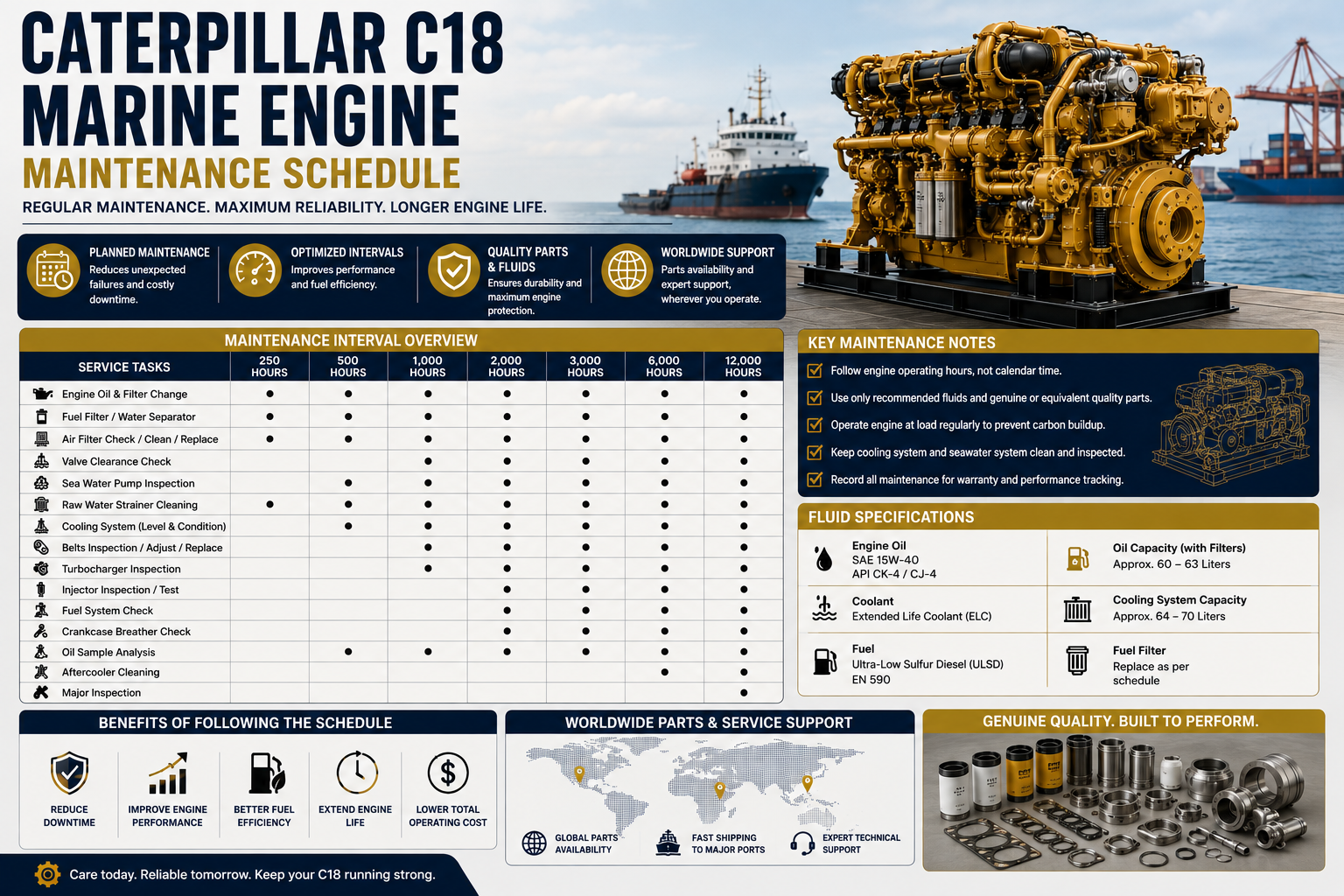
Caterpillar C18 Marine Engine Maintenance Schedule: Turning Service Hours Into a Practical Fleet Plan
The Caterpillar C18 marine engine is used across commercial propulsion, high-performance propulsion, auxiliary, and generator applications. Caterpillar lists the marine C18 as an in-line 6-cylinder, 18.1-liter, turbocharged and aftercooled diesel engine, with propulsion ratings varying by application.
For a marine engineer, the maintenance schedule is normally written in operating hours.
For a fleet manager, purchasing department, or vessel owner, it is often easier to think in months.
That is why this guide converts important Caterpillar C18 maintenance hours into easy planning blocks.
We will use:
Low Usage: 3,000 operating hours per year
High Usage: 5,000 operating hours per year
The calculation is simple:
Maintenance hours ÷ annual operating hours × 12 = approximate months
These month figures are for planning only. The exact maintenance schedule for your C18 must still be confirmed from the correct Caterpillar Operation & Maintenance Manual using the engine serial number and application. Caterpillar provides serial-number-specific manuals and service information through its official publications and SIS2GO systems.
Where Does the Caterpillar C18 Marine Engine Fit?
Manufacturer: Caterpillar
Engine: C18 Marine
Configuration: In-line 6-cylinder, 4-stroke diesel
Displacement: 18.1 liters
Bore: 145 mm
Stroke: 183 mm
Aspiration: Turbocharged / aftercooled
Typical Marine Uses: Commercial propulsion, high-performance propulsion, auxiliary engines, marine generators
Current Caterpillar commercial-propulsion information lists a power range of 454–1,136 bhp (339–847 bkW), while Caterpillar's high-performance C18 marine range reaches 803–1,136 bhp depending on configuration.
How to Read the Maintenance Blocks
Every important hour interval is placed in its own box so that engineers and fleet managers can scan the article quickly.
For example:
⏱️ 500-HOUR INTERVAL
Low Usage — 3,000 h/year: approximately 2 months
High Usage — 5,000 h/year: approximately 1.2 months
Planning meaning: A heavily utilized C18 can reach 500 operating hours about every five to six weeks.
The key is to combine these calculations with the actual Caterpillar schedule for your engine.
Daily Caterpillar C18 Engine Checks
🟦 DAILY / BEFORE OPERATION
Interval: Every operating day
Low Usage: Daily
High Usage: Daily
Engineer Focus: Look for changes, not just faults.
A useful daily engine-room inspection should include:
- Engine oil level
- Coolant level
- Fuel leaks
- Oil leaks
- Coolant leaks
- Exhaust smoke
- Unusual noise
- Engine vibration
- Oil pressure
- Coolant temperature
- Alarm history
- Seawater cooling condition where applicable
A small change today can become a much larger repair later.
Initial 100-Hour Service
Caterpillar's current C18 Marine equipment dashboard identifies an initial 100-service-hour maintenance event.
🟦 INITIAL 100 HOURS
Low Usage: approximately 0.4 month
High Usage: approximately 0.24 month
When: Initial engine service
Planning Focus: Treat this as an early-life inspection point after commissioning or installation.
For a new or recently installed engine, the initial service is useful for checking how components have settled into operation.
Possible areas to review according to the applicable OMM include:
- Fasteners
- Belt condition
- Fluid levels
- Leakage
- Initial service observations
- Engine data trends
Always use the serial-number-specific task list rather than assuming every C18 uses exactly the same initial-service procedure.
C18 Oil Change Interval: Deep Pan vs. Shallow Pan
One of the most useful verified C18 maintenance figures comes directly from Caterpillar.
For current C18 commercial propulsion engines, Caterpillar lists:
Deep center sump: 500-hour oil-change interval
Shallow center sump: 250-hour oil-change interval
This makes oil-pan configuration extremely important.
🟩 250-HOUR OIL CHANGE — SHALLOW SUMP
Verified interval: 250 hours
Low Usage — 3,000 h/year: approximately 1 month
High Usage — 5,000 h/year: approximately 0.6 month
Applies to: Applicable C18 shallow-sump configurations
Engineer Focus: Oil condition, viscosity, contamination, pressure and consumption.
At 5,000 annual hours, a 250-hour interval arrives approximately every 18 days.
That has major implications for:
- Filter stock
- Lubricating-oil inventory
- Maintenance manpower
- Waste-oil handling
- Service scheduling
🟩 500-HOUR OIL CHANGE — DEEP SUMP
Verified interval: 500 hours
Low Usage — 3,000 h/year: approximately 2 months
High Usage — 5,000 h/year: approximately 1.2 months
Applies to: Applicable C18 deep-sump configurations
Engineer Focus: Combine oil changes with oil analysis and filter inspection.
Caterpillar lists the deep-pan 500-hour interval on both its C18 propulsion and auxiliary-engine information.
Why the Oil Pan Matters More Than Many Fleet Managers Realize
Imagine two vessels with Caterpillar C18 engines.
They look similar.
They may even have similar ratings.
But one uses a deep sump and the other a shallow sump.
If the maintenance department assumes:
“C18 = 500-hour oil change”
the shallow-pan engine could be serviced incorrectly.
This is exactly why fleet databases should contain more than the engine model.
Record:
Engine model
Serial number
Rating
Application
Oil-pan configuration
Oil Analysis: Don't Wait for the Drain Interval to Tell You Everything
The hour meter tells you how long the oil has been working.
It does not tell you how well it is surviving.
Track:
- Iron
- Copper
- Lead where applicable
- Aluminium
- Silicon
- Fuel dilution
- Water
- Viscosity
- Oxidation
A 500-hour oil sample from one vessel may look excellent.
Another C18 may show contamination much earlier because of:
- Fuel-system problems
- Cooling-system issues
- Severe duty
- Excessive idling
- Dirt ingress
The maintenance schedule and condition monitoring should work together.
Fuel Filters
Caterpillar's C18 product information confirms a front-service fuel system using a gear-driven transfer pump and manual priming pump, but the exact replacement interval should be taken from the serial-specific OMM.
🟨 FUEL FILTER MAINTENANCE
Interval: Verify from the specific C18 OMM / SIS
Low Usage: Convert the verified hour interval into months
High Usage: Convert the verified hour interval into months
Engineer Focus: Water, contamination, restriction and injector performance.
Don't copy a fuel-filter interval from a C18 generator, industrial engine, or another serial prefix without confirmation.
Air Filter Maintenance
The C18 marine engine is turbocharged and aftercooled, so unrestricted intake airflow is essential.
🟨 AIR FILTER INSPECTION
Interval: Follow Caterpillar OMM and restriction indicator / condition
Fleet Planning: Inspect more often in dirty or dusty environments
Engineer Focus: Air restriction can resemble fuel or turbocharger problems.
A restricted air filter may contribute to:
- Black smoke
- Reduced power
- Higher exhaust temperature
- Increased fuel consumption
- Turbocharger workload
Cooling System
Current Caterpillar C18 marine configurations can use heat-exchanger or keel-cooling arrangements, while high-performance variants use separate-circuit aftercooling so seawater does not circulate directly through the aftercooler.
That is important because cooling-system maintenance depends on installation.
🟦 COOLING-SYSTEM INSPECTION
Interval: Daily observation + Caterpillar scheduled maintenance
Monitor:
- Coolant level
- Jacket-water temperature
- Heat exchanger
- Seawater side
- Auxiliary water pump
- Hoses and clamps
- Thermostats
- Aftercooler circuit
Engineer Focus: A cooling problem often appears under load before it becomes obvious at idle.
Seawater System
For heat-exchanger-cooled marine engines, raw-water flow deserves routine attention.
🟦 RAW-WATER / SEAWATER SYSTEM
Interval: Follow vessel and C18-specific maintenance schedule
Inspect:
- Sea inlet
- Seacock
- Strainer
- Raw-water pump
- Pump seals
- Pump bearings
- Hoses
- Heat exchanger
- Discharge flow
Engineer Focus: Don't automatically blame the pump. Check the complete circuit.
A partially restricted strainer may allow normal engine temperature at idle but insufficient cooling at full load.
Aftercooler
Caterpillar specifically highlights Separate Circuit Aftercooling (SCAC) on current C18 high-performance marine engines, with the advantage that seawater does not circulate through the aftercooler.
🟦 AFTERCOOLER MAINTENANCE
Interval: Follow C18-specific OMM
Inspect:
- Charge-air temperature
- Fouling
- Leakage
- Coolant circulation
- Hose connections
- Pressure loss
Engineer Focus: A dirty or poorly cooled aftercooler can increase combustion and exhaust temperatures.
Turbocharger
The Caterpillar C18 marine engine is turbocharged, and the turbocharger is one of the most important performance components on the engine.
🟦 TURBOCHARGER INSPECTION
Interval: Use the specific Caterpillar maintenance schedule
Watch:
- Boost pressure
- Oil leakage
- Compressor cleanliness
- Turbine deposits
- Bearing noise
- Shaft condition
- Exhaust temperature
Engineer Focus: Trend performance before a noticeable power loss develops.
A turbocharger can lose efficiency gradually.
The engine may compensate for quite some time before the crew notices an obvious performance problem.
Valve Lash
Caterpillar advises that valve lash should be checked and adjusted as part of scheduled engine maintenance, with the exact interval coming from the engine's Operation and Maintenance Guide. Caterpillar's general engine guidance notes recurring valve-lash checks typically fall within a broad 1,000–3,000-hour range after the initial adjustment, depending on engine.
For the C18, use the specific serial-number schedule.
🟨 VALVE-LASH INSPECTION
Interval: Confirm in the specific C18 OMM
If 1,000 hours applies:
Low Usage = 4 months
High Usage = 2.4 months
If 2,000 hours applies:
Low Usage = 8 months
High Usage = 4.8 months
If 3,000 hours applies:
Low Usage = 12 months
High Usage = 7.2 months
Engineer Focus: Record values before adjustment.
Do not simply write:
“Valve adjustment completed.”
Record the actual measurements by cylinder.
If the same valve repeatedly moves away from normal, that trend can be valuable.
Caterpillar C18 3,000-Hour Maintenance
Caterpillar's current C18 Marine Parts Store dashboard explicitly shows a 3,000-service-hour maintenance event.
🟥 3,000-HOUR MAINTENANCE
Verified maintenance interval: 3,000 hours
Low Usage — 3,000 h/year: approximately 12 months
High Usage — 5,000 h/year: approximately 7.2 months
Planning Level: Major scheduled maintenance event
Important: Confirm the complete task list using the engine serial number and Caterpillar OMM/SIS.
At 5,000 annual operating hours, a 3,000-hour service arrives in a little over seven months.
That means purchasing should begin planning well before the engine reaches the hour.
What Should Fleet Managers Do Before the 3,000-Hour Service?
Don't wait until 2,990 hours.
Several weeks or months beforehand:
- Verify engine serial number
- Retrieve current Caterpillar maintenance schedule
- Confirm oil-pan configuration
- Review fault history
- Review oil-analysis trends
- Inspect fuel-system performance
- Review cooling-system history
- Check turbocharger trends
- Identify required filters and seals
- Confirm any long-lead components
- Reserve workshop time
A maintenance hour only becomes expensive when everyone is surprised by it.
1,000-Hour Planning Box
Even when a particular C18 component needs schedule verification, this makes conversion easier:
⏱️ IF A VERIFIED C18 TASK IS DUE AT 1,000 HOURS
Low Usage: approximately 4 months
High Usage: approximately 2.4 months
Use these month figures only after confirming that the task actually applies at 1,000 hours to your specific C18.
2,000-Hour Planning Box
⏱️ IF A VERIFIED C18 TASK IS DUE AT 2,000 HOURS
Low Usage: approximately 8 months
High Usage: approximately 4.8 months
This becomes particularly important for high-utilization commercial vessels.
6,000-Hour Planning Box
⏱️ IF A VERIFIED C18 TASK IS DUE AT 6,000 HOURS
Low Usage: approximately 24 months
High Usage: approximately 14.4 months
Planning Focus: Long-lead overhaul parts and workshop capacity should be considered well in advance.
Again, this conversion does not mean every C18 has a 6,000-hour task. It is simply a planning conversion to use when the official schedule specifies one.
Major Overhaul
Do not assign one generic major-overhaul interval to every Caterpillar C18 marine engine.
Operating life depends on:
- Rating
- Application
- Fuel quality
- Cooling condition
- Oil condition
- Annual hours
- Load profile
- Previous maintenance
- Engine condition
🟥 CATERPILLAR C18 MAJOR OVERHAUL
Interval: Engine-specific
Verify Using: Serial number + OMM/SIS + engine history
Potential overhaul components:
- Cylinder heads
- Valves
- Fuel injectors
- Pistons
- Piston rings
- Cylinder liners
- Connecting rods
- Main bearings
- Connecting-rod bearings
- Crankshaft
- Camshaft
- Turbocharger
- Oil pump
- Water pumps
- Heat exchangers
- Aftercooler
- Gaskets and seals
Engineer Focus: Inspect and measure before finalizing the overhaul parts package.
Caterpillar C18 Maintenance Summary
⚙️ QUICK C18 FLEET PLANNING BLOCK
| IntervalLow Usage 3,000 h/yearHigh Usage 5,000 h/yearMaintenance Meaning | |||
| Daily | Daily | Daily | Operational checks |
| Initial 100 h | 0.4 mo | 0.24 mo | Caterpillar C18 initial maintenance event |
| 250 h | 1 mo | 0.6 mo | Verified shallow-pan oil interval on applicable propulsion engines |
| 500 h | 2 mo | 1.2 mo | Verified deep-pan oil interval on applicable propulsion engines |
| 1,000 h | 4 mo | 2.4 mo | Use when specific OMM assigns a task |
| 2,000 h | 8 mo | 4.8 mo | Use when specific OMM assigns a task |
| 3,000 h | 12 mo | 7.2 mo | Caterpillar C18 Marine maintenance event |
| 6,000 h | 24 mo | 14.4 mo | Planning conversion only unless confirmed in OMM |
| Major Overhaul | Engine-specific | Engine-specific | Rating, condition and application dependent |
The verified 100- and 3,000-hour maintenance events come from Caterpillar's C18 Marine equipment dashboard, while the 250/500-hour oil intervals come directly from Caterpillar's marine C18 specification.
Real Marine Maintenance Scenario
Imagine a commercial vessel operating twin Caterpillar C18 propulsion engines.
The vessels runs around 5,000 hours annually.
The engineering team initially thinks:
“500 hours is plenty of time between oil services.”
But at that utilization level, 500 hours arrive approximately every 1.2 months.
Over a year, the engine may require around ten 500-hour service cycles.
Now consider the 3,000-hour maintenance event.
It arrives after approximately 7.2 months.
Suddenly the annual maintenance plan needs:
- Multiple oil-service kits
- Filter inventory
- Oil-analysis scheduling
- Cooling-system inspections
- A 3,000-hour service package
- Technical manpower
- Parts lead-time planning
The maintenance schedule has not changed.
What changed is the way the company understands the schedule.
Engineer's Toolbox
CATERPILLAR C18 FLEET MAINTENANCE RECORD
Vessel: __________________
Engine: Caterpillar C18 Marine
Serial Number: __________________
Engine Rating: __________________
Propulsion / Auxiliary / Generator: __________________
Oil Pan: Deep / Shallow
Cooling: Heat Exchanger / Keel / Other
Current Hours: __________________
Expected Annual Hours: __________________
Next Oil Change: __________________
Next 3,000-Hour Service: __________________
Last Oil Analysis: __________________
Last Cooling-System Inspection: __________________
Turbocharger Status: __________________
Parts Ordered: __________________
Outstanding Technical Issues: __________________
Marine Engineer Tip
On a C18, record the oil-pan configuration in the maintenance file.
Caterpillar's own current specification demonstrates why this matters:
Deep pan = 500 hours
Shallow pan = 250 hours
That one line in the fleet record can prevent an incorrect service schedule.
Common Caterpillar C18 Maintenance Planning Mistakes
Avoid:
- Assuming every C18 has a 500-hour oil interval.
- Ignoring deep- versus shallow-sump configuration.
- Copying industrial C18 intervals into a marine propulsion plan.
- Copying generator-set requirements to propulsion engines.
- Ignoring serial-number-specific OMM information.
- Treating engine hours as the only measure of condition.
- Ignoring oil-analysis trends.
- Waiting until 3,000 hours to order the 3,000-hour service parts.
- Adjusting valves without recording measurements.
- Ignoring raw-water restrictions.
- Treating turbocharger performance changes as normal ageing.
- Ordering expensive major parts before inspection.
Frequently Asked Questions
What is the Caterpillar C18 marine engine?
The Caterpillar C18 is an 18.1-liter, inline-six, four-stroke marine diesel engine offered in propulsion, high-performance, auxiliary and generator configurations.
What is the C18 oil-change interval?
For Caterpillar's applicable current commercial-propulsion C18:
Deep sump: 500 hours
Shallow sump: 250 hours.
Always verify this against the specific engine configuration.
Is there an initial C18 marine service?
Yes. Caterpillar's current C18 Marine equipment dashboard identifies an initial 100-hour maintenance event.
Is there a 3,000-hour C18 maintenance interval?
Yes. Caterpillar's C18 Marine Parts Store equipment dashboard lists a 3,000-hour maintenance event. The specific task list should be confirmed against your engine serial number.
Is the Caterpillar C18 turbocharged?
Yes. Caterpillar describes the marine C18 as turbocharged and aftercooled.
Does the C18 use seawater directly through the aftercooler?
Not on current SCAC configurations. Caterpillar highlights that separate-circuit aftercooling keeps seawater out of the aftercooler.
Can maintenance hours be converted into months?
Yes, for planning purposes. Divide the verified Caterpillar interval by annual operating hours and multiply by 12.
Caterpillar C18 Marine Spare Parts
Alfa Marine Spare Parts can assist with sourcing components such as:
- Oil filters
- Fuel filters
- Air filters
- Fuel injectors
- Turbochargers
- Seawater pumps
- Freshwater pumps
- Heat exchangers
- Aftercooler components
- Thermostats
- Cylinder heads
- Intake and exhaust valves
- Pistons
- Piston rings
- Cylinder liners
- Main bearings
- Connecting-rod bearings
- Connecting rods
- Crankshaft components
- Camshaft components
- Sensors
- Gasket kits
- O-rings and seals
- Overhaul kits
Part numbers should always be verified using the engine serial number and arrangement information where available.
Related Caterpillar Engine Pages
- Caterpillar C7 Marine Engine Spare Parts
- Caterpillar C7.1 Marine Engine Spare Parts
- Caterpillar C9 Marine Engine Spare Parts
- Caterpillar C9.3 Marine Engine Spare Parts
- Caterpillar C18 Marine Engine Spare Parts
- Caterpillar C32 Marine Engine Spare Parts
- Caterpillar 3408 Marine Engine Spare Parts
- Caterpillar 3412 Marine Engine Spare Parts
- Caterpillar 3512 Marine Engine Spare Parts
- Caterpillar 3516 Marine Engine Spare Parts
Worldwide Caterpillar Marine Spare Parts Supply
Alfa Marine Spare Parts supports:
- Shipyards
- Ship repairers
- Marine engineers
- Chief engineers
- Technical superintendents
- Fleet operators
- Commercial fishing companies
- Offshore operators
- Government fleets
- Maritime contractors
- Boat builders
- Marine service companies
- Marine equipment distributors
For a Caterpillar C18 inquiry, provide:
Engine model + serial number + arrangement number + current part number + quantity + photographs where available.
That information helps reduce identification errors and improves quotation speed.
Browse Our Complete Catalog
Website:
https://alfamarinespareparts.com
Marine Spare Parts Catalog:
https://alfamarinespareparts.com/spareparts
Why Choose Alfa Marine Spare Parts?
For Caterpillar marine engines, simply knowing the words:
“C18”
is often not enough.
The correct questions are:
Which C18?
Which serial number?
Which rating?
Propulsion or auxiliary?
Deep or shallow oil pan?
Which cooling arrangement?
Alfa Marine Spare Parts helps marine customers source genuine, OEM, aftermarket, remanufactured and reconditioned Caterpillar marine components, depending on application and availability.
The goal is to identify the correct parts before the vessel reaches the service interval.
Contact Alfa Marine Spare Parts
Email: request@alfamarinespareparts.com
Website:
https://alfamarinespareparts.com
Catalog:
https://alfamarinespareparts.com/spareparts
Contact Alfa Marine Spare Parts for Caterpillar C18 filters, injectors, water pumps, heat exchangers, turbochargers, cylinder heads, pistons, bearings, liners, gasket kits and overhaul components with worldwide shipping.
One Final Thought
A Caterpillar C18 Marine Engine Maintenance Schedule becomes far easier to manage when every important operating-hour milestone is translated into calendar time.
A 250-hour oil service can arrive every few weeks on a heavily used vessel.
A 500-hour interval may arrive every month or two.
A 3,000-hour maintenance event can arrive in just over seven months on a vessel operating 5,000 hours per year.
That is why the best maintenance question is not simply:
“How many hours are on the engine?”
It is:
“Which Caterpillar C18 do we have, what interval is coming next, and are the correct parts already ready?”