Mitsubishi Marine Engine Types: What Is the Difference, and Which Engine Fits Which Vessel?
When someone says:
“I have a Mitsubishi marine engine.”
that still does not tell a marine engineer very much.
Is it an S6B3?
An S6A3?
An S6R or S6R2?
A twelve-cylinder S12A2 or S12R?
Or one of the large S16R or S16R2 engines?
They all belong to Mitsubishi's marine diesel-engine world, but they are very different engines intended for very different jobs.
Mitsubishi's current marine range stretches from approximately 221 kW to 3,580 kW and covers propulsion, auxiliary, diesel-electric and emergency applications. That range alone explains why asking for simply “a Mitsubishi marine engine” is not specific enough.
A small commercial fishing vessel does not need the same engine as an offshore vessel. A harbor generator does not work like a fast patrol boat. And an engine intended for continuous heavy-duty propulsion should not automatically be operated like a higher-rated light-duty engine.
So which Mitsubishi marine engine fits which job?
That is where this gets interesting.
First: Understanding the Main Mitsubishi Marine Engine Families
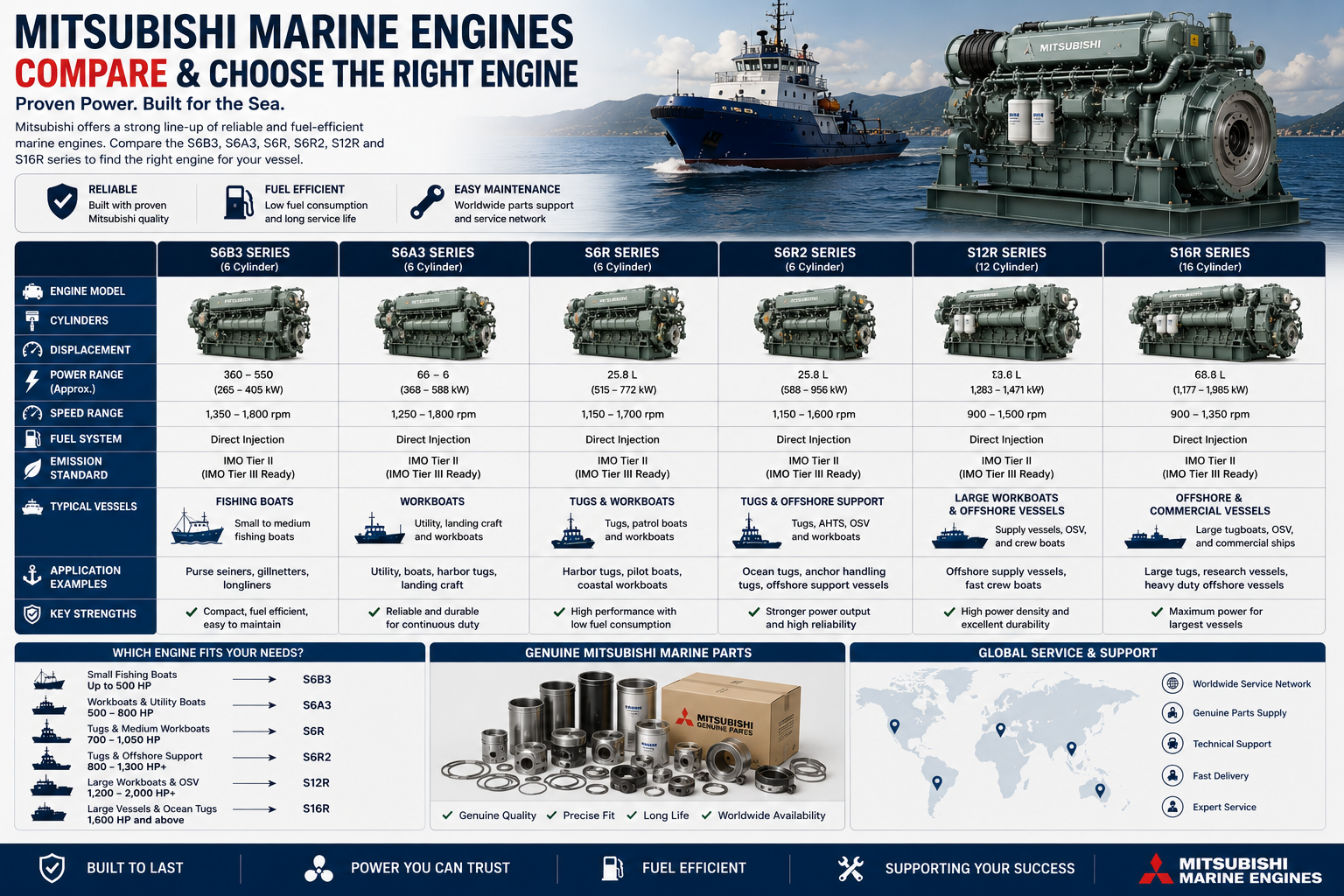
The current Mitsubishi marine diesel range is built primarily around several related engine families.
| Mitsubishi FamilyTypical ConfigurationApproximate Engine SizeGeneral Character | |||
| S6B3 | Inline 6 | 14.6 L | Compact commercial marine power |
| S6A3 | Inline 6 | 18.56 L | Step up in torque and output |
| S6R | Inline 6 | 24.51 L | Heavy commercial inline-six |
| S6R2 | Inline 6 | 29.96 L | Long-stroke, higher-output inline-six |
| S12A2 | 60° V12 | 33.93 L | Compact V12 power |
| S12R | 60° V12 | 49.03 L | Large commercial V12 |
| S16R | 60° V16 | 65.37 L | Heavy high-output commercial engine |
| S16R2 | V16 | Larger high-output development | High-power marine and generator applications |
Mitsubishi's official specifications identify the core SA/R engines as four-stroke, water-cooled and turbocharged, with the S6 families using inline layouts and the S12/S16 families using V configurations.
Why Mitsubishi Uses So Many Versions of Similar Engines
One of the reasons Mitsubishi model names can look confusing is that the same basic engine family may appear in several marine configurations.
You may see names such as:
S6R-MPTA
S6R-MPTK
S6R-T2MPTK
S6R-MPTAW
They are related, but the complete suffix can identify important differences in rating, cooling arrangement, emissions configuration or marine package.
The same principle applies to the larger engines.
An S12R-MPTK should not automatically be treated exactly like an S12R-MPTAW, and an S16R2 should not be reduced simply to “S16R.”
For spare parts, the complete designation matters.
Heavy Duty, Medium Duty and Light Duty: Why the Rating Matters
This is one of the most important things to understand about Mitsubishi marine engines.
Mitsubishi publishes different propulsion ratings for some engines:
Light Duty A
Medium Duty B
Heavy Duty C
The engine itself may belong to the same basic family, but the permitted power changes according to how intensively it is expected to operate.
For example, Mitsubishi's official IMO Tier II specifications list the S12R-T2M(P)TK at approximately 1,210 kW in Light Duty A, 1,040 kW in Medium Duty B and 940 kW in Heavy Duty C. The S16R-T2M(P)TK is listed at approximately 1,610 kW, 1,380 kW and 1,250 kW across those same duty classes.
That leads to a very useful marine-engine lesson:
The version with the highest horsepower is not necessarily the best engine for the vessel.
A commercial boat running thousands of hours may need a more conservative heavy-duty rating, while a pleasure or fast-service vessel with shorter high-load periods may be able to use a higher rating.
Mitsubishi S6B3: The Compact Commercial Workhorse
The S6B3 sits near the smaller end of Mitsubishi's traditional commercial marine range.
It is a six-cylinder inline engine with approximately 14.6 liters displacement. Mitsubishi's current marine range includes S6B3 configurations from roughly the low-200-kW level upward, depending on version, rating and application.
What Kind of Boat Fits an S6B3?
Think about vessels where you need dependable commercial diesel power but do not need a huge engine.
Good examples include small fishing vessels, harbor craft, utility boats, small passenger boats, workboats and auxiliary/generator installations.
The inline-six arrangement is also attractive from a maintenance perspective because you have one cylinder bank and relatively straightforward access compared with a large V-engine.
What Is the S6B3's Personality?
Compact, straightforward and commercial.
It is the Mitsubishi family you might consider when the vessel needs more than a small auxiliary diesel but does not justify moving into the physically larger S6R or V12 range.
Mitsubishi S6A3: More Engine Without Going to a V12
Move upward and you reach the S6A3.
It remains an inline six, but displacement increases to approximately 18.56 liters, compared with 14.6 liters for the S6B3. Mitsubishi's published marine data shows propulsion configurations extending into roughly the 360–558 kW area depending on version and rating.
This makes the S6A3 an interesting middle ground.
You still retain the practical simplicity of an inline-six arrangement, but you gain significantly more engine capacity.
Where Does an S6A3 Make Sense?
The family fits naturally around medium fishing vessels, workboats, small commercial passenger vessels, utility craft and larger generator or auxiliary installations.
If an S6B3 feels slightly too small but a large V-engine would be excessive, the S6A3 begins to look very attractive.
S6B3 vs. S6A3: What Is the Practical Difference?
Mitsubishi S6B3
14.6-liter inline six
Smaller installation footprint and lower-output applications.
Best suited to: smaller commercial craft, auxiliaries and generator applications.
Mitsubishi S6A3
18.56-liter inline six
More displacement and additional power while retaining an inline layout.
Best suited to: larger fishing vessels, workboats and higher-load auxiliary systems.
The correct choice still depends on gearbox ratio, propeller, vessel displacement and expected operating hours.
Mitsubishi S6R: The Serious Inline-Six
The S6R is where Mitsubishi's inline-six family starts feeling like a substantial commercial marine engine.
The S6R has a 24.51-liter displacement, with a 170 mm bore and 180 mm stroke in Mitsubishi's published specification. Depending on version and rating, marine output can extend from the low-300-kW range into roughly the 600-kW class.
This is an engine for vessels doing real work.
Which Boats Suit an S6R?
The S6R is a natural candidate for commercial fishing vessels, workboats, harbor vessels, utility boats, inland-waterway craft, offshore-support applications and generator/diesel-electric service.
Mitsubishi also offers configurations for both propulsion and continuous generator duty, showing how versatile the same basic engine architecture can be.
Why Marine Engineers Often Like an Inline-Six
When the available engine-room length permits it, an inline-six has several attractive characteristics.
There is one cylinder bank, one basic exhaust side, straightforward head access and no need to work between two banks as on a large V12 or V16.
The disadvantage?
An inline engine is longer.
So there comes a point where vessel designers want more power without making the engine significantly longer.
That is where V-engines become attractive.
But before we get there, Mitsubishi has another interesting inline six.
Mitsubishi S6R2: Same Cylinder Count, Different Character
The S6R2 is not simply an S6R with another number attached.
Mitsubishi's published data gives it a 170 mm bore and 220 mm stroke, creating approximately 29.96 liters of displacement, compared with 24.51 liters for the S6R.
That longer stroke gives the S6R2 a noticeably different character.
Mitsubishi itself highlights the long-stroke block when discussing the S6R2 marine engine and notes that the design increases power while maintaining a relatively compact footprint.
Current S6R2 marine versions span roughly 324–759 kW, depending on configuration, duty and emissions specification.
S6R vs. S6R2: Which Would You Choose?
Mitsubishi S6R
24.51 liters
170 × 180 mm bore and stroke.
Strong commercial inline-six architecture.
Mitsubishi S6R2
29.96 liters
170 × 220 mm bore and stroke.
Longer-stroke design with greater displacement and higher output potential.
For a vessel requiring substantial commercial power but where a V12 still feels unnecessarily large, the S6R2 can be a very interesting solution.
Which Vessel Fits an S6R2?
Think about medium-to-large fishing vessels, larger workboats, tug-support duties, inland shipping, offshore vessels, commercial passenger craft and diesel-electric propulsion.
Mitsubishi currently lists marine engines for fixed- and controllable-pitch propulsion as well as generator/diesel-electric duty, with S6R2 versions offered across these applications.
Mitsubishi S12A2: The Compact V12 Step
Eventually an inline-six is not enough.
The S12A2 moves into a 60-degree V12 layout.
Despite doubling the cylinder count compared with the S6A3, the V arrangement helps control overall engine length.
Mitsubishi specifies the S12A2 at approximately 33.93 liters displacement, using a 150 mm bore and 160 mm stroke. Depending on version, published marine output extends into roughly the 700–850 kW class.
Why Choose a V12?
Because a V12 provides significantly more total displacement and power without creating an extremely long engine.
This can make sense in a vessel where:
engine-room length is limited
but
power requirement is substantial.
What Kind of Boat Fits an S12A2?
Potential applications include larger fishing boats, workboats, medium commercial vessels, passenger craft, offshore-support vessels and larger auxiliary-generator installations.
Mitsubishi S12R: A Big Step Into Heavy Marine Power
The S12R is one of Mitsubishi's most recognizable large marine engine families.
It uses twelve cylinders arranged in a 60-degree V and has approximately 49.03 liters displacement. Mitsubishi's current marine specifications show outputs extending above 1,200 kW, depending on version, duty and speed.
Mitsubishi describes its S12R marine design as combining combustion-chamber engineering, fuel-injection technology, turbocharging and cooling while maintaining a compact installation footprint.
This is no longer an engine for a modest utility boat.
Which Boats Suit the Mitsubishi S12R?
Think about larger fishing vessels, tugboats, offshore-support vessels, passenger vessels, larger workboats, inland cargo craft, commercial ferries and large auxiliary/generator installations.
The S12R is the kind of engine where overhaul planning becomes a serious procurement exercise.
Twelve cylinders can mean twelve piston assemblies, substantial cylinder-head work, twelve injector positions and a much larger bearing and gasket requirement than an inline-six.
S12A2 vs. S12R
This is an important comparison.
| FeatureS12A2S12R | ||
| Cylinders | 12 | 12 |
| Configuration | 60° V | 60° V |
| Displacement | 33.93 L | 49.03 L |
| Bore | 150 mm | 170 mm |
| Stroke | 160 mm | 180 mm |
| Character | Compact V12 | Larger heavy-duty V12 |
Both are V12 engines.
But calling them both “Mitsubishi V12” hides a major difference in displacement and output capability.
Mitsubishi S16R: Heavy Commercial V16 Power
When twelve cylinders are not enough, Mitsubishi moves to the S16R.
The S16R is a 60-degree V16 with approximately 65.37 liters displacement, a 170 mm bore and 180 mm stroke. Published marine versions cover output well above 1 MW, with current configurations reaching roughly 1,690 kW depending on application and speed.
This is serious commercial-marine territory.
Which Vessels Suit an S16R?
Think about large workboats, tugs, offshore-support vessels, ferries, large fishing vessels, commercial passenger craft and major shipboard generator installations.
At this level, engine selection is no longer just about whether it physically fits.
You must also consider cooling capacity, gearbox, shafting, propeller load, fuel consumption, classification, lifting arrangements and future overhaul access.
Mitsubishi S16R2: When Even More Output Is Needed
The S16R2 is another high-output member of Mitsubishi's marine range.
Current Mitsubishi listings show S16R2 configurations around 1,450–1,960 kW, depending on version, with rated speeds generally in the 1,200–1,500 rpm range.
This positions the family above many S16R applications.
Where Does an S16R2 Fit?
Think larger commercial vessels, substantial offshore applications, high-output generator sets, diesel-electric systems and propulsion systems where megawatt-class output is required from a relatively compact high-speed/medium-high-speed diesel package.
Small Inline Engine vs. Large V-Engine
A very simple way to understand Mitsubishi's marine range is to imagine the engine room getting progressively more demanding.
Smaller Requirement
S6B3
Compact inline-six.
Need More
S6A3
Larger inline-six.
Commercial Heavy Work
S6R
Bigger displacement and stronger continuous-duty potential.
More From an Inline Six
S6R2
Long-stroke, nearly 30-liter architecture.
Need V12 Power
S12A2
Compact V12 step.
Heavy V12 Work
S12R
Nearly 50 liters of commercial marine diesel.
High-Output Commercial Power
S16R
65-liter V16.
Higher-Power Development
S16R2
Substantially higher-output marine and generator applications.
What Does MPTA, MPTK or MPTAW Mean for the Owner?
For the vessel owner, the important point is less about memorizing every letter and more about never dropping the suffix when identifying the engine.
Different suffixes can relate to different marine configurations, cooling arrangements and ratings.
Mitsubishi's current product selector itself distinguishes marine engines by characteristics including freshwater versus seawater intercooling, propulsion type, emissions level and engine speed.
So when requesting a spare part, don't write:
“Mitsubishi S12R.”
Write the full name from the engine plate:
“Mitsubishi S12R-T2MPTK — serial number ______.”
That extra information can save a lot of mistakes.
Freshwater Intercooler vs. Seawater Intercooler
Cooling configuration is another important difference across Mitsubishi marine engines.
Current Mitsubishi marine listings distinguish between freshwater-intercooled and seawater-intercooled configurations.
Why does that matter?
Because seawater is highly corrosive.
An engine using a seawater-side cooler requires particular attention to corrosion, fouling, zincs/anodes where applicable, leakage and raw-water condition.
A freshwater intercooler arrangement separates the charge-air cooler from direct seawater exposure, changing the maintenance profile.
Neither arrangement should be treated as identical when ordering:
cooler cores
gaskets
seals
water pumps
or related piping components.
Fixed-Pitch vs. Controllable-Pitch Propeller Applications
Mitsubishi's marine engine selector also distinguishes engines for FPP and CPP propulsion.
FPP means:
Fixed-Pitch Propeller
CPP means:
Controllable-Pitch Propeller
This matters because the way the engine sees propeller load can differ.
A controllable-pitch system can change blade pitch while engine speed is managed according to operating requirements.
A fixed-pitch installation has different load characteristics.
Engine selection therefore cannot be separated completely from the propeller and gearbox system.
Mitsubishi Engine for a Fishing Vessel
Fishing vessels can be very demanding because they may operate for long periods with high annual hours.
The best Mitsubishi family depends heavily on vessel size.
A smaller commercial fishing vessel may be suitable for an S6B3 or S6A3.
A heavier vessel may naturally move toward the S6R or S6R2.
Large trawlers can require S12R or even S16R-class power.
For a high-hour fishing vessel, pay very close attention to the heavy-duty rating rather than simply selecting the maximum horsepower version. Mitsubishi publishes lower heavy-duty outputs specifically because sustained commercial use is not the same job as intermittent light-duty operation.
Mitsubishi Engine for a Workboat
Workboats can range from small harbor launches to substantial commercial vessels.
For a smaller workboat, S6B3 or S6A3 may provide enough power.
Move into larger utility craft and the S6R/S6R2 families become more interesting.
For substantially larger vessels, the S12R enters the conversation.
The key questions are not simply horsepower.
Ask:
How many annual hours?
What percentage of time is spent under high load?
Fixed or controllable pitch?
How large is the engine room?
Can the engine be removed or overhauled in place?
Mitsubishi Engine for a Tugboat
Tugs need high-load capability and reliable torque.
A smaller harbor tug might use an S6R2-class engine depending on propulsion requirements.
Larger tug applications naturally move toward S12R and S16R territory.
The more heavily the tug works, the more important the correct commercial-duty rating becomes.
A tug that spends long periods pushing or pulling should not be treated like a pleasure vessel that occasionally uses maximum engine power.
Mitsubishi Engine for a Ferry or Passenger Vessel
Passenger vessels create an interesting compromise.
They may need:
high reliability
compact installation
good fuel efficiency
predictable maintenance
and sometimes relatively high power.
Depending on vessel size, appropriate Mitsubishi families can range from S6R/S6R2 through S12A2 and S12R to S16R-class engines.
Mitsubishi's current marine range specifically supports propulsion as well as diesel-electric arrangements, providing another option for vessels where the diesel engine drives a generator rather than directly driving the propeller shaft.
What About Marine Generators?
This is one of Mitsubishi's major strengths.
Many of these same engine families are offered for continuous generator duty.
Mitsubishi publishes generator ratings for engines including S6R2, S12A2, S12R and S16R, with different outputs at 1,200, 1,500 and 1,800 rpm depending on model.
That makes them suitable for applications such as main shipboard generators, auxiliary power, diesel-electric propulsion and emergency or harbor power depending on model and configuration.
The current Mitsubishi marine range specifically covers propulsion, auxiliary, diesel-electric and harbor-emergency applications.
Marine Engine vs. Industrial Mitsubishi Engine
This is another area where owners need to be careful.
Mitsubishi produces related engines for industrial and generator-drive applications.
For example, an industrial S6B3-PTA is also a 14.6-liter turbocharged inline-six, while industrial S6R, S12R and S16R-family engines share broad architecture with related marine families.
But that does not mean you can take an industrial engine and assume it is identical to the marine version.
A marine engine may have different cooling equipment, heat exchangers, intercoolers, seawater components, exhaust arrangement, fuel rating, controls, flywheel arrangements and certification.
The base engine may be related.
The complete installation is not necessarily the same.
Which Mitsubishi Engine Is Easiest to Work On?
In general, a smaller inline-six will usually present a simpler physical maintenance project than a large V16.
That doesn't mean the larger engine is badly designed.
It is simply bigger.
Compare an S6B3 with an S16R.
The S6B3 has six cylinders.
The S16R has sixteen.
At overhaul time, cylinder count affects the quantity of components you may need to inspect or replace.
A major V16 project can involve far more injectors, piston assemblies, liners, bearing positions, valves, cylinder-head components and sealing parts.
So when comparing purchase prices, also think about:
future maintenance scale.
Which Mitsubishi Engine Is Best for Remote Commercial Operation?
For a vessel operating far from major engine-service centers, several things become valuable:
Mechanical accessibility
Parts commonality
Straightforward inspection
Reliable cooling
Conservative duty rating
Ability to service the engine without highly specialized equipment
Mitsubishi specifically emphasizes inspection and maintenance access across its engine range, while related Mitsubishi industrial families also emphasize component commonality and a relatively low requirement for specialized maintenance tools.
That can be especially valuable to fishing and workboat operators.
Quick Mitsubishi Marine Engine Comparison
| EngineLayoutDisplacementGeneral Marine Fit | |||
| S6B3 | Inline 6 | 14.60 L | Small fishing boats, workboats, auxiliaries |
| S6A3 | Inline 6 | 18.56 L | Medium fishing and commercial boats |
| S6R | Inline 6 | 24.51 L | Commercial fishing, workboats, inland shipping |
| S6R2 | Inline 6 | 29.96 L | Larger workboats, offshore, commercial propulsion |
| S12A2 | V12 | 33.93 L | Compact higher-power commercial propulsion |
| S12R | V12 | 49.03 L | Tugs, larger fishing vessels, offshore and ferries |
| S16R | V16 | 65.37 L | Large commercial vessels, tugs, ferries, generators |
| S16R2 | V16 family | High-output | Large propulsion, diesel-electric and generator applications |
The configuration and displacement figures for the core SA/R families come directly from Mitsubishi's published specifications.
Mitsubishi Marine Engine “Personalities”
Sometimes the easiest way to remember the families is to give each one a character.
S6B3 — The Compact Worker
Small enough for tighter commercial installations while still being a serious six-cylinder marine diesel.
S6A3 — The Bigger Little Brother
More displacement and power without leaving the inline-six layout.
S6R — The Commercial Workhorse
A large-displacement inline six suited to sustained marine duty.
S6R2 — The Long-Stroke Muscle
Nearly 30 liters from six cylinders and designed to deliver considerably more output without immediately moving into V12 territory.
S12A2 — The Compact V12
Twelve cylinders where packaging and power density matter.
S12R — The Heavy V12
Nearly 50 liters and very much at home in serious commercial propulsion.
S16R — The Big Commercial Engine
Sixteen cylinders and more than a megawatt of marine output in many configurations.
S16R2 — The High-Output Specialist
The family for applications where the power requirement moves well beyond ordinary workboat territory.
Common Mitsubishi Marine Engine Spare Parts
Although parts differ considerably between engine families, common marine maintenance and overhaul requirements can include engine oil filters, fuel filters, air filters, fuel injectors, injection pumps, fuel transfer pumps, turbochargers, charge-air coolers, seawater pumps, freshwater pumps, heat exchangers, thermostats, cylinder heads, intake and exhaust valves, valve guides and seats, pistons, piston rings, cylinder liners, connecting rods, main bearings, connecting-rod bearings, crankshafts, camshafts, oil pumps, gaskets, O-rings, oil seals and complete overhaul components.
For larger S12 and S16 engines, the quantity of parts required during a top-end or major overhaul can become substantial.
Why Exact Mitsubishi Engine Identification Matters
A customer asking for:
“Mitsubishi S6R parts”
has given useful information.
But not enough information for every component.
We still want to know the full designation.
Is it:
S6R-MPTA?
S6R-MPTK?
S6R-T2MPTK?
S6R-MPTAW?
Which duty rating?
Which serial number?
Which cooling configuration?
The same principle becomes even more important on S12R and S16R installations.
For a good spare-parts inquiry, provide the complete engine model, serial number, existing part number, quantity and photographs where available.
Frequently Asked Questions
What are the main Mitsubishi marine engine families?
Mitsubishi's current marine portfolio includes S6B3, S6A3, S6R, S6R2, S12A2, S12R, S16R and S16R2 configurations across propulsion and generator applications.
What is the smallest family covered here?
The S6B3 is the smallest of these core commercial families, with approximately 14.6 liters displacement.
What is the difference between the S6R and S6R2?
Both are inline six-cylinder engines with a 170 mm bore, but the S6R uses a 180 mm stroke and 24.51-liter displacement, while the S6R2 uses a much longer 220 mm stroke and approximately 29.96 liters.
Is the S12R a V12?
Yes. Mitsubishi specifies the S12R as a 60-degree V12 with approximately 49.03 liters displacement.
Is the S16R a V16?
Yes. The S16R is a 60-degree V16 with approximately 65.37 liters displacement.
Can Mitsubishi marine engines be used for generators?
Yes. Mitsubishi publishes continuous generator ratings for several of the same families, including S6R, S6R2, S12A2, S12R and S16R configurations.
What is the difference between Light Duty A, Medium Duty B and Heavy Duty C?
They represent different operating-duty expectations. Mitsubishi publishes progressively lower rated outputs as the engine is expected to operate more heavily and continuously. For example, the S16R T2 propulsion family is rated higher in Light Duty A than in Heavy Duty C.
Is the highest-power rating always the best choice?
No. A heavily utilized commercial fishing vessel or tug may be better matched to a heavy-duty rating than a higher-output light-duty version.
Are Mitsubishi industrial and marine engines the same?
Related families can share basic architecture, but marine configurations can use different cooling, exhaust, fuel, controls and accessory arrangements. Exact marine model identification is therefore essential.
Mitsubishi Marine Engine Spare Parts
Alfa Marine Spare Parts can assist with spare parts and maintenance components for Mitsubishi marine engine families including S6B3, S6A3, S6R, S6R2, S12A2, S12R, S16R and S16R2, depending on engine configuration and parts availability.
Typical requirements can include genuine, OEM, aftermarket, remanufactured or reconditioned components depending on the application.
For accurate identification, send:
Complete Mitsubishi engine designation + serial number + existing part number + quantity + photographs where available.
Related Mitsubishi Marine Engine Pages
Useful individual engine pages include Mitsubishi S6B3 Marine Engine Spare Parts, Mitsubishi S6A3 Marine Engine Spare Parts, Mitsubishi S6R Marine Engine Spare Parts, Mitsubishi S6R2 Marine Engine Spare Parts, Mitsubishi S12A2 Marine Engine Spare Parts, Mitsubishi S12R Marine Engine Spare Parts, Mitsubishi S16R Marine Engine Spare Parts and Mitsubishi S16R2 Marine Engine Spare Parts.
Why Choose Alfa Marine Spare Parts?
Mitsubishi is another brand where the complete model can make a major difference.
A customer may write:
“Need S12R water pump.”
But before identifying the component, we want to establish:
Which S12R version?
Which serial number?
Propulsion or generator?
Which cooling arrangement?
What part number is currently installed?
Alfa Marine Spare Parts supports marine engineers, shipyards, workshops, technical superintendents and vessel operators sourcing Mitsubishi marine diesel engine components.
The objective is simple:
identify the exact engine first, then identify the correct part.
Worldwide Mitsubishi Marine Spare Parts Supply
Alfa Marine Spare Parts supports shipyards, ship repairers, marine engineers, chief engineers, technical superintendents, fishing fleets, workboat operators, tug operators, ferry operators, yacht managers, offshore operators, government fleets, maritime contractors, marine service companies and marine equipment distributors.
Contact Alfa Marine Spare Parts
Email: request@alfamarinespareparts.com
Website:
https://alfamarinespareparts.com
Marine Spare Parts Catalog:
https://alfamarinespareparts.com/spareparts
One Final Thought
There is no single typical Mitsubishi marine engine.
The S6B3 is a compact six-cylinder worker.
The S6A3 adds displacement without giving up the simple inline arrangement.
The S6R moves firmly into heavy commercial work.
The long-stroke S6R2 produces considerably more capability from an inline-six package.
Then the S12A2 and S12R move into V12 power.
And the S16R and S16R2 belong in a completely different class of high-output commercial marine engineering.
So when somebody asks:
“Which Mitsubishi marine engine is best?”
the useful answer is:
Best for which vessel and which duty?
Because a small fishing boat, an offshore workboat, a tug, a ferry and a diesel-electric vessel may all use Mitsubishi power—but they should not all use the same Mitsubishi engine.