Caterpillar 3412 Marine Engine Running Hot? Why Air in the Cooling System Could Be the Hidden Problem | Alfa Marine Spare Parts
Caterpillar 3412 Marine Engine Running Hot? Why Air in the Cooling System Could Be the Hidden Problem
If you own or maintain a Caterpillar 3412 marine engine, you've probably experienced—or at least heard about—an engine that suddenly starts running hotter than normal. The first reaction is usually to suspect the seawater pump, thermostat, or heat exchanger.
But what if none of those components are actually the problem?
One of the most overlooked causes of overheating on the Caterpillar 3412 is air trapped inside the cooling system. Even a small amount of trapped air can reduce cooling efficiency and create localized hot spots that may eventually lead to expensive repairs.
Let's look at why this happens, how to identify it, and what every marine engineer should check before replacing expensive components.
What Makes the Caterpillar 3412 So Reliable?
The Caterpillar 3412 is one of the most respected V12 marine diesel engines ever produced. It has powered:
- Commercial vessels
- Offshore support vessels
- Patrol boats
- Fishing vessels
- Workboats
- Passenger ferries
- Large yachts
Its reputation comes from its strong mechanical design, long service life, and ability to operate reliably for thousands of hours when maintained correctly.
Like every high-performance diesel engine, however, the 3412 depends heavily on an efficient cooling system.
Why Is Cooling So Important?
Marine diesel engines generate enormous amounts of heat.
The cooling system must continuously remove this heat from the:
- Cylinder heads
- Cylinder liners
- Engine block
- Turbochargers
- Lubricating oil (through the oil cooler)
If coolant cannot circulate properly, temperatures rise quickly, reducing efficiency and increasing wear.
Can Air Really Cause an Engine to Overheat?
Yes.
Many engineers underestimate how damaging trapped air can be.
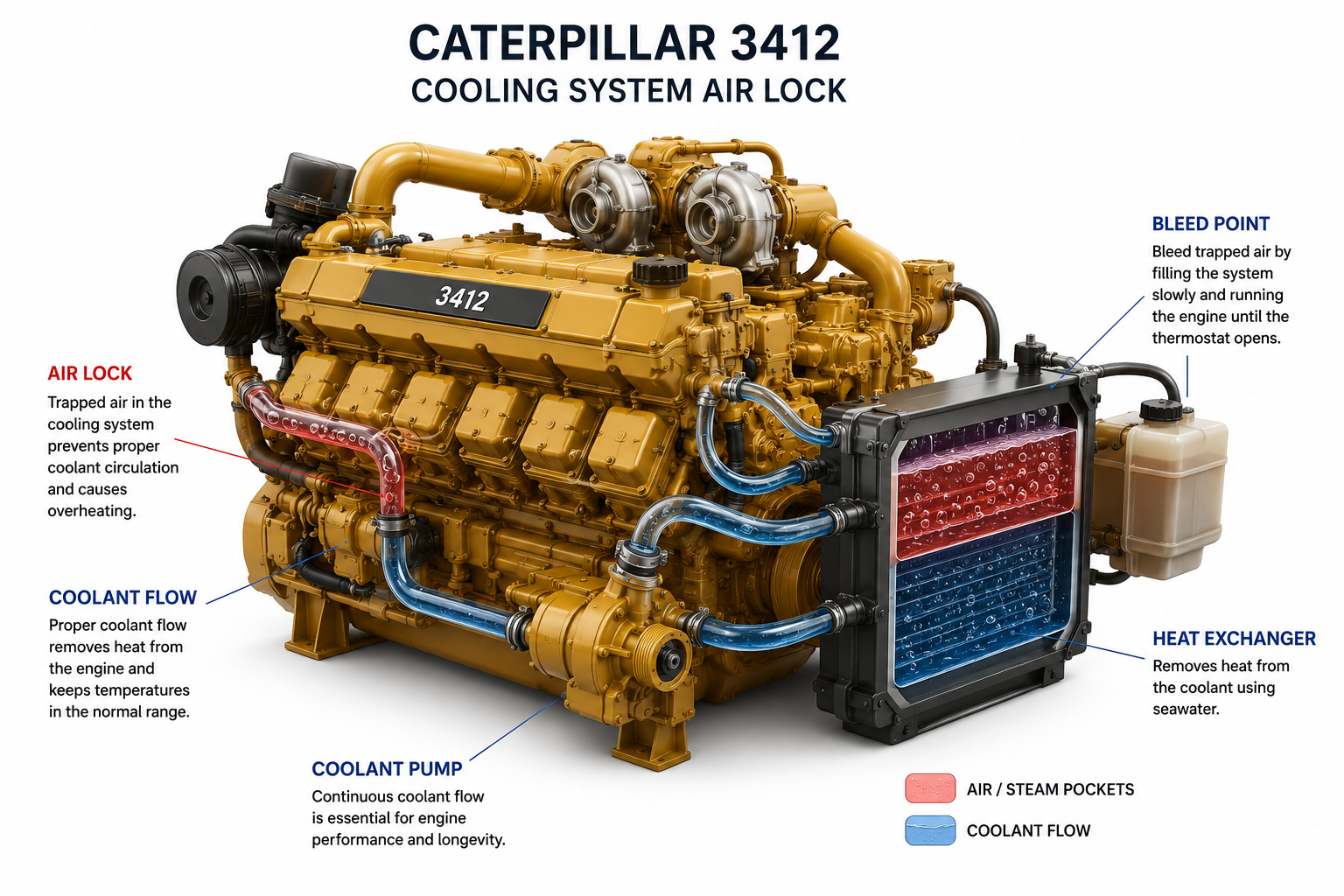
Unlike coolant, air cannot effectively transfer heat away from engine components.
When air becomes trapped inside the cooling passages, several problems may occur:
- Coolant no longer contacts all internal engine surfaces.
- Steam pockets begin forming around hot areas.
- Localized temperatures increase rapidly.
- The water pump may begin circulating an air-and-coolant mixture instead of coolant alone.
- Cooling efficiency drops.
This condition is commonly known as an air lock.
What Symptoms Can Air in the Cooling System Cause?
Some common warning signs include:
- Engine temperature fluctuates unexpectedly.
- Temperature rises under heavy load but returns to normal at idle.
- Coolant is pushed into the expansion tank.
- Bubbling inside the coolant reservoir.
- Heater or heat exchanger performance decreases.
- Intermittent overheating with no obvious cause.
Many of these symptoms are similar to a failing thermostat or clogged heat exchanger, making diagnosis more challenging.
Where Does the Air Come From?
Air can enter the cooling system in several ways.
1. Cooling System Refilled Too Quickly
After maintenance, coolant should always be added slowly.
Filling the system too fast can trap air inside the engine block and cylinder heads.
2. Loose Hose Clamps
A loose clamp may not leak coolant outward.
Instead, it can allow air to enter the cooling system when the water pump creates suction.
3. Aging Coolant Hoses
Older hoses may develop tiny cracks that are almost impossible to see.
These microscopic openings allow air into the system while producing little or no visible coolant leak.
4. Low Coolant Level
If coolant drops below the correct level, the water pump may begin drawing air instead of coolant.
5. Cooling System Repairs
Replacing components such as:
- Heat exchangers
- Thermostats
- Water pumps
- Coolant pipes
can all introduce air if the system is not bled correctly afterward.
Why Is This Dangerous?
Air pockets create localized hot spots.
Instead of the entire cooling jacket receiving coolant, some areas become insulated by trapped air.
These hot spots may eventually contribute to:
- Cylinder head damage
- Head gasket failure
- Liner distortion
- Increased thermal stress
- Reduced engine life
Ignoring the issue can lead to repairs costing far more than the original maintenance.
Should You Replace the Thermostat First?
Not necessarily.
Many mechanics immediately replace the thermostat whenever overheating occurs.
While thermostats do fail, they are not always the cause.
Before replacing parts, inspect the entire cooling system for trapped air, coolant level, hose condition, and proper circulation.
A systematic diagnosis can save both time and money.
How Do You Remove Air from the Cooling System?
A few best practices include:
Fill Coolant Slowly
Allow coolant enough time to flow through all engine passages.
Run the Engine to Operating Temperature
As the thermostat opens, coolant circulates through the complete system, allowing trapped air to escape.
Monitor Coolant Level
After the engine cools, recheck coolant level and top up if necessary.
Inspect for Leaks
Pay particular attention to:
- Hose connections
- Water pump area
- Expansion tank
- Heat exchanger connections
- Coolant pipes
Even a very small leak can introduce air over time.
What Other Components Should Be Inspected?
If overheating continues, inspect:
- Seawater pump
- Raw water impeller
- Heat exchanger
- Aftercooler
- Thermostat
- Coolant pump
- Coolant condition
- Radiator or keel cooling system (depending on installation)
- Belt tension
- Temperature sensors
A complete inspection is always more effective than replacing components one by one.
Preventive Maintenance Tips
Routine maintenance remains the most effective way to avoid cooling system failures.
Recommended practices include:
- Check coolant level before operation.
- Replace worn hoses before they fail.
- Inspect hose clamps regularly.
- Flush the cooling system according to Caterpillar maintenance intervals.
- Use the correct coolant specification.
- Monitor engine operating temperature during every voyage.
- Investigate even small temperature increases before they become major problems.
Preventive maintenance almost always costs less than emergency repairs.
Frequently Asked Questions
Why does my Caterpillar 3412 only overheat under heavy load?
Heavy load generates more heat. If coolant flow is restricted by trapped air, clogged cooling passages, or reduced seawater flow, the problem often appears only when the engine is working hard.
Can trapped air damage the engine?
Yes. Air pockets reduce heat transfer and can create localized overheating that increases stress on cylinder heads, liners, and gaskets.
Should coolant be replaced regularly?
Yes. Coolant loses its protective additives over time. Following the recommended maintenance schedule helps protect the engine against corrosion, cavitation, and scale buildup.
Can a small coolant leak cause overheating?
Absolutely. Even a minor leak can lower coolant level or allow air into the system, reducing cooling efficiency.
Learn More About Caterpillar Marine Engine Parts
If you're servicing a Caterpillar 3412 or other Caterpillar marine engine, explore our engine pages and parts catalogue:
- https://www.alfamarinespareparts.com/
- https://www.alfamarinespareparts.com/caterpillar-engine-parts/
- https://www.alfamarinespareparts.com/blog-and-news/
You'll also find technical articles covering cooling systems, seawater pumps, heat exchangers, turbochargers, injectors, and preventive maintenance for many Caterpillar marine engines.
Final Thoughts
Not every overheating Caterpillar 3412 needs a new thermostat or seawater pump.
Sometimes, the real problem is as simple as trapped air inside the cooling system. By understanding how air locks develop and following proper maintenance procedures, marine engineers can avoid unnecessary repairs, reduce downtime, and extend the life of one of the industry's most dependable marine diesel engines.
Taking a few extra minutes to inspect the cooling system thoroughly can save thousands in repair costs—and keep your vessel operating reliably for years to come.