Caterpillar Marine Engine Serial Number Guide: How to Identify Your Engine and Order the Right Parts
Learn how to identify your Caterpillar marine engine using the serial number and arrangement number. Order the correct marine spare parts with confidence from Alfa Marine Spare Parts.
Primary Keyword: Caterpillar Marine Engine Serial Number
Secondary Keywords: Caterpillar Marine Engine Identification, Caterpillar Arrangement Number, Caterpillar Marine Parts, Caterpillar Engine Serial Number, Caterpillar Marine Spare Parts
Caterpillar Marine Engine Serial Number Guide: How to Identify Your Engine and Order the Right Parts
Have you ever contacted a marine spare parts supplier for a replacement injector, seawater pump, turbocharger, or cylinder head and been asked one simple question?
"Can you provide the engine serial number?"
If you only know that your vessel is powered by a Caterpillar 3412, C18, 3512, or C32 marine engine, you may wonder why the engine model isn't enough.
The answer is simple.
Throughout the production life of many Caterpillar marine engines, engineering improvements and customer-specific configurations have resulted in multiple versions of the same engine model. Two engines may both be labelled Caterpillar C32, yet use different injectors, cylinder heads, water pumps, cooling systems, turbochargers, or other critical components.
This is why the Caterpillar Marine Engine Serial Number is one of the most valuable pieces of information you can have when ordering replacement parts or planning maintenance.
At Alfa Marine Spare Parts, we help marine engineers, chief engineers, technical superintendents, shipyards, fleet managers, and vessel owners identify the correct replacement parts every day. In many cases, providing the engine serial number and arrangement number from the beginning prevents ordering mistakes, reduces downtime, and helps keep vessels operating efficiently.
In this guide, we'll explain everything you need to know about Caterpillar engine identification, including where to find the serial number, what information it provides, why the arrangement number is equally important, and how both numbers help you order the correct marine engine parts with confidence.
Why Engine Identification Matters More Than You Might Think
Imagine your vessel is scheduled to leave port in two days.
During routine maintenance, your engineer discovers that the seawater pump needs replacing. You contact a supplier and request a replacement pump for a Caterpillar 3406 marine engine.
A few days later, the new pump arrives—but it doesn't fit.
Although the engine model is correct, your particular engine uses a different pump configuration because it was manufactured with a different factory arrangement.
Now the vessel is delayed, additional freight costs are incurred, and valuable maintenance time has been lost.
Situations like this happen more often than many people realise.
The good news is that they can often be avoided simply by identifying the engine correctly before ordering parts.
That's exactly why Caterpillar assigns every engine its own unique serial number and arrangement number.
What Is a Caterpillar Marine Engine Serial Number?
A Caterpillar Marine Engine Serial Number is a unique identification number assigned to every engine during manufacturing.
Think of it as your engine's permanent identity.
Just as every vessel has an IMO number, every Caterpillar engine has its own serial number that stays with it throughout its service life.
According to Caterpillar operation and maintenance documentation, the serial number is one of the primary references used to identify an engine and determine the correct service information and replacement parts. Marine engineers are encouraged to record these identification details for future maintenance and parts ordering.
Unlike the engine model, which may be shared by thousands of engines worldwide, the serial number belongs to only one engine.
This allows technicians and spare parts specialists to identify exactly how that engine was originally built.
Why Does Caterpillar Use Engine Serial Numbers?
Marine diesel engines operate in a wide range of applications, from commercial fishing vessels and tugboats to offshore support vessels, ferries, patrol boats, and luxury yachts.
Although two vessels may use the same Caterpillar engine model, the engines themselves may not be identical.
Different customers often require different engine configurations based on factors such as:
- Cooling system design
- Fuel injection equipment
- Turbocharger configuration
- Emission requirements
- Marine gear compatibility
- Auxiliary equipment
- Power ratings
- Operating environment
To manage these variations, Caterpillar assigns every engine its own serial number.
Rather than relying on appearance alone, engineers can identify the engine accurately and select components that match its original specification.
What Information Can the Engine Serial Number Provide?
The engine serial number is much more than a production label.
It provides valuable information that supports maintenance, repairs, and spare parts identification throughout the engine's operating life.
Depending on the engine family and available technical documentation, the serial number may help confirm:
Original Engine Specification
It identifies how the engine left the factory, including its original configuration.
Correct Replacement Parts
Many Caterpillar marine engine parts are selected using the engine serial number to ensure compatibility.
This includes components such as:
- Cylinder heads
- Fuel injectors
- Water pumps
- Seawater pumps
- Freshwater pumps
- Turbochargers
- Pistons
- Cylinder liners
- Bearings
- Oil pumps
- Heat exchangers
- Gaskets
- Complete overhaul kits
Technical Documentation
Operation and maintenance manuals, service manuals, and technical publications often reference engine serial numbers to ensure maintenance procedures apply to the correct engine configuration.
Product Updates
During an engine's production life, Caterpillar may introduce engineering improvements or specification changes.
The serial number helps determine which version of the engine you have.
Spare Parts Compatibility
Two Caterpillar engines may appear identical externally while using different internal components.
Using the serial number helps minimise the risk of ordering incompatible replacement parts.
Why Is the Serial Number So Important for Marine Applications?
Marine engines often operate under continuous heavy loads in demanding environments.
Unlike many industrial engines, marine propulsion engines may run for extended periods without interruption, making reliability essential.
When maintenance is required, installing the correct replacement part the first time helps avoid unnecessary delays and keeps vessels operating according to schedule.
Providing the engine serial number offers several important advantages:
- More accurate spare parts identification
- Faster quotation process
- Reduced risk of ordering incorrect parts
- Fewer installation problems
- Lower maintenance costs
- Reduced vessel downtime
- Improved maintenance planning
For commercial operators, preventing a single incorrect parts order can save significant time and expense.
Why Marine Engineers Always Record Engine Information
Experienced marine engineers understand that accurate engine identification is just as important as proper maintenance.
Before ordering replacement parts, many engineers routinely record:
- Engine Serial Number
- Arrangement Number
- Engine Model
- Engine Rating
- Vessel Name
- Engine Location (Port or Starboard)
- Engine Hours
Keeping this information readily available makes future maintenance easier and helps suppliers identify the correct parts more efficiently.
It's a simple habit that can prevent costly mistakes during emergency repairs or scheduled overhauls.
How Alfa Marine Spare Parts Helps You Identify the Correct Parts
At Alfa Marine Spare Parts, we know that ordering marine engine parts isn't simply about finding a component with the right name.
The correct part must match your engine's original specification.
That's why we encourage customers to provide their Caterpillar Marine Engine Serial Number whenever possible.
Using the engine identification details, our team can help identify compatible replacement parts for many Caterpillar marine engine models, including components such as:
- Cylinder Heads
- Fuel Injectors
- Turbochargers
- Seawater Pumps
- Freshwater Pumps
- Heat Exchangers
- Oil Pumps
- Pistons
- Cylinder Liners
- Bearings
- Overhaul Kits
- Gasket Sets
- Cooling System Components
- Fuel System Components
Whether your vessel operates in Europe, North America, South America, the Middle East, Africa, Asia, or Australia, our goal is to help you source the right parts quickly so your vessel can return to service with confidence.
In the next section, we'll explain:
- What a Caterpillar Arrangement Number is
- Why the arrangement number is just as important as the serial number
- How both numbers work together
- Real-world examples from common marine engine applications
- Where to locate the serial number and arrangement number on popular Caterpillar marine engines
- Common engine identification mistakes that can delay repairs
Caterpillar Arrangement Number, Engine Identification & Serial Number Locations
What Is a Caterpillar Arrangement Number?
If the engine serial number is your Caterpillar engine's identity, then the arrangement number is its original blueprint.
Many people have never heard of an arrangement number until they need to order replacement parts. However, for experienced marine engineers, it can be just as important as the serial number itself.
While the serial number identifies which engine you have, the arrangement number identifies how that engine was originally built at the Caterpillar factory.
Think of it this way.
Imagine two vessels powered by a Caterpillar C18 Marine Engine.
Both engines carry different serial numbers because they are different engines.
However, they may also have different arrangement numbers because they were built with different cooling systems, turbochargers, injectors, flywheel housings, or marine accessory packages.
Although both engines are C18 models, they may not use exactly the same replacement parts.
This is why professional marine spare parts suppliers often request both numbers.
What Does the Arrangement Number Tell You?
According to Caterpillar service documentation, the arrangement number helps identify the original factory configuration of the engine.
Depending on the engine family, it may relate to the original specification of components such as:
- Fuel injection equipment
- Cylinder heads
- Pistons
- Connecting rods
- Turbochargers
- Aftercoolers
- Heat exchangers
- Freshwater pumps
- Seawater pumps
- Lubrication system
- Oil coolers
- Flywheel housing
- Cooling system layout
- Marine accessory drives
During the engine's service life, some of these components may have been replaced or upgraded.
Knowing the original arrangement helps technicians compare the engine's current configuration with its factory specification.
Why Does the Arrangement Number Matter?
Imagine ordering a new seawater pump for your Caterpillar 3412 engine.
The engine model is correct.
The serial number is correct.
However, your engine uses a different cooling arrangement than another 3412 engine built for a different customer.
Without checking the arrangement number, the replacement pump may not match the original installation.
This can lead to:
- Installation delays
- Incorrect replacement parts
- Extra freight costs
- Additional labour
- Vessel downtime
For commercial operators, avoiding these delays is one of the biggest advantages of accurate engine identification.
Engine Serial Number vs Arrangement Number
Although both identification numbers are important, they serve different purposes.
| Engine Serial NumberArrangement Number | |
| Identifies one specific engine | Identifies the original factory configuration |
| Unique to every engine | May be shared by engines built to the same specification |
| Used for engine identification | Used for accurate parts selection |
| Supports maintenance records | Helps identify compatible components |
| Recorded throughout the engine's life | Refers to the original build arrangement |
Using both numbers together provides the most accurate way to identify Caterpillar marine engine parts.
Why Marine Engineers Use Both Numbers
Experienced marine engineers rarely rely on the engine model alone.
Instead, they usually provide:
- Engine Model
- Engine Serial Number
- Arrangement Number
- Engine Hours
- Vessel Name
- Engine Position (Port or Starboard)
These details help reduce mistakes when ordering:
- Cylinder Heads
- Turbochargers
- Injectors
- Water Pumps
- Heat Exchangers
- Oil Pumps
- Bearings
- Pistons
- Liners
- Gaskets
- Complete Overhaul Kits
Providing complete engine identification information saves time for both the customer and the supplier.
Where Can You Find the Caterpillar Engine Serial Number?
One of the questions we receive most often is:
"Where is my Caterpillar engine serial number located?"
The exact location varies depending on the engine family.
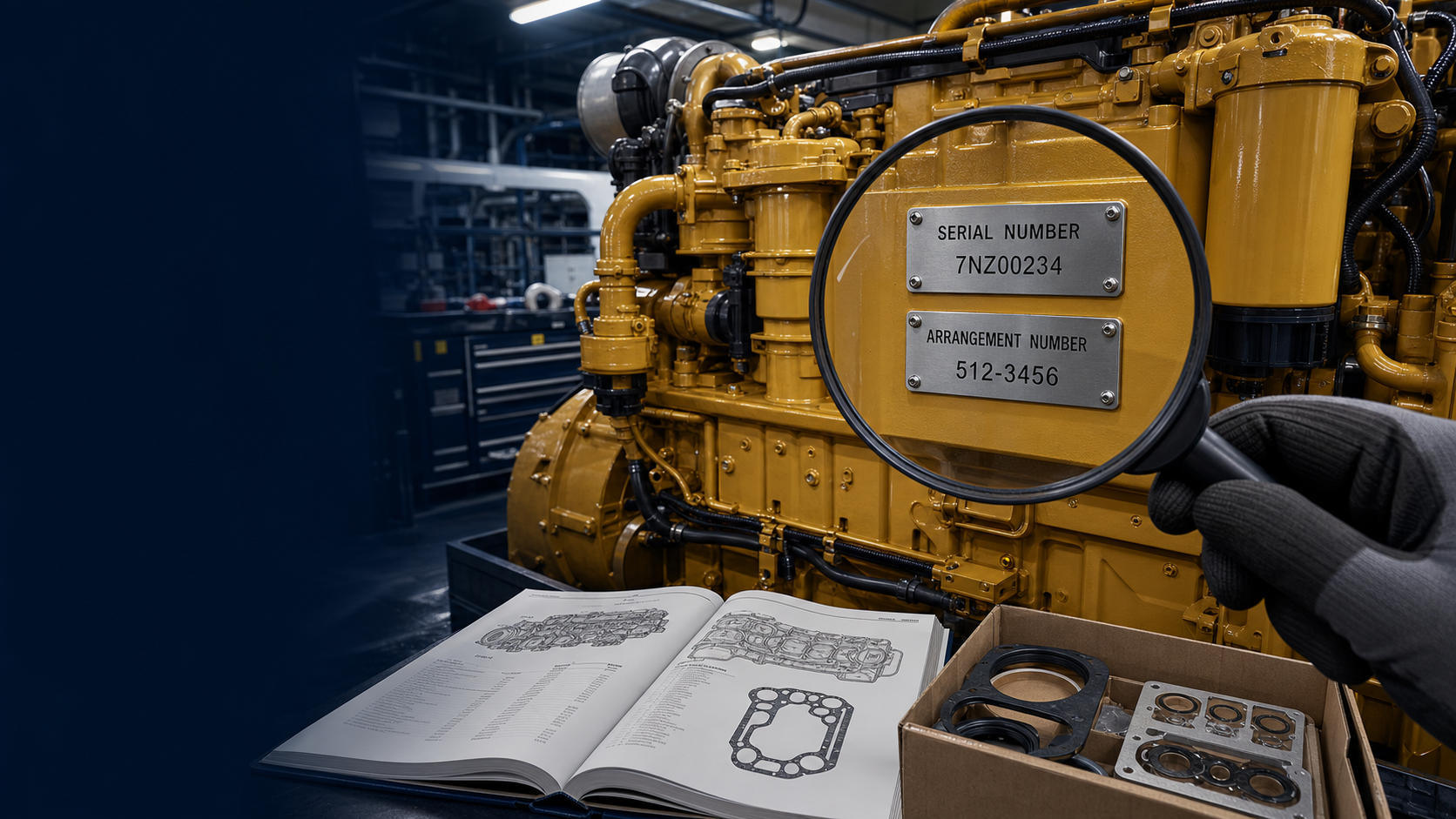
Most Caterpillar marine engines have an engine information plate attached to the engine block.
This identification plate commonly includes:
- Engine Model
- Engine Serial Number
- Arrangement Number
- Performance Information
Always clean the plate carefully before recording the numbers.
Avoid guessing if the plate is difficult to read. A single incorrect digit can result in ordering the wrong replacement parts.
Caterpillar 3100 Series (3116 & 3126)
On many Caterpillar 3116 and 3126 marine engines, the engine information plate is typically mounted on the engine block where it can be accessed during routine maintenance.
Depending on the installation, visibility may vary slightly between vessel layouts.
When recording engine information, note both the serial number and the arrangement number whenever possible.
Caterpillar 3200 Series (3208)
The Caterpillar 3208 has powered commercial fishing vessels, patrol boats, tugboats and workboats around the world for decades.
Its identification plate is generally positioned on the engine where technicians can access it during inspection or servicing.
Because many 3208 engines remain in operation after extensive rebuilds, accurate identification is especially important when selecting replacement parts.
Caterpillar 3400 Series (3406, 3408 & 3412)
The 3400 Series remains one of Caterpillar's most recognised marine engine families.
Whether you operate a 3406, 3408, or 3412, the engine information plate provides the identification details required for spare parts selection.
Since these engines have been produced in numerous marine configurations, supplying both identification numbers helps avoid compatibility issues.
Caterpillar 3500 Series (3512, 3516 & 3520)
The 3500 Series powers some of the world's largest commercial vessels, offshore support ships and industrial marine applications.
Because these engines often operate continuously under heavy load, planned maintenance is essential.
Providing the engine serial number and arrangement number helps ensure overhaul components match the engine's original specification.
Caterpillar C-Series Marine Engines
Modern Caterpillar marine engines—including the C7, C18, C32, and C280—continue the same identification system.
Their information plates contain essential engine details used during maintenance, servicing and replacement parts identification.
Whether you're replacing a turbocharger, injector, cylinder head or cooling system component, accurate engine identification remains the first step.
Caterpillar Marine Engine Serial Number Prefixes
Many Caterpillar serial numbers begin with a three-character prefix.
These prefixes help distinguish engine production groups and are commonly referenced in Caterpillar technical documentation.
However, the prefix alone is not sufficient for ordering replacement parts.
Always provide the complete engine serial number, not just the prefix.
This allows the engine to be identified more accurately and reduces the possibility of ordering incompatible components.
Common Mistakes When Ordering Caterpillar Marine Parts
Many delays could be avoided by checking engine identification before requesting a quotation.
Some of the most common mistakes include:
Ordering by Engine Model Alone
Knowing you have a Caterpillar C32 or 3412 is helpful—but it doesn't always identify the correct part.
Guessing the Serial Number
If the identification plate is dirty or damaged, clean it carefully before recording the numbers.
Never estimate missing digits.
Ignoring the Arrangement Number
Many replacement parts depend on the engine's original factory configuration.
Providing the arrangement number often prevents ordering errors.
Ordering by Appearance
Two components may look almost identical while having different specifications.
Always identify parts using engine information rather than visual appearance.
How Alfa Marine Spare Parts Can Help
At Alfa Marine Spare Parts, we understand that identifying the correct Caterpillar marine engine part can sometimes be challenging—especially on engines that have been in service for many years.
Our team can help you identify replacement components using available engine information, including:
- Engine Model
- Engine Serial Number
- Arrangement Number
- Existing Part Numbers
- Component Descriptions
We supply a wide range of genuine, OEM, aftermarket, and professionally remanufactured Caterpillar marine engine parts for customers around the world.
Whether you're carrying out routine maintenance or preparing for a complete engine overhaul, our goal is to help you source the right components efficiently and confidently.
In the final section, we'll cover:
- Frequently Asked Questions
- Caterpillar Engine Identification Checklist
- Marine Engineer Maintenance Tips
- Why Choose Alfa Marine Spare Parts
- Industries We Supply
- Worldwide Shipping
- Contact Information
- Final Thoughts
Frequently Asked Questions, Maintenance Tips & Why Choose Alfa Marine Spare Parts
Frequently Asked Questions About Caterpillar Marine Engine Serial Numbers
Over the years, we've noticed that many marine engineers and vessel owners ask the same questions when identifying their Caterpillar engines. Below are the answers to some of the most common questions.
Can I Order Caterpillar Marine Parts Without the Engine Serial Number?
Sometimes, yes—but it's not always recommended.
If you already have a genuine Caterpillar part number, identifying the correct replacement is often straightforward.
However, if the part number is missing or unreadable, the engine serial number becomes one of the most reliable ways to identify the correct replacement component.
Providing the serial number helps reduce the risk of ordering incorrect parts and can speed up the quotation process.
What If My Engine Identification Plate Is Missing?
This is common on older marine engines.
If the identification plate has become damaged, painted over, or removed during previous repairs, don't panic.
Other information may still help identify your engine, including:
- Existing part numbers
- Engine model
- Arrangement number (if available)
- Vessel documentation
- Previous maintenance records
If you can provide photographs of the engine and any remaining identification markings, our team will do its best to help identify the correct parts.
Can Two Caterpillar Engines Have the Same Serial Number?
No.
Every Caterpillar engine is assigned its own unique serial number during manufacturing.
This number stays with the engine throughout its operating life and is one of the primary references used for engine identification.
Can Two Engines Have the Same Arrangement Number?
Yes.
Engines built to the same factory specification may share the same arrangement number.
However, each engine will still have its own unique serial number.
This is why both numbers work together during engine identification.
Why Isn't the Engine Model Enough?
Many Caterpillar marine engines were produced in several different configurations.
Although two engines may both be labelled Caterpillar C18 or 3412, they may use different:
- Injectors
- Water pumps
- Cylinder heads
- Turbochargers
- Fuel systems
- Cooling systems
The engine serial number helps identify these differences.
Is the Engine Serial Number Important During an Overhaul?
Absolutely.
Whether you're replacing a single injector or carrying out a complete engine overhaul, accurate engine identification helps ensure replacement components match the engine's original specification.
This reduces delays and improves maintenance planning.
Marine Engineer's Engine Identification Checklist
Before requesting a quotation for Caterpillar marine engine parts, take a few minutes to collect the following information.
Engine Information
✔ Engine Model
✔ Engine Serial Number
✔ Arrangement Number
✔ Engine Power Rating
✔ Engine Hours
✔ Vessel Name
✔ Port or Starboard Engine
Parts Information
✔ Existing Part Number (if available)
✔ Component Description
✔ Quantity Required
✔ Photographs of the Part (if possible)
✔ Photographs of the Identification Plate
Providing this information allows suppliers to identify compatible replacement parts more efficiently.
Maintenance Tip: Protect Your Engine Identification Plate
One simple maintenance task is often overlooked.
During routine engine cleaning, avoid damaging or painting over the identification plate.
Instead:
- Keep the plate clean.
- Photograph it during scheduled maintenance.
- Record the serial number in your vessel's maintenance records.
- Store a digital copy for future reference.
Having this information readily available can save valuable time during emergency repairs.
Common Caterpillar Marine Parts Identified Using Engine Information
Once the correct engine has been identified, engineers can confidently source many different replacement components.
Some of the most commonly requested Caterpillar marine engine parts include:
- Cylinder Heads
- Cylinder Head Gaskets
- Fuel Injectors
- Turbochargers
- Pistons
- Piston Rings
- Cylinder Liners
- Connecting Rod Bearings
- Main Bearings
- Camshafts
- Crankshafts
- Oil Pumps
- Freshwater Pumps
- Seawater Pumps
- Water Pump Repair Kits
- Heat Exchangers
- Aftercoolers
- Oil Coolers
- Thermostats
- Fuel Pumps
- Exhaust Manifolds
- Complete Overhaul Kits
- Gasket Sets
- Seal Kits
Accurate engine identification helps ensure these components match the engine's original specification.
Why Marine Engineers Choose Alfa Marine Spare Parts
When sourcing marine engine components, choosing the right supplier is just as important as choosing the right part.
At Alfa Marine Spare Parts, we work with customers around the world to help identify and supply marine engine components for routine maintenance, planned overhauls, and emergency repairs.
We supply:
- Genuine Parts
- OEM Parts
- High-Quality Aftermarket Parts
- Professionally Remanufactured Components
Our experienced team assists customers by helping identify parts using engine information such as serial numbers, arrangement numbers, engine models, and available part numbers.
Our goal is simple:
To help marine professionals source the correct parts efficiently and minimise unnecessary downtime.
Industries We Support
We proudly work with customers across the maritime industry, including:
- Commercial Shipping Companies
- Shipyards
- Marine Repair Companies
- Fishing Fleets
- Offshore Operators
- Tugboat Companies
- Ferry Operators
- Government Fleets
- Naval Operators
- Yacht Management Companies
- Marine Equipment Distributors
- Boat Builders
- Marine Engineers
- Chief Engineers
- Technical Superintendents
- Fleet Managers
Whether you operate a single vessel or manage an entire fleet, we're committed to supporting your maintenance requirements.
Worldwide Marine Spare Parts Supply
Alfa Marine Spare Parts supplies customers in major maritime regions across the world, including:
- Spain
- Netherlands
- Germany
- Italy
- France
- Norway
- Greece
- United Kingdom
- United States
- Canada
- Mexico
- Brazil
- United Arab Emirates
- Saudi Arabia
- Qatar
- Nigeria
- South Africa
- Singapore
- Australia
We understand that every hour a vessel spends waiting for parts can affect operations, so we focus on helping customers source the right components as efficiently as possible.
Browse Our Complete Marine Spare Parts Catalog
Looking for Caterpillar marine engine parts or components for another leading marine diesel engine brand?
Browse our extensive online catalog:
https://alfamarinespareparts.com/spareparts
Our product range includes parts for:
- Caterpillar
- Cummins
- MTU
- MAN
- Volvo Penta
- Yanmar
- Perkins
- Wärtsilä
- Scania
- Detroit Diesel
- Mitsubishi
- Deutz
- John Deere
- Komatsu
- Doosan
Contact Alfa Marine Spare Parts
Need help identifying your Caterpillar marine engine or selecting the correct replacement part?
Our experienced team is ready to assist.
Website
https://alfamarinespareparts.com
Browse Marine Spare Parts
https://alfamarinespareparts.com/spareparts
request@alfamarinespareparts.com
Providing your engine serial number, arrangement number, or existing part number allows us to assist you more efficiently.
Final Thoughts
Identifying a Caterpillar marine engine starts with more than simply knowing the engine model. The engine serial number and arrangement number provide valuable information that helps confirm the engine's original specification and supports accurate spare parts identification.
Taking a few minutes to record these details before ordering replacement components can reduce delays, avoid ordering mistakes, and simplify maintenance planning.
Whether you're replacing a seawater pump, turbocharger, injector, cylinder head, or preparing for a complete engine overhaul, accurate engine identification is one of the best ways to ensure you receive components that match your engine's configuration.
At Alfa Marine Spare Parts, we're committed to helping marine engineers, ship owners, fleet operators, and shipyards identify the right Caterpillar marine engine parts with confidence. From routine maintenance to major overhauls, our team is here to support your vessel with genuine, OEM, aftermarket, and professionally remanufactured marine engine components supplied worldwide.
Together, the Caterpillar Marine Engine Serial Number and Arrangement Number are more than identification numbers—they are the key to ordering the right parts, reducing downtime, and keeping your vessel operating safely and efficiently for years to come.