Deutz Marine Engine Black Smoke? Your Charge Air Cooler Could Be the Real Problem
Deutz Marine Engine Black Smoke? Check the Charge Air Cooler Before Replacing the Turbocharger
One of the most common mistakes made during marine engine troubleshooting is assuming that black exhaust smoke automatically means a failed turbocharger.
While turbocharger failures certainly happen, they are not always the root cause.
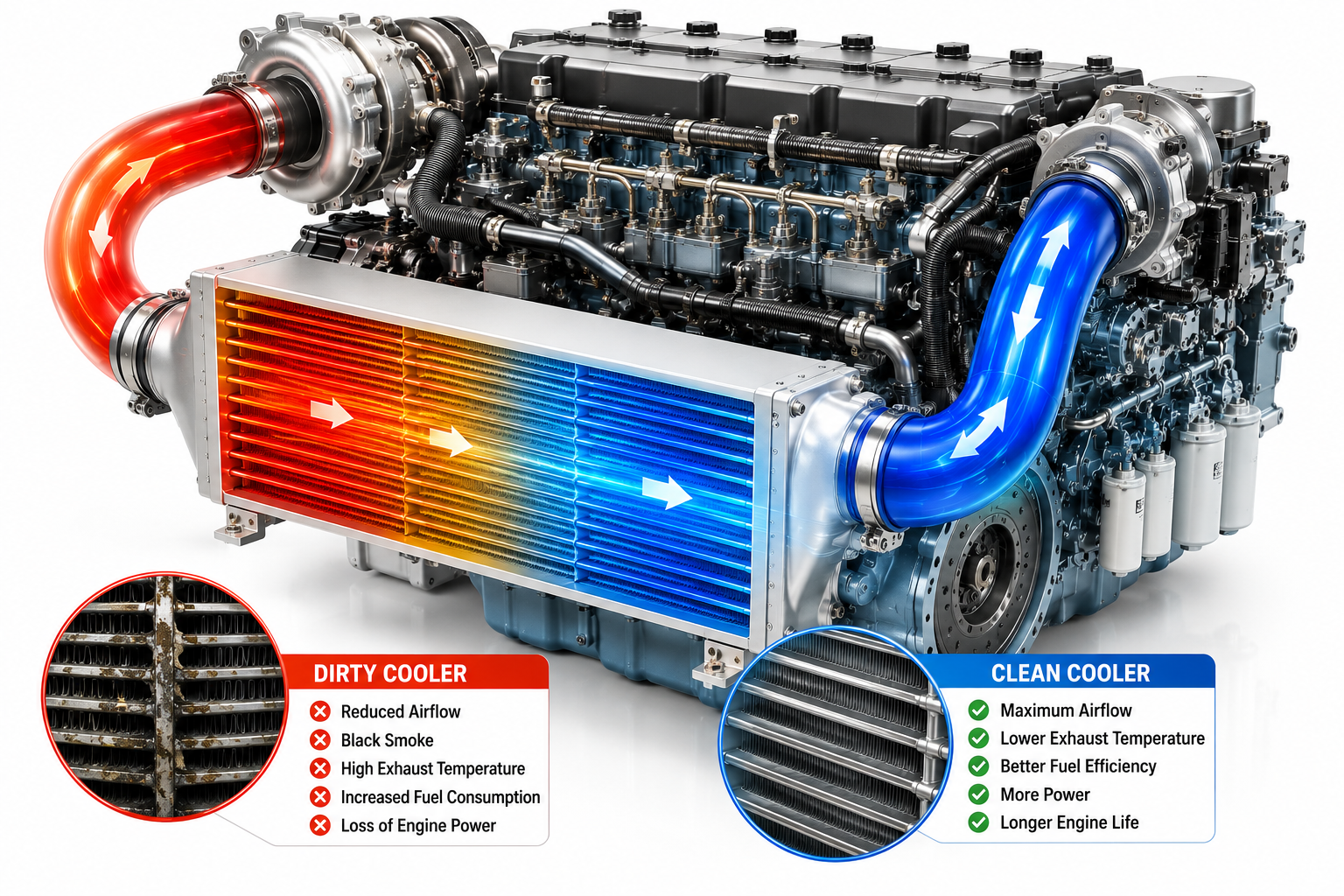
On many Deutz marine diesel engines, reduced airflow through a contaminated charge air cooler (also called an aftercooler) can create nearly identical symptoms. Before investing in an expensive turbocharger replacement, it is worth inspecting the entire air intake system.
A restricted charge air cooler can reduce engine efficiency, increase fuel consumption and raise exhaust temperatures long before obvious mechanical damage occurs.
What Does a Charge Air Cooler Do?
A turbocharger compresses incoming air.
As air is compressed, its temperature rises.
Hot air contains less oxygen than cooler air of the same volume.
The purpose of the charge air cooler is to reduce the temperature of this compressed air before it reaches the cylinders.
Cooler air provides:
- Higher oxygen density
- Better combustion
- Improved engine performance
- Lower exhaust gas temperatures
- Better fuel economy
- Reduced thermal stress
Without efficient cooling, even a healthy turbocharger cannot deliver maximum engine performance.
Why Do Charge Air Coolers Become Dirty?
Marine environments are harsh.
Over thousands of operating hours, contaminants gradually accumulate inside the cooler.
Typical deposits include:
- Salt crystals
- Oil mist from the crankcase ventilation system
- Carbon particles
- Dust
- Moisture
- Soot
These deposits reduce the available airflow area.
The engine then struggles to receive enough fresh air during combustion.
Common Symptoms on Deutz Marine Engines
Operators frequently report:
- Black smoke during acceleration
- Higher exhaust gas temperatures
- Increased fuel consumption
- Reduced engine power
- Slower turbo response
- Reduced boost pressure
- Poor throttle response
- Increased engine loading
These symptoms are often blamed on injectors or turbochargers, but restricted airflow should always be investigated first.
Why Airflow Matters
A diesel engine depends on the correct balance between air and fuel.
When airflow decreases but the fuel system continues delivering the same quantity of diesel fuel, combustion becomes incomplete.
This results in:
- More soot
- Higher cylinder temperatures
- Increased exhaust temperatures
- Smoke formation
- Carbon deposits
- Reduced efficiency
Over time, excessive exhaust temperatures can shorten the life of:
- Turbochargers
- Exhaust valves
- Pistons
- Cylinder liners
How Can You Tell if the Charge Air Cooler Needs Cleaning?
Modern maintenance practices increasingly rely on measurement rather than guesswork.
Technical service documentation recommends monitoring the pressure drop across the air side of the charge air cooler. An increase in pressure drop is a strong indicator that deposits are restricting airflow and that cleaning should be scheduled before performance deteriorates significantly. Measurements should be taken at a consistent high engine load and compared with baseline readings from a clean cooler.
Regular monitoring helps engineers avoid unnecessary component replacement.
Inspection Checklist
Before replacing expensive components, inspect:
✔ Air filter
✔ Turbocharger compressor wheel
✔ Boost hoses
✔ Hose clamps
✔ Intake manifold
✔ Charge air cooler
✔ Air leaks
✔ Intake restrictions
A complete inspection often identifies the actual cause much faster than replacing parts one by one.
Why This Matters on Deutz Marine Engines
Many Deutz marine engines operate continuously in:
- Fishing vessels
- Patrol boats
- Workboats
- Tugboats
- Offshore support vessels
- Passenger ferries
- Commercial cargo vessels
Long operating hours combined with salt-laden air accelerate contamination inside cooling components.
Preventive inspection reduces unexpected downtime and improves long-term reliability.
Can a Dirty Charge Air Cooler Damage the Turbocharger?
Indirectly, yes.
When airflow becomes restricted, the turbocharger works harder to maintain boost pressure.
This can increase:
- Bearing temperatures
- Compressor speed
- Thermal loading
- Exhaust temperatures
Although the turbocharger may not be faulty, prolonged operation under these conditions can reduce its service life.
Best Maintenance Practices
Experienced marine engineers recommend:
- Inspecting the intake system during scheduled maintenance
- Recording boost pressure trends
- Monitoring exhaust gas temperatures
- Measuring charge air cooler pressure drop
- Cleaning the cooler before heavy fouling develops
- Pressure-testing the cooler after cleaning to verify integrity
Preventive maintenance is typically less expensive than repairing damage caused by prolonged overheating or airflow restriction.
Frequently Asked Questions
Does black smoke always mean the turbocharger is failing?
No. Restricted airflow from a dirty charge air cooler, blocked air filter, intake leaks, or fuel system issues can produce similar symptoms.
Can cleaning the charge air cooler restore engine performance?
If fouling is the primary cause of airflow restriction, cleaning the cooler can improve airflow, reduce exhaust temperatures, and restore engine performance.
Should the charge air cooler be pressure-tested?
Yes. After cleaning, pressure testing helps confirm there are no internal leaks that could affect performance or allow coolant to enter the intake system.
How often should it be inspected?
Inspection intervals vary depending on engine type, operating environment, and fuel quality. Vessels operating in salty or dusty environments may require more frequent inspections than those operating in cleaner conditions.
Final Thoughts
A turbocharger is often blamed first when a Deutz marine engine begins producing black smoke, but it should not be the first component replaced.
The charge air cooler plays a critical role in engine efficiency, combustion quality, and temperature control. Monitoring airflow restriction, inspecting the intake system, and cleaning the cooler when necessary can improve performance, reduce fuel consumption, and help avoid costly repairs.
Accurate diagnosis is one of the most valuable maintenance practices in any engine room. By understanding how the charge air cooler affects engine operation, marine engineers can make informed maintenance decisions that improve reliability and extend the service life of critical engine components.