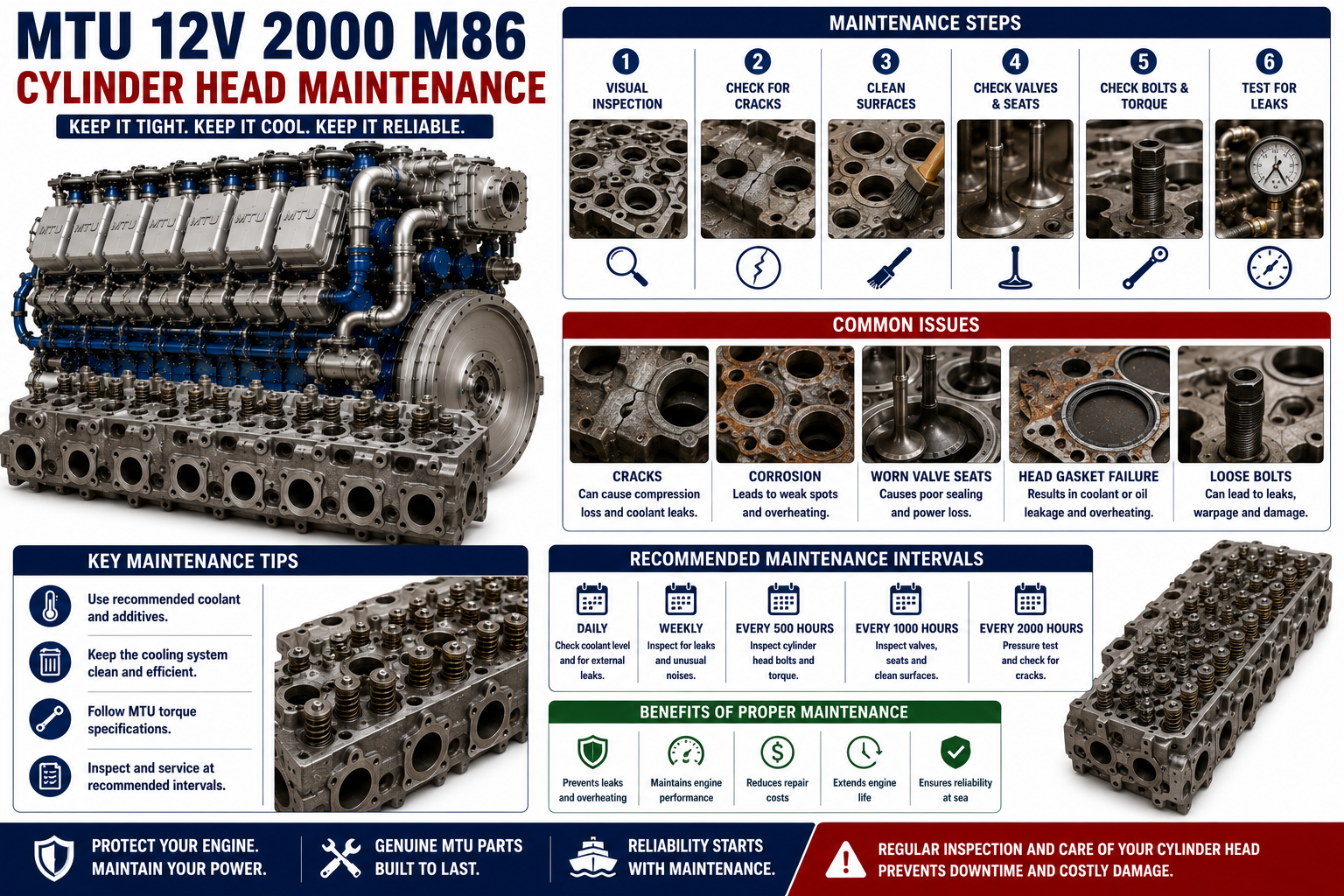
MTU 12V 2000 M86 Cylinder Head Maintenance: The Hidden Problems Every Marine Engineer Should Watch For
Have you ever noticed an MTU engine that starts perfectly, develops full power, and yet slowly begins consuming more coolant or running slightly hotter than normal?
At first, it's easy to dismiss these changes. The engine still performs well, there are no warning alarms, and everything appears to be operating normally.
But experienced marine engineers know that these small changes can sometimes point to one of the engine's most important components—the cylinder head.
The MTU 12V 2000 M86 marine engine is designed to deliver exceptional performance for luxury yachts, commercial vessels, patrol boats, and offshore support craft. The cylinder heads play a vital role in containing combustion pressure, managing airflow, housing the valves and injectors, and supporting efficient cooling.
When properly maintained, cylinder heads provide many thousands of reliable operating hours. When neglected, however, they can become the starting point for overheating, compression loss, coolant leaks, and expensive engine repairs.
Let's explore why cylinder head maintenance deserves far more attention than it often receives.
What Does the Cylinder Head Do?
Think of the cylinder head as the engine's control center.
It seals the combustion chamber while supporting several critical systems at the same time.
Inside each cylinder head you'll find:
- Intake valves
- Exhaust valves
- Fuel injector
- Valve guides
- Valve seats
- Cooling passages
- Combustion chamber
- Valve springs
- Rocker arm assembly
Every combustion cycle creates extremely high temperatures and pressures.
The cylinder head must withstand these conditions thousands of times every minute.
Why Cylinder Heads Experience Wear
One of the biggest misconceptions is that cylinder heads suddenly fail.
In reality, most problems develop slowly over hundreds or even thousands of operating hours.
Each time the engine warms up and cools down, the cylinder head expands and contracts.
This constant thermal cycling eventually affects:
- Valve seats
- Gasket sealing surfaces
- Cooling passages
- Valve guides
- Injector seats
Proper cooling and routine inspections significantly slow this natural aging process.
A Real Marine Maintenance Scenario
A commercial crew boat operating daily along the coast began showing slightly higher coolant temperatures during full-load operation.
No alarms appeared.
Oil pressure remained normal.
Fuel consumption increased only slightly.
The operator initially suspected the seawater pump.
However, during scheduled maintenance engineers pressure-tested the cooling system and discovered a minor cylinder head gasket leak.
Because the issue was identified early, only the gasket required replacement.
Had the vessel continued operating, overheating could eventually have damaged the cylinder head itself.
This example illustrates why small changes in engine behavior should never be ignored.
Common Causes of Cylinder Head Problems
Overheating
Excessive engine temperatures remain one of the leading causes of cylinder head damage.
Repeated overheating may cause:
- Warping
- Cracking
- Gasket failure
- Valve seat movement
Coolant Neglect
Coolant is much more than colored water.
Modern coolant protects against:
- Corrosion
- Cavitation
- Scale formation
- Electrolysis
Old coolant gradually loses these protective properties.
Poor Combustion
Faulty injectors may create uneven combustion temperatures.
Over time this increases thermal stress around exhaust valves and injector seats.
Improper Torque During Repairs
Cylinder heads must always be installed following MTU tightening procedures.
Incorrect torque can create uneven gasket loading and future leaks.
High Operating Loads
Continuous operation at high load naturally increases combustion temperatures.
Proper maintenance becomes even more important under these conditions.
Warning Signs Marine Engineers Should Watch For
Cylinder head problems often begin with subtle symptoms.
Watch for:
- Gradual coolant loss
- White exhaust smoke
- Hard starting
- Reduced engine power
- Higher operating temperatures
- Compression loss
- Bubbles inside the expansion tank
- Coolant contamination
- Uneven engine operation
- Increased fuel consumption
Many of these symptoms may appear long before a complete failure occurs.
Components That Should Be Inspected Together
Whenever cylinder head maintenance is performed, engineers should also inspect:
- Head gasket
- Fuel injectors
- Intake valves
- Exhaust valves
- Valve seats
- Valve guides
- Rocker arms
- Camshaft
- Cooling passages
- Thermostats
- Heat exchanger
- Charge air cooler
A cylinder head rarely works in isolation.
Understanding the relationship between these components improves diagnostic accuracy.
Can Oil Analysis Help?
Yes.
Oil analysis cannot directly identify a cracked cylinder head, but it often reveals secondary problems.
Laboratory testing may detect:
- Coolant contamination
- Sodium
- Potassium
- Water contamination
- Increased bearing wear
- Oxidation
These results provide valuable early warning before visible damage develops.
Preventive Maintenance Checklist
Good cylinder head maintenance starts long before major repairs become necessary.
Recommended practices include:
✔ Monitor coolant level before every voyage.
✔ Maintain the correct coolant mixture.
✔ Inspect for coolant leaks during routine engine room checks.
✔ Monitor engine operating temperatures.
✔ Perform regular oil analysis.
✔ Inspect injector performance.
✔ Check valve clearances according to the maintenance schedule.
✔ Clean the heat exchanger.
✔ Inspect the charge air cooler.
✔ Record engine operating data for future comparison.
Marine Engineer Tip
One of the best diagnostic tools isn't a scanner—it's your maintenance logbook.
If coolant consumption slowly increases over several months while no external leaks are visible, begin investigating immediately.
Early detection often prevents cylinder head damage and significantly reduces repair costs.
Common Mistakes
Avoid these common errors:
- Ignoring small coolant losses.
- Mixing different coolant brands.
- Delaying overheating investigations.
- Replacing the head gasket without checking cylinder head flatness.
- Skipping valve inspections during major servicing.
- Assuming white smoke always indicates injector problems.
Frequently Asked Questions
How long do MTU cylinder heads normally last?
With proper cooling system maintenance and routine inspections, cylinder heads often remain in service for many thousands of operating hours.
Can overheating permanently damage a cylinder head?
Yes. Severe overheating may cause cracking or distortion that requires machining or replacement.
Should injectors be inspected during cylinder head servicing?
Absolutely. Injector condition directly affects combustion temperatures inside the cylinder head.
Can poor coolant damage cylinder heads?
Yes. Old or contaminated coolant promotes corrosion, cavitation, and overheating.
Does oil analysis detect cylinder head problems?
Oil analysis often identifies coolant contamination and secondary wear before major mechanical damage becomes obvious.
Worldwide Marine Engine Spare Parts Supply
Alfa Marine Spare Parts supplies genuine, OEM, aftermarket, remanufactured, and reconditioned spare parts for the MTU 12V 2000 M86 and the complete MTU Series 2000 engine family.
We proudly support:
- Commercial shipping companies
- Shipyards
- Offshore operators
- Yacht builders
- Marine engineers
- Chief engineers
- Technical superintendents
- Government fleets
- Fishing fleets
- Marine maintenance companies
We regularly ship marine engine components worldwide, including the United Kingdom, United States, Dubai (UAE), Monaco, Nigeria, the Netherlands, Italy, Spain, France, Germany, Norway, and Greece, helping vessels remain operational wherever they sail.
Browse Our Complete Spare Parts Catalog
Alfa Marine Spare Parts supplies:
- Cylinder heads
- Head gasket kits
- Intake valves
- Exhaust valves
- Valve guides
- Valve seats
- Rocker arms
- Camshafts
- Fuel injectors
- Heat exchangers
- Charge air coolers
- Seawater pumps
- Oil pumps
- Complete overhaul kits
Browse our complete catalog:
https://alfamarinespareparts.com/spareparts
Why Choose Alfa Marine Spare Parts?
At Alfa Marine Spare Parts, we understand that every hour a vessel is out of service costs time and money.
Our experienced team helps marine professionals quickly identify the correct replacement parts, whether they're performing routine maintenance or planning a complete engine overhaul.
We provide:
- Genuine, OEM, aftermarket, remanufactured, and reconditioned marine engine spare parts
- Worldwide shipping
- Expert technical support
- Fast response for urgent vessel requirements
- Parts for MTU, Caterpillar, Wärtsilä, Cummins, MAN, Volvo Penta, Scania, Perkins, Detroit Diesel, Yanmar, and many other leading marine engine brands
Contact Alfa Marine Spare Parts
Need help finding the correct MTU 12V 2000 M86 cylinder head or related engine components?
Website: https://alfamarinespareparts.com
Email: request@alfamarinespareparts.com
Our marine parts specialists are ready to help you identify the correct components for your maintenance schedule, repair project, or engine overhaul.
Conclusion
The cylinder head is one of the hardest-working components in the MTU 12V 2000 M86 marine engine, constantly exposed to extreme heat, pressure, and vibration. Fortunately, serious cylinder head failures rarely happen without warning. By paying attention to subtle changes such as rising coolant consumption, higher operating temperatures, or reduced engine performance, marine engineers can detect problems early and prevent costly repairs. Combined with regular cooling system maintenance, oil analysis, injector inspections, and proper service procedures, a proactive approach to cylinder head maintenance helps ensure years of reliable performance from your MTU engine while reducing downtime and protecting your investment.