
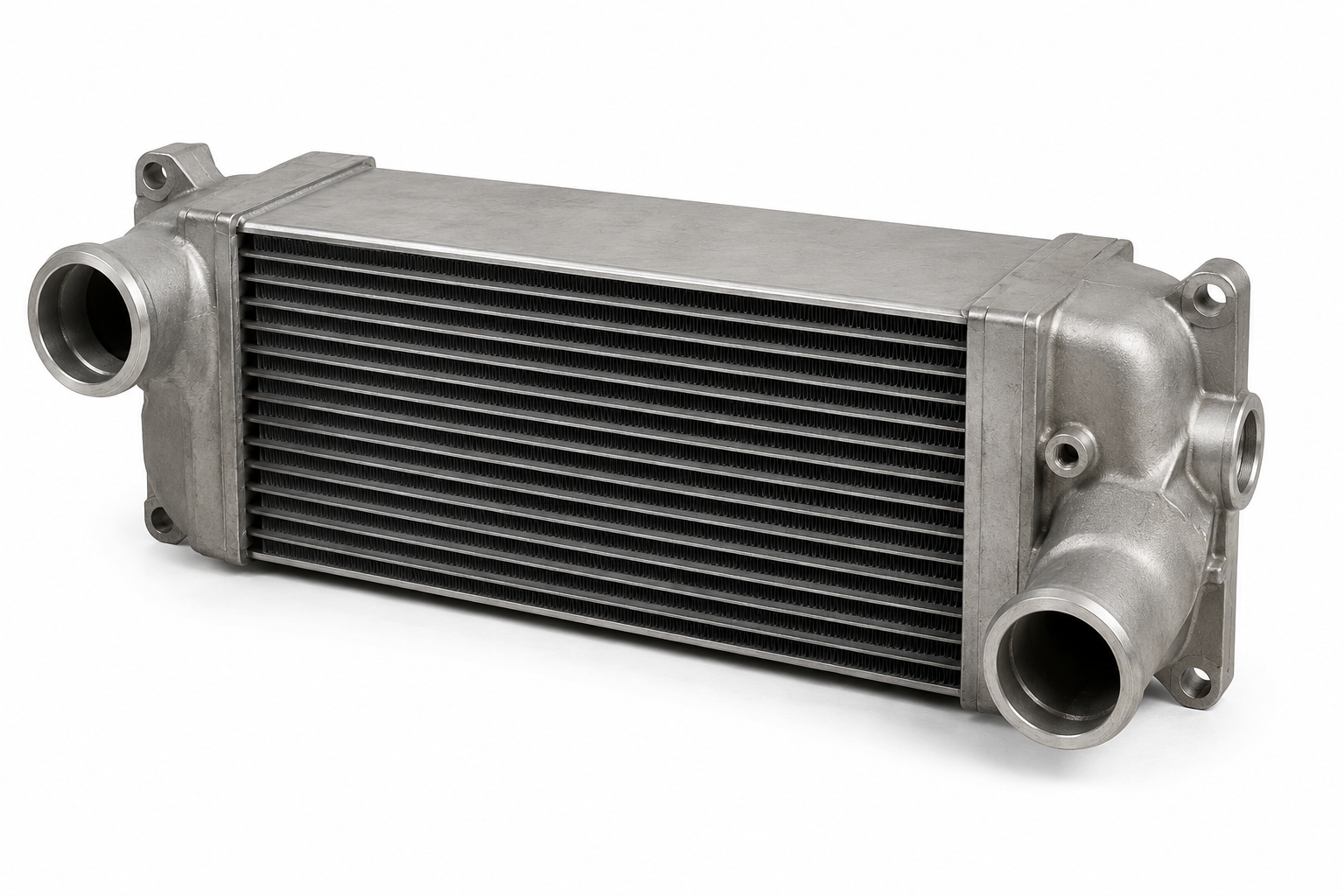
MTU 12V 2000 M96L Charge Air Cooler Maintenance: Why Clean Air Means a Healthier Marine Engine
If you've ever experienced a gradual loss of engine power without any warning lights, you're not alone.
Many marine engineers immediately think about clogged fuel filters, worn injectors, or turbocharger issues. Those are certainly common causes, but there's another component that quietly affects engine performance every single day—the charge air cooler.
The MTU 12V 2000 M96L is engineered to deliver impressive power while maintaining fuel efficiency and reliability. To achieve this, the engine depends on a continuous supply of cool, dense air entering the cylinders. That's exactly what the charge air cooler is designed to provide.
When this component becomes dirty or partially restricted, the effects often appear gradually. Fuel consumption increases, exhaust temperatures rise, and engine performance slowly declines. Because these changes happen over time, they're easy to overlook until they become expensive.
Let's explore why the charge air cooler deserves regular attention and how proper maintenance helps protect your entire engine.
What Is a Charge Air Cooler?
The turbocharger compresses incoming air before it enters the engine.
Compressing air increases its temperature.
Hot air expands, making it less dense.
The charge air cooler lowers that temperature before the air reaches the combustion chamber.
Cooler air contains more oxygen.
More oxygen allows:
- Better combustion
- Improved fuel efficiency
- Higher engine power
- Lower exhaust temperatures
- Reduced engine stress
Without efficient cooling, the turbocharger cannot perform at its full potential.
Why Is Air Temperature So Important?
Imagine trying to breathe through a warm scarf on a hot summer day.
You still receive air, but not as efficiently.
Your engine experiences something similar.
Warm intake air contains less oxygen than cool air.
When less oxygen enters the cylinders, combustion becomes less efficient.
The engine compensates by burning more fuel while producing less power.
A Real Marine Maintenance Story
A luxury charter yacht powered by MTU 12V 2000 M96L engines began using noticeably more fuel during the summer season.
Nothing appeared wrong.
No warning alarms.
Oil pressure remained normal.
Turbochargers passed inspection.
Eventually, technicians removed the charge air cooler for cleaning.
Inside the cooling passages, they found salt deposits, oil residue, and marine contamination that had gradually reduced cooling efficiency.
After cleaning the unit, intake air temperatures dropped significantly.
Fuel consumption returned to normal, and engine performance noticeably improved.
The engine itself had never been the problem.
The restriction had simply reduced the amount of cool air reaching the cylinders.
How Does a Charge Air Cooler Become Dirty?
Many engineers think contamination happens suddenly.
In reality, it develops slowly over time.
Salt Deposits
Marine environments naturally expose cooling systems to salt.
Small deposits gradually reduce heat transfer efficiency.
Oil Residue
Tiny amounts of oil from the turbocharger ventilation system may accumulate inside the cooler.
Over time, dust and soot stick to these oily surfaces.
Carbon Build-Up
Incomplete combustion sometimes creates deposits that reduce airflow efficiency.
Marine Growth
On seawater-cooled systems, biological growth inside cooling passages reduces heat transfer.
Poor Cooling System Maintenance
Restricted heat exchangers, dirty seawater strainers, or reduced seawater flow all affect charge air cooler performance.
Warning Signs Marine Engineers Should Notice
Charge air cooler problems rarely develop overnight.
Watch for:
- Higher intake air temperatures
- Increased fuel consumption
- Reduced engine power
- Higher exhaust temperatures
- Black exhaust smoke
- Slower turbocharger response
- Reduced boost efficiency
- Increased engine load
- Uneven combustion
- Higher coolant temperatures
The earlier these symptoms are investigated, the easier they usually are to correct.
Why Intake Air Temperature Matters
Modern MTU engines are carefully engineered around precise operating temperatures.
Even relatively small increases in intake air temperature reduce combustion efficiency.
Higher intake temperatures often lead to:
- Increased fuel usage
- Higher combustion temperatures
- More thermal stress
- Reduced engine responsiveness
Maintaining cool intake air protects every cylinder.
Components That Should Be Inspected Together
Whenever servicing the charge air cooler, engineers should also inspect:
- Turbocharger
- Heat exchanger
- Seawater pump
- Air filters
- Intake piping
- Boost hoses
- Temperature sensors
- Thermostats
- Cooling hoses
- Exhaust manifold
The charge air cooler performs best when the entire cooling and air intake system operates efficiently.
Can Oil Analysis Help?
Oil analysis cannot directly measure charge air cooler efficiency.
However, it may identify secondary problems caused by poor combustion, including:
- Increased soot
- Fuel dilution
- Higher oxidation
- Abnormal wear metals
Combined with engine performance data, oil analysis helps engineers understand the bigger picture.
Preventive Maintenance Checklist
Routine maintenance helps maintain cooling efficiency.
✔ Monitor intake air temperatures.
✔ Clean seawater strainers regularly.
✔ Inspect the charge air cooler according to the maintenance schedule.
✔ Monitor exhaust temperatures.
✔ Inspect turbocharger condition.
✔ Replace damaged boost hoses.
✔ Perform routine oil analysis.
✔ Record fuel consumption trends.
✔ Clean the heat exchanger.
✔ Investigate gradual power loss immediately.
Marine Engineer Tip
Don't judge engine performance only by maximum speed.
Many charge air cooler problems first appear as higher fuel consumption during normal cruising.
If fuel usage slowly increases while engine load remains unchanged, checking intake air temperatures is an excellent place to begin.
Common Maintenance Mistakes
Avoid these common errors:
- Ignoring intake air temperature trends.
- Cleaning only the outside of the cooler.
- Assuming every power loss is caused by injectors.
- Delaying seawater system maintenance.
- Ignoring small increases in fuel consumption.
- Overlooking boost hose condition.
Frequently Asked Questions
How often should a charge air cooler be cleaned?
Cleaning intervals depend on operating hours, water quality, and vessel operating conditions. Engines working in warm seawater generally require more frequent inspections.
Can a dirty charge air cooler reduce engine power?
Yes. Higher intake air temperatures reduce combustion efficiency and overall engine performance.
Does the turbocharger depend on the charge air cooler?
Absolutely. Both systems work together to supply cool, compressed air to the engine.
Why does fuel consumption increase when the cooler becomes dirty?
Hotter intake air contains less oxygen, making combustion less efficient and requiring more fuel.
Should the heat exchanger also be inspected?
Yes. Problems elsewhere in the cooling system often affect charge air cooler performance.
Worldwide Marine Engine Spare Parts Supply
Alfa Marine Spare Parts supplies genuine, OEM, aftermarket, remanufactured, and reconditioned spare parts for the MTU 12V 2000 M96L and the complete MTU Series 2000 engine family.
We proudly support:
- Shipyards
- Commercial shipping companies
- Luxury yacht operators
- Offshore operators
- Marine engineers
- Chief engineers
- Technical superintendents
- Government fleets
- Fishing fleets
- Marine service companies
We regularly deliver marine engine spare parts throughout the United Kingdom, United States, Dubai (UAE), Monaco, Nigeria, the Netherlands, Italy, Spain, France, Germany, Norway, and Greece.
Browse Our Complete Spare Parts Catalog
Alfa Marine Spare Parts supplies:
- Charge air coolers
- Turbochargers
- Heat exchangers
- Seawater pumps
- Water pumps
- Fuel injectors
- Air filters
- Oil pumps
- Cylinder heads
- Camshafts
- Cooling system components
- Complete overhaul kits
Browse our complete catalog:
https://alfamarinespareparts.com/spareparts
Why Choose Alfa Marine Spare Parts?
At Alfa Marine Spare Parts, we understand that reliable engine performance starts with reliable components. Whether you're carrying out scheduled maintenance or responding to an unexpected repair, our experienced team is here to help you identify the correct parts quickly and accurately.
We provide:
- Genuine, OEM, aftermarket, remanufactured, and reconditioned marine engine spare parts
- Worldwide shipping
- Technical support for part identification
- Fast quotations
- Spare parts for MTU, Caterpillar, Wärtsilä, Cummins, MAN, Volvo Penta, Scania, Detroit Diesel, Perkins, Yanmar, and many other leading marine engine brands
Our mission is to help keep your vessels operating safely, efficiently, and with minimal downtime.
Contact Alfa Marine Spare Parts
Need assistance finding the correct MTU 12V 2000 M96L charge air cooler or related cooling system components?
Website: https://alfamarinespareparts.com
Email: request@alfamarinespareparts.com
Our experienced marine parts specialists are ready to help you identify the right components for routine maintenance, emergency repairs, or complete engine overhauls.
Conclusion
The charge air cooler on the MTU 12V 2000 M96L does far more than cool compressed air—it directly influences engine power, fuel efficiency, combustion quality, and long-term reliability. Most performance losses linked to the charge air cooler develop gradually through salt deposits, oil residue, restricted cooling passages, or neglected maintenance. By monitoring intake air temperatures, inspecting the complete cooling system, and cleaning the charge air cooler at the recommended intervals, marine engineers can prevent unnecessary fuel consumption, protect the turbocharger, and ensure their MTU engine continues delivering dependable performance for thousands of operating hours.