
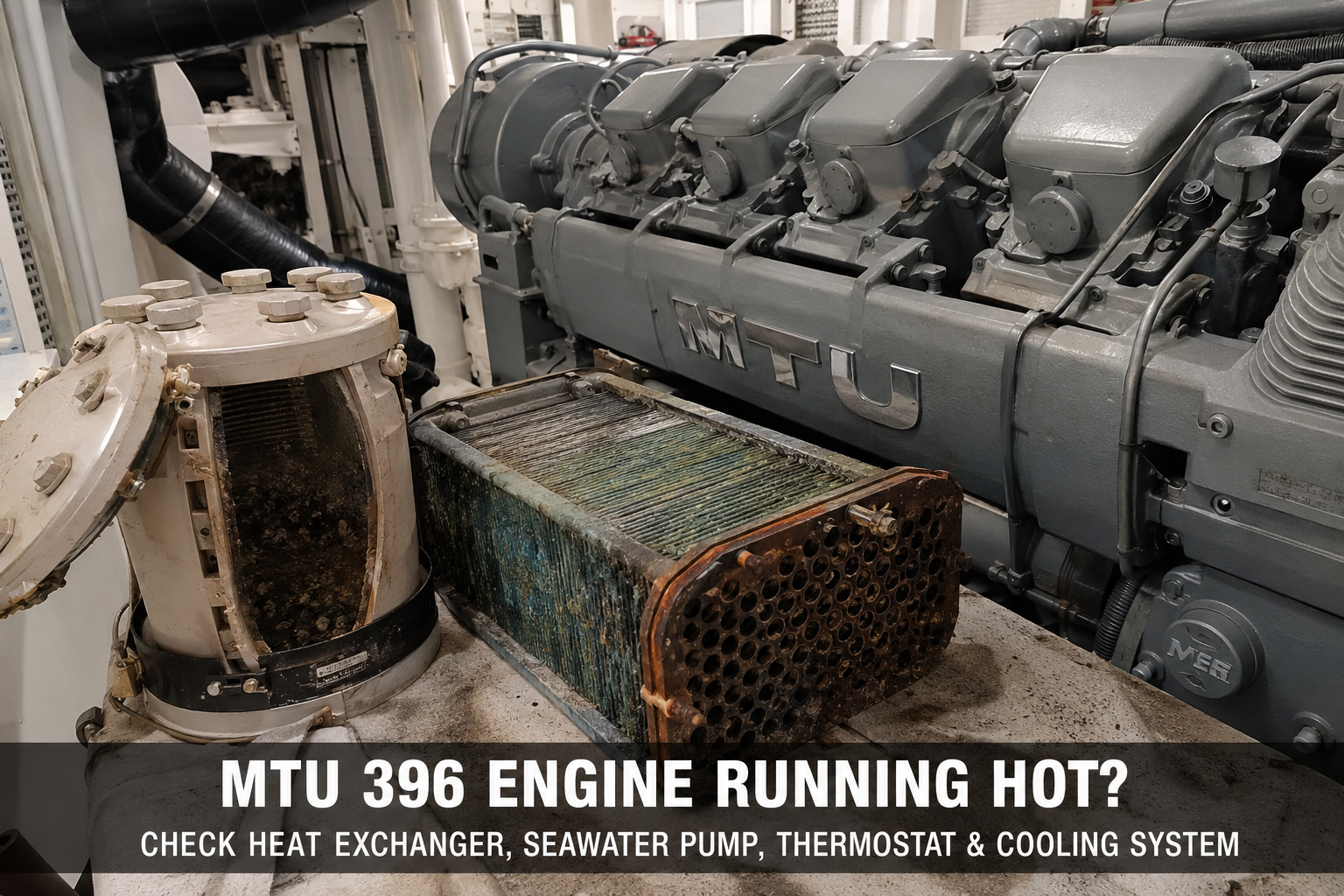
MTU 396 Engine Running Hot? Common Cooling Problems and Technical Checks
Is your MTU 396 engine running hotter than normal? Many engineers first suspect a faulty thermostat, but overheating on an MTU 396 marine diesel engine is often caused by reduced cooling efficiency rather than one failed component.
Before replacing MTU 396 engine parts, check the cooling system carefully. A restricted seawater circuit, fouled heat exchanger, worn pump, or blocked strainer can all increase engine temperature.
Why Is My MTU 396 Engine Overheating?
A gradual increase in operating temperature usually means the cooling system is no longer transferring heat efficiently.
Common causes include:
- Fouled MTU 396 heat exchanger
- Restricted seawater intake
- Blocked raw-water strainer
- Reduced seawater pump performance
- Worn water-pump impeller
- Collapsed or restricted cooling hoses
- Incorrect coolant condition
- Blocked internal cooling passages
- Marine growth around the seawater inlet
These problems may appear first when the engine is operating at high load or when seawater temperature increases.
Is the MTU 396 Heat Exchanger Dirty?
A fouled MTU 396 heat exchanger may continue working at low engine load but struggle to remove enough heat at higher power.
Typical signs include:
- Normal temperature at idle
- Higher temperature under load
- Gradual loss of cooling performance
- Frequent temperature alarms
- Different temperatures between similar engines
- Reduced seawater discharge flow
Salt deposits, scale, corrosion, oil contamination, and marine growth can reduce heat-transfer efficiency.
When inspecting the heat exchanger, also check the end covers, seals, gaskets, tubes, and coolant passages.
Could the MTU 396 Seawater Pump Be Worn?
Yes. The MTU 396 seawater pump is essential for circulating raw water through the engine cooling system.
Wear may develop in the:
- Impeller
- Pump shaft
- Bearings
- Mechanical seal
- Pump housing
- Cover plate
- Drive components
A damaged impeller may still rotate while producing insufficient flow. Missing impeller pieces can also travel downstream and restrict the heat exchanger or cooling pipes.
When inspecting an MTU 396 water pump, check for leakage, unusual noise, shaft movement, corrosion, and reduced discharge flow.
Should I Replace the Thermostat First?
Not automatically.
An MTU 396 thermostat can fail, but replacing it without checking seawater flow may not solve the problem.
Start with these basic checks:
- Inspect the seawater intake.
- Clean the raw-water strainer.
- Check seawater discharge flow.
- Inspect the pump impeller.
- Examine cooling hoses for internal collapse.
- Check the heat exchanger for fouling.
- Confirm coolant level and condition.
- Compare temperature readings with previous engine data.
Good troubleshooting should identify the cause before MTU 396 spare parts are replaced.
Why Does the Engine Only Overheat Under Load?
An engine that operates normally at idle but overheats under load usually has insufficient cooling capacity.
Possible causes include:
- Partially blocked heat exchanger
- Reduced seawater flow
- Worn pump impeller
- Restricted exhaust-water injection
- Incorrect coolant mixture
- Excessive engine load
- Poor ventilation in the engine room
- Inaccurate temperature sensor
- Combustion-related problems
Higher engine load produces more heat. A cooling system with limited capacity may appear normal at low speed but fail to maintain temperature during full-load operation.
What MTU 396 Engine Data Should Be Monitored?
Regular operating data helps identify problems before an alarm occurs.
Monitor:
- Coolant temperature
- Lubricating-oil temperature
- Engine-oil pressure
- Seawater pressure
- Cooling-water pressure
- Exhaust-gas temperature
- Engine speed
- Engine load
- Fuel consumption
- Seawater discharge flow
Record readings under similar operating conditions. A slow change over time can indicate developing wear, contamination, or restriction.
Why Is One Cylinder Running Hotter?
A high exhaust temperature on one cylinder is not usually caused by the central cooling system alone.
Possible causes include:
- Faulty MTU 396 fuel injector
- Incorrect injector spray pattern
- Low compression
- Exhaust-valve leakage
- Intake restriction
- Uneven fuel delivery
- Cylinder-head problems
- Incorrect valve clearance
- Damaged piston rings
Compare the affected cylinder with the other cylinders before removing major MTU 396 engine components.
What Should Be Checked During MTU 396 Maintenance?
Routine MTU 396 engine maintenance should include more than oil and filter replacement.
Cooling-system checks may include:
- Inspecting the seawater pump
- Cleaning the heat exchanger
- Checking coolant condition
- Inspecting hoses and clamps
- Checking thermostats
- Inspecting temperature sensors
- Cleaning seawater strainers
- Checking for coolant leaks
- Checking for seawater leaks
- Monitoring operating temperatures
Other important service areas include:
- MTU 396 fuel injectors
- MTU 396 fuel pumps
- MTU 396 turbochargers
- MTU 396 cylinder heads
- MTU 396 pistons and liners
- MTU 396 valves
- MTU 396 bearings
- MTU 396 oil pumps
- MTU 396 filters
- MTU 396 gaskets and seals
Can Cooling-System Problems Damage Other Engine Parts?
Yes. Continued overheating can affect several MTU 396 marine engine parts.
Possible consequences include:
- Damaged cylinder-head gaskets
- Distorted cylinder heads
- Reduced oil viscosity
- Piston and liner wear
- Valve damage
- Turbocharger stress
- Seal failure
- Coolant leakage
- Loss of engine performance
- Unplanned engine shutdown
An overheating alarm should never be treated as an isolated temperature problem. The cause should be identified before returning the engine to normal service.
What Information Is Needed to Identify MTU 396 Parts?
The description “MTU 396 engine” is usually not enough to identify the correct component.
Record the following information:
- Engine model
- Engine serial number
- Part number
- Component description
- Cylinder configuration
- Vessel application
- Left-hand or right-hand engine position
- Photos of the old component
- Measurements where applicable
- Information from the MTU 396 parts catalogue
Accurate identification is especially important for pumps, injectors, gaskets, sensors, turbocharger components, and cooling-system parts.
Final Technical Advice
When an MTU 396 marine engine begins running hotter than usual, avoid replacing parts based only on assumptions.
Start with operating data, inspect the seawater circuit, check the heat exchanger, confirm pump performance, and compare current readings with the engine’s normal baseline.
A systematic approach can help distinguish between a cooling restriction, worn component, sensor problem, fuel-system fault, or internal engine issue.
For additional technical articles about MTU marine engines, MTU 396 engine parts, marine diesel troubleshooting, cooling systems, pumps, injectors, heat exchangers, and engine maintenance, visit www.alfamarinespareparts.com.