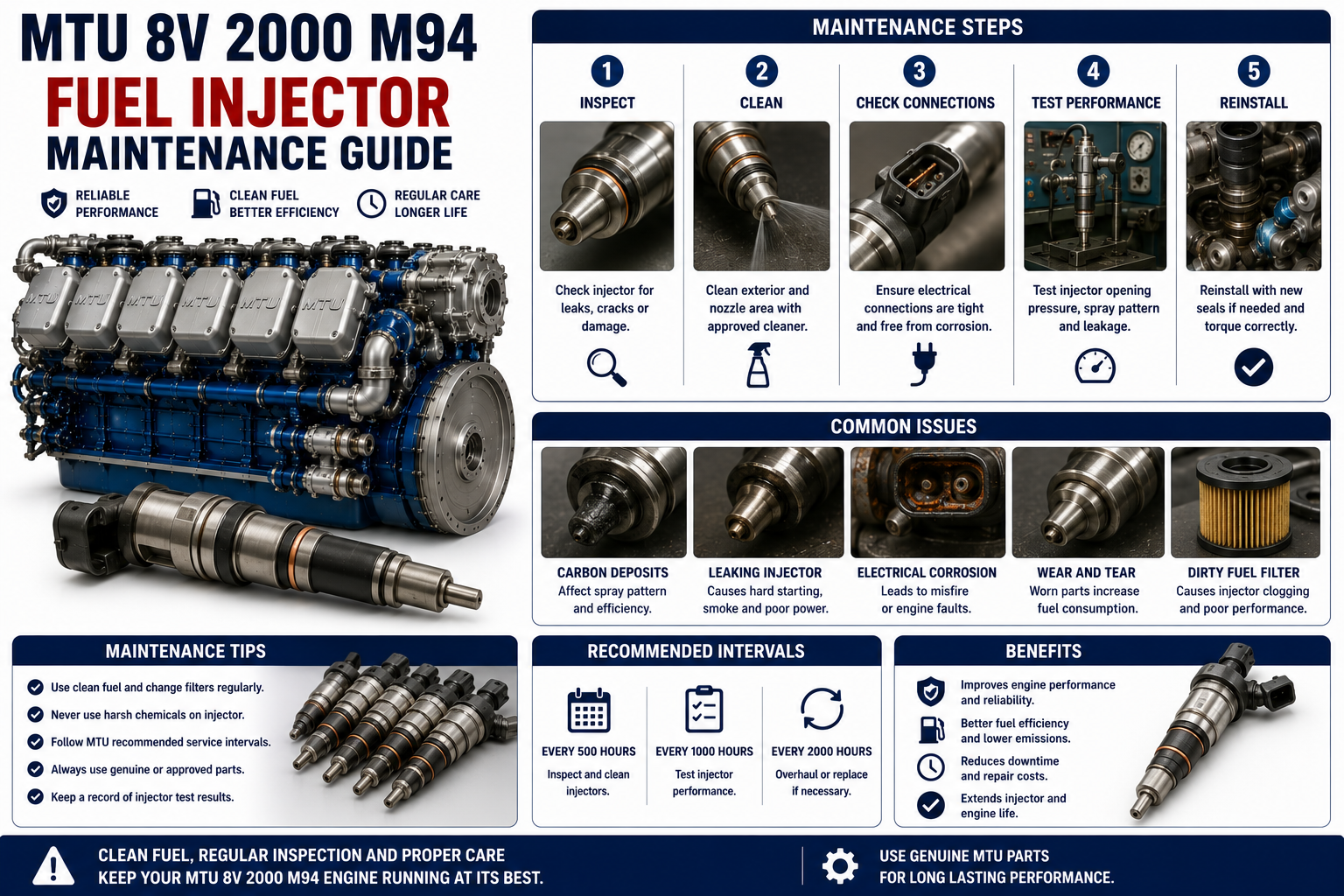
MTU 8V 2000 M94 Fuel Injector Maintenance: Why One Injector Can Affect Your Entire Marine Engine
Picture this: your vessel leaves the marina on schedule, the weather is calm, and your MTU 8V 2000 M94 starts instantly. Oil pressure is normal, coolant temperature is steady, and there are no warning lights on the display. Everything seems exactly as it should.
A few hours into the voyage, though, something changes. The engine doesn't feel quite as smooth as usual. Fuel consumption is slightly higher than the last trip, and one exhaust temperature is running hotter than the others. Nothing dramatic has happened, but experienced marine engineers know that small changes often tell the biggest story.
One of the first components they investigate is the fuel injector.
Fuel injectors are responsible for delivering precisely the right amount of fuel into each cylinder at exactly the right moment. When even one injector begins to wear, it can affect combustion, engine efficiency, emissions, and the life of other major components.
Let's look at why fuel injector maintenance is so important for the MTU 8V 2000 M94 and how early attention can prevent expensive repairs.
Why Are Fuel Injectors So Important?
Think of the injector as the engine's precision sprayer.
Its job isn't simply to deliver fuel—it must deliver the correct amount, at the correct pressure, with the correct spray pattern, and at precisely the right time.
Every combustion cycle depends on this accuracy.
If fuel is injected too early, too late, or with a poor spray pattern, combustion becomes less efficient.
That means:
- Higher fuel consumption
- Increased exhaust temperatures
- More smoke
- Reduced power
- Greater engine wear
On modern MTU engines, injector performance directly influences overall engine reliability.
How Does the MTU 8V 2000 M94 Fuel Injection System Work?
The MTU 8V 2000 M94 uses a high-pressure fuel injection system designed to deliver excellent combustion across the engine's operating range.
Fuel passes through several stages before reaching the injector:
- Fuel tank
- Primary fuel filters
- Secondary fuel filters
- High-pressure fuel system
- Injector
- Combustion chamber
Every part of this system must work together.
A restricted filter, contaminated fuel, or worn injector can reduce combustion efficiency even though the rest of the engine remains mechanically sound.
A Real Marine Maintenance Story
A commercial passenger vessel began reporting higher fuel consumption during routine operations.
The crew initially suspected hull fouling because vessel speed had also decreased slightly.
Divers cleaned the hull.
The propeller was inspected.
Turbochargers were checked.
Nothing appeared abnormal.
During scheduled engine diagnostics, technicians compared exhaust temperatures between cylinders and noticed one cylinder consistently operating hotter than the others.
Injector testing revealed a worn injector with an uneven spray pattern.
Replacing the injector restored smooth engine operation and reduced fuel consumption without any major engine repairs.
It's a reminder that sometimes the smallest components have the biggest influence on engine performance.
Why Do Fuel Injectors Wear Out?
Many people believe injectors suddenly fail.
In reality, injector wear usually develops gradually over thousands of operating hours.
Common causes include:
Normal Mechanical Wear
Internal injector components operate under extremely high pressure.
Over time, microscopic wear affects fuel delivery accuracy.
Contaminated Fuel
Marine fuel may contain:
- Water
- Dirt
- Rust particles
- Microbial contamination
Even small contaminants can damage precision injector components.
Poor Fuel Filtration
Blocked or poor-quality filters allow contaminants to reach the injector.
This increases internal wear and reduces injector life.
Carbon Deposits
Incomplete combustion can create deposits around the injector tip.
These deposits affect the spray pattern and combustion quality.
Long Periods of Low Engine Load
Engines that spend extended periods operating at light loads may experience increased carbon build-up.
Running the engine at the correct operating load helps reduce deposit formation.
Early Warning Signs
Injectors rarely fail without giving some warning.
Watch for:
- Hard starting
- Rough idle
- Increased fuel consumption
- Black exhaust smoke
- White smoke during starting
- Uneven exhaust temperatures
- Engine vibration
- Reduced acceleration
- Higher exhaust gas temperatures
- Loss of power
One symptom alone doesn't always confirm injector problems, but several occurring together deserve further investigation.
Why Exhaust Temperature Trends Matter
Many chief engineers monitor exhaust temperatures every day.
Why?
Because exhaust temperature often reveals combustion problems before a fault code appears.
When one injector delivers fuel differently from the others, that cylinder usually operates at a different temperature.
Keeping accurate engine records makes these small changes easier to identify.
Components That Should Be Checked at the Same Time
Replacing an injector without inspecting the rest of the fuel system may only solve part of the problem.
During injector maintenance, also inspect:
- Fuel filters
- Fuel lines
- Fuel pumps
- Fuel pressure
- Turbochargers
- Air filters
- Charge air cooler
- Cylinder head
- Combustion chamber
- Engine control system
Looking at the complete system helps identify the original cause of injector wear.
Can Oil Analysis Detect Injector Problems?
Oil analysis cannot directly test injector performance.
However, laboratory testing may reveal:
- Fuel dilution
- Increased soot
- Abnormal wear metals
- Reduced oil viscosity
These findings sometimes indicate incomplete combustion caused by injector problems.
Combined with engine trend monitoring, oil analysis provides valuable predictive maintenance information.
Preventive Maintenance Checklist
Good injector maintenance begins long before replacement becomes necessary.
Recommended practices include:
✔ Use clean, high-quality marine fuel.
✔ Replace fuel filters at the recommended intervals.
✔ Drain water separators regularly.
✔ Monitor exhaust temperatures.
✔ Compare fuel consumption between voyages.
✔ Perform routine oil analysis.
✔ Inspect for excessive smoke.
✔ Follow MTU maintenance schedules.
✔ Investigate hard starting immediately.
✔ Record engine operating trends.
Marine Engineer Tip
Don't rely solely on electronic diagnostics.
A daily engine room inspection, combined with careful observation of exhaust temperatures, fuel consumption, smoke colour, and engine sound, often identifies developing injector problems before electronic systems report a fault.
Experienced engineers trust both technology and their own observations.
Common Maintenance Mistakes
Avoid these common errors:
- Delaying fuel filter replacement.
- Ignoring slight increases in fuel consumption.
- Assuming all smoke is caused by turbochargers.
- Replacing only one injector without checking the others.
- Operating with contaminated fuel.
- Ignoring engine trend data.
Frequently Asked Questions
How long do MTU fuel injectors normally last?
Injector life depends on fuel quality, maintenance practices, engine load, and operating conditions. Clean fuel and regular servicing significantly extend service life.
Can one faulty injector affect the entire engine?
Yes. One injector can alter combustion balance, increasing fuel consumption and affecting engine smoothness.
Should injectors always be replaced together?
Not necessarily. Condition testing helps determine whether one or multiple injectors require replacement.
Can dirty fuel damage injectors?
Absolutely. Contaminants are among the leading causes of injector wear in marine diesel engines.
Is injector maintenance better than waiting for failure?
Yes. Preventive maintenance usually costs far less than repairing engine damage caused by poor combustion.
Worldwide Marine Engine Spare Parts Supply
Alfa Marine Spare Parts supplies genuine, OEM, aftermarket, remanufactured, and reconditioned spare parts for the MTU 8V 2000 M94 and the complete MTU Series 2000 engine range.
We support:
- Commercial shipping companies
- Luxury yacht operators
- Shipyards
- Offshore support vessels
- Marine engineers
- Chief engineers
- Technical superintendents
- Government fleets
- Fishing fleets
- Marine maintenance companies
We regularly supply marine engine parts worldwide, including the United Kingdom, United States, Dubai (UAE), Monaco, Nigeria, the Netherlands, Italy, Spain, France, Germany, Norway, and Greece, helping customers minimize downtime wherever their vessels operate.
Browse Our Complete Spare Parts Catalog
Whether you're performing routine servicing or a complete overhaul, Alfa Marine Spare Parts offers a comprehensive selection of components for MTU Series 2000 engines, including:
- Fuel injectors
- Fuel pumps
- Fuel filters
- Turbochargers
- Charge air coolers
- Heat exchangers
- Water pumps
- Oil pumps
- Camshafts
- Cylinder heads
- Pistons and liners
- Bearings
- Complete overhaul kits
Browse our complete catalog:
https://alfamarinespareparts.com/spareparts
Why Choose Alfa Marine Spare Parts?
At Alfa Marine Spare Parts, we understand that reliable engines begin with reliable components. We work with shipowners, fleet managers, marine engineers, and repair yards worldwide to supply the right parts quickly and accurately.
We offer:
- Genuine, OEM, aftermarket, remanufactured, and reconditioned marine engine spare parts
- Worldwide shipping
- Technical assistance for part identification
- Fast quotations and responsive customer support
- Parts for MTU, Caterpillar, Wärtsilä, Cummins, MAN, Volvo Penta, Scania, Detroit Diesel, Perkins, Yanmar, and many other leading marine engine brands
Contact Alfa Marine Spare Parts
Need help finding the correct MTU 8V 2000 M94 fuel injector or related fuel system components?
Website: https://alfamarinespareparts.com
Email: request@alfamarinespareparts.com
Our experienced marine parts specialists are ready to help you identify the right components for routine maintenance, emergency repairs, or complete engine overhauls.
Conclusion
The fuel injector is one of the most precise and important components in the MTU 8V 2000 M94 marine engine. While injector wear develops gradually, its effects can spread throughout the engine, influencing fuel efficiency, exhaust temperatures, emissions, and overall reliability. By monitoring engine trends, maintaining clean fuel systems, replacing filters on schedule, and investigating subtle changes before they become major problems, marine engineers can extend injector life and keep their MTU engines performing at their best for many years.