Caterpillar 3208 Marine Engine: What Should Be Serviced Every 3000 Hours?
Introduction
Imagine your Caterpillar 3208 Marine Engine has been operating reliably for thousands of hours. Oil changes have been completed on schedule, filters have been replaced, and daily inspections have become part of the vessel's routine.
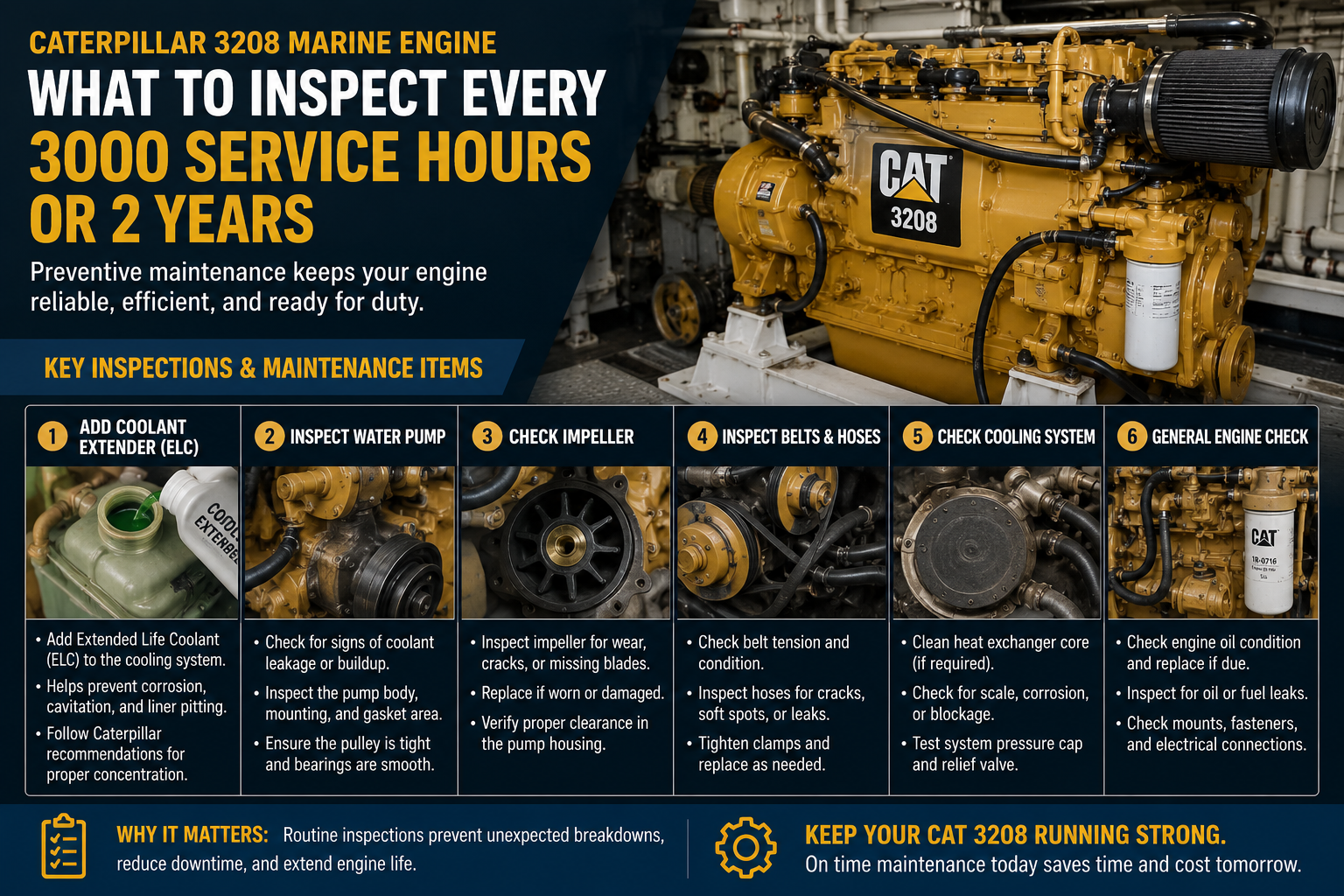
As the engine approaches 3,000 service hours—or approximately two years of operation, depending on the maintenance programme—it's time for a more comprehensive inspection.
This maintenance interval is about more than simply replacing fluids. It provides an opportunity to inspect critical cooling system components, evaluate engine condition, and address wear before it develops into unexpected downtime.
One of the most important areas of attention during this interval is the engine's cooling system, particularly the Extended Life Coolant (ELC) and the water pump.
At Alfa Marine Spare Parts, we support marine engineers, chief engineers, technical superintendents, shipyards, and vessel owners with replacement parts and technical guidance for the Caterpillar 3208 Marine Engine. Preventive maintenance at the recommended intervals is one of the most effective ways to maximise engine reliability and service life.
In this guide, we'll explain why the 3000-hour maintenance interval matters, how coolant extender helps protect the cooling system, and why inspecting the water pump is an essential part of every major service.
Table of Contents
- Understanding the 3000-Hour Maintenance Interval
- Why Cooling System Maintenance Matters
- Adding Coolant Extender (ELC)
- Inspecting the Water Pump
- Preventive Maintenance Tips
- Engine Room Insight
- Chief Engineer's Tip
- Frequently Asked Questions
- Related Caterpillar 3208 Marine Engine Parts
- Why Choose Alfa Marine Spare Parts
- Technical Reference
- Final Thoughts
Understanding the 3000-Hour Maintenance Interval
Every marine diesel engine benefits from regular maintenance, but certain service intervals require more detailed inspections than routine daily or weekly checks.
For the Caterpillar 3208 Marine Engine, the 3000-hour (or two-year) interval is an opportunity to evaluate systems that experience gradual wear over time.
Rather than waiting for a cooling problem to develop, marine engineers use this scheduled maintenance period to inspect components that are essential for reliable engine operation.
By carrying out preventive maintenance at the recommended interval, operators can often identify developing issues before they affect vessel availability.
Why Cooling System Maintenance Matters
The cooling system plays a vital role in maintaining stable engine operating temperatures.
Its responsibilities include:
- Removing excess engine heat.
- Protecting internal components from overheating.
- Reducing thermal stress.
- Supporting efficient combustion.
- Helping extend engine service life.
A well-maintained cooling system contributes directly to engine reliability.
Even a small loss of cooling efficiency can increase operating temperatures and place unnecessary stress on cylinder heads, liners, gaskets, and other critical engine components.
Routine inspection of coolant condition and cooling system components helps maintain dependable performance throughout the engine's operating life.
Adding Coolant Extender (ELC)
One maintenance task commonly associated with the 3000-hour interval is checking the condition of the Extended Life Coolant (ELC) and adding coolant extender where required according to the engine manufacturer's maintenance recommendations.
Extended Life Coolant is designed to provide long-term protection for the cooling system by helping minimise:
- Corrosion
- Scale formation
- Cavitation
- Internal cooling passage deposits
Over time, the protective additives within the coolant gradually become depleted.
Adding the appropriate coolant extender at the recommended maintenance interval helps restore these protective properties and supports continued cooling system performance.
Following the manufacturer's coolant recommendations is important, as different coolant formulations require different maintenance procedures.
Why Coolant Extender Matters
Although coolant is often associated with temperature control, it performs several additional functions inside the engine.
Proper coolant maintenance helps:
- Protect metal surfaces from corrosion.
- Maintain efficient heat transfer.
- Reduce internal deposits.
- Support water pump reliability.
- Extend cooling system component life.
Neglecting coolant maintenance may reduce cooling system efficiency and increase the likelihood of premature component wear.
Engine Room Insight
Many experienced Chief Engineers consider the cooling system to be one of the most important systems to monitor throughout an engine's service life.
Engine overheating is often the result of several small issues developing gradually rather than one major failure.
Routine coolant inspections and scheduled maintenance provide an opportunity to identify these issues before they affect engine performance.
Chief Engineer's Tip
Whenever carrying out major cooling system maintenance, inspect the entire system rather than focusing on one component.
A complete inspection typically includes:
✔ Coolant condition.
✔ Hoses.
✔ Clamps.
✔ Water pump.
✔ Heat exchanger.
✔ Thermostats.
✔ Expansion tank.
✔ External leaks.
Preventive inspections help improve reliability and reduce unexpected downtime.
We'll continue with:
- Inspecting the Water Pump
- Step-by-Step Water Pump Inspection
- Replacing the Water Pump
- Best Practices for Water Pump Maintenance
- Common Cooling System Mistakes
- Preventive Maintenance Checklist
- Marine Engineer's Inspection Tips
This article keeps the Caterpillar 3208 Marine Engine as the primary keyword while transforming the original maintenance schedule into a unique, educational guide that supports both SEO and practical marine engineering knowledge.
Inspecting the Water Pump & Cooling System Maintenance for the Caterpillar 3208 Marine Engine
Inspecting the Water Pump
During the 3,000-hour or two-year maintenance interval, one of the most important cooling system components to inspect is the water pump.
Although the water pump is a relatively compact component compared with the engine itself, it performs one of the most critical functions in the cooling system.
Its job is to continuously circulate coolant through the engine block, cylinder heads, heat exchanger, and other cooling system components, helping maintain stable operating temperatures under varying engine loads.
Because the water pump operates whenever the engine is running, it experiences continuous wear throughout its service life.
Routine inspection during scheduled maintenance helps identify developing problems before they lead to overheating or unexpected engine downtime.
The Critical Role of the Water Pump
The Caterpillar 3208 Marine Engine depends on an efficient cooling system to operate within its designed temperature range.
The water pump helps:
- Circulate coolant throughout the engine.
- Remove excess engine heat.
- Maintain consistent operating temperatures.
- Protect cylinder heads and cylinder liners.
- Support efficient combustion.
- Reduce thermal stress on internal components.
If coolant circulation becomes restricted, engine temperatures can rise quickly, increasing stress on critical engine components and potentially leading to expensive repairs.
Step-by-Step Water Pump Inspection
During scheduled maintenance, marine engineers normally inspect the complete water pump assembly rather than focusing on one individual component.
A systematic inspection typically includes:
External Visual Inspection
Begin by inspecting the outside of the water pump.
Look for:
- Coolant leaks.
- Signs of corrosion.
- Damaged housing.
- Loose mounting bolts.
- Worn hose connections.
Even a small coolant leak should be investigated before the vessel returns to service.
Check the Pump Shaft
The pump shaft should rotate smoothly without excessive resistance or movement.
Inspect for:
- Excessive shaft play.
- Rough rotation.
- Unusual movement.
- Signs of bearing wear.
These inspections help determine whether further maintenance may be required.
Inspect the Water Pump Bearings
Bearings support the rotating shaft inside the water pump.
Although they are protected during normal operation, bearings gradually wear over time.
Common signs of bearing wear include:
- Unusual noise.
- Excessive vibration.
- Shaft movement.
- Rough rotation.
Early detection helps reduce the likelihood of more extensive cooling system failures.
Inspect the Seals
Water pump seals help prevent coolant leakage during operation.
Inspect for:
- Coolant residue.
- Moisture around the seal area.
- Evidence of leakage.
- Seal deterioration.
Replacing worn seals before complete failure helps maintain cooling system integrity.
Inspect the Impeller (Where Applicable)
Depending on the water pump design, inspect the impeller for:
- Corrosion.
- Cavitation damage.
- Erosion.
- Damaged blades.
- Excessive wear.
A worn impeller may reduce coolant flow, even if the rest of the pump appears to be in good condition.
Replacing the Water Pump (If Necessary)
If inspection indicates excessive wear or damage, replacement may be the most reliable solution.
Before installing a replacement water pump, experienced marine engineers generally:
- Clean all mounting surfaces.
- Remove old gasket material.
- Inspect mating surfaces.
- Verify correct replacement parts.
- Replace seals and gaskets where required.
Taking the time to prepare the installation area helps support a reliable seal and proper coolant circulation after reassembly.
Best Practices for Water Pump Maintenance
Routine maintenance helps maximise the service life of both the water pump and the cooling system.
Good maintenance practices include:
- Maintaining the correct coolant level.
- Using the recommended coolant specification.
- Inspecting hoses and clamps regularly.
- Monitoring engine operating temperature.
- Replacing worn gaskets and seals.
- Inspecting the heat exchanger.
- Following scheduled maintenance intervals.
Preventive maintenance often costs significantly less than repairing damage caused by overheating.
Why Water Pump Inspection Matters
Many cooling system failures develop gradually.
A small coolant leak, worn bearing, or damaged impeller may not immediately affect engine performance.
However, over time these issues can reduce coolant circulation and increase engine operating temperatures.
Routine inspection allows marine engineers to identify developing problems before they lead to:
- Engine overheating.
- Coolant loss.
- Reduced cooling efficiency.
- Unplanned vessel downtime.
- More extensive engine repairs.
A well-maintained water pump plays a key role in supporting long-term engine reliability.
Common Cooling System Mistakes
Even experienced operators can overlook important maintenance tasks.
Some common mistakes include:
❌ Ignoring small coolant leaks.
❌ Delaying coolant replacement.
❌ Failing to inspect the water pump during scheduled maintenance.
❌ Mixing incompatible coolant types.
❌ Reusing damaged gaskets.
❌ Ignoring rising engine temperatures.
❌ Neglecting heat exchanger maintenance.
Avoiding these mistakes helps protect the complete cooling system.
Engine Room Insight
Marine engineers often say that cooling system problems rarely appear overnight.
Instead, they develop gradually through small changes that may initially seem insignificant.
A slight increase in operating temperature, a small coolant leak, or minor bearing noise can all provide valuable warning signs.
Routine inspections during scheduled maintenance allow these issues to be identified before they become major failures.
Chief Engineer's Tip
When inspecting the water pump, don't stop at the pump itself.
Inspect the complete cooling circuit, including:
✔ Heat exchanger.
✔ Thermostats.
✔ Coolant hoses.
✔ Hose clamps.
✔ Expansion tank.
✔ Coolant condition.
✔ Drive belts (where applicable).
✔ Cooling connections.
Viewing the cooling system as one complete unit helps improve overall engine reliability.
Marine Engineer's Preventive Maintenance Checklist
Daily
✔ Check coolant level.
✔ Monitor engine temperature.
✔ Inspect for coolant leaks.
Weekly
✔ Inspect hoses.
✔ Check hose clamps.
✔ Monitor water pump operation.
Monthly
✔ Inspect the heat exchanger.
✔ Review coolant condition.
✔ Inspect external cooling system components.
Every 3,000 Service Hours or 2 Years
✔ Inspect the water pump.
✔ Check bearings and seals.
✔ Inspect the impeller where applicable.
✔ Add coolant extender if required.
✔ Inspect the complete cooling system.
✔ Replace worn components where necessary.
Routine preventive maintenance helps extend the service life of the Caterpillar 3208 Marine Engine while reducing the risk of unplanned downtime.
We'll complete the guide with:
- Comprehensive Summary of the 3000-Hour Maintenance Interval
- Safety and Compliance Reminder
- Frequently Asked Questions
- Related Caterpillar 3208 Marine Engine Parts
- Why Choose Alfa Marine Spare Parts
- Industries We Support
- Worldwide Marine Spare Parts Supply
- Browse Our Complete Marine Spare Parts Catalog
- Contact Alfa Marine Spare Parts
- Technical Reference
- Final Thoughts
3000-Hour Maintenance Summary, FAQs & Why Choose Alfa Marine Spare Parts
Comprehensive Summary for the 3000-Hour / 2-Year Maintenance Interval
Reaching 3,000 service hours or approximately two years of operation is an important milestone in the maintenance programme of the Caterpillar 3208 Marine Engine.
By this stage, the engine has accumulated thousands of operating hours under varying loads and environmental conditions. Although routine maintenance performed throughout the year helps keep the engine reliable, this major service interval provides an opportunity to inspect critical cooling system components in greater detail.
During this maintenance period, experienced marine engineers typically focus on:
- Cooling system condition.
- Extended Life Coolant (ELC).
- Coolant extender requirements.
- Water pump inspection.
- Heat exchanger condition.
- Thermostats.
- Cooling hoses.
- Hose clamps.
- Coolant leaks.
- Overall engine condition.
Completing these inspections before problems develop helps reduce the likelihood of overheating, unplanned repairs, and costly vessel downtime.
Preventive maintenance remains one of the most effective ways to maximise the service life of the Caterpillar 3208 Marine Engine.
Safety and Compliance Reminder
Cooling system maintenance should always be carried out with safety as the highest priority.
Before beginning work:
✔ Shut down the engine.
✔ Allow the engine to cool completely.
✔ Relieve cooling system pressure safely.
✔ Wear appropriate personal protective equipment (PPE).
✔ Follow the vessel's maintenance procedures.
✔ Dispose of used coolant according to local environmental regulations.
Following recognised maintenance procedures helps protect both personnel and equipment.
Frequently Asked Questions About the Caterpillar 3208 Marine Engine
Routine maintenance often raises practical questions from marine engineers, mechanics, and vessel owners.
Below are some of the most common.
Why is the 3000-hour maintenance interval important?
The 3,000-hour maintenance interval provides an opportunity to inspect systems that experience gradual wear over time.
Rather than waiting for a cooling system failure, engineers can identify developing issues early and schedule repairs before they affect engine reliability.
What does coolant extender do?
Coolant extender helps restore the protective additives in Extended Life Coolant (ELC).
These additives help protect the cooling system by reducing:
- Corrosion.
- Scale formation.
- Cavitation.
- Internal deposits.
Maintaining the correct coolant condition supports efficient heat transfer and longer component life.
Why should the water pump be inspected regularly?
The water pump circulates coolant throughout the engine.
A worn pump may reduce coolant flow, increasing engine temperatures and placing additional stress on engine components.
Routine inspections help identify bearing wear, seal deterioration, and coolant leaks before they develop into larger problems.
Can I continue operating if a small coolant leak is present?
Even a minor coolant leak should be investigated.
Small leaks can gradually reduce coolant levels and affect cooling system performance.
Correcting the problem early is often simpler and less expensive than repairing damage caused by overheating.
How often should the cooling system be inspected?
Although major inspections occur at scheduled service intervals, experienced marine engineers monitor the cooling system during routine daily and weekly inspections.
Monitoring coolant level, engine temperature, and signs of leakage helps identify potential problems early.
What are the signs of cooling system problems?
Common warning signs include:
- Rising engine temperature.
- Coolant loss.
- Visible coolant leaks.
- Steam.
- Unusual pump noise.
- Reduced cooling efficiency.
Any unexpected change should be investigated before continuing normal operation.
Engine Room Insight
Many experienced Chief Engineers consider cooling system maintenance to be one of the best investments in engine reliability.
In many cases, overheating does not result from one major failure but from several smaller issues that develop gradually over time.
Routine inspections, correct coolant maintenance, and careful monitoring of operating temperatures help identify these issues before they affect engine performance.
Chief Engineer's Tip
Whenever the cooling system is opened for maintenance, use the opportunity to inspect the complete system.
Typical inspection points include:
✔ Water pump.
✔ Heat exchanger.
✔ Thermostats.
✔ Coolant hoses.
✔ Hose clamps.
✔ Expansion tank.
✔ Coolant condition.
✔ External leaks.
Inspecting related components during the same maintenance period often reduces future downtime and repeat labour.
Marine Engineer's Preventive Maintenance Checklist
Routine inspections remain one of the best ways to protect the Caterpillar 3208 Marine Engine.
Daily
✔ Check coolant level.
✔ Monitor engine temperature.
✔ Inspect for coolant leaks.
Weekly
✔ Inspect hoses and clamps.
✔ Monitor water pump condition.
✔ Check coolant recovery tank.
Monthly
✔ Inspect the heat exchanger.
✔ Review coolant condition.
✔ Inspect cooling system connections.
Every 3,000 Service Hours or 2 Years
✔ Inspect the water pump.
✔ Inspect bearings.
✔ Inspect seals.
✔ Inspect the impeller where applicable.
✔ Add coolant extender when required.
✔ Inspect the complete cooling system.
✔ Replace worn components where necessary.
Following a structured maintenance programme helps improve reliability while reducing unexpected vessel downtime.
Related Caterpillar 3208 Marine Engine Parts
During the 3,000-hour maintenance interval, marine engineers frequently inspect or replace additional cooling system and engine components, including:
- Water Pumps
- Water Pump Repair Kits
- Heat Exchangers
- Thermostats
- Coolant Hoses
- Hose Clamps
- Expansion Tanks
- Cylinder Head Gaskets
- Oil Coolers
- Oil Filters
- Fuel Filters
- Freshwater Pumps
- Seawater Pumps
- Fan Belts (where applicable)
- Gasket Sets
- Complete Overhaul Kits
Replacing related wear components during planned maintenance can improve engine reliability and reduce future repair costs.
Why Choose Alfa Marine Spare Parts?
At Alfa Marine Spare Parts, we understand that every maintenance programme begins with using the correct replacement parts.
Our experienced team assists customers in identifying compatible parts for the Caterpillar 3208 Marine Engine using:
- Engine Model
- Engine Serial Number
- Arrangement Number
- Existing Part Numbers
- Technical Documentation
We supply:
- Genuine Marine Parts
- OEM Replacement Parts
- Premium Aftermarket Components
- Professionally Remanufactured Parts
Whether you're carrying out routine maintenance or planning a complete engine overhaul, we are ready to help identify the right parts for your engine.
Industries We Support
Our customers include professionals across the global maritime industry, including:
- Marine Engineers
- Chief Engineers
- Technical Superintendents
- Shipyards
- Commercial Shipping Companies
- Offshore Operators
- Fishing Fleets
- Tugboat Operators
- Ferry Companies
- Government Fleets
- Naval Operators
- Yacht Management Companies
- Marine Service Companies
- Boat Builders
- Marine Equipment Distributors
Worldwide Marine Spare Parts Supply
Alfa Marine Spare Parts supplies marine engine components to customers around the world, including:
- Spain
- Netherlands
- Germany
- Italy
- France
- Norway
- Greece
- United Kingdom
- United States
- Canada
- Brazil
- United Arab Emirates
- Saudi Arabia
- Qatar
- Nigeria
- South Africa
- Singapore
- Australia
Whether your vessel operates in commercial shipping, offshore support, fishing, passenger transport, or recreational boating, we are committed to helping you source reliable replacement parts.
Browse Our Complete Marine Spare Parts Catalog
Looking for parts for your Caterpillar 3208 Marine Engine?
Browse our complete catalogue:
https://alfamarinespareparts.com/spareparts
We supply marine parts for:
- Caterpillar
- MTU
- Cummins
- MAN
- Twin Disc
- Volvo Penta
- Wärtsilä
- Scania
- Perkins
- Detroit Diesel
- Yanmar
- Deutz
- Mitsubishi
- Komatsu
- John Deere
- Doosan
Contact Alfa Marine Spare Parts
Need assistance identifying the correct parts for your Caterpillar 3208 Marine Engine?
Our experienced team is here to help.
Website
https://alfamarinespareparts.com
Browse Our Marine Spare Parts Catalog
https://alfamarinespareparts.com/spareparts
request@alfamarinespareparts.com
Providing your engine model, engine serial number, arrangement number, or existing part number helps us identify compatible replacement parts more accurately.
Technical Reference
The information presented in this guide follows recognised marine engineering practices and maintenance procedures applicable to marine diesel engines. Service intervals, coolant specifications, inspection procedures, and replacement recommendations may vary depending on the engine configuration, operating environment, and maintenance programme. Always consult the appropriate manufacturer documentation before carrying out inspection, maintenance, or overhaul work.
Final Thoughts
The Caterpillar 3208 Marine Engine has earned a long-standing reputation for durability and dependable performance in commercial and recreational marine applications. Reaching the 3,000-hour or two-year maintenance interval is an opportunity to do more than simply complete scheduled servicing—it is a chance to evaluate the health of the entire cooling system.
Inspecting the water pump, maintaining the correct coolant condition, adding coolant extender when required, and checking related cooling components all contribute to stable operating temperatures and reliable engine performance. These preventive maintenance tasks help reduce the risk of overheating, extend component life, and minimise unexpected vessel downtime.
At Alfa Marine Spare Parts, we support marine engineers, chief engineers, technical superintendents, shipyards, fleet operators, and vessel owners with genuine, OEM, aftermarket, and professionally remanufactured Caterpillar marine engine parts. Whether you need cooling system components, overhaul parts, or expert assistance identifying the correct replacement part, our experienced team is ready to help keep your Caterpillar 3208 Marine Engine operating safely and efficiently for years to come.