Caterpillar 3208 Marine Engine Overhaul Guide: When, Why & What to Inspect
Caterpillar 3208 Marine Engine Overhaul Guide: Understanding When an Overhaul Becomes the Best Option
Introduction
A Caterpillar 3208 Marine Engine is built to deliver dependable service for thousands of operating hours. Whether powering a commercial fishing vessel, workboat, passenger ferry, patrol craft, or private yacht, it has earned a reputation for durability when maintained correctly.
Even the most reliable marine diesel engines, however, eventually reach a stage where routine servicing is no longer enough to restore performance.
Components gradually wear, clearances increase, compression declines, and cooling or lubrication systems may no longer operate as efficiently as they once did.
When this happens, vessel owners are often faced with an important decision:
Should the engine continue operating with repairs as required, or is it time for a complete overhaul?
A planned overhaul allows marine engineers to restore critical engine components before a major failure occurs, helping reduce unexpected downtime and extending the engine's service life.
At Alfa Marine Spare Parts, we support marine engineers, chief engineers, technical superintendents, shipyards, and vessel owners worldwide with replacement parts for the Caterpillar 3208 Marine Engine. In this guide, we'll explain which components are commonly inspected during an overhaul, the warning signs that indicate major maintenance may be approaching, and why proactive planning often provides the best long-term value.
Table of Contents
- Understanding a Caterpillar 3208 Marine Engine Overhaul
- Why Planned Overhauls Matter
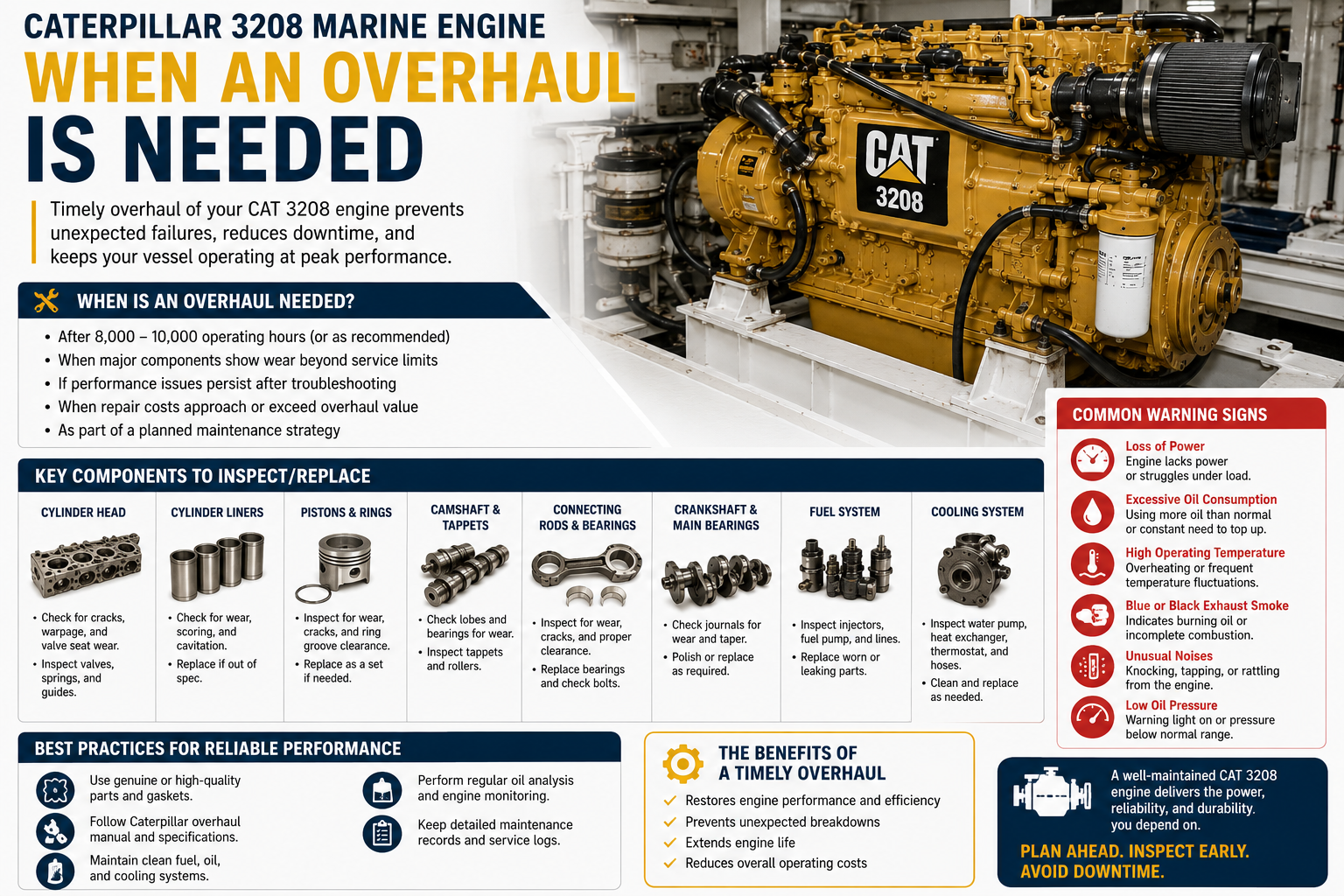
- Comprehensive Inspection and Replacement of Key Engine Components
- Recognising Signs That an Overhaul May Be Required
- Pre-Failure vs Post-Failure Overhaul
- Engine Room Insight
- Chief Engineer's Tip
- Frequently Asked Questions
- Related Caterpillar 3208 Marine Engine Parts
- Why Choose Alfa Marine Spare Parts
- Technical Reference
- Final Thoughts
Understanding a Caterpillar 3208 Marine Engine Overhaul
An overhaul is much more than replacing worn parts.
It is a structured process that restores the engine to a reliable operating condition by inspecting, measuring, repairing, or replacing critical components that experience wear over time.
Unlike routine maintenance, which focuses on consumable items such as filters and lubricants, an overhaul addresses the internal condition of the engine itself.
Depending on the engine's operating history and condition, an overhaul may involve inspecting:
- Cylinder heads
- Pistons
- Piston rings
- Cylinder liners
- Crankshaft
- Bearings
- Camshaft
- Fuel injection system
- Turbocharger
- Cooling system
- Lubrication system
- Seals and gaskets
Every overhaul should begin with a thorough inspection rather than assuming every component requires replacement.
Why Planned Overhauls Matter
One of the biggest advantages of a planned overhaul is that it allows maintenance to be scheduled before an unexpected failure interrupts vessel operations.
For commercial operators, avoiding unplanned downtime can be just as important as reducing repair costs.
A planned overhaul may help:
- Restore engine performance.
- Improve reliability.
- Reduce oil consumption.
- Improve compression.
- Reduce the risk of secondary damage.
- Extend engine service life.
- Improve maintenance planning.
Waiting until a major failure occurs often increases repair costs because damaged components may affect other parts of the engine.
Comprehensive Inspection and Replacement of Key Engine Components
Every overhaul begins with a careful assessment of the engine's internal condition.
Experienced marine engineers inspect each component individually before deciding whether it should be reused, repaired, or replaced.
1. Cylinder Heads and Valves
The cylinder head is one of the most heavily loaded components in the engine.
During an overhaul, engineers commonly inspect:
- Valve seats
- Valve guides
- Valve springs
- Cylinder head surface
- Cooling passages
- Injector bores
Any signs of cracking, excessive wear, or distortion should be evaluated before reassembly.
Proper cylinder head condition supports good compression, efficient combustion, and reliable engine performance.
2. Pistons, Rings and Cylinder Liners
Pistons and cylinder liners operate under extremely high temperatures and pressures.
Routine overhaul inspections typically include:
- Piston crown condition
- Ring groove wear
- Piston ring condition
- Cylinder liner wear
- Scoring
- Cavitation damage
- Surface finish
Maintaining correct piston and liner condition helps preserve engine compression and minimise oil consumption.
3. Crankshaft and Bearings
The crankshaft converts combustion forces into rotational power.
Because it supports the entire rotating assembly, it receives careful attention during every overhaul.
Typical inspections include:
- Main bearing condition
- Connecting rod bearings
- Journal surfaces
- Bearing clearances
- Surface wear
- Signs of overheating
Any abnormal wear patterns should be investigated before reassembly.
4. Camshaft and Lifters
The camshaft controls valve operation and contributes directly to engine breathing efficiency.
Inspection may include:
- Cam lobes
- Lifter condition
- Cam bearings
- Surface wear
- Lubrication passages
Maintaining correct valve timing supports efficient engine operation and consistent performance.
5. Turbocharger
The turbocharger supplies additional air to improve combustion efficiency and engine power.
During overhaul, engineers generally inspect:
- Compressor wheel
- Turbine wheel
- Bearings
- Oil seals
- Shaft condition
- Housing
Because the turbocharger operates at extremely high speeds, even minor wear should be evaluated carefully.
Engine Room Insight
Experienced Chief Engineers rarely judge an engine's condition by operating hours alone.
Instead, they combine service history, inspection findings, oil analysis, compression results, and engine performance to determine when an overhaul is appropriate.
Two engines with similar operating hours may require very different maintenance depending on how they have been operated and maintained.
Chief Engineer's Tip
An overhaul should never begin by ordering parts.
Begin with a detailed inspection.
Measure components.
Record clearances.
Compare results with manufacturer specifications.
Only then decide which components require replacement.
A structured inspection often reduces unnecessary parts replacement while ensuring worn components are not overlooked.
We'll continue with:
- Fuel Injection System
- Cooling System Components
- Lubrication System
- Engine Mounts and Vibration Dampers
- Gaskets and Seals
- Recognising Signs Indicating the Need for Overhaul
- Increased Oil Consumption
- Loss of Compression
- Excessive Exhaust Smoke
- High Blow-By Levels
- Declining Engine Performance
- Unusual Engine Noises
- Contaminated Oil or Coolant
- S·O·S Fluid Analysis Results
Key Engine Components & Recognising When a Caterpillar 3208 Marine Engine Needs an Overhaul
6. Fuel Injection System
The fuel injection system plays a major role in the performance and efficiency of the Caterpillar 3208 Marine Engine.
During a planned overhaul, marine engineers typically inspect the complete fuel system to ensure it continues delivering fuel accurately and consistently.
Common inspection areas include:
- Fuel injectors
- Injector nozzles
- Fuel transfer pump
- Fuel lines
- Fuel filters
- Injection timing
- Injector sealing surfaces
A properly functioning fuel system supports:
- Efficient combustion
- Improved fuel economy
- Easier starting
- Reduced exhaust smoke
- Stable engine performance
Even small changes in injector performance can affect engine efficiency over time.
7. Cooling System Components
A reliable cooling system is essential for protecting the Caterpillar 3208 Marine Engine from excessive operating temperatures.
During an overhaul, engineers commonly inspect:
- Freshwater pump
- Seawater pump
- Heat exchanger
- Thermostats
- Coolant hoses
- Hose clamps
- Expansion tank
- Cooling passages
Any restriction within the cooling system may reduce heat transfer efficiency and increase thermal stress on engine components.
Replacing worn cooling system components during an overhaul often improves long-term reliability.
8. Lubrication System
Every rotating component inside the engine depends on clean, pressurised lubricating oil.
During overhaul, inspection typically includes:
- Oil pump
- Oil cooler
- Oil pressure relief valve
- Oil galleries
- Oil filters
- Lubrication passages
The lubrication system protects:
- Main bearings
- Connecting rod bearings
- Camshaft bearings
- Pistons
- Turbocharger bearings
Maintaining proper oil circulation is one of the most important factors in extending engine service life.
9. Engine Mounts and Vibration Dampers
Although often overlooked, engine mounts and vibration dampers play an important role in maintaining smooth engine operation.
Routine inspection may include:
- Mount condition
- Rubber deterioration
- Mounting hardware
- Vibration damper condition
- Signs of excessive movement
Worn mounts may increase engine vibration, place additional stress on the drivetrain, and reduce operator comfort.
Replacing worn components during an overhaul helps maintain correct engine alignment.
10. Gaskets and Seals
Every engine overhaul provides an opportunity to inspect and replace sealing components throughout the engine.
These commonly include:
- Cylinder head gaskets
- Valve cover gaskets
- Oil pan gasket
- Front seals
- Rear crankshaft seals
- O-rings
- Cooling system seals
Replacing worn gaskets and seals helps reduce the risk of future oil or coolant leaks once the engine returns to service.
Recognising Signs Indicating the Need for an Overhaul
An engine rarely fails without providing warning signs.
Experienced marine engineers monitor engine performance continuously and recognise changes that may indicate increasing internal wear.
1. Increased Oil Consumption
Gradually increasing oil consumption may indicate wear affecting:
- Piston rings
- Cylinder liners
- Valve guides
- Turbocharger seals
Monitoring oil consumption trends over time helps identify developing problems before they become more serious.
2. Loss of Compression
Reduced compression can affect:
- Engine starting
- Combustion efficiency
- Power output
- Fuel economy
Common causes include wear affecting piston rings, cylinder liners, valves, or cylinder heads.
Compression testing is often performed when engine performance begins to decline.
3. Excessive Exhaust Smoke
Changes in exhaust appearance can provide useful information about engine condition.
Persistent abnormal smoke may indicate issues requiring further investigation within:
- Combustion system
- Fuel system
- Lubrication system
- Cooling system
Rather than assuming the cause, experienced engineers investigate the complete engine before deciding on repairs.
4. High Blow-By Levels
Blow-by occurs when combustion gases pass between the piston rings and cylinder liner.
As components wear, blow-by may gradually increase.
Higher-than-normal blow-by levels may suggest increasing wear within:
- Pistons
- Rings
- Cylinder liners
Monitoring crankcase condition helps identify these changes over time.
5. Declining Engine Performance
Many operators first notice that the engine no longer performs as it once did.
Possible observations include:
- Reduced acceleration
- Lower available power
- Increased fuel consumption
- Slower response under load
Performance changes should always be investigated systematically rather than attributed to normal engine ageing.
6. Unusual Noises
New mechanical noises often provide valuable clues about internal engine condition.
Examples include:
- Knocking
- Rattling
- Tapping
- Bearing noise
- Gear noise
Early investigation may prevent additional damage from developing.
7. Contaminated Oil or Coolant
Routine inspections may reveal contamination within engine fluids.
Examples include:
- Metal particles
- Coolant contamination
- Oil contamination
- Sludge
- Discolouration
Changes in fluid condition should never be ignored during routine maintenance.
8. S·O·S Fluid Analysis Results
Many fleet operators use Scheduled Oil Sampling (S·O·S) programmes to monitor engine condition.
Oil analysis can help identify:
- Wear metals
- Coolant contamination
- Dirt ingestion
- Lubrication problems
- Internal wear trends
Rather than reacting after a failure occurs, fluid analysis supports predictive maintenance and more informed overhaul planning.
Engine Room Insight
One of the most valuable skills developed by experienced Chief Engineers is recognising trends rather than isolated events.
An increase in oil consumption, a gradual rise in blow-by, changing oil analysis results, and declining performance often occur together.
When viewed collectively, these indicators provide a much clearer picture of engine condition than any single symptom on its own.
Chief Engineer's Tip
Don't schedule an overhaul based solely on engine operating hours.
Consider the complete picture, including:
✔ Compression test results.
✔ Oil analysis reports.
✔ Cooling system condition.
✔ Fuel consumption.
✔ Engine performance.
✔ Maintenance history.
✔ Inspection findings.
A data-driven approach helps ensure maintenance is carried out at the right time rather than too early or too late.
We'll complete the guide with:
- Pre-Failure vs. Post-Failure Overhaul
- Caterpillar Official Guidelines and OEM Parts
- Why Following OEM Guidelines Matters
- Importance of OEM Parts
- Frequently Asked Questions
- Related Caterpillar 3208 Marine Engine Parts
- Why Choose Alfa Marine Spare Parts
- Worldwide Marine Spare Parts Supply
- Technical Reference
- Final Thoughts
Pre-Failure vs. Post-Failure Overhaul, OEM Recommendations & Why Choose Alfa Marine Spare Parts
Pre-Failure vs. Post-Failure Overhaul
One of the most important decisions for any vessel owner or technical superintendent is determining when to overhaul a Caterpillar 3208 Marine Engine.
In most cases, there are two approaches:
- Pre-Failure Overhaul
- Post-Failure Overhaul
Although both restore the engine, the timing of the overhaul can have a significant impact on costs, downtime, and long-term reliability.
Pre-Failure Overhaul
A pre-failure overhaul is performed before a major mechanical failure occurs.
Rather than waiting until the engine can no longer operate, marine engineers schedule the overhaul based on operating hours, engine condition, inspection findings, and maintenance history.
This proactive approach allows maintenance to be planned during scheduled vessel downtime.
Benefits of a Pre-Failure Overhaul
- Reduced risk of unexpected engine failure.
- Better maintenance planning.
- Shorter vessel downtime.
- Lower likelihood of secondary engine damage.
- More predictable repair costs.
- Opportunity to inspect and replace worn components before failure.
For commercial vessels where operational availability is critical, a planned overhaul is often the preferred maintenance strategy.
Post-Failure Overhaul
A post-failure overhaul takes place after a major engine problem has already occurred.
Examples include:
- Bearing failure.
- Severe overheating.
- Broken piston components.
- Crankshaft damage.
- Connecting rod failure.
- Major lubrication system failure.
Although a post-failure overhaul restores the engine, repairs are often more extensive because damaged components may affect surrounding parts.
This can increase:
- Repair costs.
- Parts requirements.
- Labour time.
- Vessel downtime.
Whenever possible, identifying wear before failure generally provides better long-term value.
Caterpillar's Official Guidelines and the Importance of OEM Maintenance Procedures
Every overhaul should follow recognised maintenance procedures and engineering specifications.
Manufacturer recommendations provide guidance for:
- Inspection procedures.
- Wear limits.
- Component measurements.
- Torque specifications.
- Assembly sequences.
- Clearance checks.
- Testing procedures.
Following these recommendations helps ensure that rebuilt engines operate safely and reliably after returning to service.
Because engine configurations may vary, always consult the appropriate technical documentation for the specific Caterpillar 3208 Marine Engine before beginning overhaul work.
Why Following OEM Guidelines Matters
Marine diesel engines are manufactured to precise engineering tolerances.
Correct overhaul procedures help ensure:
- Proper bearing clearances.
- Accurate valve timing.
- Correct piston-to-liner fit.
- Reliable sealing.
- Stable oil pressure.
- Efficient cooling.
Skipping measurement procedures or relying solely on visual inspection can increase the risk of premature wear after the overhaul is complete.
Careful planning and accurate measurements remain essential parts of every successful engine rebuild.
Importance of Quality Replacement Parts
The quality of replacement components has a direct influence on engine reliability.
During a major overhaul, marine engineers typically evaluate whether components should be:
- Reused after inspection.
- Reconditioned.
- Professionally remanufactured.
- Replaced with new components.
Selecting quality replacement parts helps support:
- Reliable engine performance.
- Correct fit and function.
- Long service life.
- Reduced maintenance costs.
- Improved vessel availability.
Using components that meet the required specifications contributes to a dependable overhaul outcome.
Engine Room Insight
Experienced Chief Engineers understand that successful overhauls begin long before the engine is dismantled.
Accurate maintenance records, oil analysis reports, compression testing, cooling system inspections, and routine performance monitoring all provide valuable information that helps determine the right time for an overhaul.
Engines that receive consistent preventive maintenance often experience fewer unexpected failures and can remain in reliable service for many years.
Chief Engineer's Tip
Every overhaul should begin with documentation.
Before dismantling the engine, record:
✔ Engine operating hours.
✔ Oil consumption.
✔ Compression readings.
✔ Oil analysis results.
✔ Coolant condition.
✔ Maintenance history.
✔ Engine performance observations.
These records provide valuable reference information during the overhaul and help confirm improvements once the engine has been returned to service.
Frequently Asked Questions About the Caterpillar 3208 Marine Engine
How do I know when my Caterpillar 3208 Marine Engine needs an overhaul?
No single operating hour figure applies to every engine.
The decision should be based on:
- Maintenance history.
- Compression results.
- Oil analysis.
- Blow-by levels.
- Oil consumption.
- Engine performance.
- Inspection findings.
A complete assessment provides a more accurate indication than operating hours alone.
Is a planned overhaul better than waiting for engine failure?
In many cases, yes.
A planned overhaul allows maintenance to be scheduled before major damage occurs, helping reduce repair costs and minimise unexpected downtime.
Should every engine component be replaced during an overhaul?
Not necessarily.
Each component should be inspected and measured individually.
Components that remain within acceptable specifications may continue in service, while worn or damaged parts should be repaired or replaced as appropriate.
Why are oil analysis reports valuable?
Routine oil analysis helps monitor internal engine condition by identifying:
- Wear metals.
- Coolant contamination.
- Dirt contamination.
- Lubrication issues.
- Long-term wear trends.
These reports support predictive maintenance and help determine when further inspection may be required.
Can regular maintenance delay a major overhaul?
Yes.
Routine servicing, correct lubrication, cooling system maintenance, fuel system care, and regular inspections all contribute to extending engine service life.
Although every engine eventually requires major maintenance, good preventive maintenance can help maximise operating hours between overhauls.
Related Caterpillar 3208 Marine Engine Parts
During an overhaul, marine engineers frequently inspect or replace related components, including:
- Cylinder Heads
- Valves
- Valve Guides
- Pistons
- Piston Rings
- Cylinder Liners
- Connecting Rod Bearings
- Main Bearings
- Crankshafts
- Camshafts
- Lifters
- Fuel Injectors
- Fuel Pumps
- Turbochargers
- Water Pumps
- Seawater Pumps
- Heat Exchangers
- Thermostats
- Oil Pumps
- Oil Coolers
- Gasket Sets
- Complete Overhaul Kits
Replacing related wear components during the same overhaul can improve long-term engine reliability.
Why Choose Alfa Marine Spare Parts?
At Alfa Marine Spare Parts, we help marine professionals identify the correct replacement parts for the Caterpillar 3208 Marine Engine using:
- Engine Model
- Engine Serial Number
- Arrangement Number
- Existing Part Numbers
- Technical Documentation
We supply:
- Genuine Marine Parts
- OEM Replacement Parts
- Premium Aftermarket Parts
- Professionally Remanufactured Components
- Complete Overhaul Parts
Whether you're planning a preventive overhaul or rebuilding an engine following a failure, our experienced team can help identify compatible parts for your application.
Industries We Support
We proudly support customers throughout the global maritime industry, including:
- Marine Engineers
- Chief Engineers
- Technical Superintendents
- Shipyards
- Commercial Shipping Companies
- Offshore Operators
- Tugboat Companies
- Fishing Fleets
- Passenger Ferry Operators
- Government Fleets
- Naval Operators
- Yacht Management Companies
- Marine Service Companies
- Boat Builders
- Marine Equipment Distributors
Worldwide Marine Spare Parts Supply
Alfa Marine Spare Parts supplies marine engine components worldwide, including:
- Spain
- Netherlands
- Germany
- Italy
- France
- Norway
- Greece
- United Kingdom
- United States
- Canada
- Brazil
- United Arab Emirates
- Saudi Arabia
- Qatar
- Nigeria
- South Africa
- Singapore
- Australia
We support commercial vessels, offshore fleets, fishing vessels, ferries, workboats, patrol boats, and recreational marine operators around the world.
Browse Our Complete Marine Spare Parts Catalog
Looking for parts for your Caterpillar 3208 Marine Engine?
Browse our complete catalogue:
https://alfamarinespareparts.com/spareparts
We supply marine parts for:
- Caterpillar
- MTU
- Cummins
- Twin Disc
- MAN
- Volvo Penta
- Wärtsilä
- Scania
- Perkins
- Detroit Diesel
- Deutz
- John Deere
- Mitsubishi
- Komatsu
- Doosan
- Yanmar
Contact Alfa Marine Spare Parts
Need help identifying the correct overhaul parts for your Caterpillar 3208 Marine Engine?
Our experienced team is ready to assist.
Website
https://alfamarinespareparts.com
Browse Our Marine Spare Parts Catalog
https://alfamarinespareparts.com/spareparts
request@alfamarinespareparts.com
Providing your engine model, serial number, arrangement number, or existing part number helps us identify compatible replacement parts more accurately.
Technical Reference
This guide is based on recognised marine engineering practices and technical guidance applicable to medium-duty marine diesel engines. Inspection procedures, overhaul limits, torque values, and replacement recommendations may vary depending on engine configuration and application. Always consult the appropriate manufacturer documentation before carrying out inspection, maintenance, or overhaul work.
Final Thoughts
A Caterpillar 3208 Marine Engine overhaul is more than a repair—it is an opportunity to restore engine reliability, improve performance, and prepare the vessel for many more hours of dependable operation. The key to a successful overhaul is understanding the engine's condition before major failures occur and making informed decisions based on inspections, measurements, maintenance history, and performance trends.
Planning an overhaul before a catastrophic failure often reduces repair costs, limits downtime, and helps protect valuable engine components from secondary damage. Combined with quality replacement parts and careful assembly, a well-executed overhaul can significantly extend the service life of the engine.
At Alfa Marine Spare Parts, we support marine engineers, chief engineers, technical superintendents, shipyards, fleet operators, mechanics, and vessel owners with genuine, OEM, aftermarket, and professionally remanufactured Caterpillar marine engine parts. Whether you're replacing individual components or completing a full overhaul, our experienced team is ready to help you source the right parts and keep your Caterpillar 3208 Marine Engine operating safely, efficiently, and reliably for years to come.