Komatsu Marine Engine Types: What Is the Difference, and Which Engine Fits Which Vessel?
When most people hear Komatsu, they immediately think about excavators, bulldozers, wheel loaders and mining equipment.
But Komatsu diesel-engine technology also has a long history in marine propulsion.
Marine operators may encounter engines such as:
6M95
6M122
6M125
6M137
6M140
6M170
12M140
as well as Komatsu engine families identified by industrial-style designations such as SAA6D125, SAA6D140 and SAA6D170.
These engines cover very different power classes and vessel applications. Published marine-engine listings show Komatsu marine power ranging from roughly 250 PS to 2,500 PS, depending on model and rating, with applications including fishing vessels, passenger vessels and workboats.
So when someone asks:
“Which Komatsu marine engine is best?”
the answer should really start with another question:
Best for which boat and which type of work?
Understanding the Komatsu Marine Engine Range
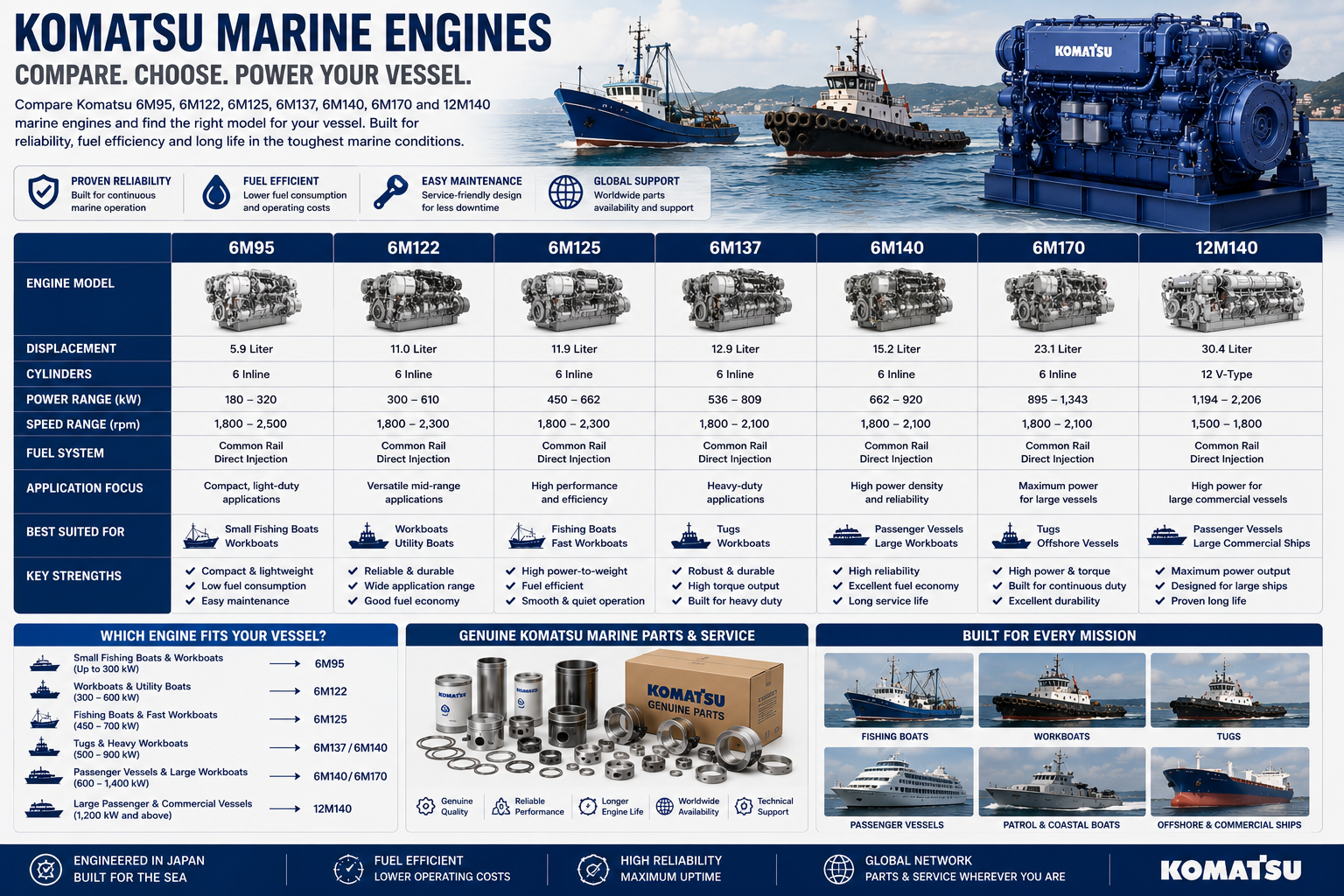
A useful starting point is to look at the major marine models by size.
| Komatsu Marine EngineApprox. DisplacementPublished Maximum Output*General Character | |||
| 6M95 | 4.89 L | 250 PS | Compact marine diesel |
| 6M122 | 10.5 L | 630 PS | High-output compact six |
| 6M125 | 11.0 L | 650 PS | Medium commercial marine engine |
| 6M137 | 14.8 L | 808 PS | Larger commercial propulsion |
| 6M140 | 15.24 L | 930 PS | Heavy commercial inline-six |
| 6M170 | 23.15 L | 1,000 PS | Large-displacement commercial six |
| 12M140 | 30.48 L | 1,331 PS | High-output 12-cylinder marine engine |
*These are published maximum figures for particular configurations, not universal continuous ratings. Actual output depends on the engine specification and duty rating.
And that last point is extremely important.
A Komatsu engine's maximum horsepower does not automatically tell you how it should be operated.
Why Komatsu Marine Engines Are Interesting
Komatsu's reputation was built largely around diesel engines that operate under demanding conditions.
Think about an excavator.
Its engine experiences changing loads, dust, vibration, long operating days and difficult working environments.
A commercial marine engine faces a different environment, but there is an obvious similarity:
it has to work.
Marine engines must also deal with continuous propulsion loads, cooling demands, vibration, corrosion and long operating periods.
This makes Komatsu's heavy-duty diesel-engine background particularly relevant to commercial marine applications.
Komatsu 6M95: The Compact Worker
At the smaller end is the Komatsu 6M95.
Published specifications list approximately:
Displacement: 4.89 liters
Maximum output: 250 PS at 3,100 rpm
Dry weight: approximately 635 kg
This is very different from a 23-liter 6M170.
The 6M95 belongs much closer to the small commercial-vessel end of the range.
What Kind of Boat Fits a Komatsu 6M95?
Potential applications include smaller fishing boats, coastal workboats, launches, utility boats and other compact commercial craft.
Its relatively small displacement also makes it easier to package where engine-room space is limited.
The 6M95 Personality
The Compact Worker
Small enough for tighter installations but still designed around commercial marine operation.
Komatsu 6M122: A Big Jump in Power
Move from the 6M95 to the 6M122, and things change quickly.
Published marine specifications list approximately:
Displacement: 10.5 liters
Maximum output: 630 PS at 2,300 rpm
Dry weight: approximately 1,690 kg
Notice what happened.
Displacement has more than doubled compared with the 6M95.
This puts the 6M122 into a much more serious propulsion category.
Where Does a 6M122 Fit?
Think about medium fishing vessels, workboats, passenger boats and commercial craft requiring substantially more power than a small coastal vessel.
Komatsu 6M125: The Commercial Middleweight
The Komatsu 6M125 is another important marine engine family.
Published marine specifications give approximately:
Displacement: 11 liters
Maximum output: 650 PS at 2,300 rpm
Dry weight: approximately 1,520 kg
The 6M125 sits in a useful middle ground.
It is large enough for serious commercial propulsion but remains an inline six-cylinder-class package rather than a large multi-bank engine.
Which Boats Suit a 6M125?
Typical candidates include commercial fishing vessels, medium workboats, passenger craft and utility vessels.
For an owner who needs considerably more power than a compact diesel but does not need a huge engine, this class can be very attractive.
Why Inline-Six Marine Engines Are So Popular
Several of the familiar Komatsu marine models use six-cylinder architecture.
There is a practical reason.
An inline six can offer a useful combination of:
smooth power delivery
good torque
one cylinder bank
relatively straightforward cylinder-head access
and
simpler maintenance than a large V-engine.
There is a trade-off.
An inline engine can become long.
Once the required power becomes very high, a V configuration can package more cylinders into a shorter overall engine.
Komatsu 6M137: Moving Into Larger Commercial Propulsion
The 6M137 takes another step upward.
Published marine specifications list approximately:
Displacement: 14.8 liters
Maximum output: 808 PS at 2,200 rpm
Dry weight: approximately 2,350 kg
Now we're talking about a substantial commercial diesel.
What Kind of Vessel Fits the 6M137?
Think about larger fishing vessels, passenger boats, workboats, coastal commercial vessels and other applications where the engine may spend significant time under load.
This is where choosing the correct duty rating becomes particularly important.
Komatsu 6M140: Serious Commercial Power
The Komatsu 6M140 is one of the more recognizable larger Komatsu marine engines.
Published marine information gives approximately:
Displacement: 15.24 liters
Maximum output: 930 PS at 2,200 rpm
Dry weight: approximately 2,100 kg
That's a lot of power from an inline-six-class marine package.
Where Does a 6M140 Make Sense?
Potential applications include larger fishing vessels, fast commercial boats, passenger vessels and substantial workboats.
This engine class is particularly interesting where the operator needs high power but wants to retain the service characteristics of a six-cylinder arrangement.
6M125 vs. 6M137 vs. 6M140
This comparison helps show how the Komatsu range progresses.
6M125
11.0 liters
Up to approximately 650 PS
Good middleweight commercial option.
6M137
14.8 liters
Up to approximately 808 PS
More displacement for larger commercial vessels.
6M140
15.24 liters
Up to approximately 930 PS
High-output six-cylinder-class propulsion.
They may all look like “large Komatsu six-cylinder marine engines” from a distance.
Mechanically and operationally, however, they are not the same engine.
Komatsu 6M170: Big Displacement Without Going to Twelve Cylinders
Then we arrive at the Komatsu 6M170.
This is where things become particularly interesting.
Published specifications list approximately:
Displacement: 23.15 liters
Maximum output: 1,000 PS at 2,000 rpm
Dry weight: approximately 3,800 kg
That is a huge displacement for six cylinders.
What Does That Mean?
Large individual cylinders can produce substantial torque without requiring extremely high engine speed.
For a commercial vessel, that can be attractive.
The 6M170 belongs naturally around applications such as large fishing vessels, heavy workboats, commercial passenger vessels and other demanding propulsion duties.
Why Would You Choose a 6M170 Instead of a Smaller High-Speed Engine?
Imagine two engines producing broadly similar power.
One obtains that output through smaller displacement and higher specific output.
The other uses much larger displacement.
Depending on the vessel and rating, the larger-displacement engine may provide characteristics that are attractive for commercial work.
For a fishing vessel that operates for long periods every day, the engine-selection priorities can be very different from those of a pleasure craft used primarily on weekends.
This is why power alone never tells the full story.
Komatsu 12M140: When Six Cylinders Are No Longer Enough
The 12M140 moves Komatsu into another category.
Published marine specifications list approximately:
Displacement: 30.48 liters
Maximum output: 1,331 PS at 2,100 rpm
Dry weight: approximately 4,160 kg
Now we're dealing with twelve cylinders.
That changes both power capability and maintenance scale.
Where Does a 12M140 Fit?
Think about larger fishing vessels, substantial workboats, passenger vessels and commercial craft requiring considerably more propulsion power.
Six Cylinders vs. Twelve Cylinders: What Changes for the Engineer?
A lot.
Imagine planning an overhaul.
On a six-cylinder engine you may be dealing with six cylinder positions.
Move to twelve cylinders and suddenly the potential quantities of many components double.
That can mean more:
pistons
piston rings
cylinder liners
connecting rods
injectors
valves
bearings
gaskets
and associated hardware.
So a larger engine doesn't only consume more fuel and produce more power.
It also changes the scale of maintenance and spare-parts planning.
Komatsu Marine Engine Duty Ratings Matter
This is one of the most important parts of the entire discussion.
Published Komatsu marine information identifies different specifications within engine families for different operating duties, including categories translated as medium duty, light duty, limited duty and pleasure-boat use.
That tells us something important:
the same engine family can be rated differently depending on how the vessel will actually use it.
A fishing vessel running thousands of hours per year should not automatically be treated like a pleasure boat.
Maximum Horsepower Is Not Always the Best Horsepower
This is one of the easiest mistakes to make when selecting a marine engine.
Someone sees:
930 PS
and immediately thinks:
“That is better than 700 PS.”
Not necessarily.
If the higher output is intended for shorter or lighter-duty operation while the vessel spends most of its life heavily loaded, a more conservative rating may be the better engineering choice.
For commercial boats, always consider:
annual operating hours
average engine load
time at maximum power
vessel displacement
propeller loading
gearbox ratio
and
intended duty classification.
Komatsu Marine Engine for a Fishing Boat
Fishing vessels are a natural environment for this type of engine.
The appropriate model depends heavily on vessel size and operating profile.
Smaller fishing vessel
Consider the smaller end of the range, such as:
6M95
Medium fishing vessel
Models such as:
6M122
6M125
may become relevant.
Larger fishing vessel
You may move toward:
6M137
6M140
6M170
or a larger configuration such as:
12M140
Published Komatsu marine listings specifically identify fishing vessels among the applications for these engines.
Komatsu Marine Engine for a Workboat
The word workboat covers a huge range of vessels.
A small harbor utility boat and a substantial commercial workboat may both be called workboats, but their propulsion requirements are completely different.
A smaller workboat might suit a 6M95-class engine.
Move upward and:
6M125
6M137
or
6M140
may become more appropriate.
Heavy commercial work can move toward the 6M170 or 12M140 class.
Again, the correct answer depends on actual propulsion calculations rather than engine reputation alone.
Komatsu Marine Engine for a Passenger Vessel
Passenger boats need a slightly different balance.
Operators may value:
reliability
predictable maintenance
fuel efficiency
low vibration
compact installation
and
adequate reserve power.
Published Komatsu marine information identifies passenger vessels among the applications for the range.
Depending on vessel size, the relevant engine could range from a smaller six-cylinder model to a much larger 6M140 or 12M140 installation.
What About Pleasure Boats?
This is interesting because Komatsu's marine range is not limited to heavy commercial service.
Published marine information also distinguishes specifications intended for pleasure-boat duty.
That means the operating profile matters enormously.
A pleasure boat may accumulate relatively few annual hours but require high output for shorter periods.
A commercial fishing vessel may run almost every day.
Those are completely different jobs.
Komatsu Marine Engines vs. Komatsu Industrial Engines
This is an important distinction.
Komatsu manufactures major diesel-engine families such as:
SAA6D125
SAA6D140
SAA6D170
and others for construction and industrial equipment.
For example, Komatsu's current engine information shows the SAA6D125, SAA6D140 and SAA6D170 families powering substantial off-highway machinery, and Komatsu's genuine-parts catalog lists dedicated turbochargers for these engines.
But this is important:
Do not assume that an industrial Komatsu engine and a marine Komatsu engine with related architecture use identical components.
A marine installation has additional requirements.
What Makes a Marine Engine Different?
A marine engine may require equipment such as:
marine heat exchangers
seawater cooling systems
raw-water pumps
water-cooled exhaust components
marine exhaust systems
marine engine mounts
gearbox connections
different turbocharger arrangements
and other application-specific components.
Saltwater changes everything.
Components exposed directly or indirectly to seawater must be designed around corrosion, temperature and marine operating conditions.
Why Cooling Is So Important on a Komatsu Marine Engine
Cooling is one of the most critical systems on any marine diesel.
The engine produces an enormous amount of heat.
That heat must be removed from:
cylinder heads
cylinder liners
engine oil
charge air
and sometimes the exhaust system.
A typical marine arrangement may use an internal freshwater circuit combined with a seawater-fed heat exchanger or another marine cooling arrangement.
Problems such as fouled coolers, restricted seawater flow, damaged impellers or failing thermostats can cause operating temperatures to rise.
And overheating doesn't remain a cooling-system problem for very long.
Eventually it becomes an engine problem.
The Raw-Water Side Deserves Special Attention
On a seawater-cooled installation, inspect components such as:
raw-water pump
impeller
pump seals
heat exchanger
cooler cores
hoses
clamps
seawater passages
and applicable corrosion-protection components.
A small reduction in seawater flow can slowly become a much bigger problem under high engine load.
Komatsu Marine Engine Fuel Systems
Fuel-system design varies according to engine generation.
Older Komatsu engines may use more conventional mechanically controlled injection systems.
Newer Komatsu diesel technology includes electronically controlled fuel injection.
Published marine-engine information specifically highlights electronic fuel-injection technology as contributing to fuel economy and cleaner exhaust emissions.
Electronic control can provide more precise injection.
But it also changes troubleshooting.
Mechanical vs. Electronic Komatsu Engines
Older Mechanical Engine
Troubleshooting may focus heavily on:
- Fuel pressure
- Injection timing
- Injector condition
- Compression
- Valve clearance
- Turbocharger condition
- Exhaust temperature
- Cooling temperature
Electronic Engine
Now add:
- Sensors
- Wiring
- Electronic control units
- Fault codes
- Rail-pressure information where applicable
- Electronic injectors
- Engine monitoring
The computer does not replace the marine engineer.
It gives the engineer another set of tools.
Komatsu Marine Engine “Personalities”
Sometimes it is easier to remember the range by giving each engine a character.
6M95 — The Compact Worker
Small and practical for lighter marine applications.
6M122 — The Compact Performer
A major increase in power while remaining in a manageable package.
6M125 — The Commercial Middleweight
An approximately 11-liter engine suited to medium commercial propulsion.
6M137 — The Bigger Worker
Nearly 15 liters for vessels requiring more continuous commercial capability.
6M140 — The Strong Six
Up to approximately 930 PS in published configurations while retaining a six-cylinder-class layout.
6M170 — The Big-Displacement Six
More than 23 liters and built for serious commercial propulsion.
12M140 — The Twelve-Cylinder Heavyweight
More than 30 liters and over 1,300 PS in published configurations.
Quick Komatsu Marine Engine Comparison
| EngineDisplacementMaximum Published Output*Possible Vessel Type | |||
| 6M95 | 4.89 L | 250 PS | Small fishing/workboat |
| 6M122 | 10.5 L | 630 PS | Fishing/passenger/workboat |
| 6M125 | 11.0 L | 650 PS | Medium commercial vessel |
| 6M137 | 14.8 L | 808 PS | Larger fishing/workboat |
| 6M140 | 15.24 L | 930 PS | Heavy commercial vessel |
| 6M170 | 23.15 L | 1,000 PS | Large fishing/workboat |
| 12M140 | 30.48 L | 1,331 PS | Large commercial vessel |
*Model-specific maximum figures; not universal continuous ratings.
Which Komatsu Marine Engine Would You Choose?
A simple way to think about it:
SMALLER COMMERCIAL BOAT
6M95
↓
MEDIUM FISHING / WORKBOAT
6M122 / 6M125
↓
LARGER COMMERCIAL VESSEL
6M137
↓
HIGHER-POWER COMMERCIAL PROPULSION
6M140
↓
LARGE-DISPLACEMENT SIX-CYLINDER POWER
6M170
↓
LARGE HIGH-OUTPUT INSTALLATION
12M140
This is a general comparison, not an engine-selection or interchangeability chart.
Which Komatsu Marine Engine Is Easiest to Maintain?
Generally, a smaller six-cylinder engine creates a smaller maintenance project than a large twelve-cylinder engine.
But accessibility depends heavily on the vessel.
A perfectly designed engine installed in an extremely tight engine room can be difficult to maintain.
Before selecting an engine, think about whether the engineer can actually reach:
filters
injectors
valve covers
turbocharger
water pump
starter
coolers
and other service points.
Also ask a bigger question:
Can the cylinder head, piston or other major component be removed without dismantling half the vessel?
That matters when the first major overhaul arrives.
Common Komatsu Marine Engine Spare Parts
Depending on engine model and configuration, maintenance requirements may include:
- Engine oil filters
- Fuel filters
- Air filters
- Fuel injectors
- Injector nozzles
- Injection pumps
- Fuel transfer pumps
- Turbochargers
- Raw-water pumps
- Freshwater pumps
- Water-pump repair kits
- Impellers
- Heat exchangers
- Charge-air coolers
- Oil coolers
- Thermostats
- Exhaust manifolds
- Cylinder heads
- Intake valves
- Exhaust valves
- Valve guides
- Valve seats
- Pistons
- Piston rings
- Cylinder liners
- Connecting rods
- Connecting-rod bearings
- Main bearings
- Crankshafts
- Camshafts
- Oil pumps
- Gaskets
- O-rings
- Oil seals
- Sensors
- Electrical components
- Overhaul components
Komatsu's genuine-parts catalog, for example, identifies dedicated turbocharger assemblies for the SAA6D125, SAA6D140 and SAA6D170 engine families, illustrating why matching components to the exact engine model matters.
Why Exact Komatsu Engine Identification Matters
A request saying:
“Need Komatsu marine water pump.”
is not enough.
Even:
“Need 6M140 water pump.”
may require additional identification.
A much better inquiry looks like this:
Engine Make: Komatsu
Complete Engine Model: 6M140
Engine Serial Number: __________
Existing Part Number: __________
Application: Marine propulsion
Quantity: __________
Photographs: Attached
This becomes particularly important for older vessels because an engine may have been modified, rebuilt or repowered during its lifetime.
Don't Identify the Engine Only From a Photograph
Two Komatsu engines can look remarkably similar from the outside.
The safest identification starts with the engine data plate and serial number.
Photographs are still extremely useful.
For difficult parts inquiries, send:
engine plate
complete engine
existing component
part-number markings
and
connection/flange details where relevant.
This gives the parts supplier much more information to work with.
Buying a Used Komatsu Marine Engine: What Should You Check?
A used engine can look excellent after being painted.
That tells you almost nothing about its internal condition.
Ask for:
Engine hours
Serial number
Maintenance history
Previous overhaul information
Oil analysis if available
Cold-start video
Running video
Oil pressure
Coolant temperature
Exhaust condition
Turbocharger history
Injector history
Compression or cylinder-condition information where available
Reason for removal
A clean paint job is not an overhaul report.
What Should You Inspect Before a Major Komatsu Overhaul?
Before automatically ordering every internal component, establish the engine's actual condition.
Depending on engine and workshop procedures, this may include inspection of:
cylinder heads
valves
valve seats
liners
pistons
piston rings
connecting rods
main and connecting-rod bearings
crankshaft journals
camshaft
oil pump
water pumps
injectors
fuel pump
turbocharger
and
cooling equipment.
Measurement should determine what can be reused and what needs replacement.
Marine Engineer Tip
Don't Order “A Komatsu Overhaul Kit” Until You Know the Exact Engine
Before ordering, confirm:
Complete engine designation
Serial number
Existing part numbers
Cylinder configuration
Duty rating
Rated rpm
Marine application
Required overhaul scope
Quantity
The more expensive the overhaul becomes, the more important this identification process becomes.
Frequently Asked Questions About Komatsu Marine Engines
Does Komatsu Make Marine Diesel Engines?
Komatsu diesel technology has been used in dedicated marine engine configurations, with published marine ranges covering fishing vessels, passenger ships, workboats and other applications.
What Are Common Komatsu Marine Engine Models?
Common marine designations include 6M95, 6M122, 6M125, 6M137, 6M140, 6M170 and 12M140.
What Is the Smallest Engine in This Comparison?
The 6M95, with approximately 4.89 liters displacement and a published maximum output of around 250 PS.
How Powerful Is the Komatsu 6M125?
Published marine information lists up to approximately 650 PS at 2,300 rpm for a 6M125 configuration.
How Powerful Is the Komatsu 6M140?
Published information lists a maximum of approximately 930 PS at 2,200 rpm for a particular marine configuration.
How Large Is the Komatsu 6M170?
The 6M170 is listed at approximately 23.15 liters displacement, with a published maximum output around 1,000 PS at 2,000 rpm.
Is There a Twelve-Cylinder Komatsu Marine Engine?
Yes. The 12M140 is listed with approximately 30.48 liters displacement and maximum output around 1,331 PS in the referenced marine specification.
Are All Komatsu Marine Engines Rated for the Same Duty?
No. Published Komatsu marine information distinguishes different operating specifications, including medium-duty, light-duty, limited-duty and pleasure-boat applications.
Are Komatsu Industrial and Marine Engines Identical?
Do not assume so. Related base-engine technology may exist, but a marine engine can require different cooling, exhaust, mounting, control and accessory arrangements.
Can I Order Parts Using Only the Engine Model?
For some parts the model may narrow the search considerably, but the engine serial number and existing part number should be provided whenever possible.
Komatsu Marine Engine Spare Parts
Alfa Marine Spare Parts can assist with spare-parts inquiries for Komatsu marine diesel engines and related engine families, depending on model and component availability.
Typical requirements may include:
Komatsu 6M95 Marine Engine Parts
Komatsu 6M122 Marine Engine Parts
Komatsu 6M125 Marine Engine Parts
Komatsu 6M137 Marine Engine Parts
Komatsu 6M140 Marine Engine Parts
Komatsu 6M170 Marine Engine Parts
Komatsu 12M140 Marine Engine Parts
as well as selected components associated with SAA6D125, SAA6D140, SAA6D170 and related Komatsu diesel-engine families where the exact application and compatibility have been verified.
Related Komatsu Marine Engine Pages
Useful individual engine pages can include:
Komatsu 6M95 Marine Engine Spare Parts
Komatsu 6M122 Marine Engine Spare Parts
Komatsu 6M125 Marine Engine Spare Parts
Komatsu 6M137 Marine Engine Spare Parts
Komatsu 6M140 Marine Engine Spare Parts
Komatsu 6M170 Marine Engine Spare Parts
Komatsu 12M140 Marine Engine Spare Parts
These individual pages can go deeper into specifications, applications, cooling systems, fuel systems and common spare parts for each engine.
Why Choose Alfa Marine Spare Parts?
Komatsu is another engine brand where accurate identification is more important than simply recognizing the manufacturer's name.
A customer may ask for:
“Komatsu 6M140 piston rings.”
Another may need:
“Komatsu 6M170 turbocharger.”
A fishing-vessel engineer may be looking for a 6M125 water pump.
And another vessel may require overhaul components for a 12M140.
All are Komatsu-related requirements.
But they are not the same engine and should never be treated as though their components are automatically interchangeable.
Alfa Marine Spare Parts assists shipyards, ship repairers, marine engineers, chief engineers, technical superintendents, fishing companies, workboat operators, passenger-vessel operators and marine service companies with marine diesel spare-parts requirements.
The goal is straightforward:
identify the exact engine first, then identify the correct component.
Worldwide Komatsu Marine Spare Parts Supply
Alfa Marine Spare Parts supports marine customers including shipyards, ship repairers, commercial fishing companies, workboat operators, marine engineers, chief engineers, technical superintendents, passenger-vessel operators, fleet operators, offshore operators, government fleets, maritime contractors, boat builders and marine equipment distributors.
When requesting Komatsu marine engine parts, send:
Engine model + serial number + existing part number + quantity + photographs where available.
Contact Alfa Marine Spare Parts
Email: request@alfamarinespareparts.com
Alfa Marine Spare Parts
Marine Spare Parts Catalog
One Final Thought
Komatsu marine engines become much easier to understand when you stop looking at the model numbers as one long list.
The 6M95 is the compact worker.
The 6M122 and 6M125 move into medium commercial power.
The 6M137 gives you considerably more displacement.
The 6M140 reaches roughly the 900-PS class in published configurations.
The 6M170 is the big-displacement six, with more than 23 liters available for serious commercial propulsion.
And the 12M140 takes the range into twelve-cylinder, 1,300-plus-PS territory.
But the most important lesson is not which one has the highest horsepower.
It is this:
Choose the engine around the vessel's real job.
A fishing boat working thousands of hours per year, a passenger vessel running a fixed schedule, a harbor workboat and a pleasure craft can all need very different ratings—even when the badge on the engine says Komatsu.