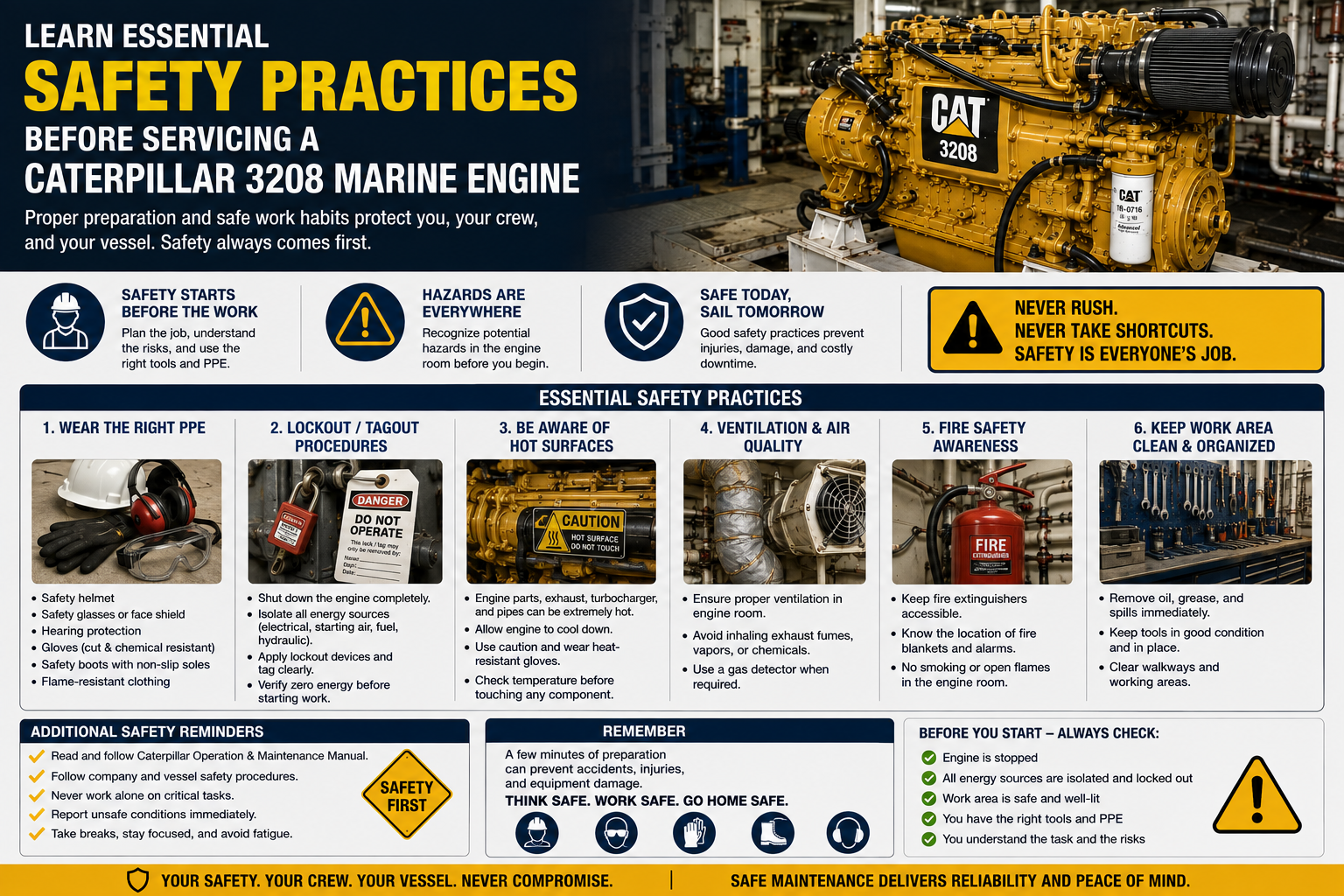
Caterpillar 3208 Marine Engine Safety Guide: Best Practices Before Maintenance
Caterpillar 3208 Marine Engine Safety Guide: Why Safe Maintenance Always Comes First
Introduction
Whether you're performing a routine inspection, replacing a water pump, adjusting valve lash, or carrying out a complete overhaul, safety should always be the first step when working on a Caterpillar 3208 Marine Engine.
Marine engine rooms are demanding working environments. High temperatures, rotating machinery, pressurised systems, electrical equipment, and confined spaces all create potential hazards that require careful planning before maintenance begins.
Experienced marine engineers know that most accidents are preventable when proper procedures are followed. A well-organised maintenance programme not only protects the engine but also safeguards the people working around it.
At Alfa Marine Spare Parts, we support marine engineers, chief engineers, technical superintendents, shipyards, mechanics, and vessel owners by supplying quality marine engine parts and sharing practical technical knowledge. In this guide, we'll review the essential safety practices that should be considered before servicing the Caterpillar 3208 Marine Engine.
Table of Contents
- Why Safety Matters
- Essential Safety Instructions
- Understanding the Engine's Design and Risks
- Lockout/Tagout Procedures
- Avoiding Hot Surfaces
- Personal Protective Equipment (PPE)
- Safe Handling of Fuel, Lubricants, and Coolants
- Working Around Rotating Components
- Electrical Safety
- Engine Room Safety
- Fire Prevention
- Environmental Protection
- Training and Emergency Preparedness
- Frequently Asked Questions
- Why Choose Alfa Marine Spare Parts
- Technical Reference
- Final Thoughts
Why Safety Matters
Routine maintenance is an important part of keeping the Caterpillar 3208 Marine Engine reliable, but every maintenance task should begin with a safety assessment.
Even relatively simple jobs can expose personnel to hazards such as:
- Hot engine components.
- Rotating shafts and belts.
- Pressurised cooling systems.
- Fuel under pressure.
- Electrical circuits.
- Slippery engine room surfaces.
- Heavy lifting operations.
Taking a few minutes to prepare the work area often prevents injuries and unnecessary equipment damage.
Essential Safety Instructions for Servicing the Caterpillar 3208 Marine Engine
Before beginning any maintenance activity, experienced marine engineers generally:
- Review the maintenance procedure.
- Identify potential hazards.
- Prepare the correct tools.
- Wear suitable PPE.
- Secure the engine against accidental starting.
- Ensure adequate lighting.
- Confirm safe access to the work area.
Good preparation is one of the most effective safety measures available.
Understand the Engine's Design and Risks
Every marine diesel engine contains systems operating under high temperatures and pressures.
Before maintenance begins, understand the location of:
- Fuel system components.
- Cooling system.
- Lubrication system.
- Electrical equipment.
- Rotating assemblies.
- Turbocharger.
- Exhaust system.
Understanding how these systems interact helps engineers recognise potential hazards before work starts.
Lockout/Tagout Procedures
One of the most important safety practices is preventing accidental engine starting while maintenance is in progress.
Before beginning work:
- Shut down the engine.
- Isolate electrical power where appropriate.
- Secure starting controls.
- Inform other crew members.
- Clearly identify that maintenance is in progress.
Following established lockout/tagout procedures reduces the risk of unexpected engine operation during servicing.
Avoid Hot Surfaces and Components
Many components remain extremely hot long after the engine has been shut down.
Examples include:
- Turbocharger.
- Exhaust manifold.
- Cooling system.
- Engine block.
- Heat exchanger.
- Lubricating oil.
Always allow sufficient cooling time before beginning maintenance.
Opening pressurised cooling systems while hot can result in serious injury.
Engine Room Insight
Experienced Chief Engineers rarely begin work immediately after shutting down an engine.
Instead, they use the cooling period to prepare tools, review procedures, organise replacement parts, and complete maintenance documentation.
This not only improves efficiency but also allows hot components to cool naturally before work begins.
Chief Engineer's Tip
Before opening any system, ask yourself three questions:
✔ Is it hot?
✔ Is it pressurised?
✔ Can it move unexpectedly?
If the answer to any of these is yes, stop and make the system safe before continuing.
This simple habit has helped prevent countless maintenance accidents throughout the marine industry.
We'll cover:
- Personal Protective Equipment (PPE)
- Eye Protection
- Hand Protection
- Protective Clothing
- Foot Protection
- Respiratory Protection
- Safe Handling of Fuel, Lubricants, and Coolants
- Fuel System Safety
- Lubricant and Oil Safety
- Coolant Safety
- Safe Work Practices Around Rotating Components
- Electrical Safety
Personal Protective Equipment, Safe Handling & Working Safely Around the Caterpillar 3208 Marine Engine
Personal Protective Equipment (PPE) for Working on the Caterpillar 3208 Marine Engine
Every maintenance task begins with protecting the person performing the work.
Whether you're carrying out a routine inspection or a complete engine overhaul, the correct Personal Protective Equipment (PPE) helps reduce the risk of injury while working around the Caterpillar 3208 Marine Engine.
The type of PPE required depends on the task being performed, but protection should always be selected based on the hazards present in the engine room.
Eye Protection
Eye injuries are among the most common maintenance-related incidents.
Safety glasses or approved eye protection should be worn whenever there is a possibility of exposure to:
- Flying debris.
- Pressurised fluids.
- Cleaning chemicals.
- Metal particles.
- Rust.
- Coolant splashes.
- Lubricating oil.
Additional face protection may be appropriate when working with pressurised systems or cleaning components.
Hand Protection
Marine engineers frequently work around:
- Sharp metal edges.
- Hot engine components.
- Oils.
- Grease.
- Fuel.
- Cleaning solvents.
Suitable protective gloves help reduce the risk of cuts, burns, and chemical exposure.
Different maintenance tasks may require different glove materials, so gloves should always be selected for the work being performed.
Protective Clothing
Loose clothing should never be worn around operating machinery.
Suitable work clothing should:
- Fit correctly.
- Protect exposed skin.
- Resist tearing.
- Allow safe movement.
- Minimise the risk of becoming caught in rotating equipment.
Long sleeves may provide additional protection during maintenance but should always be secured appropriately.
Foot Protection
Engine rooms contain many slip and trip hazards.
Marine engineers regularly work around:
- Oil spills.
- Coolant leaks.
- Wet decks.
- Heavy components.
- Tools.
Protective footwear with slip-resistant soles and toe protection helps reduce the risk of injury during maintenance activities.
Respiratory Protection
Some maintenance procedures may expose personnel to:
- Cleaning chemicals.
- Dust.
- Engine deposits.
- Exhaust residues.
- Solvent vapours.
Where ventilation is limited or airborne contaminants are present, suitable respiratory protection should be considered in accordance with workplace safety procedures.
Safe Handling of Fuel, Lubricants and Coolants
Working with engine fluids requires careful handling to protect both personnel and the environment.
Always identify the fluid before beginning maintenance and follow approved handling procedures.
Good housekeeping is equally important.
Clean work areas reduce slip hazards and help prevent contamination of engine components.
Fuel System Safety
Fuel systems may remain pressurised even after engine shutdown.
Before working on the fuel system:
- Shut down the engine.
- Allow pressure to dissipate where applicable.
- Avoid ignition sources.
- Clean surrounding components.
- Use suitable containers for fuel collection.
Diesel fuel should never be handled near open flames or sources of ignition.
Lubricant and Oil Safety
Lubricating oil may remain extremely hot immediately after engine operation.
During maintenance:
- Allow the engine to cool.
- Avoid skin contact with hot oil.
- Clean spills immediately.
- Dispose of used oil responsibly.
Keeping the work area clean also helps reduce slip hazards inside the engine room.
Coolant Safety
The cooling system should never be opened while it remains hot or pressurised.
Before servicing:
- Allow the engine to cool.
- Release pressure carefully.
- Wear suitable PPE.
- Collect coolant using appropriate containers.
Used coolant should always be handled and disposed of according to local environmental regulations.
Safe Work Practices Around Rotating Components
Rotating machinery presents one of the greatest hazards during engine maintenance.
Examples include:
- Drive belts.
- Pulleys.
- Couplings.
- Fans.
- Alternators.
- Turbocharger shafts.
Before beginning work:
- Confirm the engine cannot start unexpectedly.
- Remove loose clothing.
- Secure long hair.
- Remove jewellery where appropriate.
- Keep hands and tools clear of rotating equipment.
Never perform maintenance near moving components unless the procedure specifically requires the engine to be operating and appropriate safety precautions have been implemented.
Electrical Safety for the Caterpillar 3208 Marine Engine
Electrical systems should never be overlooked during maintenance.
Before inspecting electrical components:
- Isolate power where appropriate.
- Inspect wiring for damage.
- Check electrical terminals.
- Confirm battery condition.
- Avoid short circuits.
Damaged wiring should be repaired before returning the engine to service.
Electrical faults may also increase the risk of fire if left unresolved.
Engine Room Insight
Experienced marine engineers know that the safest maintenance job is usually the one that has been planned properly before any tools are picked up.
Preparing replacement parts, reviewing procedures, identifying hazards, and organising the work area often reduces both maintenance time and the likelihood of accidents.
Good preparation is one of the most valuable safety tools available in any engine room.
Chief Engineer's Tip
Before starting any maintenance task, complete a quick safety check.
Ask yourself:
✔ Is the engine isolated?
✔ Is the system depressurised?
✔ Are hot surfaces cool enough to touch safely?
✔ Am I wearing the correct PPE?
✔ Is the work area clean and well lit?
Taking a few moments to answer these questions helps establish a safer working environment for everyone involved.
Marine Engineer's Safety Checklist
Before beginning maintenance on the Caterpillar 3208 Marine Engine, confirm:
Personal Safety
✔ Safety glasses.
✔ Protective gloves.
✔ Safety footwear.
✔ Appropriate work clothing.
✔ Hearing protection where required.
Engine Safety
✔ Engine shut down.
✔ Lockout/Tagout completed.
✔ Systems depressurised.
✔ Engine cooled.
✔ Adequate lighting.
Work Area
✔ Clean deck.
✔ No oil spills.
✔ Fire extinguisher accessible.
✔ Correct tools available.
✔ Replacement parts prepared.
A systematic approach to safety helps reduce risks while improving maintenance quality.
We'll complete the guide with:
- Confined Space and Engine Room Safety
- Fire Safety Measures
- Environmental Safety and Spill Prevention
- Training and Qualification Requirements
- Emergency Preparedness for Engine Room Incidents
- Compliance with Regulatory Standards
- Frequently Asked Questions
- Why Choose Alfa Marine Spare Parts
- Disclaimer
- Technical Reference
- Final Thoughts
Engine Room Safety, Emergency Preparedness & Final Thoughts
Confined Space and Engine Room Safety
Many Caterpillar 3208 Marine Engine maintenance tasks take place inside engine rooms where space is limited and environmental conditions can change quickly.
Working safely in these areas requires careful planning before maintenance begins.
Before entering the engine room, engineers should ensure:
- Adequate ventilation.
- Sufficient lighting.
- Safe access routes.
- Clear escape paths.
- Good housekeeping.
- Effective communication with other crew members.
Whenever maintenance involves enclosed or restricted spaces, the vessel's confined space procedures should always be followed.
Good communication between crew members helps ensure that assistance is immediately available if required.
Fire Safety Measures
Marine engine rooms contain several potential fire hazards, including:
- Diesel fuel.
- Lubricating oil.
- Electrical equipment.
- Hot exhaust components.
- Cleaning solvents.
- Battery systems.
Before carrying out maintenance:
- Remove unnecessary combustible materials.
- Keep suitable fire extinguishers readily available.
- Avoid open flames.
- Ensure adequate ventilation.
- Clean oil and fuel spills immediately.
Maintaining a clean engine room significantly reduces fire risk.
Fire prevention begins with good housekeeping.
Environmental Safety and Spill Prevention
Protecting the marine environment is an important responsibility during every maintenance activity.
When servicing the Caterpillar 3208 Marine Engine, take steps to prevent accidental spills of:
- Diesel fuel.
- Lubricating oil.
- Hydraulic fluids.
- Coolant.
- Cleaning chemicals.
Recommended practices include:
- Using drip trays.
- Collecting waste fluids in approved containers.
- Cleaning spills immediately.
- Storing hazardous materials correctly.
- Disposing of waste through approved facilities.
Good environmental practices protect both the vessel and the surrounding marine environment.
Training and Qualification Requirements
Although routine inspections may appear straightforward, proper maintenance requires appropriate knowledge and experience.
Personnel working on the Caterpillar 3208 Marine Engine should be familiar with:
- Marine diesel engine operation.
- Maintenance procedures.
- Safe lifting practices.
- Lockout/Tagout procedures.
- Fire prevention.
- Emergency response.
- Hazard identification.
Continuing technical training helps engineers remain current with maintenance practices and evolving safety standards.
Emergency Preparedness for Engine Room Incidents
Even with excellent planning, emergencies can still occur.
Every maintenance team should know:
- Emergency shutdown procedures.
- Fire alarm locations.
- Fire extinguisher locations.
- First aid equipment locations.
- Emergency escape routes.
- Communication procedures.
Quick, organised responses help minimise injuries and equipment damage.
Regular emergency drills also improve crew preparedness.
Compliance with Regulatory Standards
Safe engine maintenance should always follow the vessel's operating procedures together with applicable maritime safety regulations and recognised engineering practices.
Depending on the vessel and its area of operation, maintenance activities may also need to comply with:
- Flag State requirements.
- Classification Society requirements.
- Company Safety Management Systems (SMS).
- International maritime regulations.
- Environmental protection requirements.
Maintaining accurate maintenance records supports both operational reliability and regulatory compliance.
Frequently Asked Questions About Caterpillar 3208 Marine Engine Safety
Why is safety planning important before maintenance?
Preparing the work area, identifying hazards, and reviewing maintenance procedures helps reduce the likelihood of accidents while improving maintenance efficiency.
Why is Lockout/Tagout important?
Lockout/Tagout procedures help prevent accidental engine starting while maintenance is being carried out.
This protects personnel working on or around the engine from unexpected movement of mechanical systems.
Why should the cooling system never be opened while hot?
A hot cooling system may remain under pressure.
Opening the system before it has cooled sufficiently may release hot coolant and steam, creating a serious burn hazard.
Always allow the engine to cool before servicing the cooling system.
Why is housekeeping important inside the engine room?
A clean engine room helps reduce:
- Slip hazards.
- Fire risk.
- Equipment contamination.
- Trip hazards.
- Maintenance delays.
Good housekeeping also makes routine inspections easier.
Why should maintenance records be kept?
Accurate maintenance records help engineers:
- Track service intervals.
- Monitor recurring issues.
- Plan future maintenance.
- Demonstrate maintenance history.
- Support troubleshooting.
Well-maintained records contribute to safer long-term engine operation.
Engine Room Insight
Experienced Chief Engineers understand that most maintenance accidents are preventable.
Good planning, effective communication, organised work areas, and proper use of PPE all contribute to safer maintenance.
Safety should never be viewed as an additional task—it should be part of every maintenance procedure from start to finish.
Chief Engineer's Tip
Before beginning any maintenance task, carry out a simple "Stop, Think, Check" review.
Ask yourself:
✔ Have all hazards been identified?
✔ Is the engine fully isolated?
✔ Are all systems depressurised?
✔ Is the work area safe?
✔ Does everyone involved understand the task?
Taking a few extra minutes before starting work often prevents hours of unnecessary downtime—or far worse, a serious injury.
Marine Engineer's Safety Checklist
Before servicing the Caterpillar 3208 Marine Engine, confirm:
Personal Safety
✔ Safety glasses.
✔ Protective gloves.
✔ Protective footwear.
✔ Appropriate work clothing.
✔ Hearing protection where required.
Engine Safety
✔ Engine shut down.
✔ Lockout/Tagout completed.
✔ Systems depressurised.
✔ Engine cooled.
✔ Batteries isolated where appropriate.
Work Area Safety
✔ Adequate lighting.
✔ Good ventilation.
✔ Fire extinguisher available.
✔ Spill containment ready.
✔ Escape routes clear.
✔ Correct tools prepared.
Following a structured checklist helps improve both safety and maintenance quality.
Why Choose Alfa Marine Spare Parts?
At Alfa Marine Spare Parts, we understand that safe maintenance begins with quality replacement parts and accurate technical information.
Our experienced team helps marine professionals identify compatible parts for the Caterpillar 3208 Marine Engine using:
- Engine Model
- Engine Serial Number
- Arrangement Number
- Existing Part Numbers
- Technical Documentation
We supply:
- Genuine Marine Parts
- OEM Replacement Parts
- Premium Aftermarket Components
- Professionally Remanufactured Parts
- Complete Engine Overhaul Components
Whether you're carrying out routine servicing or preparing for a major overhaul, we're here to help you source the right parts for your engine.
Industries We Support
We proudly serve:
- Marine Engineers
- Chief Engineers
- Technical Superintendents
- Shipyards
- Commercial Shipping Companies
- Offshore Operators
- Fishing Fleets
- Tugboat Operators
- Passenger Ferry Companies
- Government Fleets
- Naval Operators
- Yacht Management Companies
- Marine Service Companies
- Boat Builders
- Marine Equipment Distributors
Worldwide Marine Spare Parts Supply
Alfa Marine Spare Parts supplies marine engine parts worldwide, including:
- Spain
- Netherlands
- Germany
- Italy
- France
- Norway
- Greece
- United Kingdom
- United States
- Canada
- Brazil
- United Arab Emirates
- Saudi Arabia
- Qatar
- Nigeria
- South Africa
- Singapore
- Australia
Our team supports commercial shipping, offshore operations, fishing vessels, workboats, ferries, patrol boats, and recreational marine operators around the globe.
Browse Our Complete Marine Spare Parts Catalog
Looking for parts for your Caterpillar 3208 Marine Engine?
Browse our complete catalogue:
https://alfamarinespareparts.com/spareparts
We supply marine parts for:
- Caterpillar
- MTU
- Cummins
- Twin Disc
- MAN
- Volvo Penta
- Wärtsilä
- Scania
- Perkins
- Detroit Diesel
- Deutz
- Mitsubishi
- John Deere
- Komatsu
- Doosan
- Yanmar
Disclaimer
This guide is intended for educational and informational purposes only. Maintenance procedures, safety practices, inspection methods, and service requirements may vary depending on the engine configuration, vessel, and operating conditions.
Always consult the latest manufacturer service documentation and follow your company's safety management procedures before carrying out maintenance or repairs on the Caterpillar 3208 Marine Engine.
Contact Alfa Marine Spare Parts
Need help identifying the correct parts for your Caterpillar 3208 Marine Engine?
Our experienced team is ready to assist.
Website
https://alfamarinespareparts.com
Browse Our Marine Spare Parts Catalog
https://alfamarinespareparts.com/spareparts
request@alfamarinespareparts.com
Providing your engine model, serial number, arrangement number, or existing part number helps us identify compatible replacement parts quickly and accurately.
Technical Reference
The information in this guide is based on recognised marine engineering safety practices and maintenance principles applicable to heavy-duty marine diesel engines. Safety procedures, inspection methods, and maintenance requirements may vary depending on engine configuration, vessel design, and applicable maritime regulations. Always consult the appropriate manufacturer documentation and your vessel's safety management procedures before carrying out maintenance.
Final Thoughts
Working on a Caterpillar 3208 Marine Engine safely is just as important as performing the maintenance itself. Every inspection, adjustment, and repair should begin with proper preparation, hazard identification, and a commitment to safe working practices.
By following lockout procedures, wearing appropriate personal protective equipment, maintaining good housekeeping, handling fuel and coolant responsibly, and preparing for emergencies, marine engineers can significantly reduce the risk of accidents while improving maintenance quality. Safety is not a one-time checklist—it is a habit that supports reliable engine operation and protects everyone working in the engine room.
At Alfa Marine Spare Parts, we are committed to supporting marine engineers, chief engineers, technical superintendents, shipyards, fleet operators, mechanics, and vessel owners with quality marine engine parts and practical technical guidance. Whether you are performing routine servicing, troubleshooting a component, or planning a complete overhaul, our team is ready to help you keep your Caterpillar 3208 Marine Engine operating safely, efficiently, and reliably throughout its service life.