
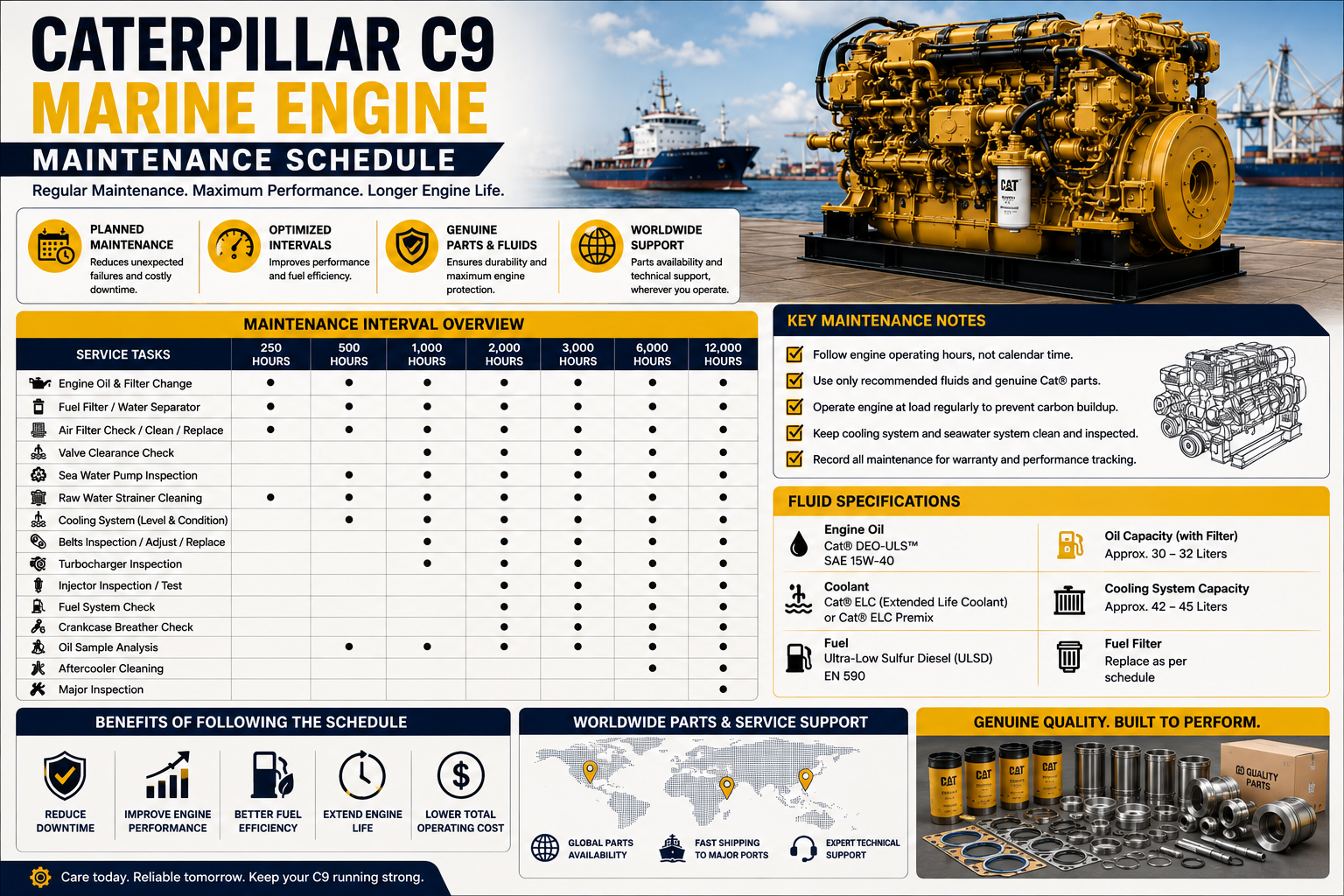
Caterpillar C9 Marine Engine Maintenance Schedule: Turning Service Hours Into a Practical Fleet Plan
The Caterpillar C9 marine engine has served in commercial marine propulsion and auxiliary applications for many years. Caterpillar introduced the marine propulsion C9 as an 8.8-liter inline-six, turbocharged and aftercooled diesel engine, with applications including fishing vessels, patrol boats, harbor craft and other commercial vessels.
For a marine engineer, Caterpillar maintenance information is normally expressed in operating hours.
For a fleet manager, those hours become much easier to understand when translated into calendar time.
A 500-hour service may sound distant.
But on a vessel running 5,000 hours per year, those 500 hours arrive roughly every 1.2 months.
That is why this guide places every major interval inside its own easy-to-read maintenance box.
For planning examples, we will use:
Low Usage: 3,000 operating hours per year
High Usage: 5,000 operating hours per year
The calculation is:
Maintenance interval ÷ annual operating hours × 12 = approximate months
The month figures below are planning tools. Exact maintenance requirements should always be checked against the correct Caterpillar Operation & Maintenance Manual using the engine serial number and application. Caterpillar's current Parts Store specifically asks C9 marine owners to add the serial number to access appropriate manuals and maintenance resources.
Where Does the Caterpillar C9 Marine Engine Fit?
Manufacturer: Caterpillar
Engine: C9 Marine
Configuration: Inline 6-cylinder
Displacement: 8.8 liters
Aspiration: Turbocharged and aftercooled
Control: Electronic
Common applications: Fishing boats, patrol craft, harbor vessels, municipal vessels and other commercial marine applications
Published Caterpillar material describes the marine propulsion C9 at 375 bkW / 503 bhp at 2,500 rpm in one commercial rating and identifies its HEUI fuel system and ADEM III electronic controls.
That older C9 should not be confused with the later C9.3, which is a different engine family variant with its own specifications and maintenance information.
How to Use the Maintenance Boxes
Each hour interval below includes:
- Caterpillar maintenance timing
- Approximate months at 3,000 annual hours
- Approximate months at 5,000 annual hours
- Practical engineer notes
The detailed C9 marine maintenance document reviewed includes daily, initial, 250-hour, 500-hour, 1,000-hour, 2,000-hour, 3,000-hour and major-overhaul requirements.
Some of those detailed intervals come from a C9 Marine Generator Set schedule, so where a task is configuration-sensitive, I make that clear rather than treating it as universal for every propulsion C9.
Caterpillar C9 Daily Maintenance
🟦 DAILY / BEFORE OPERATION
Interval: Every operating day
Low Usage: Daily
High Usage: Daily
Typical checks include:
- Engine oil level
- Coolant level
- Fuel/water separator
- Leaks
- Engine air-cleaner indicator
- Instrument panel
- Walk-around inspection
Engineer Focus: Look for changes from the previous day, not only active faults.
C9 marine maintenance documentation includes daily checks for engine oil, coolant, primary fuel/water separation and general walk-around condition.
A small coolant stain today may be far more useful than a high-temperature alarm next month.
Initial 20–40 Service Hours
🟦 INITIAL 20–40 HOURS
Approximate timing: Very early commissioning period
Verified task in referenced C9 marine schedule:
Belts — inspect / adjust / replace
Engineer Focus: Check belt seating and tension after initial running.
The referenced C9 marine maintenance schedule places belt inspection and adjustment at the initial 20–40 service-hour point.
This is especially relevant after:
- New engine installation
- Belt replacement
- Major service
- Accessory-drive work
Every 50 Service Hours or Weekly
🟦 50 HOURS / WEEKLY
Low Usage: about 0.2 month
High Usage: about 0.12 month
Verified tasks in the referenced C9 marine schedule:
- Aftercooler condensate drain valve — inspect / clean
- Seawater strainer — clean / inspect
- Zinc rods — inspect / replace
Engineer Focus: Seawater-side restriction can show up under load before the engine overheats at idle.
The C9 marine maintenance schedule specifically lists these items every 50 service hours or weekly.
Why the Seawater Strainer Deserves Weekly Attention
A partially blocked strainer may still allow enough flow at low load.
At high load, however, the engine requires much more heat rejection.
Reduced seawater flow can contribute to:
- Higher coolant temperature
- Poor aftercooler performance
- Reduced heat-exchanger efficiency
- Higher exhaust temperature
- Increased engine-room heat
So when a C9 starts running warmer under load, do not immediately replace the seawater pump.
Check the whole raw-water circuit first.
Initial 250-Hour Service
🟦 INITIAL 250 HOURS
Low Usage: about 1 month
High Usage: about 0.6 month
Referenced initial tasks:
- Engine valve lash — check
- Injector bolt torque — inspect
Engineer Focus: Record actual valve-clearance measurements before adjustment.
The referenced C9 marine schedule places these tasks at the initial 250-hour service or first oil change.
This is not just a tightening exercise.
The recorded values become a useful baseline for future maintenance.
Every 250 Service Hours
🟩 250-HOUR SERVICE
Low Usage — 3,000 h/year: about 1 month
High Usage — 5,000 h/year: about 0.6 month
Referenced tasks include:
- Auxiliary water pump with rubber impeller — inspect
- Battery electrolyte level — check
- Belts — inspect / adjust / replace
- Supplemental Coolant Additive — test / add
- Engine oil sample — obtain
- Fuel tank water and sediment — drain
- Hoses and clamps — inspect / replace
Engineer Focus: This is a useful condition-monitoring point, not just a service interval.
The C9 marine schedule lists these tasks at 250 service hours or a fuel/calendar equivalent, whichever comes first.
Oil Analysis at 250 Hours
Oil analysis is particularly valuable on an electronically controlled C9 because several engine systems can influence lubricant condition.
Track:
- Iron
- Copper
- Aluminium
- Silicon
- Fuel dilution
- Water contamination
- Viscosity
- Oxidation
Do not look only at one sample.
The trend is what matters.
Every 500 Service Hours
🟩 500-HOUR SERVICE
Low Usage: about 2 months
High Usage: about 1.2 months
Referenced C9 marine tasks:
- Engine oil and filter — change
- Fuel primary filter / water separator element — replace
- Fuel secondary filter — replace
- Air-cleaner element — inspect / clean / replace
- Battery charger — check on applicable installations
Engineer Focus: Fuel and lubrication maintenance come together at this point.
The referenced C9 marine schedule places engine oil/filter and both primary and secondary fuel-filter maintenance at the 500-hour level.
At 5,000 hours per year, 500 hours arrive about every five to six weeks.
That means a high-use fleet needs a serious inventory plan for:
- Oil
- Oil filters
- Primary fuel filters
- Secondary fuel filters
- Air-filter elements
- Sealing components
Engine Oil and Filter
The referenced C9 marine schedule uses a 500-hour oil and filter interval for the particular installation documented.
However, Caterpillar's broader marine guidance notes that oil-change intervals can vary with configuration and recommends using the specific OMM.
So before applying 500 hours to your own engine, verify:
Engine serial number
Application
Oil sump configuration
Oil specification
Operating duty
Fuel Filters
The 500-hour maintenance point in the referenced marine schedule includes replacement of:
- Primary fuel/water separator element
- Secondary fuel filter
This is especially important on the C9 because fuel cleanliness directly influences the electronically controlled injection system.
A filter is inexpensive compared with injector-system damage.
Initial 500 Hours After Cooling-System Work
🟦 INITIAL 500 HOURS — COOLING SYSTEM
Applies after: New cooling system, refill, or conversion
Verified task: Level 2 coolant sample
Engineer Focus: Confirm coolant chemistry after the system has stabilized.
The referenced C9 maintenance schedule specifies a Level 2 coolant sample at the initial 500 hours for new, refilled, or converted systems.
Every 1,000 Service Hours
🟦 1,000-HOUR SERVICE
Low Usage: about 4 months
High Usage: about 2.4 months
Referenced tasks include:
- Aftercooler core — clean / test
- Engine crankcase breather — clean
- Engine mounts — inspect
- Heat exchanger — inspect
- Injector bolt torque — inspect
- Turbocharger — inspect
Engineer Focus: This is where air, cooling, mounting and turbocharger condition come together.
The referenced C9 marine schedule assigns these tasks at the 1,000-hour level.
Aftercooler Maintenance
A dirty aftercooler can create symptoms that look like another problem.
Possible results include:
- Higher intake-air temperature
- Higher exhaust temperature
- Reduced air density
- Lower combustion efficiency
- Higher turbocharger load
Cleaning and testing the aftercooler at the appropriate interval helps preserve engine breathing.
Heat Exchanger Inspection
At the 1,000-hour interval, the referenced schedule calls for heat-exchanger inspection.
Inspect for:
- Fouling
- Corrosion
- Leakage
- Restricted seawater passages
- Scale
- Debris
The engine may still have normal coolant temperature at low load while heat-transfer capacity is already deteriorating.
Turbocharger Inspection
🟦 TURBOCHARGER — 1,000-HOUR REFERENCED INSPECTION
Low Usage: about 4 months
High Usage: about 2.4 months
Inspect:
- Compressor cleanliness
- Turbine deposits
- Oil leakage
- Bearing condition
- Shaft movement
- Boost trend
Engineer Focus: Compare turbocharger performance over time.
The C9 uses turbocharging as a central part of its marine performance package.
Every 2,000 Service Hours
🟥 2,000-HOUR SERVICE
Low Usage: about 8 months
High Usage: about 4.8 months
Referenced tasks include:
- Alternator — inspect
- Coolant temperature regulator — replace
- Crankshaft vibration damper — inspect
- Engine speed/timing sensor — clean / inspect
- Engine valve lash — check
- Starting motor — inspect
- Water pump — inspect
Engineer Focus: This is a significant mechanical inspection point.
The referenced C9 marine maintenance schedule places these items at the 2,000-hour service level.
Valve Lash at 2,000 Hours
Valve lash appears again at this interval.
This is why recording the initial values matters.
Do not simply write:
“Valve lash checked.”
Instead record:
- Cylinder number
- Intake measurement
- Exhaust measurement
- Adjustment made
- Unusual movement
If the same valve repeatedly changes, investigate why.
Crankshaft Vibration Damper
The crankshaft vibration damper is not a cosmetic accessory.
It helps manage torsional vibration in the crankshaft system.
At the 2,000-hour inspection, look for:
- Physical deterioration
- Leakage where applicable
- Damage
- Mounting condition
- Abnormal vibration history
A deteriorated damper can have consequences far beyond the damper itself.
Every 3,000 Service Hours
Caterpillar's current C9 Marine equipment dashboard explicitly lists a 3,000-hour maintenance event.
The referenced C9 marine schedule also identifies an auxiliary water pump with bronze impeller at 3,000 hours or its equivalent.
🟥 3,000-HOUR MAINTENANCE
Low Usage — 3,000 h/year: about 12 months
High Usage — 5,000 h/year: about 7.2 months
Referenced task: Auxiliary water pump with bronze impeller — inspect
Caterpillar Parts Store: 3,000-hour maintenance event is recognized for the C9 Marine Engine
Engineer Focus: Start parts planning well before the hour meter reaches 3,000.
At 5,000 annual hours, this maintenance point arrives in just over seven months.
Every 3,000 Hours or 3 Years
🟥 3,000 HOURS / 3 YEARS
Service-hours basis: 12 months at 3,000 h/year / 7.2 months at 5,000 h/year
Referenced task: Engine protective devices — check
Rule: Use whichever limit applies first
Engineer Focus: Protective systems matter even when the engine appears mechanically healthy.
The C9 maintenance documentation specifically includes protective-device checks at this interval.
Every 5,000 Service Hours
🟥 5,000-HOUR SERVICE
Low Usage: about 20 months
High Usage: about 12 months
Referenced task: Oil cooler core — check / clean / test
Engineer Focus: Oil temperature control is essential for bearing and turbocharger protection.
The referenced C9 marine schedule identifies oil-cooler-core maintenance at 5,000 hours.
Major Overhaul
The referenced C9 marine generator-set schedule lists a major overhaul at 12,000 service hours for that specific configuration.
That should not automatically be treated as the universal overhaul interval for every propulsion C9.
However, for the referenced application:
🟥 12,000-HOUR MAJOR OVERHAUL — REFERENCED CONFIGURATION
Low Usage: about 48 months
High Usage: about 28.8 months
Possible overhaul scope may include:
- Cylinder head
- Valves
- Fuel injectors
- Pistons
- Piston rings
- Cylinder liners
- Main bearings
- Connecting-rod bearings
- Crankshaft inspection
- Turbocharger
- Water pumps
- Oil cooler
- Gaskets and seals
Important: Confirm overhaul timing using the exact C9 serial number, duty and OMM.
For propulsion engines, overhaul planning should also consider:
- Load factor
- Fuel quality
- Oil analysis
- Cooling history
- Turbocharger history
- Cylinder condition
- Previous rebuild work
Caterpillar C9 Maintenance Summary
⚙️ QUICK C9 FLEET PLANNING BLOCK
| IntervalLow Usage 3,000 h/yearHigh Usage 5,000 h/yearKey Maintenance | |||
| Daily | Daily | Daily | Oil, coolant, fuel/water separator, walk-around |
| 20–40 h initial | — | — | Belt inspection / adjustment |
| 50 h / weekly | 0.2 mo | 0.12 mo | Aftercooler drain, seawater strainer, zinc rods |
| 250 h | 1 mo | 0.6 mo | Oil sample, rubber-impeller auxiliary pump, belts, hoses |
| 500 h | 2 mo | 1.2 mo | Oil/filter and fuel-filter service in referenced schedule |
| 1,000 h | 4 mo | 2.4 mo | Aftercooler, breather, mounts, heat exchanger, turbocharger |
| 2,000 h | 8 mo | 4.8 mo | Valve lash, water pump, damper, regulator, starting system |
| 3,000 h | 12 mo | 7.2 mo | C9 Marine maintenance event; bronze auxiliary pump inspection |
| 5,000 h | 20 mo | 12 mo | Oil cooler core maintenance |
| 12,000 h* | 48 mo | 28.8 mo | Major overhaul in referenced C9 marine generator configuration |
*The 12,000-hour overhaul figure is configuration-specific and should not automatically be applied to every C9 marine propulsion engine.
Real Marine Maintenance Scenario
Imagine a commercial fishing vessel powered by a Caterpillar C9.
The vessel accumulates approximately 5,000 hours per year.
At first glance, a 1,000-hour maintenance interval may sound generous.
But the engine reaches 1,000 hours approximately every 2.4 months.
That means during one year the crew may need to deal repeatedly with:
- Filter inventory
- Turbocharger inspections
- Heat-exchanger monitoring
- Aftercooler condition
- Oil analysis
- Cooling-system inspection
The 2,000-hour point arrives in less than five months.
The 3,000-hour point arrives in about seven months.
Suddenly, service-hour planning becomes annual procurement planning.
That is exactly why converting hours into months is so useful.
Engineer's Toolbox
CATERPILLAR C9 FLEET MAINTENANCE RECORD
Vessel: __________________
Engine: Caterpillar C9 Marine
Serial Number: __________________
Propulsion / Auxiliary / Generator: __________________
Current Hours: __________________
Annual Operating Hours: __________________
Next 250-Hour Service: __________________
Next 500-Hour Service: __________________
Next 1,000-Hour Service: __________________
Next 2,000-Hour Service: __________________
Next 3,000-Hour Maintenance: __________________
Last Oil Analysis: __________________
Last Coolant Analysis: __________________
Turbocharger Status: __________________
Seawater Pump Status: __________________
Parts Ordered: __________________
Open Technical Observations: __________________
Marine Engineer Tip
Always write “C9 Marine” and the serial number in the maintenance record—not just “C9.”
Caterpillar used the C9 platform in multiple industrial, generator and marine applications.
The maintenance schedule for one configuration should not automatically be copied to another.
Condition Monitoring Between Maintenance Intervals
The hour meter should not be your only maintenance tool.
Watch:
- Engine oil pressure
- Engine oil temperature
- Fuel consumption
- Oil consumption
- Coolant temperature
- Coolant consumption
- Exhaust smoke
- Turbocharger boost
- Exhaust temperature
- Seawater flow
- Filter restriction
- Engine vibration
- Oil-analysis trends
- Coolant-analysis trends
- Fault-code history
A C9 can tell you something is changing long before the next scheduled service point arrives.
Caterpillar C9 Spare Parts Fleet Managers Should Plan
Depending on the maintenance scope, parts may include:
- Engine oil filters
- Primary fuel filters
- Secondary fuel filters
- Air filters
- Fuel injectors
- Turbocharger components
- Raw-water pump components
- Auxiliary water pumps
- Heat exchangers
- Aftercooler components
- Thermostats / temperature regulators
- Cylinder heads
- Intake and exhaust valves
- Pistons
- Piston rings
- Cylinder liners
- Main bearings
- Connecting-rod bearings
- Crankshaft components
- Sensors
- Belts
- Gasket kits
- O-rings and seals
Caterpillar's current C9 Marine Parts Store maintains a dedicated equipment page, parts categories, manuals and maintenance resources for the engine.
Common C9 Maintenance Planning Mistakes
Avoid:
- Confusing the C9 with the later C9.3.
- Applying a C9 generator schedule blindly to a propulsion engine.
- Ignoring engine serial-number information.
- Waiting for overheating before cleaning the seawater strainer.
- Changing oil without inspecting the filter contents.
- Adjusting valve lash without recording measurements.
- Ignoring turbocharger trend changes.
- Delaying heat-exchanger inspection.
- Forgetting coolant-analysis intervals.
- Waiting until 3,000 hours before sourcing service parts.
- Assuming one major-overhaul hour applies to every C9 installation.
Frequently Asked Questions
Is the Caterpillar C9 the same as the C9.3?
No. The original C9 marine engine is an 8.8-liter engine, while the later C9.3 is a 9.3-liter platform with different specifications and maintenance documentation. Caterpillar's historic C9 marine material identifies the C9 as an 8.8-liter inline six.
What applications used the Caterpillar C9 marine engine?
Caterpillar identified applications including fishing boats, patrol boats, harbor vessels and municipal craft.
Is there a 3,000-hour Caterpillar C9 Marine maintenance event?
Yes. Caterpillar's current C9 Marine Parts Store dashboard lists a 3,000-hour maintenance event.
How often should the seawater strainer be cleaned?
The referenced C9 marine schedule specifies every 50 service hours or weekly.
When is the turbocharger inspected?
In the referenced C9 marine schedule, turbocharger inspection appears at 1,000 service hours.
When is valve lash checked?
The referenced schedule includes an initial check around 250 hours and another at 2,000 hours. Exact applicability should be confirmed against the engine-specific OMM.
Is 12,000 hours the overhaul interval for every C9?
No. The 12,000-hour major-overhaul figure comes from the referenced C9 Marine Generator Set schedule. Propulsion engines may have different overhaul planning depending on rating, load factor and engine-specific Caterpillar guidance.
Related Caterpillar C9 Marine Parts
Alfa Marine Spare Parts can assist with sourcing:
- Caterpillar C9 oil filters
- Caterpillar C9 fuel filters
- Caterpillar C9 air filters
- Caterpillar C9 injectors
- Caterpillar C9 turbocharger components
- Caterpillar C9 seawater pumps
- Caterpillar C9 auxiliary water pumps
- Caterpillar C9 heat exchangers
- Caterpillar C9 aftercooler components
- Caterpillar C9 cylinder heads
- Caterpillar C9 valves
- Caterpillar C9 piston kits
- Caterpillar C9 cylinder liners
- Caterpillar C9 bearings
- Caterpillar C9 sensors
- Caterpillar C9 gasket sets
- Caterpillar C9 overhaul components
Related Caterpillar Engine Pages
- Caterpillar C7 Marine Engine Spare Parts
- Caterpillar C7.1 Marine Engine Spare Parts
- Caterpillar C9 Marine Engine Spare Parts
- Caterpillar C9.3 Marine Engine Spare Parts
- Caterpillar C18 Marine Engine Spare Parts
- Caterpillar C32 Marine Engine Spare Parts
- Caterpillar 3408 Marine Engine Spare Parts
- Caterpillar 3412 Marine Engine Spare Parts
- Caterpillar 3512 Marine Engine Spare Parts
- Caterpillar 3516 Marine Engine Spare Parts
Worldwide Caterpillar Marine Spare Parts Supply
Alfa Marine Spare Parts supports:
- Shipyards
- Ship repairers
- Marine engineers
- Chief engineers
- Technical superintendents
- Fleet operators
- Fishing companies
- Offshore operators
- Government fleets
- Maritime contractors
- Boat builders
- Marine service companies
- Marine equipment distributors
For a C9 inquiry, provide:
Engine model + serial number + arrangement information + existing part number + quantity + photographs where available.
This helps identify the correct component before international shipping.
Browse Our Complete Catalog
Website:
https://alfamarinespareparts.com
Marine Spare Parts Catalog:
https://alfamarinespareparts.com/spareparts
Why Choose Alfa Marine Spare Parts?
A request that simply says:
“Need Caterpillar C9 parts.”
still leaves important questions.
Is it:
C9 or C9.3?
Propulsion or generator?
Which serial number?
Which cooling arrangement?
Which maintenance interval is approaching?
Alfa Marine Spare Parts helps marine customers source genuine, OEM, aftermarket, remanufactured and reconditioned Caterpillar marine engine components, depending on application and availability.
The objective is to have the correct parts ready before the C9 reaches the service hour.
Contact Alfa Marine Spare Parts
Email: request@alfamarinespareparts.com
Website:
https://alfamarinespareparts.com
Catalog:
https://alfamarinespareparts.com/spareparts
Contact Alfa Marine Spare Parts for Caterpillar C9 filters, injectors, water pumps, heat exchangers, turbocharger components, cylinder heads, bearings, pistons, liners, gaskets and overhaul components with worldwide supply.
One Final Thought
A Caterpillar C9 Marine Engine Maintenance Schedule becomes far more useful once the hours are translated into actual calendar planning.
On a vessel operating 5,000 hours per year:
250 hours arrive in roughly 0.6 month.
500 hours arrive in roughly 1.2 months.
1,000 hours arrive in roughly 2.4 months.
2,000 hours arrive in roughly 4.8 months.
3,000 hours arrive in roughly 7.2 months.
Those numbers change the way maintenance should be planned.
The best question is no longer simply:
“How many hours are on the engine?”
It becomes:
“Which C9 do we have, what service event is coming next, and are the right parts already in place?”