DEUTZ Marine Engine Types: What Is the Difference, and Which Engine Is Right for Which Boat or Machine?
Someone looking at an old DEUTZ engine plate may see something like:
F4L912
or
BF6L914
or
BF6M1013
and think:
“They're all DEUTZ engines. How different can they really be?”
Quite different.
DEUTZ has produced engine families for decades covering everything from compact industrial equipment to agricultural machinery, pumps, generator sets and marine installations.
Some are famously simple air-cooled mechanical diesels.
Others are water-cooled turbocharged engines.
Newer TCD engines add common-rail injection, electronics, charge-air cooling and modern emissions technology.
DEUTZ's own historical lubrication documentation groups well-known families such as 912, 913, 914, 1012, 1013, 2012, 2013 and 2015 among engines used in built-in and marine applications, while DEUTZ's current engine archive shows how the product range evolved into newer TCD families.
So which DEUTZ engine makes sense for which job?
That is where things become interesting.
First: Understanding DEUTZ Engine Names
Older DEUTZ engine names can look complicated until you learn the basic pattern.
Take:
F6L912
The designation tells us something about the configuration.
In traditional DEUTZ nomenclature, the number of cylinders is represented in the designation, and families such as the 912 were produced as modular inline engines.
The 912 family, for example, was offered in several cylinder counts, allowing DEUTZ to use the same basic engine concept across different power requirements. DEUTZ's current legacy documentation still lists the FL 912 family.
You will commonly encounter names such as:
- F3L912
- F4L912
- F6L912
- F4L913
- F6L913
- F4L914
- F6L914
- BF6L914
- BF4M1012
- BF6M1013
- BF4M2012
- BF6M2012
- BF4M2013
- BF6M2013
The letters and suffixes tell you more about cooling, turbocharging and configuration.
That matters when you are ordering parts.
A F6L912 and a BF6L914 may look related, but they should never simply be treated as the same engine.
DEUTZ 912 Series: The Simple Air-Cooled Workhorse
If someone asks:
“Which old DEUTZ engine is known for simplicity?”
The DEUTZ 912 Series is one of the first families that comes to mind.
DEUTZ's legacy material shows the FL 912 as part of its long-running engine portfolio, and the family is particularly well known for its air-cooled design.
Common versions include:
F3L912
F4L912
F6L912
Why Do People Still Like the 912?
The biggest attraction is simplicity.
There is no conventional liquid-cooling circuit with:
- radiator coolant
- freshwater circulation
- coolant hoses
- thermostat housing
- conventional coolant pump
Instead, engine cooling is handled through forced airflow.
For machinery working in remote locations, that simplicity historically made the 912 very attractive.
Where Will You Find a DEUTZ 912?
Common applications have included:
- Generator sets
- Pumps
- Compressors
- Construction equipment
- Agricultural machinery
- Industrial equipment
- Older marine auxiliary installations
- Repowered boats and workboats
Is the 912 a Good Main Marine Propulsion Engine?
It can be found in marine installations, especially older conversions and auxiliary applications, but it is fundamentally famous as a versatile industrial engine.
For a commercial boat where compact packaging, very high power density and modern electronic control are priorities, a newer engine family would generally be more natural.
But for a simple older vessel where mechanical simplicity is valued?
The 912 still has a loyal following.
DEUTZ 914 Series: Similar Philosophy, More Development
The DEUTZ 914 Series followed the same basic air-cooled philosophy but represented a later development.
DEUTZ describes the 914 family as air-cooled inline engines, available in 3- to 6-cylinder naturally aspirated configurations, with a six-cylinder turbocharged and charge-air-cooled version also available. The family uses approximately 1.1 liters per cylinder.
Common engine types include:
- F3L914
- F4L914
- F5L914
- F6L914
- BF6L914
912 vs. 914: What Is the Difference?
Think of it this way:
912 = classic air-cooled DEUTZ architecture
914 = later evolution of that air-cooled concept
The 914 family offered later-generation improvements while retaining the simplicity that made air-cooled DEUTZ engines attractive.
What Is the BF6L914?
This is where things become more interesting.
The BF6L914 is a six-cylinder turbocharged member of the family.
Compared with a naturally aspirated version, turbocharging provides greater power from the same basic engine size.
That makes it more suitable when the machine needs:
- higher output
- more torque
- stronger performance under load
without moving immediately into a much larger engine.
Which Boat Suits a 912 or 914 Best?
For marine use, these families make the most sense where simplicity and serviceability matter more than extremely high power density.
Potential applications include:
- Small workboats
- Fishing vessels
- Auxiliary engines
- Hydraulic-power packs
- Deck machinery
- Generator installations
- Older repower projects
One reason engineers still appreciate these engines is that a mechanically simple air-cooled diesel can be easier to understand in remote operating areas.
There is simply less cooling-system equipment to fail.
But that comes with a tradeoff.
Air-cooled engines need excellent airflow.
Put one into a badly ventilated engine room and the simplicity becomes a disadvantage.
DEUTZ 1012 Series: Moving Into Water-Cooled Compact Engines
The DEUTZ 1012 family represents a different engineering philosophy.
Here you move away from the classic air-cooled 912/914 concept and toward liquid-cooled compact engines.
DEUTZ documentation groups the 1012 together with other built-in and marine engine families in its technical lubrication guidance.
Common variants include engines such as:
- BF4M1012
- BF6M1012
- BF4M1012C
- BF6M1012C
Why Move to Water Cooling?
Water cooling allows tighter thermal control.
That can help with:
- higher specific power
- more consistent temperature
- turbocharging
- charge-air cooling
- quieter operation
- compact installation
But naturally it adds components.
Now the engineer has to think about:
- coolant pumps
- thermostats
- hoses
- heat exchangers
- coolant chemistry
- seawater cooling where marinized
So the engine becomes more sophisticated.
Where Does the DEUTZ 1012 Fit?
The 1012 became popular in:
- Generator sets
- Pumps
- Construction machinery
- Industrial equipment
- Agricultural equipment
- Marine auxiliary installations
- Workboat repowers
For a vessel operator moving from an old air-cooled DEUTZ to a water-cooled engine, the 1012 represents a noticeable change in maintenance philosophy.
DEUTZ 1013 Series: More Power for Heavier Work
The DEUTZ 1013 is another important family in the used engine and spare-parts market.
The 1013 sits naturally above many smaller compact engines and has been widely used where more torque and continuous output were required.
DEUTZ technical documentation specifically recognizes 1013 and 1013M variants among engines without exhaust after-treatment, showing that marine-specific versions existed within the broader family.
Common names include:
- BF4M1013
- BF6M1013
- BF6M1013E
- BF6M1013M
What Does the “M” Matter?
In many DEUTZ model contexts, an M designation is associated with marine application/configuration.
So when sourcing parts, don't ignore that final letter.
A marine engine may have different:
- cooling arrangements
- exhaust components
- pumps
- heat exchangers
- mounting equipment
than an industrial engine using the same basic block.
Which Vessels Suit the 1013?
A 1013-type engine can make sense for:
- Workboats
- Fishing vessels
- Small commercial craft
- Auxiliary power
- Marine generator applications
- Hydraulic systems
- Repower projects
Compared with an old F6L912, a water-cooled turbocharged 1013 provides a more modern balance of output and packaging.
DEUTZ 2012 Series: Compact, Turbocharged and Very Versatile
The DEUTZ 2012 family is another widely encountered compact-engine series.
DEUTZ's official lubrication guidance specifically lists BFM 2012 and related versions in built-in and marine-engine categories.
Common models include:
- BF4M2012
- BF4M2012C
- BF6M2012
- BF6M2012C
- TCD 2012 variants
What Makes the 2012 Different From a 912?
This comparison shows how far DEUTZ engine design evolved.
912
- Air cooled
- Mechanically simple
- Older architecture
- Ideal where simplicity matters
2012
- Liquid cooled
- Turbocharged versions widely used
- Higher power density
- More modern fuel and air systems
- Better suited to compact high-output installations
So a mechanic who loves a 912 because “there's almost nothing around it” may find a 2012 more complicated.
A boatbuilder looking for more power from a smaller installation may prefer the 2012 concept.
DEUTZ 2013 Series: A Step Up for Heavier Applications
The 2013 family continues the water-cooled, higher-output approach.
DEUTZ documentation groups the 2013 alongside the 1012, 1013 and 2012 families in its built-in/marine technical guidance.
Common variants include:
- BF4M2013
- BF6M2013
- TCD 2013
The family fits naturally where applications need more sustained output than the smallest compact engines can provide.
Potential uses include:
- Larger generator sets
- Heavy pumps
- Workboats
- Commercial vessel auxiliaries
- Construction equipment
- Material-handling machinery
- Industrial power units
TCD Engines: Modern DEUTZ Technology
Now we come to the newer generation.
Modern TCD engines move well beyond the mechanical simplicity of an F4L912.
DEUTZ's current engine range includes water-cooled, turbocharged, charge-air-cooled engines with modern fuel injection and emissions systems.
For example, DEUTZ describes the TCD 4.1 L4 as a water-cooled four-cylinder inline engine with turbocharging, charge-air cooling and cooled external EGR.
The larger TCD 12.0 L6 is a water-cooled six-cylinder inline engine with turbocharging and intercooling.
Modern TCD families include engines such as:
- TCD 2.9
- TCD 3.6
- TCD 4.1
- TCD 6.1
- TCD 7.8
- TCD 12.0
- TCD 16.0
DEUTZ's engine archive and product history show these modern families covering mobile machinery, agriculture and industrial power requirements.
Old DEUTZ vs. Modern DEUTZ: Which Would an Engineer Prefer?
That depends entirely on the job.
Imagine two engineers.
One maintains a remote fishing vessel where:
- electronics support is limited
- fuel quality can vary
- crew mechanics perform most repairs
- simplicity is valuable
That engineer might have a soft spot for an older mechanical DEUTZ.
Another engineer operates modern commercial equipment where:
- fuel efficiency matters
- emissions compliance matters
- diagnostics are available
- power density matters
- downtime is carefully monitored
That engineer may prefer a modern TCD.
Neither is automatically wrong.
They are solving different problems.
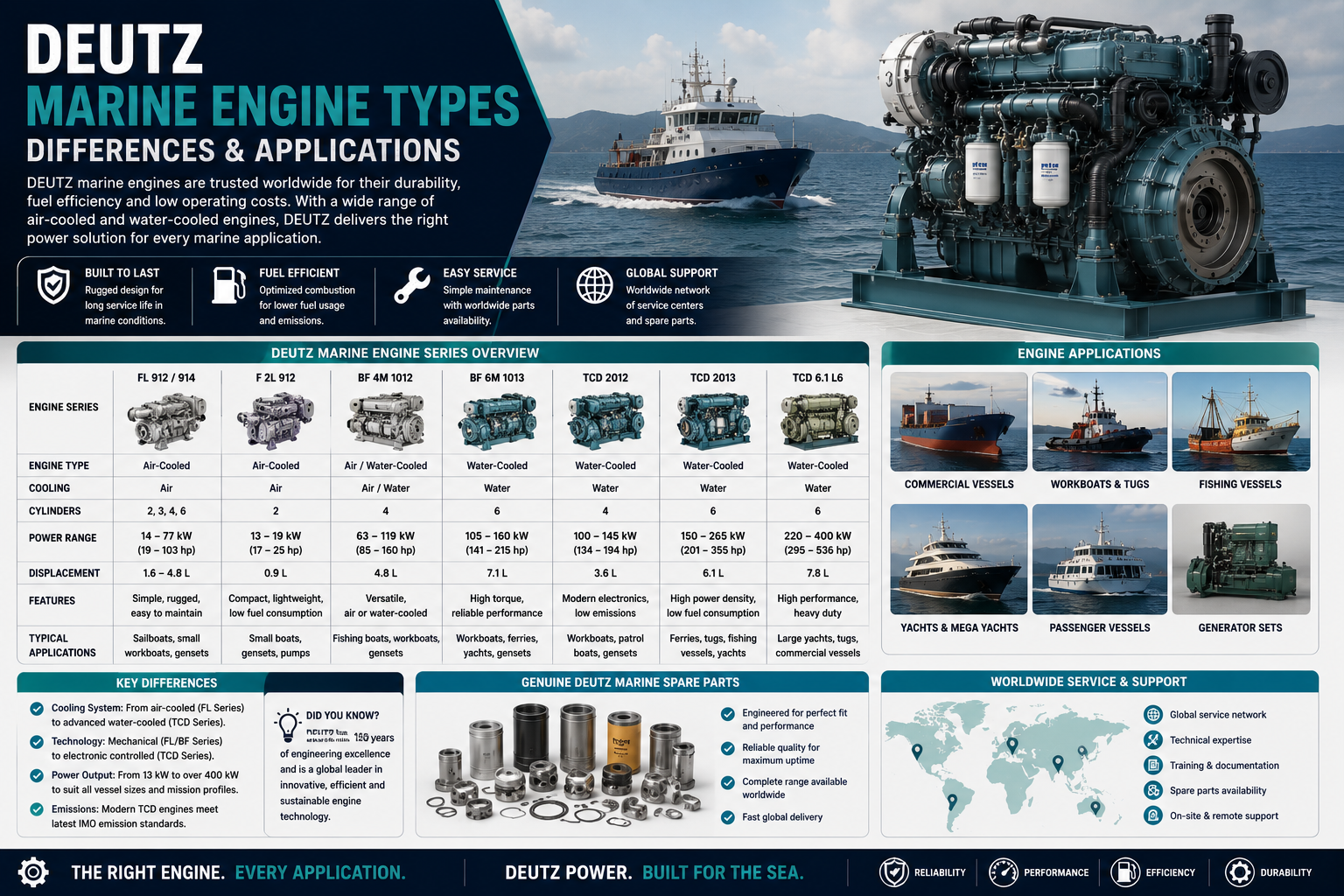
DEUTZ Engine Families Compared
⚙️ QUICK DEUTZ ENGINE COMPARISON
| DEUTZ FamilyCoolingTypical CharacterGood Fit For | |||
| 912 | Air cooled | Very simple, mechanical, robust | Pumps, generators, older workboats, machinery |
| 913 | Air cooled | Development of classic air-cooled architecture | Industrial equipment, generators, machinery |
| 914 | Air cooled | Later air-cooled generation; turbo option available | Construction, agricultural, generators, marine auxiliary |
| 1012 | Liquid cooled | Compact and more modern | Workboats, generators, pumps, industrial equipment |
| 1013 | Liquid cooled | Higher output, turbocharged family | Fishing vessels, workboats, gensets, heavy machinery |
| 2012 | Liquid cooled | Compact, modern, high power density | Generator sets, workboats, equipment |
| 2013 | Liquid cooled | Larger-duty compact engine | Commercial auxiliaries, heavy machines, power units |
| TCD Series | Liquid cooled | Electronic, common-rail, modern emissions technology | Newer industrial machinery, generators, modern power applications |
If You Own a Small Workboat, Which DEUTZ Makes Sense?
For an older small workboat, engines such as:
F4L912
F6L912
F4L914
can be attractive because of their mechanical simplicity.
But before repowering a boat with an air-cooled engine, ask:
Can the engine room supply enough cooling air?
That question is critical.
A water-cooled engine transfers much of its heat into coolant.
An air-cooled engine transfers heat directly into the surrounding airflow.
Engine-room ventilation therefore becomes part of the cooling system.
What About a Fishing Boat?
A fishing vessel often wants:
- reliability
- good low-speed torque
- easy service
- reasonable fuel consumption
- parts availability
Older installations may use 912/913/914 families.
For larger or more heavily loaded vessels, 1013, 2012 or 2013-type engines can make more sense because of their higher power density and water-cooled architecture.
The exact choice depends on:
- displacement
- gearbox
- propeller
- operating rpm
- duty cycle
- engine-room space
Never choose a marine engine only by horsepower.
What About a Marine Generator?
This is where DEUTZ engines have historically been especially versatile.
Generator installations may use families such as:
- 912
- 913
- 914
- 1012
- 1013
- 2012
- 2013
- newer TCD engines
A generator doesn't care whether the engine looks modern.
It cares whether the engine can maintain stable speed and power under its expected load.
For a simple standby genset, an older mechanical engine may be perfectly adequate.
For a modern electronically controlled vessel, a newer platform can integrate more naturally with monitoring and emissions requirements.
What About Pumps and Hydraulic Power Packs?
DEUTZ engines have long been popular here because a self-contained diesel power unit can be used almost anywhere.
Typical applications include:
- Fire pumps
- Dewatering pumps
- Dredging equipment
- Hydraulic deck machinery
- Emergency pumps
- Irrigation equipment
- Industrial pumping systems
Older air-cooled engines can be particularly attractive where there is no convenient external cooling system.
What About Construction Machinery?
Here the answer changes.
DEUTZ's current engine catalog focuses heavily on off-highway and mobile machinery applications, with modern TCD engines used for construction, material handling and industrial equipment.
Applications can include:
- Excavators
- Crushers
- Loaders
- Compressors
- Access platforms
- Concrete equipment
- Forklifts
- Material handlers
Modern equipment increasingly benefits from electronic control and emissions systems.
So a TCD is much more at home in a new construction machine than an F4L912.
Agricultural Machinery
Agriculture is another major DEUTZ application.
DEUTZ's current engine range includes dedicated agricultural versions, from small TCD families through much larger engines such as the TCD 12.0.
Typical equipment includes:
- Tractors
- Harvesters
- Irrigation pumps
- Agricultural power units
- Sprayers
- Specialized field equipment
Again, modern agriculture increasingly values:
- fuel efficiency
- electronic engine management
- emissions compliance
- torque response
Which DEUTZ Engine Is Easiest to Repair?
If you asked many mechanics which family they would prefer to repair in a basic workshop, an older air-cooled mechanical engine would often be high on the list.
Why?
Because there is less supporting equipment.
An older 912 may allow you to understand a large percentage of the engine with:
- mechanical tools
- pressure gauges
- visual inspection
- engine experience
A modern TCD may require:
- diagnostic software
- electronic fault codes
- sensor testing
- common-rail knowledge
- emissions-system diagnostics
That is the price of modern performance and emissions control.
Which DEUTZ Is Best for Remote Locations?
This is where older mechanical engines can still make sense.
Imagine a workboat operating far from a major service center.
The engineer may value:
Simple mechanical fuel system
No complex aftertreatment
Air cooling
Easy access
Fewer electronic sensors
That makes a 912/913/914-type engine attractive.
But again, older does not automatically mean better.
Parts condition and maintenance history matter enormously.
A badly worn F6L912 is not automatically more reliable than a well-maintained newer engine.
Marine Engineer's Tip
Don't buy a DEUTZ replacement engine because the horsepower looks right.
Check:
- Continuous versus intermittent rating
- Rated rpm
- Gearbox ratio
- Propeller requirement
- Cooling arrangement
- Engine-room ventilation
- Exhaust system
- Mounting points
- PTO requirements
- Electrical system
- Parts availability
The correct horsepower with the wrong installation can still make a poor marine engine.
The Biggest Difference: Air Cooling vs. Water Cooling
This is probably the easiest way for readers to understand the older DEUTZ families.
Air-Cooled DEUTZ
Examples:
- 912
- 913
- 914
Advantages can include:
- No conventional radiator/coolant system
- Fewer hoses
- No conventional coolant pump
- Simple installation in some machinery
- Good suitability for remote industrial work
But:
- Cooling-air flow is essential
- Engine-room heat can be significant
- Air passages must stay clean
Water-Cooled DEUTZ
Examples:
- 1012
- 1013
- 2012
- 2013
- TCD families
Advantages include:
- More controlled engine temperature
- Higher specific output
- Better compatibility with turbocharging and charge-air cooling
- Easier integration into many enclosed installations
But they bring:
- Coolant
- Pumps
- Thermostats
- Heat exchangers
- Hoses
- More potential leak points
Neither system is automatically superior.
It depends on the application.
Common DEUTZ Spare Parts by Engine Family
912 / 913 / 914
Common maintenance and overhaul requirements may include:
- Fuel injectors
- Injection pumps
- Cylinder heads
- Pistons
- Piston rings
- Cylinders / liners
- Connecting rods
- Bearings
- Oil pumps
- Cooling fans
- Fan belts
- Gaskets
- Seals
- Complete overhaul kits
1012 / 1013
Common requirements may include:
- Injectors
- Turbochargers
- Water pumps
- Oil pumps
- Cylinder heads
- Pistons
- Liners
- Bearings
- Thermostats
- Gasket sets
- Heat-exchanger-related components on marine versions
2012 / 2013
Common requirements include:
- Fuel-system components
- Turbochargers
- Water pumps
- Oil coolers
- Cylinder heads
- Pistons
- Liners
- Bearings
- Gaskets
- Sensors on applicable versions
Modern TCD Engines
Parts requirements increasingly include:
- Common-rail injectors
- High-pressure fuel pumps
- Turbochargers
- Sensors
- Electronic controls
- EGR components
- Aftertreatment components
- Cooling-system parts
- Engine mechanical internals
Which DEUTZ Family Is Best? A Simple Answer
⚓ IF YOUR PRIORITY IS...
Mechanical simplicity:
Look toward older 912 / 913 / 914 architecture.
Compact water-cooled power:
Look toward 1012 / 1013.
More modern compact industrial power:
2012 / 2013 become interesting.
Modern electronics, emissions compliance and high efficiency:
Look toward the newer TCD families.
Marine auxiliary or generator use:
Several families can work—the correct answer depends heavily on rating, cooling arrangement and installation.
Repowering a boat:
Do not choose by engine family alone. Match the engine, gearbox, propeller and vessel duty.
Frequently Asked Questions
Is the DEUTZ 912 water cooled?
No. The classic 912 family is air cooled. DEUTZ continues to maintain documentation for the legacy FL 912 family.
Is the DEUTZ 914 air cooled?
Yes. DEUTZ describes the 914 as an air-cooled inline family available with three to six cylinders, including a turbocharged six-cylinder version.
What is the main difference between DEUTZ 912 and 914?
They share the classic DEUTZ air-cooled philosophy, but the 914 is a later engine generation with different specifications and available configurations. Parts should not automatically be treated as interchangeable.
Is the DEUTZ 1013 used in marine applications?
DEUTZ technical documentation specifically recognizes 1013M among its engine variants, alongside the broader 1013 family.
Are DEUTZ 2012 and 2013 engines water cooled?
They belong to DEUTZ's later compact liquid-cooled engine generations, distinct from the older air-cooled 912/913/914 architecture. DEUTZ's technical documentation groups these families among built-in and marine applications.
What does TCD mean for a DEUTZ engine?
TCD designations are associated with DEUTZ's later turbocharged, charge-air-cooled diesel families. Current TCD engines can incorporate common-rail injection, EGR and emissions-control systems depending on model and emissions stage.
Can I replace a DEUTZ 912 with a newer DEUTZ engine?
Potentially, but a repower must consider much more than engine power. Mounting, dimensions, rated rpm, gearbox, propeller, cooling, exhaust, electrical system and vessel duty must all be reviewed.
DEUTZ Marine Engine Spare Parts
Alfa Marine Spare Parts can assist with components for DEUTZ engine families such as:
- DEUTZ 912
- DEUTZ 913
- DEUTZ 914
- DEUTZ 1012
- DEUTZ 1013
- DEUTZ 2012
- DEUTZ 2013
- Selected TCD engine families
Parts requirements may include fuel injectors, injection pumps, turbochargers, water pumps, oil pumps, cylinder heads, pistons, rings, liners, bearings, gasket sets, cooling components and overhaul parts.
For older DEUTZ engines especially, send:
Complete engine designation + serial number + existing part number + photos.
That is far safer than requesting:
“DEUTZ six-cylinder water pump.”
Related DEUTZ Engine Pages
- DEUTZ F3L912 Marine Engine Spare Parts
- DEUTZ F4L912 Marine Engine Spare Parts
- DEUTZ F6L912 Marine Engine Spare Parts
- DEUTZ F4L914 Marine Engine Spare Parts
- DEUTZ F6L914 Marine Engine Spare Parts
- DEUTZ BF6L914 Marine Engine Spare Parts
- DEUTZ BF4M1012 Marine Engine Spare Parts
- DEUTZ BF6M1013 Marine Engine Spare Parts
- DEUTZ BF4M2012 Marine Engine Spare Parts
- DEUTZ BF6M2012 Marine Engine Spare Parts
- DEUTZ BF6M2013 Marine Engine Spare Parts
Why Choose Alfa Marine Spare Parts?
With DEUTZ engines, correct identification becomes particularly important because the installed fleet spans many generations.
A customer may have an engine from decades ago sitting beside a much newer electronically controlled DEUTZ on another vessel.
Alfa Marine Spare Parts assists marine engineers, ship repairers, workshops and fleet operators sourcing OEM, genuine, aftermarket, remanufactured and reconditioned DEUTZ components, depending on the engine and availability.
For an accurate inquiry, provide:
Engine designation + serial number + current part number + quantity + photos where available.
Contact Alfa Marine Spare Parts
Email: request@alfamarinespareparts.com
Website:
https://alfamarinespareparts.com
Marine Spare Parts Catalog:
https://alfamarinespareparts.com/spareparts
One Final Thought
The interesting thing about DEUTZ marine engine types is that there really isn't one “typical DEUTZ.”
A F4L912 represents the old-school philosophy:
simple, mechanical and air cooled.
A BF6L914 takes that air-cooled idea and adds more performance.
A 1013 or 2012 moves into compact water-cooled turbocharged power.
And a modern TCD brings DEUTZ into the world of common rail, electronics and modern emissions control.
So when somebody asks:
“Which DEUTZ engine is best?”
the better answer is another question:
“Best for what?”
A fishing boat, emergency generator, excavator, hydraulic power pack and modern construction machine do not need the same engine.
And that is exactly why DEUTZ has produced so many different engine families.