
Caterpillar Turbochargers (C7, C9, C13, C15 & 3406): Why Do They Fail? A Marine Engineer Answers the Most Common Questions
Caterpillar Turbochargers (C7, C9, C13, C15 & 3406): Why Do They Fail?
A turbocharger is one of the hardest-working components on any Caterpillar marine engine. Whether you're running a C7, C9, C13, C15, or 3406, the turbocharger is responsible for delivering the extra air your engine needs to produce power efficiently.
But here's something many boat owners don't realize:
Most Caterpillar turbochargers don't fail because they're worn out—they fail because another problem damaged them first.
That's why experienced marine engineers rarely replace a turbocharger without first asking one important question:
"Why did it fail?"
Let's answer the questions we hear most often.
What does a Caterpillar turbocharger actually do?
Think of the turbocharger as your engine's air compressor.
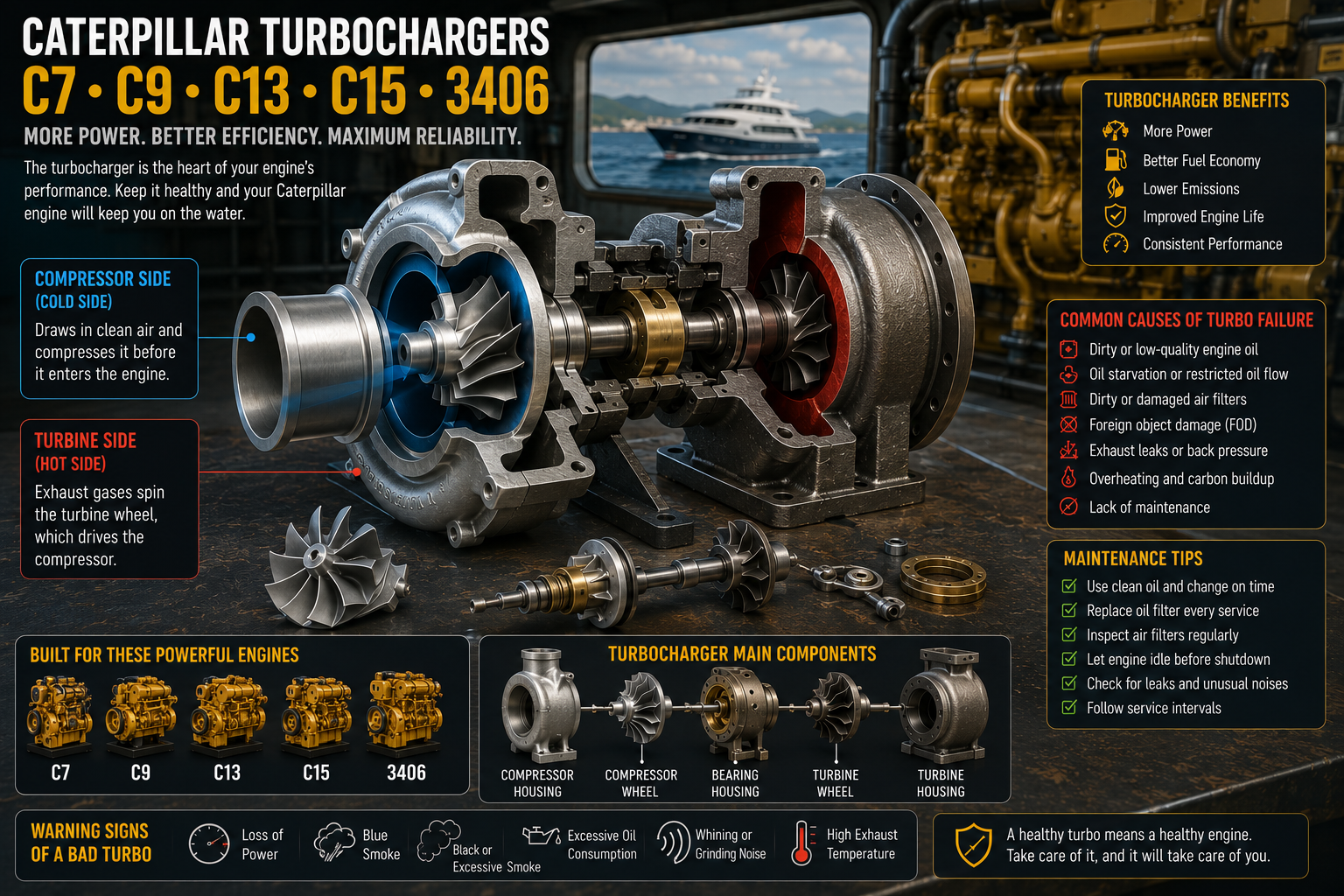
Instead of letting hot exhaust gases escape overboard, the turbocharger uses that energy to spin a turbine wheel.
That spinning turbine drives a compressor wheel on the opposite side, forcing more clean air into the engine.
More air means:
- More horsepower
- Better combustion
- Lower fuel consumption
- Cleaner exhaust
- Higher engine efficiency
Without a healthy turbocharger, even a powerful Caterpillar engine will feel sluggish.
Why do Caterpillar turbochargers fail?
This is probably the most common question asked during an engine overhaul.
According to Caterpillar service information and turbocharger maintenance guides found in marine engineering manuals, the most common causes include:
- Dirty engine oil
- Oil starvation
- Foreign object damage
- Restricted air filters
- Exhaust leaks
- Overheating
- Carbon buildup
- Lack of routine maintenance
In many cases, the turbocharger is simply the victim—not the cause—of the engine problem.
Can dirty engine oil damage a turbocharger?
Absolutely.
The turbocharger shaft spins at incredibly high speeds—often well over 100,000 RPM.
Its bearings rely entirely on clean engine oil.
If the oil contains dirt, metal particles, sludge, or carbon, those contaminants act like fine grinding paste.
Over time they wear the bearings and shaft.
As the clearance increases, the turbocharger begins losing efficiency.
Eventually the compressor or turbine wheel may contact the housing, causing major damage.
Clean oil is one of the best forms of turbocharger protection.
What happens if the turbocharger doesn't receive enough oil?
This is known as oil starvation, and it's one of the quickest ways to destroy a turbocharger.
Without a constant supply of oil:
- Bearings overheat.
- The shaft begins to score.
- Friction increases rapidly.
- Components seize.
Sometimes this damage happens in only a few minutes.
That's why oil pressure should always be verified before starting an engine after maintenance.
Can dirty air damage a Caterpillar turbocharger?
Yes.
Every bit of air entering the engine passes through the turbocharger first.
If the air filter is damaged or missing, dust, sand, or other debris can strike the compressor wheel.
Even small particles can chip or erode the blades.
Over time this changes the balance of the rotating assembly.
An unbalanced turbocharger vibrates more, wears faster, and loses efficiency.
What is foreign object damage?
Marine engineers often call it FOD.
Foreign object damage happens when debris enters either side of the turbocharger.
Examples include:
- Broken air filter parts
- Loose bolts
- Engine fragments
- Pieces of damaged valves
- Broken compressor blades
- Exhaust debris
Because the turbine spins so fast, even a tiny object can destroy the wheel instantly.
That's why a damaged turbocharger should always be inspected carefully before installing a replacement.
Why does a turbocharger make a whining noise?
A slight whistle under load is completely normal.
However, a loud whining, grinding, or scraping sound usually isn't.
Possible causes include:
- Worn bearings
- Shaft movement
- Compressor wheel contact
- Air leaks
- Damaged blades
If the noise suddenly changes, it's worth inspecting the turbocharger before further engine damage occurs.
Can a turbocharger cause black smoke?
Yes.
One of the turbocharger's jobs is supplying enough air for complete combustion.
If it cannot provide enough airflow, the engine receives too much fuel for the available air.
The result is incomplete combustion.
Common symptoms include:
- Black exhaust smoke
- Reduced engine power
- Poor acceleration
- Higher fuel consumption
- Higher exhaust temperatures
Black smoke doesn't always mean the turbocharger is faulty, but it's certainly one component that should be inspected.
How long should a Caterpillar turbocharger last?
There's no fixed number of operating hours.
Turbocharger life depends on:
- Oil quality
- Maintenance
- Engine loading
- Air filter condition
- Cooling practices
- Overall engine health
A properly maintained turbocharger can provide many thousands of reliable operating hours before requiring overhaul.
Neglecting maintenance, however, can shorten its life dramatically.
Should you let the engine idle before shutting it down?
Yes.
This is one of the simplest habits that can extend turbocharger life.
After operating under heavy load, the turbocharger becomes extremely hot.
If the engine is shut down immediately, oil circulation stops while the turbocharger is still spinning and retaining heat.
The remaining oil can overheat and leave hard carbon deposits inside the bearing housing.
Allowing the engine to idle for a few minutes lets the turbocharger cool gradually while oil continues circulating.
It's a simple practice that helps reduce long-term wear.
What are the warning signs of a failing Caterpillar turbocharger?
Most turbochargers give you clues before they fail completely.
Watch for:
- Loss of engine power
- Black exhaust smoke
- Blue exhaust smoke
- Excessive oil consumption
- Whining or grinding noises
- Oil leaking around the turbocharger
- Slow engine acceleration
- Higher fuel consumption
- High exhaust temperatures
Finding these symptoms early can often prevent much more expensive engine repairs.
How can you make your Caterpillar turbocharger last longer?
Good maintenance is the key.
Simple habits include:
- Change engine oil on schedule.
- Always replace the oil filter.
- Inspect air filters regularly.
- Check intake piping for leaks.
- Allow the engine to warm up before heavy loading.
- Let the engine idle before shutdown after high-power operation.
- Investigate unusual smoke or noises immediately.
- Inspect the turbocharger during major engine services.
These maintenance steps help protect Caterpillar Turbochargers for the C7, C9, C13, C15, and 3406 from premature wear.
Final Thoughts
Whether your vessel is powered by a C7, C9, C13, C15, or 3406, the turbocharger is essential to engine performance. It delivers the airflow needed for efficient combustion, better fuel economy, and reliable power.
The good news is that most turbocharger failures are preventable. Clean engine oil, unrestricted airflow, proper shutdown procedures, and routine inspections can significantly extend the life of your turbocharger.
If you notice black smoke, unusual noises, reduced power, or increased oil consumption, don't ignore the warning signs. Identifying the root cause early can prevent costly repairs and keep your Caterpillar marine engine operating reliably for thousands of hours.