Marine Caterpillar C32 Heat Exchanger: Why It Matters More Than You Think
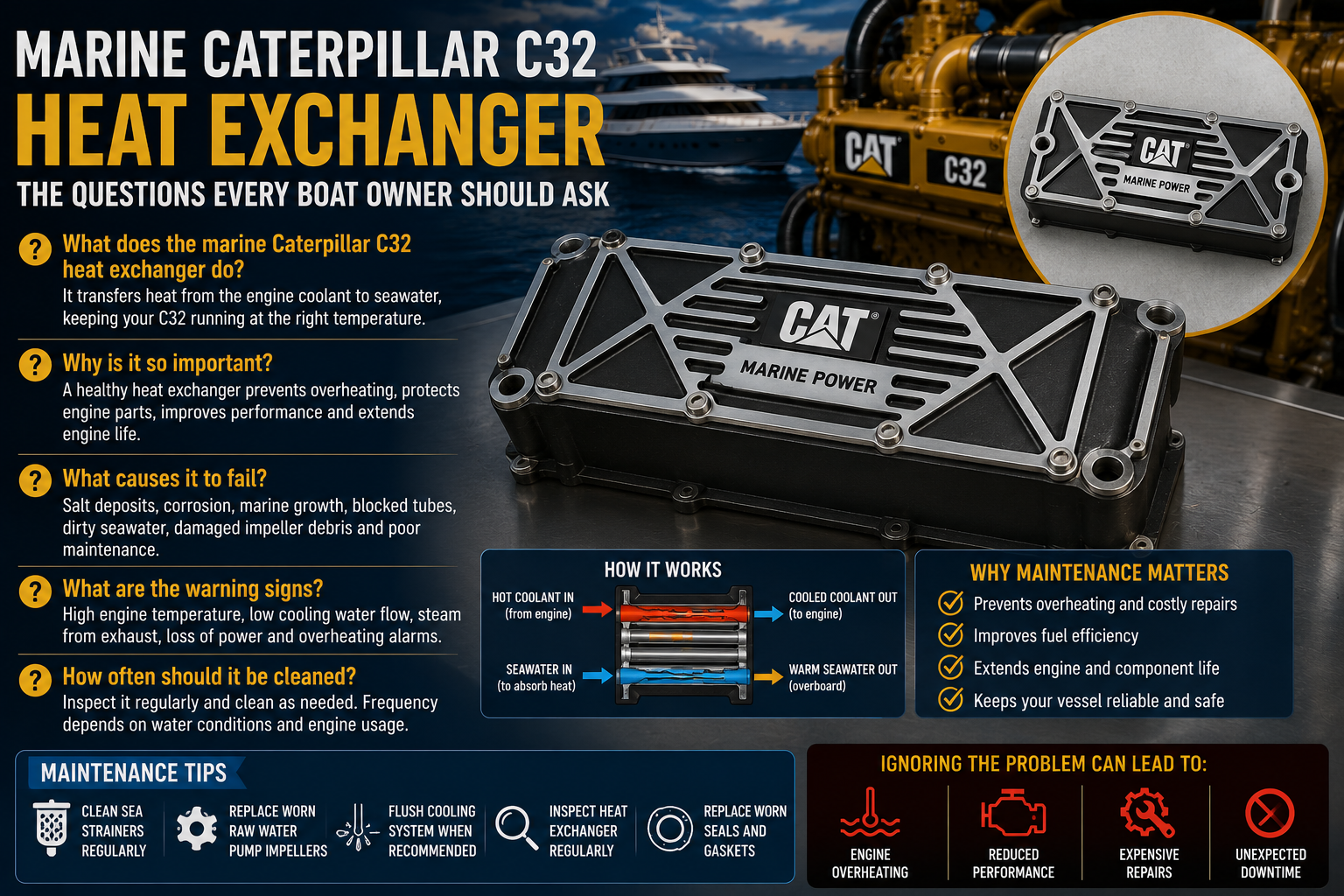
Marine Caterpillar C32 Heat Exchanger: The Questions Every Boat Owner Should Ask
Imagine you're cruising offshore. The marine Caterpillar C32 has been running perfectly for hours. Then suddenly, the engine temperature starts climbing. Nothing seems obviously wrong, but the alarm sounds and you're forced to reduce power.
One of the first components an experienced marine engineer will inspect is the marine Caterpillar C32 heat exchanger.
It's not the biggest part on the engine, and it's rarely the most expensive. But when it stops doing its job properly, the entire cooling system can suffer.
Let's answer the questions that vessel owners and marine engineers ask most often.
What does the marine Caterpillar C32 heat exchanger actually do?
Think of the marine Caterpillar C32 heat exchanger as the engine's radiator.
Unlike a truck radiator that uses outside air, a marine heat exchanger transfers heat from the engine coolant to seawater.
Here's how it works:
- Engine coolant absorbs heat as it circulates through the engine.
- The hot coolant flows into the heat exchanger.
- Seawater passes through separate tubes inside the heat exchanger.
- Heat transfers through the tube walls.
- The cooled engine coolant returns to the engine.
- The warmed seawater is discharged overboard.
The coolant and seawater never mix. They remain in separate passages while heat moves between them.
This process allows the engine to maintain the correct operating temperature, even during long hours under heavy load.
Why is the marine Caterpillar C32 heat exchanger so important?
Every diesel engine produces a tremendous amount of heat.
Without a properly working marine Caterpillar C32 heat exchanger, that heat has nowhere to go.
If the engine runs too hot, several serious problems can develop:
- Reduced engine efficiency
- High coolant temperatures
- Increased fuel consumption
- Turbocharger overheating
- Damage to cylinder heads
- Premature wear on engine components
A healthy cooling system is one of the biggest factors in engine reliability.
What causes a marine Caterpillar C32 heat exchanger to fail?
Many people assume the heat exchanger simply wears out with age.
In reality, most problems begin with poor maintenance.
Common causes include:
- Salt deposits inside the tubes
- Marine growth
- Corrosion
- Scale buildup
- Blocked seawater passages
- Debris from damaged raw water pump impellers
- Dirty cooling systems
As deposits build up inside the heat exchanger, seawater flow becomes restricted.
Less water means less cooling.
Eventually, engine temperatures begin to rise.
Can seawater really block a heat exchanger?
Absolutely.
The ocean carries far more than just water.
Sand, shell fragments, mud, algae, seaweed and marine organisms all travel through the cooling system.
Over time these materials collect inside the narrow cooling tubes.
Even a partial blockage can reduce cooling efficiency.
Many overheating problems are simply caused by restricted seawater flow rather than a failed engine component.
What are the warning signs of a blocked marine Caterpillar C32 heat exchanger?
Fortunately, the engine usually gives several warnings before serious damage occurs.
Watch for symptoms like:
- Higher than normal coolant temperature
- Engine overheating alarms
- Reduced cooling water discharge
- Loss of engine power
- Steam from the exhaust outlet
- Higher exhaust temperatures
- Reduced performance under heavy load
If these symptoms appear, don't assume the thermostat is the problem.
The marine Caterpillar C32 heat exchanger should also be inspected.
How often should a marine Caterpillar C32 heat exchanger be cleaned?
The answer depends on where the vessel operates.
A yacht used in clean offshore water may require less frequent cleaning than a commercial vessel operating in shallow coastal waters filled with sand and marine growth.
Marine service manuals generally recommend inspecting the cooling system during scheduled maintenance and removing the heat exchanger for cleaning whenever performance begins to decline or during major service intervals.
Waiting until the engine overheats is rarely the best maintenance strategy.
Can corrosion damage the marine Caterpillar C32 heat exchanger?
Yes.
Although marine heat exchangers are built from corrosion-resistant materials, saltwater is extremely aggressive over time.
Corrosion can damage:
- Tube bundles
- End covers
- Seals
- Internal passages
If corrosion becomes severe, coolant and seawater may leak internally.
That's why regular inspections are so important.
Small problems are much easier—and less expensive—to fix than complete heat exchanger failures.
Can a damaged raw water pump affect the heat exchanger?
It certainly can.
When a raw water pump impeller begins to fail, pieces of rubber often break away.
These small fragments travel through the cooling circuit.
Many eventually become trapped inside the marine Caterpillar C32 heat exchanger, reducing water flow through the tubes.
This is why experienced marine engineers always account for every impeller blade after replacing an impeller.
If blades are missing, the cooling system should be inspected before returning the engine to service.
Should the marine Caterpillar C32 heat exchanger be pressure tested?
Yes.
Whenever the heat exchanger is removed for major maintenance, many marine workshops pressure test it.
Pressure testing helps identify:
- Internal leaks
- Cracked tubes
- Weak seals
- Corrosion damage
Finding these problems early helps prevent coolant contamination and unexpected breakdowns.
How can you extend the life of a marine Caterpillar C32 heat exchanger?
Good maintenance makes all the difference.
Simple habits include:
- Clean seawater strainers regularly.
- Replace damaged raw water pump impellers promptly.
- Flush the cooling system when recommended.
- Inspect the heat exchanger during scheduled servicing.
- Remove salt deposits before they become severe.
- Replace worn seals and gaskets.
- Monitor engine operating temperature on every trip.
These small maintenance tasks can significantly extend the life of the marine Caterpillar C32 heat exchanger.
Final Thoughts
The marine Caterpillar C32 heat exchanger works quietly in the background every time your engine is running, but its role is critical. By removing excess heat from the cooling system, it helps protect the engine from overheating, preserves fuel efficiency, and supports long-term reliability.
Most heat exchanger problems develop slowly through salt deposits, marine growth, corrosion, or restricted seawater flow. The encouraging news is that these issues are usually preventable with routine inspections and regular maintenance.
If your Caterpillar C32 starts running hotter than normal, don't ignore the warning signs. A clean and well-maintained marine Caterpillar C32 heat exchanger can mean the difference between a reliable day on the water and an expensive repair that could have been avoided.