What Causes Marine Diesel Injectors to Fail? A Marine Engineer Answers the Most Common Questions
What Causes Marine Diesel Injectors to Fail?
If you've spent any time around marine engines, you've probably heard someone say:
"It must be the injectors."
Sometimes they're right.
Sometimes they're not.
The truth is, marine diesel injectors are incredibly reliable components. They don't simply stop working overnight. In most cases, they fail because something else in the fuel system has been slowly damaging them for hundreds—or even thousands—of running hours.
The good news? Most injector problems can be prevented if you know what causes them.
Let's answer the questions marine engineers and vessel owners ask every day.
What exactly do marine diesel injectors do?
Think of a marine injector as the engine's precision fuel sprayer.
Every time a piston reaches the top of its compression stroke, the injector opens for just a fraction of a second. During that tiny moment, it must inject the correct amount of diesel fuel at extremely high pressure while creating a fine mist that burns evenly inside the cylinder.
If that spray pattern isn't perfect, combustion isn't perfect either.
That's when problems begin.
Why do marine diesel injectors fail?
This is the biggest question—and fortunately, the answer is usually straightforward.
According to marine diesel service manuals and fuel injection maintenance guides, the majority of injector failures are caused by contamination rather than manufacturing defects.
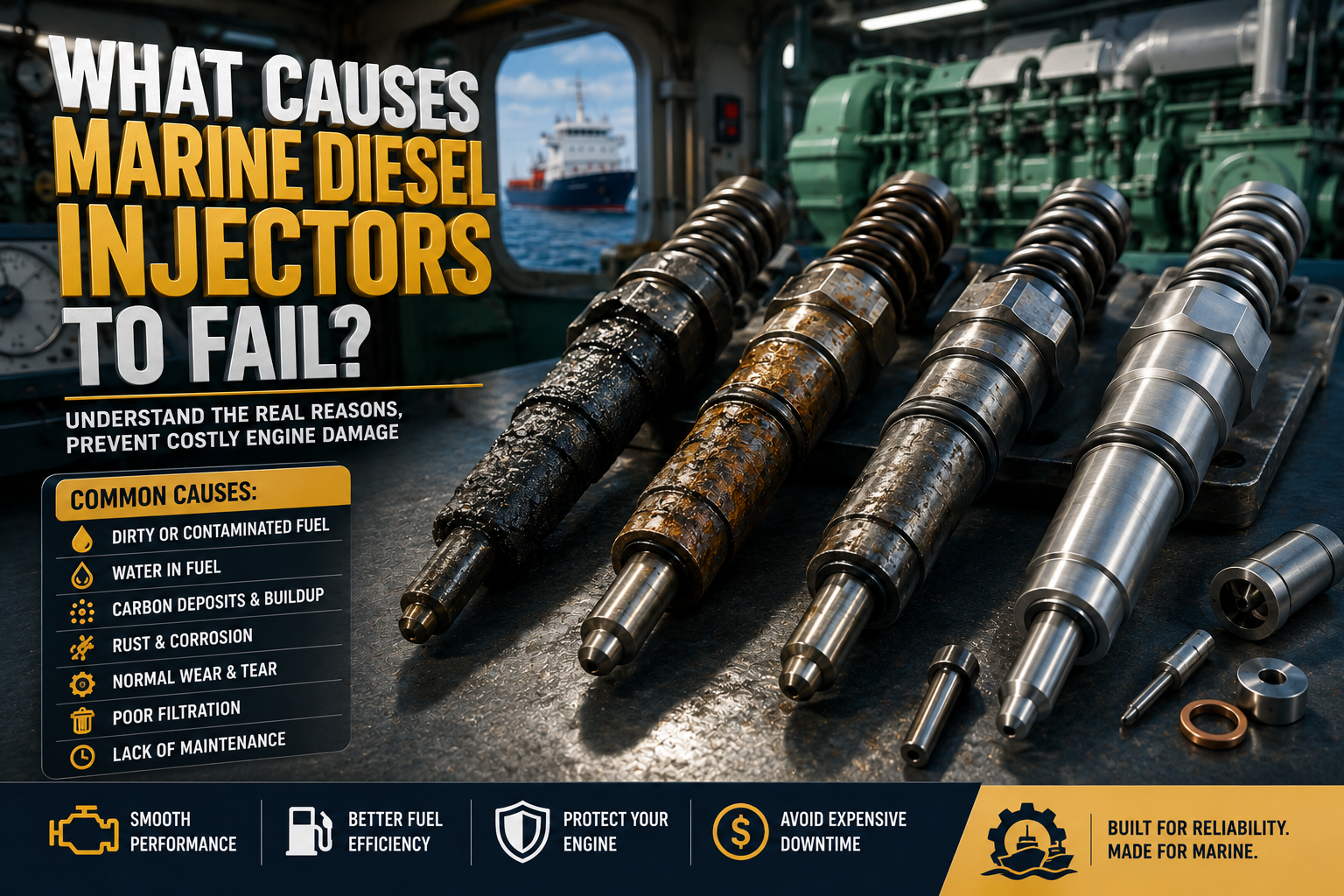
The most common causes include:
- Dirty diesel fuel
- Water contamination
- Rust particles
- Worn internal injector parts
- Carbon deposits
- Poor fuel filtration
- Lack of regular maintenance
In other words, injectors usually become victims of the fuel system, not the cause of the problem.
Can dirty fuel really damage marine injectors?
Absolutely.
Imagine pouring fine sand through a precision watch.
That's similar to what happens when contaminated fuel passes through a marine injector.
Marine injectors contain extremely small internal passages and moving parts. Even microscopic dirt particles can scratch the nozzle needle, wear sealing surfaces and block spray holes.
As the wear increases, the injector can no longer produce the fine fuel mist the engine needs.
Instead of efficient combustion, you get poor combustion.
That's when you begin seeing smoke, rough running and increased fuel consumption.
Is water in diesel really that harmful?
Yes—and many injector failures start here.
Water doesn't burn like diesel fuel.
Instead, it removes the natural lubrication diesel provides to the injector's precision components.
Once lubrication disappears, metal parts begin wearing against each other.
Water also causes corrosion inside injectors, fuel pumps and high-pressure fuel lines.
Eventually, rust particles travel through the fuel system and damage other injectors as well.
Can carbon deposits cause injector problems?
Definitely.
Over time, incomplete combustion leaves carbon deposits around the injector nozzle.
These deposits partially block the tiny spray holes.
Instead of producing a fine cone-shaped spray, the injector starts squirting uneven streams of fuel.
That means:
- Poor combustion
- Higher exhaust temperatures
- Black smoke
- Reduced engine power
- Increased fuel consumption
Many marine manuals recommend inspecting injector nozzles whenever excessive carbon buildup is found during routine maintenance.
Do marine injectors wear out naturally?
Yes.
Like every precision mechanical component, injectors have a service life.
After thousands of operating hours, normal wear begins to affect:
- Nozzle tips
- Needle valves
- Springs
- Internal sealing surfaces
As these parts wear, the injector opening pressure changes and the spray pattern becomes less accurate.
The engine may still run—but not as efficiently as before.
This gradual wear is why many manufacturers recommend injector testing during major engine overhauls instead of waiting for complete failure.
What are the first signs of failing marine diesel injectors?
One injector rarely fails without giving a warning.
Common symptoms include:
✅ Hard starting
✅ Rough idle
✅ Engine vibration
✅ Loss of power
✅ Black exhaust smoke
✅ White smoke during cold starts
✅ Higher fuel consumption
✅ Engine knocking
✅ Uneven cylinder temperatures
If several of these symptoms appear together, it's worth having the injectors professionally tested before replacing expensive engine components.
Can a bad injector damage the engine?
Unfortunately, yes.
When fuel isn't atomized correctly, combustion becomes uneven.
Some cylinders may run hotter than others.
Over time this can lead to:
- Carbon-covered pistons
- Worn piston rings
- Damaged cylinder liners
- Increased exhaust temperatures
- Turbocharger contamination
- Reduced engine efficiency
A relatively inexpensive injector problem can eventually become a major overhaul if ignored.
Can marine injectors be repaired?
Often they can.
A qualified diesel workshop can test an injector to check:
- Opening pressure
- Spray pattern
- Leakage
- Nozzle condition
- Needle movement
If only the nozzle or internal wear parts are damaged, rebuilding the injector may be possible.
However, injectors with severe wear, corrosion or damaged bodies are usually replaced to restore reliable engine performance.
How can you make marine injectors last longer?
The answer is surprisingly simple.
Take care of the fuel before it reaches the injector.
Good maintenance habits include:
- Replace fuel filters on schedule.
- Drain water separators regularly.
- Keep fuel tanks clean.
- Avoid storing old diesel for long periods.
- Remove water from fuel tanks whenever possible.
- Test injectors during scheduled overhauls.
- Investigate excessive smoke before it becomes a bigger problem.
These simple steps can add thousands of reliable operating hours to your marine diesel injectors.
Final Thoughts
Marine diesel injectors don't usually fail because they're poorly made—they fail because they're asked to work with contaminated fuel, water, carbon deposits, or worn fuel system components.
The encouraging news is that these problems are often preventable. Clean fuel, effective filtration, routine inspections, and injector testing during scheduled maintenance can dramatically extend injector life and improve engine reliability.
Whether you're running a commercial fishing vessel, tugboat, workboat, ferry, or yacht, taking care of your marine injectors is one of the smartest ways to reduce fuel costs, avoid unexpected downtime, and keep your engine performing at its best for years to come.