John Deere Marine Engine Types: What Is the Difference, and Which Engine Fits Which Vessel?
When somebody says:
“I have a John Deere marine engine.”
that still leaves an important question:
Which one?
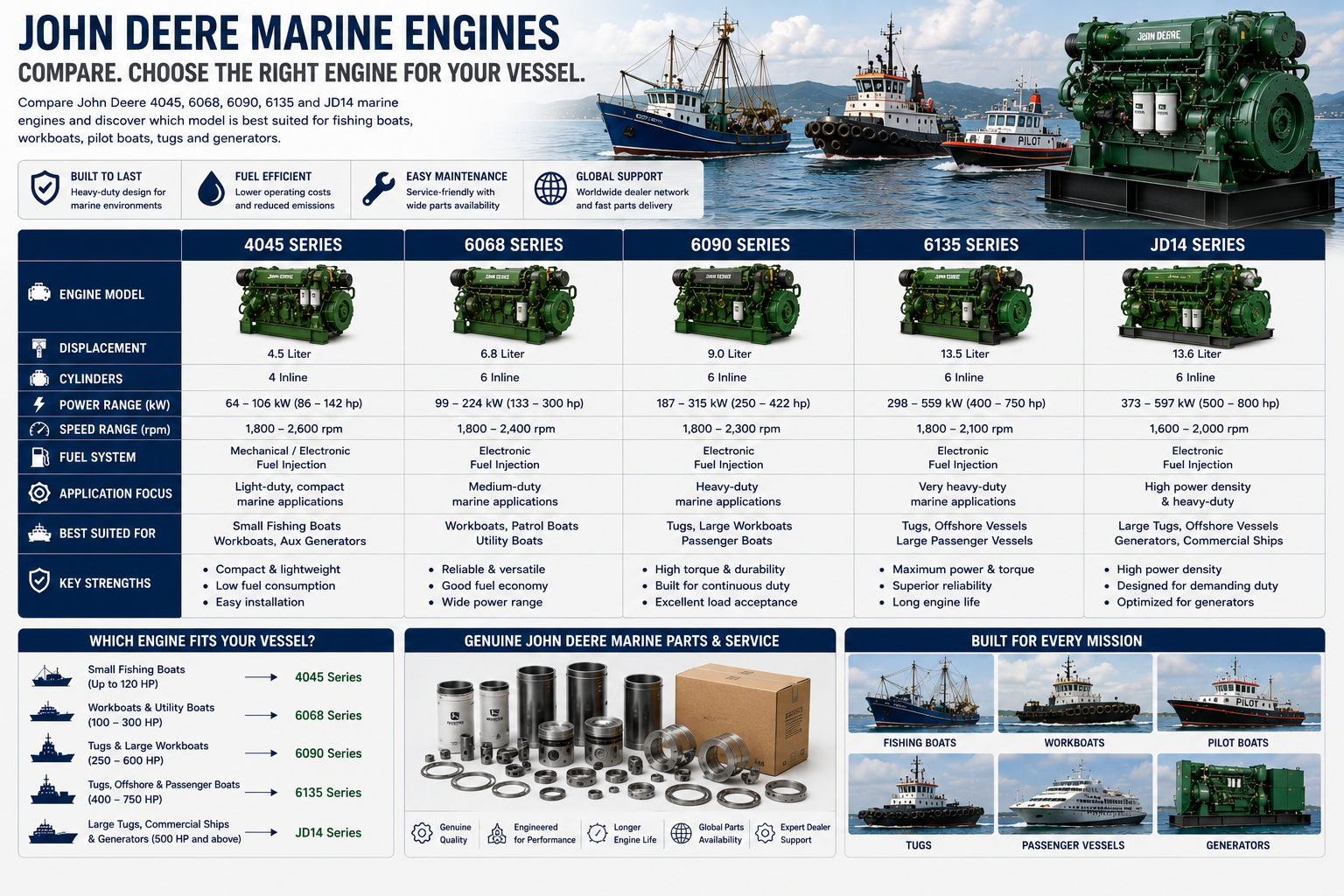
A compact 4045 can be a good fit for a smaller workboat or auxiliary installation. A 6068 moves into a very popular middle range. A 6090 gives substantially more commercial propulsion capability, while the 6135 and newer JD14 move toward heavier workboats, passenger vessels, pilot boats and other demanding marine applications.
John Deere currently offers marine engines for propulsion, generator and auxiliary use, serving both commercial and recreational vessels.
What makes the range interesting is that the engines do not simply get “better” as they get larger.
They become suitable for different jobs.
A fishing boat running thousands of hours per year does not need the same rating as a pleasure craft. A generator does not operate like a propulsion engine. And a pilot boat that needs fast acceleration can have very different requirements from a displacement workboat.
So instead of asking:
“Which John Deere marine engine is the best?”
a better question is:
“Which John Deere engine best matches the boat, load and annual operating hours?”
Understanding John Deere Marine Engine Names
John Deere engine numbers are easier to understand than they may first appear.
For example:
4045 generally identifies a 4-cylinder, 4.5-liter engine.
6068 identifies a 6-cylinder, 6.8-liter engine.
6090 identifies a 6-cylinder, 9.0-liter engine.
6135 identifies a 6-cylinder, 13.5-liter engine.
John Deere's own engine-identification information confirms this naming logic—for example, 4045 means four cylinders and 4.5 liters, while 6068 means six cylinders and 6.8 liters.
That makes the model number itself useful when you first encounter an unfamiliar Deere engine.
But the complete model still matters.
A 4045DFM and a 4045AFM are not necessarily the same configuration.
Neither are all 6068 or 6090 engines identical.
The Main John Deere Marine Engine Families
A practical way to understand the range is:
| John Deere FamilyBasic ConfigurationGeneral CharacterTypical Marine Fit | |||
| 4045 / 4.5L | Inline 4 | Compact marine power | Small workboats, fishing boats, gensets |
| 6068 / 6.8L | Inline 6 | Versatile middleweight | Fishing, workboats, passenger and pleasure craft |
| 6090 / 9.0L | Inline 6 | Strong commercial propulsion | Pilot boats, patrol, workboats, commercial vessels |
| 6135 / 13.5L | Inline 6 | Heavy commercial power | Tugs, barges, larger workboats and passenger craft |
| JD14 / 13.6L | Inline 6 | New-generation high-output marine power | Pilot boats, passenger vessels, workboats, pleasure craft |
John Deere's current marine lineup includes 4.5L, 6.8L and newer 13.6L JD14 propulsion products, alongside other marine propulsion and auxiliary offerings.
John Deere 4045: The Compact Four-Cylinder Worker
The 4045 sits toward the smaller end of John Deere's marine range.
John Deere's 4045AFM85 specification identifies it as a:
4-cylinder
4.5-liter
inline four-stroke
turbocharged and air-to-coolant aftercooled
marine propulsion engine.
Depending on rating, John Deere published the 4045AFM85 from approximately 119 kW / 160 hp to 168 kW / 225 hp.
That makes it a very useful compact engine.
Which Boats Suit a John Deere 4045?
Think about:
- Small fishing vessels
- Harbor workboats
- Utility boats
- Small passenger craft
- Patrol launches
- Recreational boats
- Auxiliary and generator installations
The 4045 is especially attractive when space matters.
You get a commercial-style diesel in a relatively compact four-cylinder package.
Why the 4045 Is More Sophisticated Than It Looks
Calling it “just a four-cylinder” misses a lot.
The 4045AFM85 uses:
- Four-valve cylinder-head technology
- High-pressure common-rail fuel injection
- Electronic engine control
- Water-cooled exhaust manifold
- Replaceable wet cylinder liners
- Integrated marine heat exchanger
- Keel-cooling or heat-exchanger options depending on configuration.
That means this is not the same type of engine technology as an old mechanically injected small diesel.
It is compact, but modern.
John Deere 4.5L: One Engine Size, Different Ratings
John Deere currently divides its 4.5-liter propulsion range into different output classes.
For example, current marine pages show:
4.5G MLR: approximately 75–93 kW / 100–125 hp.
4.5P MLR: approximately 119–168 kW / 160–225 hp.
4.5X MLR: approximately 205–235 kW / 275–315 hp.
That is a very important lesson.
You cannot look at:
“John Deere 4.5L”
and assume one horsepower.
The rating and exact model matter.
Why Would One 4.5L Make 125 hp and Another More Than 300 hp?
Because marine engines can be configured for different:
- Turbocharging levels
- Fuel-system calibration
- Cooling systems
- Duty cycles
- Rated speeds
- Emissions requirements
More power does not automatically mean the higher-rated version is suitable for every vessel.
A high-hour commercial vessel may require a more conservative duty rating than a pleasure boat that uses full power occasionally.
John Deere 6068: The Popular 6.8-Liter Marine Engine
The 6068 is one of the best-known John Deere marine engine families.
John Deere's engine nomenclature identifies it as a:
6-cylinder, 6.8-liter engine.
John Deere has produced multiple marine versions, including mechanical and electronically controlled configurations. Its official marine manual covers engines such as the 4045DFM70 and 6068SFM75, showing how the 4.5L and 6.8L families have shared a broad marine product architecture.
Where Does a John Deere 6068 Fit?
The 6.8L family works well in the middle of the marine market.
Potential applications include:
- Fishing boats
- Workboats
- Passenger vessels
- Pilot boats
- Patrol craft
- Trawlers
- Recreational boats
- Generator sets
- Auxiliary engines
The current 6.8P MLR propulsion engine is rated approximately 172–246 kW / 230–330 hp at 2,300–2,600 rpm, and John Deere also offers the platform in constant-speed auxiliary and generator configurations.
That versatility is one reason the 6.8L family is so useful.
4045 vs. 6068: Which Makes More Sense?
John Deere 4045
4 cylinders / 4.5 liters
More compact.
Better where engine-room space and lower power requirements matter.
John Deere 6068
6 cylinders / 6.8 liters
More displacement and smoother six-cylinder power.
Better suited to larger fishing boats, workboats and higher-load installations.
The correct answer depends on the vessel.
A 4045 can be perfect in a boat where a 6068 would simply add unnecessary size and weight.
Why Six Cylinders Are Popular in Commercial Marine Engines
A six-cylinder inline engine has several characteristics engineers often appreciate.
It provides smooth power delivery and good torque while retaining only one cylinder bank.
Maintenance access can also be straightforward compared with a large V-engine.
You have one row of:
- Injectors
- Cylinder-head components
- Exhaust ports
- Valve train
The tradeoff is engine length.
But for many workboats and fishing vessels, an inline-six is an excellent package.
John Deere 6090: Stepping Into Stronger Commercial Propulsion
The 6090 moves to approximately 9.0 liters, while retaining six-cylinder architecture. John Deere's identification guidance lists 6090 as a six-cylinder, 9.0-liter engine family.
This increase in displacement gives the engine substantially more commercial propulsion potential than the smaller 6068.
Which Boats Suit a John Deere 9.0L?
Think:
- Pilot boats
- Patrol vessels
- Fishing vessels
- Workboats
- Commercial passenger boats
- Utility vessels
- Government craft
John Deere has documented 9.0L marine engines being used for patrol and pilot-vessel repowers, including a Croatian patrol vessel and Venetian pilot boats.
That tells us a lot about where the 9.0L fits.
It is particularly useful in vessels where dependable commercial power and strong acceleration are both important.
What Is the Difference Between a Fishing Boat and a Pilot Boat Engine Requirement?
A fishing vessel may spend long hours at relatively stable engine loads.
A pilot boat may repeatedly need to:
- Leave harbor quickly
- Accelerate hard
- Run at high cruise speed
- Maneuver alongside larger vessels
- Return to harbor
- Repeat the process
Both are commercial boats.
But their operating profiles are different.
That is why engine rating matters as much as displacement.
John Deere 6135: Heavy Commercial Inline-Six Power
The 6135 is the larger 13.5-liter member of the established John Deere marine range.
It remains a six-cylinder engine, but with much more displacement.
This puts it into a significantly heavier commercial class.
A good real-world example comes from the Bald Head Island Barge operation.
John Deere reports that its tug uses twin 6135AFM85 13.5L marine engines, each producing 425 hp / 317 kW. The engines had accumulated approximately 15,200 hours each when John Deere profiled the vessel.
That is exactly the sort of installation that shows what the 13.5L engine is about.
It works.
Which Vessels Suit a John Deere 6135?
Think about:
- Tugboats
- Barges
- Larger workboats
- Fishing vessels
- Passenger vessels
- Heavy utility craft
- Government vessels
- Commercial marine auxiliaries
This is where John Deere starts moving away from the “small boat diesel” image entirely.
A 13.5-liter Deere is a serious commercial engine.
Why a 13.5L Inline-Six Can Be Attractive
The 6135 provides large-engine torque without requiring a V12 layout.
For a vessel that has the engine-room length available, this can provide relatively straightforward access.
At overhaul time, you're still working around six cylinder positions rather than twelve or sixteen.
That can make a difference in:
- Parts quantity
- Labor
- Cylinder-head work
- Injector quantity
- Piston and liner quantity
- Bearing quantity
Large displacement does not always require high cylinder count.
John Deere JD14: The New Generation
The JD14 is one of the most important developments in the current John Deere marine range.
It is a 13.6-liter six-cylinder engine, positioned as a newer-generation successor in the large inline-six marine class.
John Deere states that JD14 marine engines provide higher duty cycles and more power in a smaller package than its 13.5L models.
In 2025, John Deere described the JD14 marine engine as suitable for:
- Passenger vessels
- Pilot boats
- Workboats
- Pleasure craft.
That gives the JD14 a particularly interesting position.
It is commercial enough for serious work, but versatile enough for higher-performance recreational and passenger applications.
6135 vs. JD14: What's the Difference?
The simplest way to understand the transition is:
6135
13.5 liters
Established PowerTech commercial marine engine.
Proven in high-hour installations such as tugs and barges.
JD14
13.6 liters
New-generation John Deere platform.
Designed to provide greater power density and higher-duty capabilities in a more compact package.
The JD14 is not simply a 6135 with a slightly larger displacement.
It represents a newer engine architecture.
Why John Deere Is Moving Toward JD-Series Engines
John Deere's next-generation engine strategy includes the:
- JD4
- JD9
- JD14
- JD18
families across its broader power systems portfolio.
For marine applications, this evolution reflects modern priorities such as:
- Higher power density
- Improved efficiency
- Electronic integration
- Reduced installation size
- Modern emissions requirements
- Easier integration with future power systems
This is the same general direction seen across the marine diesel industry.
Older John Deere vs. Newer John Deere
The installed fleet contains both older and modern technology.
An older Deere marine engine may use a relatively simple mechanical injection system.
A newer engine may include:
- High-pressure common rail
- Electronic engine control
- Sensors
- Fault-code diagnostics
- Electronic transfer pumps
- Digital vessel integration
John Deere's 4045AFM85, for example, uses HPCR injection and an electronic ECU with customizable protections and diagnostic capability.
The newer engine gives the operator more data.
But the basic mechanical systems still matter just as much.
What Does High-Pressure Common Rail Change?
A high-pressure common-rail system allows the ECU to control:
- Injection pressure
- Injection timing
- Duration
- Multiple injection events
John Deere says the HPCR system used on its marine engine can provide improved performance, fuel economy and emissions control.
For engineers, however, this creates another maintenance reality:
fuel cleanliness becomes extremely important.
High-pressure fuel components do not like:
- Water
- Dirt
- Rust
- Poor filtration
A cheap contaminated fuel problem can become an expensive injector or pump problem very quickly.
John Deere Cooling Systems: Heat Exchanger or Keel Cooling?
This is one of the most interesting features of the Deere marine range.
John Deere offers marine configurations using:
heat exchanger cooling
and
keel cooling.
For the 4045AFM85, Deere states that the keel-cooled option uses a closed cooling system and can eliminate the need for a sea strainer, seawater pump and anodes, while the heat-exchanger option provides a lighter and more compact marine installation.
This changes maintenance significantly.
Heat Exchanger Cooling
With a heat-exchanger system, the vessel typically has a raw-water side.
That means engineers may need to maintain:
- Sea inlet
- Seacock
- Strainer
- Seawater pump
- Impeller
- Heat exchanger
- Zinc anodes where applicable
- Hoses
- Marine growth
This system is compact and common.
But seawater is extremely aggressive.
Keel Cooling
Keel cooling transfers engine heat through an external cooler attached to or integrated with the vessel.
Depending on the installation, this can remove the need for a conventional seawater pump and engine-mounted heat exchanger circuit.
That can be very attractive on:
- Workboats
- Fishing vessels
- Shallow-water craft
- Vessels operating in debris-heavy water
- Commercial boats prioritizing raw-water-system simplicity
But keel cooling also has its own maintenance requirements.
The external cooler has to remain clear and structurally sound.
Which System Is Better?
Neither.
They solve different installation problems.
A heat-exchanger system can be compact and practical.
A keel-cooled system can reduce the number of raw-water components on the engine.
The best solution depends on:
- Hull
- Operating waters
- Vessel speed
- Engine load
- Installation layout
John Deere Marine Generator Engines
John Deere's marine business is not limited to propulsion.
The company offers engines for:
- Propulsion
- Constant-speed auxiliary duty
- Generator drive.
For example, the 4045TFM85 is offered as a 4.5L marine generator-drive engine in approximately the 61–74 kW / 82–99 hp range.
The 6.8L platform is also available in auxiliary and generator configurations.
What Is Different About a Generator Engine?
A propulsion engine may constantly change rpm and load as the vessel accelerates or slows.
A generator engine often needs to hold a specific speed so the alternator maintains electrical frequency.
Typical speeds may be related to:
1,500 rpm for 50 Hz
or
1,800 rpm for 60 Hz
depending on generator configuration.
That means the operating profile is different.
The same basic engine family may therefore have a different rating and component package for generator use.
Which John Deere Engine Makes Sense for a Small Fishing Boat?
A smaller fishing vessel may fit naturally around:
4045 / 4.5L
or
6068 / 6.8L
depending on boat size and power requirement.
Why are these attractive?
They combine:
- Commercial diesel architecture
- Relatively compact dimensions
- Parts and service support
- Modern fuel systems in applicable versions
- Rebuildable wet-liner construction on engines such as the 4045AFM85.
For a fishing vessel running many annual hours, select the engine according to its commercial duty rating rather than its highest available horsepower.
Which John Deere Engine Makes Sense for a Workboat?
Workboats cover a huge range.
For a small harbor utility boat:
4.5L
may be enough.
For a larger commercial workboat:
6.8L
or
9.0L
may fit better.
For heavy work:
13.5L
or the newer
JD14
can make much more sense.
The vessel's job should determine the engine.
Which John Deere Engine Makes Sense for a Pilot Boat?
Pilot boats often need:
- Rapid acceleration
- High cruise speed
- Good maneuverability
- High reliability
- Frequent daily operation
John Deere has documented 9.0L engines in pilot and patrol vessels, while the company specifically identifies the newer JD14 as a fit for pilot boats.
So depending on vessel size, the 9.0L or JD14 becomes particularly interesting.
Which John Deere Engine Makes Sense for a Tugboat?
A tugboat has a different personality.
The engine has to handle substantial propulsion load, often at relatively low vessel speed.
For smaller tug and barge applications, the 13.5L 6135 has real-world commercial history.
The Bald Head Island tug example is especially useful: twin 6135AFM85 engines power a daily barge operation and had logged more than 15,000 hours each when profiled by John Deere.
That is exactly the type of application where engine durability matters more than impressive brochure horsepower.
Which John Deere Engine Makes Sense for a Passenger Vessel?
Depending on vessel size:
6.8L
9.0L
13.5L
and
JD14
can all be relevant.
The newer JD14 is explicitly positioned by Deere for passenger-vessel applications.
Passenger operators often value:
- Low vibration
- Low noise
- Predictable maintenance
- Good fuel efficiency
- Strong service support
These factors can be just as important as maximum power.
What About Recreational Boats?
John Deere also serves recreational marine applications.
Smaller and mid-sized recreational vessels may use 4.5L or 6.8L engines, while newer higher-output configurations can suit faster or larger pleasure craft.
But there is an important distinction.
A pleasure craft that runs 300 hours per year has a completely different life from a commercial workboat running 4,000 hours annually.
That is why duty rating matters.
John Deere Marine Duty Ratings Explained
The 4045AFM85 is a good example of how John Deere structures marine ratings.
John Deere published M1 through M4 ratings with different expected load factors and annual usage.
For that engine:
M1: continuous operation with typical load factor above 65%.
M2: up to approximately 3,000–5,000 annual hours.
M3: approximately 2,000–4,000 annual hours.
M4: approximately 1,000–3,000 annual hours, with less full-power operation.
This is extremely useful.
The same base engine can produce more horsepower when it is expected to spend less time operating at full output.
Why Maximum Horsepower Is Not Always Better
Imagine two 4045 engines.
One is rated at:
160 hp
and another at:
225 hp.
Which one is better?
There is no answer until you know the vessel.
For a commercial boat running nearly continuously, the lower-output continuous rating can be exactly what you want.
For a lighter-duty craft that rarely operates at full throttle, the higher rating might make sense.
That is why choosing an engine by horsepower alone is a mistake.
Quick John Deere Marine Engine Comparison
| EngineCylindersDisplacementGeneral Marine Fit | |||
| 4045 / 4.5L | 4 | 4.5 L | Small fishing boats, workboats, generators |
| 6068 / 6.8L | 6 | 6.8 L | Fishing, passenger, pleasure and workboats |
| 6090 / 9.0L | 6 | 9.0 L | Pilot, patrol and medium commercial vessels |
| 6135 / 13.5L | 6 | 13.5 L | Tugs, barges and heavy workboats |
| JD14 / 13.6L | 6 | 13.6 L | Passenger, pilot, workboat and pleasurecraft applications |
The basic displacement/cylinder identification is confirmed in Deere's engine documentation, while the current marine lineup and JD14 application information come from Deere's marine product pages.
John Deere Marine Engine “Personalities”
Sometimes the easiest way to remember the families is to give each one a character.
4045 — The Compact Worker
Four cylinders, 4.5 liters and enough flexibility to work as propulsion or generator power.
6068 — The Marine All-Rounder
Six cylinders and 6.8 liters make it useful across fishing, passenger, workboat and recreational applications.
6090 — The Commercial Performer
More displacement for boats that need stronger acceleration and sustained commercial power.
6135 — The Heavy Worker
Large-displacement inline-six power with proven high-hour commercial installations.
JD14 — The New-Generation Strong Six
More power density and modern technology in the 13.6-liter class.
John Deere Marine vs. John Deere Agricultural Engines
This is an important distinction.
John Deere is famous for tractors.
So people sometimes assume a John Deere marine engine is simply a tractor engine with a seawater pump attached.
That is far too simplistic.
The company does use common PowerTech engine architecture across markets, but a dedicated marine engine can include completely different:
- Cooling system
- Exhaust manifold
- Heat exchanger
- Turbocharger arrangement
- Engine calibration
- ECU settings
- Mounting system
- Auxiliary drives
- Classification equipment
John Deere's marine accessory documentation even includes engine-mounted auxiliary-drive options specifically intended for marine engine installations.
The underlying architecture may be related.
The complete engine package is application-specific.
Can You Use a John Deere Tractor Engine in a Boat?
A related base engine can sometimes form the basis of a properly engineered marine conversion.
But you should never assume it is a direct replacement.
A proper marine installation must account for:
- Cooling
- Water-cooled exhaust
- Gearbox
- Flywheel housing
- Engine mounts
- Electrical system
- Fuel calibration
- Propeller load
- Marine certification
- Corrosion protection
A tractor engine works in air.
A marine engine operates inside a hull surrounded by water.
That changes the engineering substantially.
Common John Deere Marine Spare Parts
Depending on model and configuration, common maintenance and overhaul parts can include:
- Oil filters
- Primary fuel filters
- Secondary fuel filters
- Air filters
- Fuel injectors
- High-pressure fuel pumps
- Electronic fuel components
- Turbochargers
- Water pumps
- Seawater pumps
- Raw-water pump impellers
- Heat exchangers
- Charge-air coolers
- Oil coolers
- Thermostats
- Water-cooled exhaust manifolds
- Cylinder heads
- Intake valves
- Exhaust valves
- Valve guides
- Pistons
- Piston rings
- Wet cylinder liners
- Connecting rods
- Main bearings
- Connecting-rod bearings
- Crankshaft components
- Camshaft components
- Oil pumps
- Sensors
- Wiring harnesses
- Gaskets
- O-rings
- Seals
- Overhaul components
John Deere specifically identifies replaceable wet-type liners on the 4045AFM85, allowing the engine to be rebuilt back toward original specifications rather than treating the cylinder block as disposable.
Why Exact Engine Identification Matters
A request saying:
“I need a John Deere water pump.”
is far too broad.
Even:
“I need a 6068 marine water pump.”
may require more information.
A better request is:
Manufacturer: John Deere
Complete Engine Model: 6068________
Engine Serial Number: __________
Existing Part Number: __________
Application: Marine propulsion / generator
Cooling: Heat exchanger / keel cooled
Quantity: __________
Photographs: Attached
The serial plate can reveal valuable information about the engine model and manufacturing specification.
Why Cooling Configuration Matters When Ordering Parts
Imagine two 4045 engines.
One is heat-exchanger cooled.
The other is keel cooled.
They may share much of the base engine.
But the marine cooling equipment can be completely different.
The heat-exchanger engine may require:
- Seawater pump
- Heat exchanger
- Raw-water hoses
- Anodes
- Associated seals
The keel-cooled engine may not use those same components. John Deere specifically notes that its keel-cooled 4045 arrangement can eliminate the sea strainer, seawater pump and anodes required by the alternative configuration.
So:
engine model + cooling system
can be just as important as the part number.
Buying a Used John Deere Marine Engine: What Should You Check?
A new coat of green paint doesn't tell you much about the inside of an engine.
Before buying a used Deere marine engine, ask for:
- Complete model number
- Serial number
- Engine hours
- Duty history
- Previous overhaul records
- Oil-analysis history
- Cold-start video
- Running video
- Oil pressure
- Coolant temperature
- Exhaust smoke under load
- Injector history
- Turbocharger history
- Cooling-system history
- Reason for removal
And ask the most important question:
What was the engine doing during those hours?
A 5,000-hour pleasure engine and a 5,000-hour commercial engine may have lived very different lives.
Maintenance Accessibility Matters More Than Many Buyers Realize
John Deere has put attention into service access on marine engines.
For example, the 4045AFM85 offers multiple oil-fill and dipstick options plus remote oil- and fuel-filter possibilities.
This sounds like a small detail until you've tried changing a filter between the side of an engine and a bulkhead.
When selecting an engine or planning a repower, look at:
- Oil filter access
- Fuel filter access
- Injector access
- Valve-cover clearance
- Heat exchanger access
- Starter removal
- Turbocharger removal
- Water-pump access
- Cylinder-head lifting clearance
A reliable engine still needs to be maintainable.
Marine Engineer Tip
Don't Choose a John Deere Engine Only by Horsepower
Check:
Engine model
Duty rating
Annual operating hours
Full-load operating time
Rated rpm
Gearbox
Propeller
Heat exchanger or keel cooling
Engine-room dimensions
Future overhaul access
Parts availability
The right engine is not always the one with the highest number on the spec sheet.
Frequently Asked Questions
Does John Deere make dedicated marine engines?
Yes. John Deere currently offers dedicated marine propulsion, generator and auxiliary engines for commercial and recreational applications.
What does 4045 mean?
John Deere identifies 4045 as a four-cylinder, 4.5-liter engine family.
What does 6068 mean?
It identifies a six-cylinder, 6.8-liter engine.
How powerful is a John Deere 4.5L marine engine?
It depends on the version. Current 4.5L propulsion models span from approximately 100 hp on lower-rated configurations to more than 300 hp on newer high-output versions.
How powerful is the 6.8L marine engine?
John Deere's current 6.8P MLR is rated approximately 230–330 hp, depending on configuration.
Is the 6068 used for generators too?
Yes. John Deere lists the current 6.8L platform as available in constant-speed auxiliary and generator models.
Is the 6135 suitable for heavy commercial use?
Yes. John Deere has documented a commercial tug/barge installation using twin 6135AFM85 engines that had accumulated about 15,200 hours each at the time of the case study.
What is the John Deere JD14?
The JD14 is a newer 13.6-liter marine engine platform. Deere states that it offers higher duty cycles and more power in a smaller package compared with its 13.5L engines.
What boats is the JD14 designed for?
John Deere identifies applications including passenger vessels, pilot boats, workboats and pleasure craft.
Does John Deere offer keel-cooled marine engines?
Yes. The 4045AFM85 documentation, for example, includes both keel-cooled and heat-exchanger-cooled options.
Are John Deere marine engines electronically controlled?
Many modern versions are. The 4045AFM85, for example, uses high-pressure common-rail injection and an electronic ECU with diagnostic capability.
John Deere Marine Engine Spare Parts
Alfa Marine Spare Parts can assist with marine spare-parts inquiries for John Deere engine families including:
- John Deere 4045 Marine Engine
- John Deere 6068 Marine Engine
- John Deere 6090 Marine Engine
- John Deere 6135 Marine Engine
- John Deere JD14 Marine Engine
- Related PowerTech marine propulsion engines
- John Deere marine generator and auxiliary engines
Depending on engine type and availability, parts may include genuine, OEM, aftermarket, remanufactured and reconditioned components.
Related John Deere Marine Engine Pages
- John Deere 4045 Marine Engine Spare Parts
- John Deere 4045AFM85 Marine Engine Spare Parts
- John Deere 4045TFM85 Marine Generator Parts
- John Deere 6068 Marine Engine Spare Parts
- John Deere 6068AFM Marine Engine Spare Parts
- John Deere 6068SFM Marine Engine Spare Parts
- John Deere 6090 Marine Engine Spare Parts
- John Deere 6135 Marine Engine Spare Parts
- John Deere 6135AFM85 Marine Engine Spare Parts
- John Deere JD14 Marine Engine Spare Parts
Why Choose Alfa Marine Spare Parts?
John Deere is a perfect example of why the complete engine designation matters.
A customer may ask:
“Need a John Deere 6068 water pump.”
Before sourcing the component, it helps to establish:
Which 6068 marine model?
Which serial number?
Propulsion or generator?
Keel cooled or heat exchanger cooled?
What part number is currently installed?
Alfa Marine Spare Parts supports marine engineers, shipyards, ship repairers, technical superintendents, fishing companies, workboat operators, passenger-vessel operators and yacht owners with marine diesel spare-parts requirements.
The goal is straightforward:
identify the exact John Deere engine first, then identify the correct part.
Worldwide John Deere Marine Spare Parts Supply
Alfa Marine Spare Parts supports:
- Shipyards
- Ship repair companies
- Marine engineers
- Chief engineers
- Technical superintendents
- Fishing fleets
- Workboat operators
- Pilot-boat operators
- Passenger-vessel operators
- Tug operators
- Yacht managers
- Offshore operators
- Government fleets
- Maritime contractors
- Marine service companies
- Marine equipment distributors
For an inquiry, provide:
John Deere engine model + serial number + current part number + cooling configuration + quantity + photographs where available.
Contact Alfa Marine Spare Parts
Email: request@alfamarinespareparts.com
Website:
https://alfamarinespareparts.com
Marine Spare Parts Catalog:
https://alfamarinespareparts.com/spareparts
One Final Thought
The easiest way to understand John Deere marine engines is not to memorize every model suffix.
Think about the job each engine class is built to perform.
The 4045 / 4.5L is the compact worker—small enough for many workboats and generator installations but available with modern common-rail technology and serious commercial ratings.
The 6068 / 6.8L is the all-rounder, fitting naturally into fishing boats, workboats, passenger craft and auxiliary systems.
The 6090 / 9.0L moves toward stronger commercial and fast-vessel propulsion.
The 6135 / 13.5L is a heavy commercial inline-six with documented high-hour service in tug and barge operation.
And the newer JD14 takes John Deere's marine range forward with a 13.6-liter platform designed for higher power density and applications including pilot boats, passenger vessels and workboats.
So when somebody asks:
“Which John Deere marine engine is the best?”
the answer should start with:
What kind of boat is it, how hard will it work, and how many hours will it run every year?
Because the best engine for a small fishing boat, pilot boat, commercial tug and marine generator will never be exactly the same.