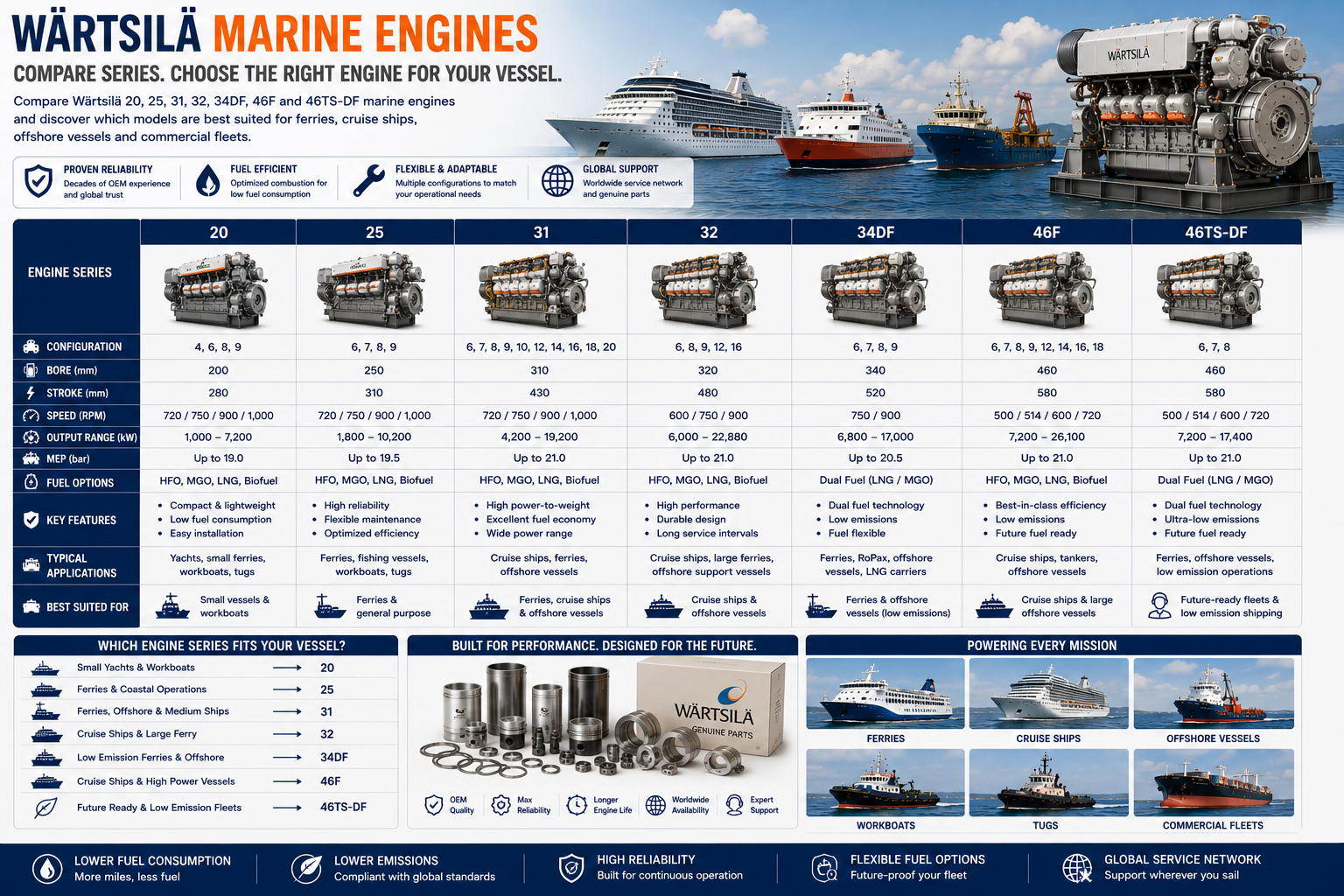
Wärtsilä Marine Engine Types: What Is the Difference, and Which Engine Fits Which Vessel?
When somebody says:
“We have Wärtsilä engines onboard.”
that still does not tell a marine engineer very much.
It could be a smaller Wärtsilä 20 serving as an auxiliary engine.
It could be a Wärtsilä 31 powering a modern ferry.
A Wärtsilä 32 might be installed on a tanker, offshore vessel or cruise ship.
A dual-fuel 34DF may be operating on LNG and liquid fuel.
Or the vessel could have a massive Wärtsilä 46F or 46TS-DF delivering well into the megawatt range.
Wärtsilä's marine engine portfolio is built mainly around medium-speed four-stroke engines used for main propulsion, diesel-electric propulsion and onboard electrical generation. The current range includes conventional diesel engines, dual-fuel engines and newer platforms prepared for fuels such as methanol and ammonia.
That makes Wärtsilä very different from a brand focused mainly on small yacht engines.
Here, we are talking about engines commonly found in:
- Ferries
- Cruise ships
- Tankers
- LNG carriers
- Offshore vessels
- Tugs
- Fishing vessels
- Research vessels
- Merchant ships
- Large passenger vessels
- Diesel-electric ships
So which Wärtsilä engine makes sense for which ship?
First: Understanding Wärtsilä Engine Names
Wärtsilä engine names often refer to the approximate cylinder bore.
For example:
Wärtsilä 20
Wärtsilä 25
Wärtsilä 31
Wärtsilä 32
Wärtsilä 34DF
Wärtsilä 46F
The larger number generally points toward a larger engine platform and cylinder size.
You may also see cylinder arrangements such as:
6L
8L
9L
12V
16V
where:
L = inline
and
V = V configuration.
So an 8L32 and a 16V32 belong to the same basic 32-family but have very different total output and physical scale.
The Main Wärtsilä Marine Engine Families
| Wärtsilä FamilyGeneral CharacterTypical Marine Role | ||
| Wärtsilä 20 / 20DF | Compact medium-speed engine | Auxiliary power, gensets, smaller propulsion |
| Wärtsilä 25 / 25DF | New-generation compact platform | Main propulsion, diesel-electric, LNG and future-fuel vessels |
| Wärtsilä 31 / 31DF | High-efficiency medium-speed engine | Ferries, cruise, offshore, ice-class and diesel-electric ships |
| Wärtsilä 32 | Proven workhorse | Tankers, ferries, offshore, fishing and merchant vessels |
| Wärtsilä 34DF | Dual-fuel medium-speed engine | LNG vessels, ferries, offshore and gensets |
| Wärtsilä 46 / 46F | Large-bore heavy commercial engine | Cruise ships, ferries and large merchant vessels |
| Wärtsilä 46DF / 46TS-DF | Large dual-fuel engine | LNG carriers, cruise ships, ferries and large merchant vessels |
| Methanol variants | Future-fuel capable engines | New low-carbon vessel projects |
Wärtsilä's current portfolio includes diesel, dual-fuel and sustainable-fuel-ready engines covering a very broad range of ship applications.
Wärtsilä 20: The Compact Workhorse
The Wärtsilä 20 sits toward the smaller end of the company's medium-speed marine range.
But “small” is relative.
This is still a proper ship engine rather than a yacht-size diesel.
The Wärtsilä 20DF is available in 6L, 8L and 9L configurations, with approximately 870–1,755 kW depending on cylinder count and rated speed. Wärtsilä says the 20DF is based on the established Wärtsilä 20 diesel platform and can be used for constant-speed generating sets as well as variable-speed mechanical drives and main-engine applications.
Where Does a Wärtsilä 20 Fit?
Think about:
- Marine generator sets
- Smaller diesel-electric installations
- Small commercial ships
- Auxiliary engines
- Offshore vessels
- Smaller ferries
- Specialized workboats
Its compact dimensions make it useful when the vessel needs true medium-speed engine durability without jumping into the physical size of a 31, 32 or 46-series engine.
Wärtsilä 20 Personality
The Compact Ship Engine
Small enough for auxiliary and smaller propulsion applications, but still built around commercial ship operation.
Wärtsilä 20DF: Same Family, More Fuel Flexibility
The 20DF adds dual-fuel capability.
That means the vessel can use gas while retaining liquid-fuel capability.
Wärtsilä's dual-fuel technology allows operation on LNG or conventional liquid marine fuels such as LFO, HFO or liquid biofuel, depending on engine configuration.
Why is this useful?
Because shipping operators do not always want to depend on one fuel.
A dual-fuel engine gives more operational flexibility.
Wärtsilä 25: The New-Generation Compact Platform
The Wärtsilä 25 is a much newer engine platform.
Wärtsilä describes it as a next-generation medium-speed marine engine designed around:
- Fuel flexibility
- Efficiency
- Low emissions
- Modular construction
- Future upgradeability
The current platform covers roughly 1.9–3.4 MW and is available in diesel, LNG/dual-fuel and ammonia-related variants.
Which Vessels Suit a Wärtsilä 25?
Think:
- Tankers
- Ferries
- Smaller merchant vessels
- Offshore vessels
- Diesel-electric vessels
- LNG-fuelled ships
- Ships preparing for future fuel transitions
Wärtsilä has already selected the 25DF for new LNG-fuelled tankers using a mechanical propulsion arrangement.
Why the Wärtsilä 25 Is Interesting
A shipowner ordering a vessel today has a problem:
What fuel will make sense in 15 or 20 years?
Diesel?
LNG?
Biofuel?
Methanol?
Ammonia?
No one wants to install an engine that becomes strategically obsolete halfway through the ship's useful life.
The Wärtsilä 25 is designed with modularity and future fuel transition in mind.
That gives it a different personality from older engine families.
Wärtsilä 25 Personality
The Future-Ready Compact Engine
Smaller medium-speed power designed around flexibility rather than one fixed fuel strategy.
Wärtsilä 25DF and Methane Slip
One issue with gas engines is methane slip—unburned methane escaping from the combustion process.
Wärtsilä introduced its NextDF technology for the 25DF specifically to reduce this issue. In 2025, Wärtsilä reported methane emissions as low as approximately 1.1% across a wide load range with the NextDF feature.
For ship operators considering LNG, this matters because fuel choice isn't only about CO₂.
Methane emissions also affect overall greenhouse-gas performance.
Wärtsilä 31: The Efficiency Specialist
The Wärtsilä 31 is one of the company's most important modern engine families.
Wärtsilä describes it as a medium-speed four-stroke engine with extremely high fuel efficiency.
The current family is available from 8 to 16 cylinders, producing approximately 4.6–10.4 MW at 720 or 750 rpm.
That puts it in a completely different power class from the Wärtsilä 20 or 25.
Where Does a Wärtsilä 31 Fit?
Potential applications include:
- Ferries
- Cruise vessels
- Offshore vessels
- Ice-class vessels
- Research vessels
- Diesel-electric ships
- Large merchant vessels
Wärtsilä highlights the 31DF, for example, in the luxury icebreaker Le Commandant Charcot.
Why Would a Ferry Operator Like the Wärtsilä 31?
Ferries often operate predictable routes.
They may:
- Leave port
- Accelerate
- Cruise
- Maneuver
- Dock
- Repeat the cycle several times per day
That makes efficiency across a broad operating range extremely important.
The engine does not spend its entire life at one perfect load.
Wärtsilä specifically emphasizes that the 31 maintains strong efficiency across its operating range.
Wärtsilä 31DF: Add Dual-Fuel Capability
The 31DF applies dual-fuel technology to the 31 platform.
That makes it useful where operators want:
- LNG operation
- Liquid-fuel backup
- Lower emissions
- Future flexibility
- Diesel-electric integration
Wärtsilä has continued developing the 31DF to reduce methane slip, including a newer version announced in 2023.
Wärtsilä 31 Personality
The Efficiency Specialist
Built for ship operators who pay very close attention to fuel consumption over thousands of annual operating hours.
Wärtsilä 32: The Proven Marine Workhorse
The Wärtsilä 32 has one of the broadest marine application histories in the range.
Wärtsilä describes it as a four-stroke diesel engine designed for:
- Efficient operation
- Easy maintenance
- Long maintenance-free operating periods.
The 32 has been widely used for both main propulsion and auxiliary power.
Wärtsilä has specifically identified applications including:
- Tankers
- Container vessels
- Offshore support vessels
- Drilling vessels
- Cruise ships
- Ferries.
That is about as close to an all-round commercial ship engine as you can get.
Why the Wärtsilä 32 Became So Popular
Ships need engines that workshops understand.
A proven engine family brings:
- Known maintenance procedures
- Established overhaul experience
- Large installed population
- Familiar spare-parts requirements
- Predictable service planning
Wärtsilä has also developed common-rail versions of the 32. As early as 2003, Wärtsilä was delivering 32CR engines with common-rail injection for improved emissions and smoke performance.
Which Vessels Suit a Wärtsilä 32?
Think:
- Ro-ro vessels
- Ferries
- Cruise ships
- Tankers
- Offshore vessels
- Fishing vessels
- Merchant vessels
- Generator installations
This is an engine family that can appear almost anywhere in the commercial marine world.
Wärtsilä 32 Personality
The Proven Workhorse
Not necessarily the newest family, but one of the engines marine engineers are most likely to encounter across many vessel types.
Wärtsilä 32 Methanol: Giving an Established Engine a New Fuel
One of the interesting developments in the Wärtsilä range is the ability to adapt established platforms to new fuels.
The Wärtsilä 32 Methanol can operate on:
- Methanol
- HFO
- MDO
- Liquid biofuel.
This is significant.
Instead of throwing away decades of engine experience, manufacturers can adapt proven architectures to emerging fuels.
The engine becomes part of the vessel's decarbonisation strategy.
Wärtsilä 34DF: The Dual-Fuel Specialist
The Wärtsilä 34DF is a dual-fuel engine developed around the proven Wärtsilä 32 architecture.
For marine main-engine applications, Wärtsilä lists configurations from 6L to 16V, with approximately 500 kW per cylinder and total mechanical output up to around 8 MW.
That gives the 34DF considerably more flexibility in engine size.
A smaller inline configuration can suit one ship.
A large V-engine can suit another.
Where Does a 34DF Fit?
Think:
- LNG carriers
- Ferries
- Offshore vessels
- Cruise ships
- Diesel-electric ships
- Marine generator sets
Dual-fuel capability is particularly attractive when the vessel already has LNG onboard as cargo or fuel.
Why LNG Vessels Like Dual-Fuel Engines
Consider an LNG carrier.
The ship already has gas available.
Using gas as engine fuel can make sense.
But the operator may still want liquid-fuel capability for:
- Redundancy
- Port restrictions
- Fuel availability
- Operational flexibility
That is exactly the kind of environment where dual-fuel technology becomes valuable.
Wärtsilä 46: The Classic Large-Bore Marine Engine
Now we enter the large-engine class.
The original Wärtsilä 46 family was introduced in the late 1980s and became particularly popular in the cruise and ferry sectors.
This is the type of engine where each cylinder is a major piece of machinery.
Maintenance can involve:
- Large cylinder heads
- Pistons
- Liners
- Connecting rods
- Fuel injection equipment
- Turbochargers
- Heavy lifting equipment
A single cylinder overhaul becomes a significant maintenance job.
Wärtsilä 46F: Large Ship Power
The Wärtsilä 46F is the later development of this large-bore engine family.
Wärtsilä describes it as a four-stroke medium-speed engine available from 6L to 16V, producing approximately 7.5–20 MW at 600 rpm.
That is serious ship propulsion.
Twenty megawatts is approximately 26,800 horsepower.
This is no longer about “which engine fits my boat?”
This is about:
how do we engineer the propulsion plant for the ship?
Which Ships Suit the Wärtsilä 46F?
Think:
- Large cruise ships
- Ferries
- Large merchant vessels
- Major offshore vessels
- Large diesel-electric propulsion plants
The earlier 46 family established a particularly strong presence in cruise and ferry service, while the 46F expanded the engine's technology and fuel-flexibility capabilities.
Wärtsilä 46F Personality
The Large-Bore Workhorse
Serious megawatt power for vessels where the engine room is measured in decks rather than centimeters.
Wärtsilä 46DF: Large Dual-Fuel Power
The 46DF brought dual-fuel capability into this large power class.
Wärtsilä developed it specifically for high-output applications including:
- Cruise ships
- Ferries
- Merchant vessels
- LNG carriers
- FSRUs
- Offshore vessels and platforms.
That is a very broad commercial application range.
Wärtsilä 46TS-DF: Two-Stage Turbocharging Changes the Game
The newer 46TS-DF represents another step forward.
The “TS” refers to its two-stage turbocharging system.
Instead of one compressor stage, the engine uses a more advanced two-stage arrangement to improve efficiency and power density across a broad operating range.
Wärtsilä lists the 46TS-DF around 7.8–20.8 MW for marine applications, depending on configuration.
Which Ships Suit the 46TS-DF?
Think:
- Cruise ships
- Large ferries
- Merchant vessels
- Large diesel-electric installations
- Hybrid vessels
- Large LNG-fuelled ships
Wärtsilä specifically identifies it for diesel-electric, mechanical and hybrid propulsion arrangements.
Why Two-Stage Turbocharging Matters
A large marine engine must work efficiently at many different loads.
A single turbocharger arrangement may be optimized for one operating region.
Two-stage turbocharging gives engineers more flexibility in controlling:
- Charge-air pressure
- Combustion
- Efficiency
- Power density
- Emissions
Wärtsilä states that the 46TS-DF produces approximately 1,300 kW per cylinder, demonstrating how much power is being extracted from each cylinder unit.
One cylinder can produce more power than several complete smaller marine engines.
Diesel vs. Dual Fuel: What's the Difference?
This is one of the most important distinctions in the Wärtsilä portfolio.
Diesel Engine
Runs primarily on liquid fuel.
Depending on platform, this can include fuels such as:
- Marine diesel oil
- Heavy fuel oil
- Biofuel
- Other approved liquid fuels
Dual-Fuel Engine
Can operate using gaseous fuel such as LNG while retaining liquid-fuel capability.
Wärtsilä's current dual-fuel portfolio supports LNG alongside conventional liquid marine fuels.
Why Choose Dual Fuel?
Because shipowners want flexibility.
Fuel prices change.
Regulations change.
Port requirements change.
Fuel infrastructure changes.
A vessel may remain in service for 25 or 30 years.
Fuel flexibility therefore has real economic value.
Methanol: The Next Step
Methanol is becoming another important marine fuel.
Wärtsilä has developed methanol capability across several engine platforms, including:
- Wärtsilä 20
- Wärtsilä 31
- Wärtsilä 32
- Wärtsilä 46F
- Wärtsilä 46TS.
This creates an interesting situation.
A shipowner no longer has to think only:
diesel or LNG?
Now the discussion can include:
methanol
and increasingly:
ammonia.
Wärtsilä 46F Methanol
Wärtsilä states that the 46F Methanol will be available in inline and V configurations, producing approximately 7.5–20 MW at 600 rpm.
That means methanol capability is no longer limited to small demonstration engines.
It is moving directly into large ship propulsion.
Wärtsilä 46TS Methanol
The 46TS Methanol takes the two-stage turbocharging concept and combines it with methanol capability.
Wärtsilä lists output at approximately 8.1–21.6 MW at 600 rpm in inline and V configurations.
That puts it among the highest-output methanol-capable four-stroke marine engines in the portfolio.
What About Ammonia?
Ammonia is another potential marine fuel.
The Wärtsilä 25 platform is being developed in ammonia-capable form, and Wärtsilä announced an increased-power version of its 25 Ammonia engine in 2026, with commercial deliveries planned from 2028.
This is a good illustration of where marine engineering is heading.
Today's engine choice increasingly involves asking:
What fuels will this engine need to use during the next 20 years?
Wärtsilä Engine Families Compared
WÄRTSILÄ 20
Character: Compact medium-speed engine.
Best fit: Auxiliary power and smaller propulsion systems.
WÄRTSILÄ 25
Character: New modular future-fuel platform.
Best fit: New ships where flexibility and future fuel conversion matter.
WÄRTSILÄ 31
Character: Efficiency-focused medium-speed engine.
Best fit: Ferries, cruise vessels, offshore and diesel-electric ships.
WÄRTSILÄ 32
Character: Proven all-round workhorse.
Best fit: Tankers, offshore vessels, ferries, cruise and merchant ships.
WÄRTSILÄ 34DF
Character: Proven dual-fuel platform.
Best fit: LNG-powered commercial vessels and generator installations.
WÄRTSILÄ 46F
Character: Large-bore megawatt engine.
Best fit: Cruise ships, ferries and large merchant vessels.
WÄRTSILÄ 46TS-DF
Character: Next-generation high-power dual-fuel engine.
Best fit: Large ferries, cruise ships and future-focused merchant vessels.
Which Wärtsilä Engine Makes Sense for a Ferry?
Ferries are one of Wärtsilä's natural markets.
Depending on ferry size and propulsion concept, relevant engines can include:
- Wärtsilä 20
- Wärtsilä 25
- Wärtsilä 31
- Wärtsilä 32
- Wärtsilä 34DF
- Wärtsilä 46F
- Wärtsilä 46TS-DF
The smaller engines may suit regional or auxiliary applications.
The large 46-family engines belong naturally in much larger ferries.
Wärtsilä's 46 family has a particularly long history in ferry service.
Which Wärtsilä Engine Makes Sense for a Cruise Ship?
Cruise ships require huge amounts of electricity even before propulsion is considered.
Power is needed for:
- HVAC
- Lighting
- Kitchens
- Elevators
- Entertainment
- Hotel loads
- Pumps
- Propulsion motors on diesel-electric ships
That makes medium-speed generating sets particularly attractive.
Relevant engine families include:
31 / 31DF
32
34DF
46F
46DF
46TS-DF
Wärtsilä has specifically developed the larger dual-fuel platforms for cruise and ferry applications.
Which Wärtsilä Engine Makes Sense for an LNG Carrier?
An LNG carrier already has access to gas.
That makes dual-fuel engines particularly logical.
Possible families include:
- 20DF
- 25DF
- 31DF
- 34DF
- 46DF
- 46TS-DF
The choice depends on vessel size and whether the engines drive:
- Propellers mechanically
- Generators for electric propulsion
- A hybrid system
Wärtsilä explicitly identifies the 46DF for LNG carriers and FSRUs.
Which Wärtsilä Engine Makes Sense for an Offshore Vessel?
Offshore vessels often operate at highly variable loads.
One hour they may be transiting.
The next they may be:
- Holding position
- Operating thrusters
- Running cranes
- Supporting drilling
- Supplying platforms
That makes diesel-electric propulsion particularly attractive.
Wärtsilä engines such as the 20, 25, 31, 32 and 34DF can all be relevant depending on the vessel.
The 32 has a documented history in offshore-support and drilling applications.
Which Wärtsilä Engine Makes Sense for a Fishing Vessel?
Large commercial fishing vessels can also use medium-speed engines.
The Wärtsilä 32 is especially relevant here.
Wärtsilä's reference material includes the Voyager, a large pelagic trawler, among vessels associated with the 32 engine family.
For these vessels, priorities include:
- Long operating hours
- Fuel efficiency
- Reliability
- Easy maintenance
- Strong continuous-duty performance
Mechanical Propulsion vs. Diesel-Electric
This is one of the most important choices in large-vessel engineering.
Mechanical Propulsion
The diesel engine connects through:
gearbox → shaft → propeller
Advantages can include:
- Efficient direct propulsion
- Relatively straightforward driveline
- Familiar engineering
Diesel-Electric Propulsion
The engine drives a generator.
The generator supplies electricity.
Electric motors drive the propellers or thrusters.
Advantages can include:
- Flexible machinery arrangement
- Multiple engines sharing electrical load
- Efficient variable-load operation
- Easier integration with batteries
- Better suitability for dynamic positioning and hotel loads
Wärtsilä offers its engines for mechanical, diesel-electric and hybrid configurations depending on engine family.
Why Cruise Ships Often Like Diesel-Electric
A cruise ship consumes enormous electrical power even when propulsion demand changes.
With diesel-electric architecture, several generating sets can be brought online or offline according to total demand.
Rather than forcing one huge propulsion engine to operate inefficiently at low load, the vessel can distribute load among several generator engines.
That is one reason medium-speed engines are so common in cruise and passenger ships.
Inline vs. V-Type Wärtsilä Engines
Large Wärtsilä families are often available in both layouts.
For example, the 46F spans configurations from 6L through 16V.
Inline Engine
Advantages can include:
- One cylinder bank
- Simpler access
- Narrow engine
Disadvantage:
- Longer installation
V Engine
Advantages include:
- More cylinders in shorter engine length
- Much higher total output
Disadvantages:
- Two cylinder banks
- More complicated access
- Larger overhaul scope
Ship layout often determines which makes more sense.
One Cylinder Can Be an Entire Maintenance Project
This is something that separates Wärtsilä engines from small yacht diesels.
On a large medium-speed engine, one cylinder unit may include:
- Cylinder head
- Large piston
- Cylinder liner
- Connecting rod
- Fuel injector
- Intake and exhaust valves
- Cooling components
When a chief engineer says:
“We're doing one unit.”
that can represent a major maintenance operation.
On a 16-cylinder engine, the complete overhaul becomes a large logistics project.
Common Wärtsilä Marine Engine Spare Parts
Depending on engine family and configuration, maintenance can involve:
- Fuel injectors
- Injector nozzles
- Fuel pumps
- Common-rail components
- Turbochargers
- Charge-air coolers
- Cylinder heads
- Intake valves
- Exhaust valves
- Valve seats
- Valve guides
- Valve rotators
- Pistons
- Piston crowns
- Piston rings
- Cylinder liners
- Connecting rods
- Connecting-rod bearings
- Main bearings
- Crankshaft components
- Camshafts
- Cam followers
- Oil pumps
- Cooling-water pumps
- Thermostatic valves
- Oil coolers
- Fuel coolers
- Exhaust components
- Gaskets
- O-rings
- Sealing rings
- Sensors
- Electronic control components
- SCR components where fitted
- Complete cylinder-unit overhaul components
Why Exact Wärtsilä Engine Identification Matters
A request saying:
“Need Wärtsilä 32 injector.”
is a useful beginning.
But it may still not be enough.
A better request would include:
Engine: Wärtsilä 8L32
Engine Serial Number: __________
Current Part Number: __________
Fuel Configuration: Diesel / Dual Fuel / other
Application: Main engine / auxiliary / generating set
Quantity: __________
Photos: Available
Because:
6L32
8L32
9L32
and other configurations may share family architecture but should not automatically be treated as identical installations.
Fuel Type Matters When Ordering Parts
This becomes even more important on dual-fuel and alternative-fuel engines.
A:
Wärtsilä 31
and
Wärtsilä 31DF
belong to related architecture.
But their fuel-system and control components are not simply interchangeable.
Similarly:
Wärtsilä 46F diesel
46DF
46F Methanol
and
46TS-DF
represent very different fuel and air-system configurations.
Always identify the complete engine designation.
Common Wärtsilä Maintenance Areas
A large medium-speed engine needs condition monitoring across many systems.
Experienced crews watch:
Exhaust temperatures
Cylinder pressure
Bearing temperatures
Lubricating-oil condition
Cooling-water temperatures
Turbocharger performance
Charge-air pressure
Fuel pressure
Crankcase condition
Vibration
Valve condition
Patterns are often more useful than one isolated number.
If one cylinder's exhaust temperature begins moving away from the others, that difference may be more important than the absolute temperature alone.
Turbocharger Maintenance
The turbocharger is especially important on large Wärtsilä engines.
Its condition affects:
- Air supply
- Combustion
- Fuel consumption
- Exhaust temperature
- Engine power
- Smoke
- Emissions
On engines such as the 46TS-DF, turbocharging becomes even more sophisticated because two-stage turbocharging is integral to the engine's efficiency and power-density strategy.
Cylinder Head Maintenance
Cylinder-head work on a medium-speed Wärtsilä can involve:
- Exhaust valves
- Intake valves
- Valve seats
- Guides
- Springs
- Rotators
- Fuel injector
- Cooling passages
- Sealing surfaces
The removed cylinder head can tell the engineer a great deal.
Compare cylinders for:
- Deposit pattern
- Valve burning
- Injector condition
- Cooling differences
- Abnormal thermal loading
Do not clean everything before documenting what it looked like.
Cylinder Liners and Pistons
Large cylinder liners should be examined for:
- Running pattern
- Bore wear
- Polishing
- Scuffing
- Deposits
- Lubrication condition
Piston rings can reveal:
- Blow-by
- Lubrication problems
- Combustion problems
- Excessive deposits
- Cylinder wear
On large engines, trend information collected between overhauls can help determine whether wear is normal or accelerating.
Why Spare-Parts Planning Is Different on a Wärtsilä Engine
Imagine a yacht engine needs one injector.
Now imagine a large vessel planning maintenance on four 16-cylinder medium-speed generating sets.
The required inventory may include dozens of:
- Injectors
- Valve components
- Gaskets
- Seals
- Bearing shells
plus major components such as turbocharger parts, cylinder heads and liners.
For a ship operator, spare-parts planning is therefore connected directly to:
- Dry-docking schedule
- Planned maintenance system
- Voyage schedule
- Classification inspections
- Engine running hours
Marine Engineer Tip
Don't identify a Wärtsilä engine only by the family number.
Check:
Complete engine designation
Cylinder configuration
Serial number
Diesel / DF / methanol / other fuel
Main engine or auxiliary
Mechanical or diesel-electric propulsion
Rated rpm
Current part number
Maintenance scope
Quantity
For large engines, one incorrect assumption can mean an extremely expensive wrong part.
Quick Wärtsilä Marine Engine Comparison
| Wärtsilä FamilyApproximate Power/RoleGeneral CharacterTypical Vessel | |||
| 20 / 20DF | ~0.9–1.8 MW class | Compact medium-speed | Auxiliary, smaller ships |
| 25 / 25DF | ~1.9–3.4 MW | New modular platform | Tankers, ferries, future-fuel ships |
| 31 / 31DF | ~4.6–10.4 MW family | High efficiency | Ferries, cruise, offshore |
| 32 | Medium-large | Proven workhorse | Tanker, ferry, offshore, fishing |
| 34DF | Up to ~8 MW mechanical | Dual-fuel specialist | LNG, ferry, offshore |
| 46F | ~7.5–20 MW | Large-bore heavy-duty | Cruise, ferry, merchant |
| 46TS-DF | ~7.8–20.8 MW | Two-stage dual fuel | Large ferry, cruise, merchant |
| 46TS Methanol | ~8.1–21.6 MW | Future-fuel large-bore | Large low-carbon ships |
The current ranges above are based on Wärtsilä's published engine specifications.
Wärtsilä Marine Engine “Personalities”
Wärtsilä 20 — The Compact Worker
Small by ship-engine standards and useful for auxiliary or smaller propulsion applications.
Wärtsilä 25 — The Future-Ready Engine
Designed around modularity and changing fuel requirements.
Wärtsilä 31 — The Efficiency Expert
Built around fuel economy across real operating profiles.
Wärtsilä 32 — The Veteran Workhorse
Proven across tankers, ferries, offshore vessels and many other ship types.
Wärtsilä 34DF — The LNG Specialist
A proven dual-fuel platform for ships that want gas and liquid-fuel flexibility.
Wärtsilä 46F — The Big Ship Engine
Up to approximately 20 MW for major commercial propulsion and generating plants.
Wärtsilä 46TS-DF — The Next-Generation Heavyweight
Two-stage turbocharging, dual fuel and power approaching 21 MW.
Frequently Asked Questions
What types of marine engines does Wärtsilä make?
Wärtsilä's current ship-engine portfolio includes diesel, dual-fuel and alternative-fuel-ready medium-speed engines for propulsion and onboard electrical generation.
What is the Wärtsilä 20DF?
It is a smaller dual-fuel medium-speed engine based on the Wärtsilä 20 platform. It is available in 6L, 8L and 9L configurations and covers approximately 870–1,755 kW.
What is special about the Wärtsilä 25?
It is a newer modular medium-speed platform designed around fuel flexibility and future upgrades. The current family spans roughly 1.9–3.4 MW.
How powerful is the Wärtsilä 31?
Current Wärtsilä information lists approximately 4.6–10.4 MW, depending on configuration.
What ships use the Wärtsilä 32?
The 32 has been used for main and auxiliary power in vessels including tankers, container ships, offshore-support vessels, drilling ships, cruise ships and ferries.
What is the Wärtsilä 34DF?
It is a dual-fuel marine engine available from 6L through 16V for main-engine applications, with total mechanical output up to approximately 8 MW.
How powerful is the Wärtsilä 46F?
Wärtsilä currently lists the 46F at approximately 7.5–20 MW at 600 rpm, with configurations from 6L to 16V.
What is the difference between 46F and 46TS-DF?
The 46F is a large-bore four-stroke engine family, while the 46TS-DF is a newer dual-fuel platform using two-stage turbocharging for higher efficiency and power density.
Can Wärtsilä engines run on methanol?
Yes. Wärtsilä has developed methanol-capable versions across several platforms, including the 20, 31, 32, 46F and 46TS families.
Does Wärtsilä have an ammonia engine?
Yes. Wärtsilä is commercialising an ammonia-capable version of the Wärtsilä 25 platform, with an increased-power version announced in 2026 for deliveries from 2028.
Can Wärtsilä engines be used for diesel-electric propulsion?
Yes. Wärtsilä supplies engines and generating sets specifically for diesel-electric and auxiliary power, and platforms such as the 46TS-DF can be used in diesel-electric, mechanical or hybrid arrangements.
Wärtsilä Marine Engine Spare Parts
Alfa Marine Spare Parts can assist with spare-parts inquiries for Wärtsilä marine engine families including:
- Wärtsilä 20
- Wärtsilä 20DF
- Wärtsilä 25
- Wärtsilä 25DF
- Wärtsilä 31
- Wärtsilä 31DF
- Wärtsilä 32
- Wärtsilä 32 Methanol
- Wärtsilä 34DF
- Wärtsilä 46
- Wärtsilä 46F
- Wärtsilä 46DF
- Wärtsilä 46TS-DF
- Wärtsilä 46F Methanol
- Wärtsilä 46TS Methanol
- Selected Wärtsilä auxiliary and generating-set engines
Depending on engine type and availability, requirements may include genuine, OEM, aftermarket, remanufactured or reconditioned components.
Common Wärtsilä Parts We Can Help Identify
Requirements may include:
- Fuel injectors
- Fuel injection pumps
- Common-rail components
- Cylinder heads
- Exhaust valves
- Intake valves
- Valve seats
- Valve guides
- Pistons
- Piston rings
- Cylinder liners
- Connecting rods
- Main bearings
- Connecting-rod bearings
- Crankshaft components
- Camshaft components
- Turbochargers
- Turbocharger repair components
- Cooling-water pumps
- Oil pumps
- Oil coolers
- Charge-air coolers
- Gaskets
- O-rings
- Sealing rings
- Sensors
- Engine-control components
- Cylinder-unit overhaul components
Related Wärtsilä Marine Engine Pages
- Wärtsilä 20 Marine Engine Spare Parts
- Wärtsilä 20DF Marine Engine Spare Parts
- Wärtsilä 25 Marine Engine Spare Parts
- Wärtsilä 25DF Marine Engine Spare Parts
- Wärtsilä 31 Marine Engine Spare Parts
- Wärtsilä 31DF Marine Engine Spare Parts
- Wärtsilä 32 Marine Engine Spare Parts
- Wärtsilä 32 Methanol Engine Spare Parts
- Wärtsilä 34DF Marine Engine Spare Parts
- Wärtsilä 46 Marine Engine Spare Parts
- Wärtsilä 46F Marine Engine Spare Parts
- Wärtsilä 46DF Marine Engine Spare Parts
- Wärtsilä 46TS-DF Marine Engine Spare Parts
- Wärtsilä 46F Methanol Engine Spare Parts
- Wärtsilä 46TS Methanol Engine Spare Parts
Why Choose Alfa Marine Spare Parts?
Wärtsilä is exactly the kind of engine brand where precise identification becomes essential.
A request such as:
“Need parts for Wärtsilä 32.”
is only the beginning.
We also want to know:
6L, 8L, 9L or another configuration?
Diesel or another fuel configuration?
Main engine or generating set?
What is the engine serial number?
What part number is currently installed?
What maintenance job is being performed?
Alfa Marine Spare Parts supports marine engineers, chief engineers, shipyards, ship repairers, technical superintendents, fleet operators and marine service companies with Wärtsilä marine diesel engine spare-parts requirements.
The goal is straightforward:
identify the exact Wärtsilä engine first, then identify the correct component.
Worldwide Wärtsilä Marine Spare Parts Supply
Alfa Marine Spare Parts supports:
- Shipyards
- Ship repair companies
- Chief engineers
- Marine engineers
- Technical superintendents
- Fleet managers
- Ferry operators
- Cruise operators
- Tanker operators
- Fishing fleets
- Offshore operators
- Tug operators
- Merchant-vessel operators
- Government fleets
- Maritime contractors
- Marine service companies
- Marine equipment distributors
For a parts inquiry, provide:
Wärtsilä engine model + cylinder configuration + serial number + existing part number + quantity + photographs where available.
Contact Alfa Marine Spare Parts
Email: request@alfamarinespareparts.com
Website:
https://alfamarinespareparts.com
Marine Spare Parts Catalog:
https://alfamarinespareparts.com/spareparts
One Final Thought
The easiest way to understand Wärtsilä marine engines is to stop thinking about them simply as different-sized diesels.
Each family represents a different place in ship engineering.
The Wärtsilä 20 is the compact medium-speed worker.
The Wärtsilä 25 is the newer modular platform built around future fuel flexibility.
The Wärtsilä 31 focuses strongly on efficiency, with output extending beyond 10 MW.
The Wärtsilä 32 is the established workhorse found across tankers, ferries, offshore vessels and other commercial ships.
The 34DF brings proven dual-fuel capability into a broad range of medium-speed applications.
Then the 46F and 46TS-DF move into major ship propulsion, with outputs around 20 MW or more depending on engine version.
And now the same families are increasingly being adapted for methanol, ammonia and other lower-carbon fuels, changing what a ship engine may need to do over its 20- or 30-year working life.
So when somebody asks:
“Which Wärtsilä marine engine is the best?”
the answer should begin with:
What type of ship, what propulsion system, what fuel strategy and what operating profile?
Because the right Wärtsilä engine for a fishing vessel, LNG carrier, cruise ship, offshore vessel and large ferry will never be exactly the same.