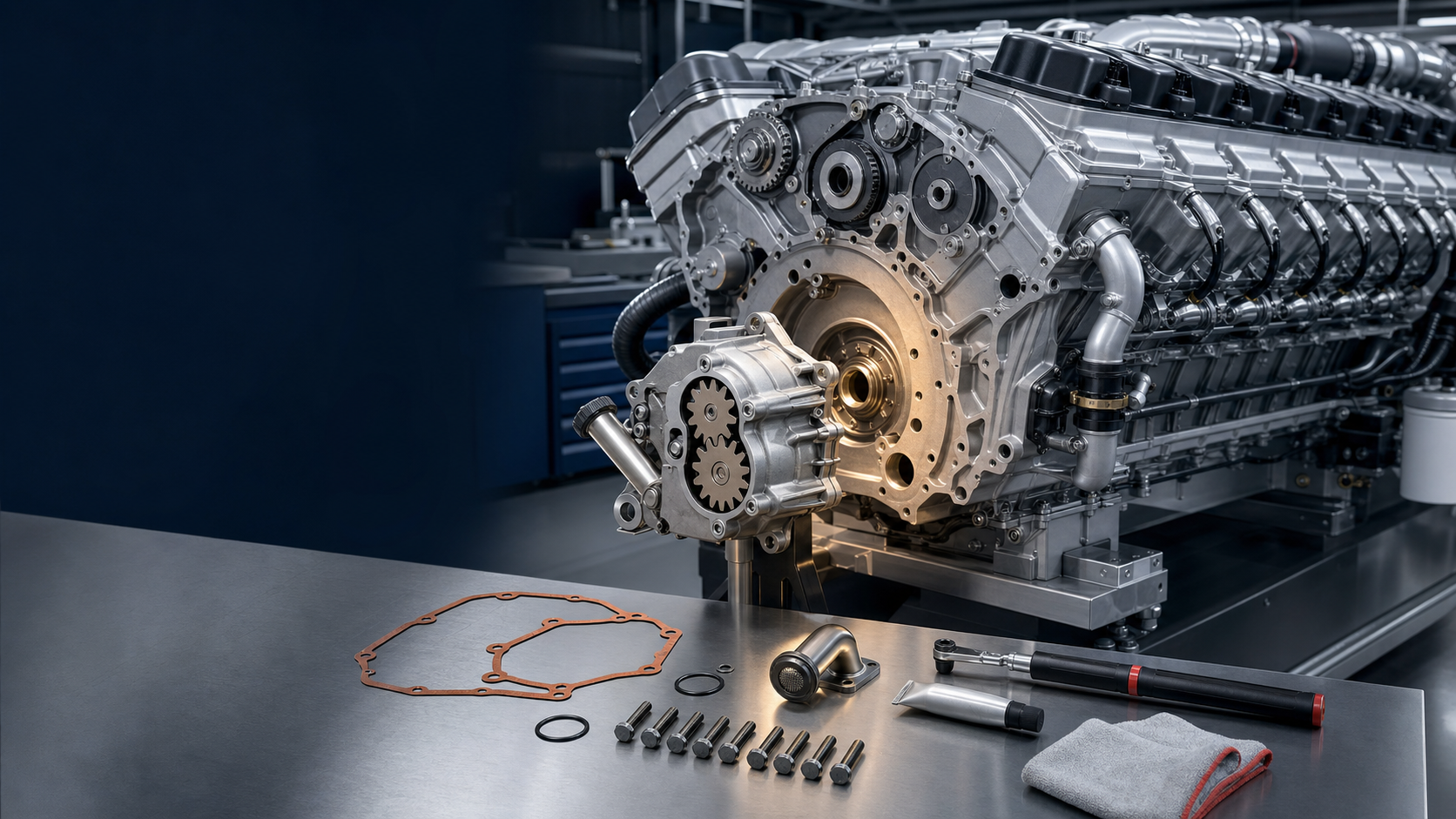
MTU 12V4000 M90 Marine Engine: Lubricating Oil Pump Installation Guide for Reliable Engine Performance
MTU 12V4000 M90 Marine Engine: Why Correct Lubricating Oil Pump Installation Is Essential
Imagine your MTU 12V4000 M90 Marine Engine has just completed a major overhaul.
The crankshaft has been installed.
The connecting rods have been torqued to specification.
New bearings are in place.
Now comes one of the most important stages before the engine can safely return to service—installing the lubricating oil pump.
Although it isn't one of the largest components inside the engine, the oil pump is often described as the heart of the lubrication system. Every bearing, camshaft, piston cooling nozzle, and moving component depends on a continuous supply of clean, pressurised lubricating oil.
If the oil pump is installed incorrectly, even a perfectly rebuilt engine may experience inadequate lubrication, abnormal wear, or costly internal damage during start-up.
At Alfa Marine Spare Parts, we regularly support marine engineers, chief engineers, technical superintendents, shipyards, and fleet operators with replacement parts and overhaul components for the MTU 12V4000 M90 Marine Engine. One lesson remains consistent across every successful rebuild:
Precision during assembly is just as important as the quality of the replacement parts themselves.
In this guide, we'll explain the purpose of the lubricating oil pump, why proper installation matters, and the key checks that experienced marine engineers perform during an overhaul.
Understanding the MTU 12V4000 M90 Marine Engine
The MTU 12V4000 M90 Marine Engine is widely recognised for its high power output, fuel efficiency, and dependable performance in demanding marine environments.
It is commonly installed in:
- Fast ferries
- Offshore support vessels
- Crew transfer vessels
- Patrol boats
- Pilot boats
- High-performance yachts
- Government vessels
- Commercial workboats
Designed for continuous heavy-duty operation, the engine relies on several interconnected systems working together. Among these, the lubrication system plays one of the most important roles in protecting internal engine components from friction and wear.
Without adequate oil pressure, even the strongest engine components can suffer rapid damage.
What Does the Lubricating Oil Pump Do?
The lubricating oil pump is responsible for circulating engine oil throughout the lubrication system.
Its primary function is to deliver a continuous supply of pressurised oil to critical moving parts while the engine is operating.
These components include:
- Main bearings
- Connecting rod bearings
- Camshafts
- Valve train components
- Timing gears
- Piston cooling nozzles
- Turbocharger lubrication circuits
By maintaining the correct oil flow and pressure, the pump helps reduce friction, remove heat, minimise wear, and support reliable engine performance.
The lubrication system is one of the first systems that must function correctly when an engine starts after an overhaul.
Why Proper Oil Pump Installation Is So Important
Installing the lubricating oil pump involves much more than tightening a few mounting bolts.
The pump must be correctly positioned, aligned with the drive gears, and inspected before final engine assembly.
During overhaul procedures, experienced marine engineers carefully verify that:
- The pump seats correctly.
- Mounting surfaces are clean.
- Fasteners are tightened according to the manufacturer's procedures.
- Rotating components move freely.
- Oil passages remain unobstructed.
These checks help ensure the lubrication system can develop oil pressure quickly during the first engine start.
Preparing for Installation
Before installing the oil pump, experienced engineers typically inspect both the replacement component and the surrounding engine components.
Preparation may include:
- Cleaning mounting surfaces.
- Inspecting sealing faces.
- Checking threaded holes.
- Removing debris.
- Confirming correct replacement parts.
- Inspecting drive gears for wear.
Cleanliness during assembly is extremely important.
Even small particles introduced during installation may circulate through the lubrication system once the engine starts.
Why Lubrication System Reliability Matters
The MTU 12V4000 M90 Marine Engine is designed to operate under demanding marine conditions where continuous reliability is essential.
The lubricating oil pump supports every rotating component inside the engine.
Without sufficient oil flow:
- Bearing temperatures increase.
- Friction rises.
- Engine wear accelerates.
- Oil pressure may drop.
- Internal engine damage can occur.
For this reason, proper installation and inspection of the oil pump are considered essential steps during any professional engine rebuild.
Engine Room Insight
Marine engineers often say that the first few seconds after an engine starts are some of the most important in its entire service life.
During those first moments, the lubricating oil pump establishes oil pressure and delivers oil to components that have been stationary throughout the overhaul.
A correctly installed oil pump helps ensure that lubrication reaches critical engine components as quickly as possible, reducing wear during initial start-up.
Chief Engineer's Tip
Before completing engine assembly, many experienced Chief Engineers manually rotate the engine after installing the lubricating oil pump.
This simple inspection helps verify that rotating components move smoothly and that no abnormal resistance is present before the engine is started.
Careful inspection during assembly often prevents costly problems later.
Installing the Lubricating Oil Pump on the MTU 12V4000 M90 Marine Engine
Step 1 – Position the Lubricating Oil Pump Correctly
Once the engine block has been cleaned and inspected, the next stage is positioning the lubricating oil pump.
Although this may appear straightforward, careful alignment is essential.
The pump should be installed gently into its mounting location without forcing or twisting it into position. Before installation, experienced marine engineers normally verify that:
- The mounting surfaces are clean.
- The locating features are free from damage.
- Oil passages are unobstructed.
- The replacement pump matches the engine specification.
According to accepted overhaul practices for MTU Series 4000 engines, cleanliness during assembly is critical. Small particles introduced during installation can circulate through the lubrication system once the engine starts.
Taking a few extra minutes to prepare the installation area helps protect every lubricated component inside the engine.
Step 2 – Install and Tighten the Mounting Bolts
With the oil pump correctly positioned, the mounting bolts can be installed.
Rather than tightening one bolt completely at a time, experienced technicians generally install all fasteners first before tightening them evenly according to the manufacturer's recommended sequence and torque specifications.
This helps:
- Maintain correct pump alignment.
- Prevent distortion of the mounting surface.
- Reduce unnecessary stress on the pump housing.
- Promote proper sealing.
Using calibrated torque tools and following the workshop procedures for the specific engine model contributes to a more reliable installation.
Step 3 – Verify Gear Lash
One of the most important inspections after installing the lubricating oil pump is checking the drive gear engagement.
Proper gear lash allows the oil pump to operate efficiently while avoiding excessive gear wear or unnecessary loading.
Depending on the engine configuration and overhaul procedures, engineers may inspect:
- Gear alignment.
- Tooth contact.
- Gear condition.
- Signs of abnormal wear.
- Smooth engagement.
If excessive wear or damage is discovered during inspection, the underlying cause should be investigated before the engine is returned to service.
Proper gear engagement helps maintain consistent lubrication throughout the engine.
Step 4 – Check Free Rotation
Before completing engine assembly, the lubricating oil pump should rotate smoothly without abnormal resistance.
Many experienced Chief Engineers manually rotate the pump or the engine assembly during overhaul to confirm that:
- Rotating components move freely.
- There is no unusual binding.
- Gears engage smoothly.
- Internal components rotate correctly.
This inspection provides an additional opportunity to identify installation issues before the engine is started.
Finding a problem during assembly is considerably easier than investigating abnormal oil pressure after the engine is running.
Step 5 – Install the Oil Pickup Tube and Gasket
If the oil pickup tube is installed separately, it should be inspected carefully before reassembly.
Engineers typically examine:
- The pickup tube.
- Mounting surfaces.
- Fasteners.
- Sealing gasket or O-ring.
- Oil screen condition.
A damaged gasket or poorly sealed pickup connection may allow air to enter the lubrication system, reducing the pump's ability to deliver consistent oil flow.
Ensuring that the pickup assembly is correctly installed supports reliable oil circulation from the first engine start.
Why Every Installation Step Matters
The lubricating oil pump is responsible for supplying oil to every major moving component inside the MTU 12V4000 M90 Marine Engine.
That includes:
- Main Bearings
- Connecting Rod Bearings
- Camshafts
- Valve Train Components
- Timing Gears
- Piston Cooling Jets
- Turbocharger Bearings
A small installation error can affect oil pressure throughout the engine.
This is why experienced marine engineers never rush the lubrication system during an overhaul.
Engine Room Insight
Many successful engine overhauls have one thing in common:
The technicians never assume that "good enough" is acceptable.
Instead, they inspect every mounting surface, verify every rotating component, and complete every installation check before the engine is started.
The lubricating oil pump may be hidden once the engine is assembled, but its performance affects every lubricated component inside the engine.
Attention to detail during installation helps build confidence that the engine is ready for reliable service.
Chief Engineer's Tip
Before fitting the oil pan, many experienced Chief Engineers perform one final inspection of the lubrication system.
Typical checks include:
✔ Oil pump securely mounted.
✔ Fasteners tightened according to specification.
✔ Pickup tube installed correctly.
✔ Gasket or sealing ring replaced.
✔ Oil passages visually inspected.
✔ Rotating components checked.
This final inspection can prevent unnecessary dismantling later.
Marine Engineer's Preventive Maintenance Checklist
Although the lubricating oil pump is serviced primarily during overhaul, the complete lubrication system should be monitored throughout the engine's operating life.
Daily
✔ Check engine oil level.
✔ Monitor oil pressure.
✔ Observe engine temperature.
Weekly
✔ Inspect for oil leaks.
✔ Check oil filter condition.
✔ Monitor abnormal engine noise.
Scheduled Maintenance
✔ Replace engine oil according to MTU recommendations.
✔ Replace oil filters.
✔ Inspect oil coolers.
✔ Check oil pressure readings.
✔ Analyse engine oil condition where applicable.
During Major Overhaul
✔ Inspect the lubricating oil pump.
✔ Replace worn seals and gaskets.
✔ Inspect drive gears.
✔ Verify gear engagement.
✔ Check free rotation.
✔ Inspect oil pickup tube and screen.
Common Installation Mistakes
Even experienced technicians recognise that careful assembly is essential.
Common mistakes include:
❌ Installing the wrong oil pump for the engine specification.
❌ Damaging sealing surfaces during assembly.
❌ Reusing worn gaskets or O-rings.
❌ Failing to inspect drive gears.
❌ Skipping free rotation checks.
❌ Forgetting to inspect the oil pickup tube.
❌ Ignoring contamination inside the lubrication system.
Avoiding these mistakes helps protect one of the most important systems in the engine.
Technical Reference
The information presented in this article follows accepted marine engineering practices together with guidance consistent with MTU Series 4000 workshop manuals, overhaul procedures, operation manuals, and technical documentation used by marine professionals.
Because engine specifications may differ according to engine model, serial number, and application, always consult the appropriate manufacturer documentation before carrying out installation, inspection, or overhaul work.
Part 3 – Frequently Asked Questions, Related Parts & Why Marine Engineers Choose Alfa Marine Spare Parts
Frequently Asked Questions About the MTU 12V4000 M90 Marine Engine
During a major overhaul of an MTU 12V4000 M90 Marine Engine, marine engineers often ask practical questions about the lubricating oil pump and lubrication system. Here are some of the most common.
Should the lubricating oil pump always be inspected during an engine overhaul?
Yes.
The lubricating oil pump is responsible for supplying pressurised oil to every major rotating component inside the engine. During a major overhaul, inspecting the pump for wear, damage, and proper operation is considered good engineering practice.
Replacing worn seals, inspecting the drive gears, and verifying correct operation before final assembly helps improve long-term reliability.
Can a worn oil pump reduce engine life?
It can.
If the lubrication system cannot maintain the required oil flow or pressure, bearings and other moving components may receive insufficient lubrication.
Over time, this may contribute to accelerated wear and reduced engine reliability.
Routine inspection helps identify problems before they become serious.
Why is checking free rotation important?
After installing the lubricating oil pump, engineers verify that the rotating assembly moves freely.
This inspection helps confirm:
- Correct installation.
- Proper gear engagement.
- No abnormal binding.
- Smooth operation before the first engine start.
Identifying installation issues before startup is always preferable to troubleshooting lubrication problems after the engine is running.
Why is gear lash inspection necessary?
The oil pump is driven by engine gears.
Incorrect gear engagement may increase wear, generate unnecessary noise, or affect long-term reliability.
Checking gear condition and engagement during overhaul supports smooth operation throughout the engine's service life.
Can contamination damage the lubricating oil pump?
Yes.
Small particles, metal debris, gasket material, or dirt introduced during assembly can circulate through the lubrication system.
Maintaining a clean working environment during installation is one of the simplest ways to help protect the pump and the engine.
How often should the lubrication system be inspected?
Although overhaul intervals vary depending on operating conditions, marine engineers typically monitor the lubrication system during every routine engine inspection.
Daily monitoring of oil pressure and oil level, combined with scheduled oil analysis and filter replacement, helps identify potential issues before they affect engine performance.
Engine Room Insight
Many experienced Chief Engineers agree that one of the most valuable gauges in the engine room is the oil pressure gauge.
A stable oil pressure reading provides confidence that the lubrication system is functioning correctly.
If oil pressure begins to change unexpectedly, the engine should be inspected promptly to identify the cause before continued operation.
Monitoring trends is often more valuable than reacting to a warning alarm after a problem has already developed.
Chief Engineer's Tip
Before starting an engine after a major overhaul, experienced engineers often carry out one final visual inspection of the lubrication system.
Typical checks include:
✔ Oil pump correctly installed.
✔ Oil pickup tube secured.
✔ Gaskets and seals replaced.
✔ Oil filters installed.
✔ Engine filled with the correct lubricating oil.
✔ Oil pressure monitoring system ready.
✔ No tools or loose components left inside the engine.
Taking a few extra minutes before the first start can prevent hours of unnecessary troubleshooting later.
Marine Engineer's Preventive Maintenance Checklist
Maintaining the lubrication system throughout the life of the MTU 12V4000 M90 Marine Engine helps reduce wear and improve reliability.
Daily
✔ Check engine oil level.
✔ Monitor oil pressure.
✔ Inspect for external oil leaks.
Weekly
✔ Inspect oil filters.
✔ Check oil cooler condition.
✔ Monitor engine temperature.
Monthly
✔ Inspect the lubrication system.
✔ Check breather condition.
✔ Review engine operating data.
Scheduled Maintenance
✔ Replace engine oil.
✔ Replace oil filters.
✔ Inspect oil coolers.
✔ Monitor oil analysis results.
✔ Inspect lubrication system components.
During Major Overhaul
✔ Inspect the lubricating oil pump.
✔ Inspect drive gears.
✔ Replace seals and gaskets.
✔ Verify gear engagement.
✔ Check free rotation.
✔ Inspect oil pickup tube.
✔ Confirm oil passages are clean.
Common Mistakes During Oil Pump Installation
Attention to detail during assembly helps avoid problems after the engine returns to service.
Common mistakes include:
❌ Installing the incorrect oil pump.
❌ Reusing damaged gaskets.
❌ Allowing contamination into the lubrication system.
❌ Failing to inspect drive gears.
❌ Not checking free rotation.
❌ Ignoring worn oil pickup components.
❌ Starting the engine without completing final inspection checks.
Avoiding these mistakes contributes to a more reliable overhaul.
Related MTU 12V4000 M90 Marine Engine Parts
The lubricating oil pump is only one part of the engine's lubrication system.
During planned maintenance, marine engineers frequently inspect or replace additional components, including:
- Oil Pumps
- Oil Pump Repair Kits
- Oil Filters
- Oil Coolers
- Main Bearings
- Connecting Rod Bearings
- Camshaft Bearings
- Crankshaft Bearings
- Pistons
- Piston Rings
- Cylinder Liners
- Cylinder Heads
- Cylinder Head Gaskets
- Turbochargers
- Fuel Injectors
- Freshwater Pumps
- Seawater Pumps
- Heat Exchangers
- Aftercoolers
- Thermostats
- Complete Overhaul Kits
Replacing related wear components during scheduled maintenance helps improve engine reliability and reduce future downtime.
Why Marine Engineers Choose Alfa Marine Spare Parts
Every overhaul is different, but one thing remains the same—identifying the correct replacement parts is essential.
At Alfa Marine Spare Parts, we help customers identify components for the MTU 12V4000 M90 Marine Engine using:
- Engine Model
- Engine Serial Number
- Existing Part Numbers
- Technical Documentation
- Component Identification
We supply:
- Genuine Marine Parts
- OEM Replacement Parts
- Premium Aftermarket Components
- Professionally Remanufactured Parts
Whether you're replacing a lubricating oil pump or carrying out a complete engine overhaul, our experienced team is available to help you identify the right components for your engine.
Industries We Support
Our customers include:
- Marine Engineers
- Chief Engineers
- Technical Superintendents
- Shipyards
- Commercial Shipping Companies
- Offshore Operators
- Fishing Fleets
- Ferry Operators
- Tugboat Companies
- Government Fleets
- Naval Operators
- Yacht Management Companies
- Marine Service Companies
- Marine Equipment Distributors
Worldwide Marine Spare Parts Supply
Alfa Marine Spare Parts supplies marine engine components to customers throughout the world, including:
- Spain
- Netherlands
- Germany
- Italy
- France
- Norway
- Greece
- United Kingdom
- United States
- Canada
- Brazil
- United Arab Emirates
- Saudi Arabia
- Nigeria
- South Africa
- Singapore
- Australia
Whether your vessel is preparing for scheduled maintenance or undergoing a complete overhaul, we are ready to support your spare parts requirements.
Browse Our Complete Marine Spare Parts Catalog
Looking for parts for your MTU 12V4000 M90 Marine Engine or another leading marine diesel engine?
Browse our complete catalogue:
https://alfamarinespareparts.com/spareparts
Our product range includes components for:
- MTU
- Caterpillar
- Cummins
- MAN
- Volvo Penta
- Wärtsilä
- Yanmar
- Perkins
- Mitsubishi
- Scania
- Detroit Diesel
- Deutz
- John Deere
- Komatsu
- Doosan
Contact Alfa Marine Spare Parts
Need assistance identifying the correct parts for your MTU 12V4000 M90 Marine Engine?
Our experienced team is ready to assist.
Website
https://alfamarinespareparts.com
Browse Our Marine Spare Parts Catalogue
https://alfamarinespareparts.com/spareparts
request@alfamarinespareparts.com
Providing your engine model, serial number, or existing part number helps us identify compatible replacement components more efficiently.
Technical Reference
The maintenance recommendations and installation guidance in this article are based on accepted marine engineering practices together with information consistent with MTU Series 4000 workshop manuals, overhaul procedures, operation manuals, and manufacturer technical documentation.
Because maintenance procedures may vary depending on the engine configuration and serial number, always refer to the official documentation applicable to your engine before carrying out inspection, maintenance, or overhaul work.
Final Thoughts
The MTU 12V4000 M90 Marine Engine is engineered to deliver dependable performance in demanding marine environments, but its reliability depends on the condition of every critical system—including the lubrication system.
Correct installation of the lubricating oil pump, careful inspection of related components, and following recognised overhaul practices help ensure that clean, pressurised oil reaches every major engine component from the moment the engine starts.
By combining preventive maintenance, accurate engine identification, and quality replacement parts, marine engineers can reduce unplanned downtime and maximise engine service life.
At Alfa Marine Spare Parts, we support marine professionals worldwide with genuine, OEM, aftermarket, and professionally remanufactured MTU marine engine parts. Whether you are carrying out scheduled maintenance or a complete overhaul, our team is ready to help you keep your MTU 12V4000 M90 Marine Engine operating safely, efficiently, and reliably for years to come.