MTU 16V 2000 M86 Valve Guide Wear: Why It Can Affect More Than Just Your Cylinder Head
Have you ever noticed your MTU 16V 2000 M86 producing a little more exhaust smoke than usual, even though the injectors, turbocharger, and fuel filters all appear to be in good condition?
Many marine engineers immediately focus on the fuel system, but sometimes the problem starts somewhere much smaller—the valve guides.
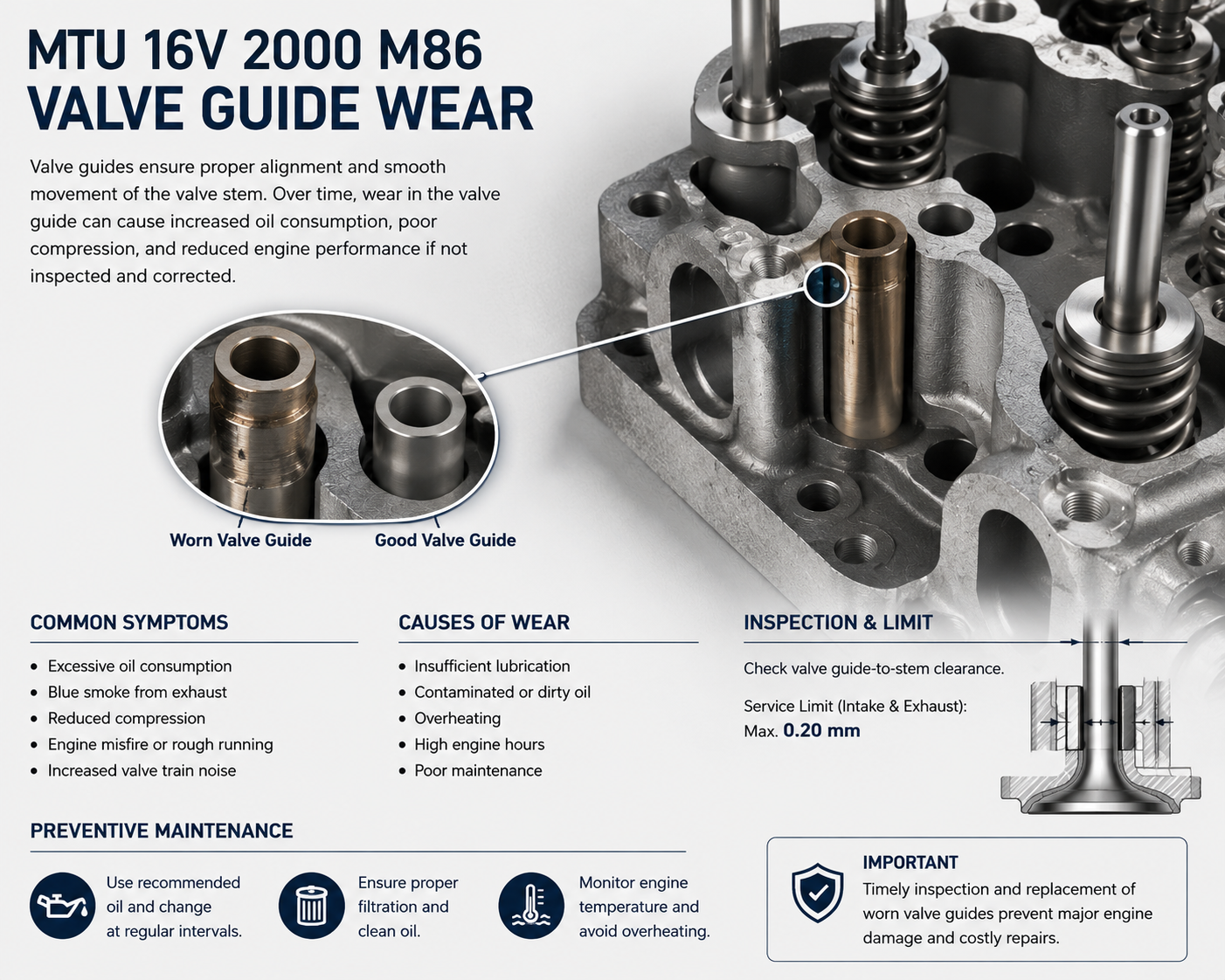
Valve guides don't receive as much attention as pistons or turbochargers, yet they play an important role in keeping the engine operating efficiently. As they wear over thousands of operating hours, they can affect oil consumption, combustion quality, exhaust emissions, and even the lifespan of the valves themselves.
The good news is that valve guide wear usually develops slowly. With regular inspections during scheduled maintenance, it can often be identified before it leads to expensive cylinder head repairs.
Let's look at how valve guides work, why they wear, and what signs every marine engineer should recognize.
What Are Valve Guides?
Every intake and exhaust valve moves up and down thousands of times every minute.
The valve guide keeps each valve perfectly aligned while allowing it to move freely.
Its job is to:
- Guide valve movement
- Maintain correct valve alignment
- Reduce wear on the valve stem
- Help control engine oil entering the combustion chamber
- Support proper valve seating
Without accurate guidance, the valves cannot seal correctly.
Why Are Valve Guides Important?
The valve guide may be a relatively small component, but it directly affects:
- Engine compression
- Combustion efficiency
- Oil consumption
- Exhaust emissions
- Cylinder head reliability
- Valve life
Even slight wear can gradually reduce engine efficiency.
A Real Marine Maintenance Scenario
A luxury yacht equipped with MTU 16V 2000 M86 engines began using more lubricating oil than expected.
There were no coolant leaks.
Turbochargers inspected normally.
Injectors tested within specification.
During a scheduled cylinder head inspection, technicians measured excessive clearance between several valve stems and their guides.
The worn guides allowed small amounts of engine oil to enter the combustion chamber.
After replacing the valve guides and servicing the cylinder heads, oil consumption returned to normal and exhaust smoke was significantly reduced.
The issue wasn't caused by the pistons or turbocharger—it was the gradual wear of the valve guides.
What Causes Valve Guide Wear?
Valve guides are designed for long service life, but several factors contribute to wear.
Normal Operating Hours
Continuous valve movement naturally wears both the guide and valve stem over time.
Poor Lubrication
Although valves receive limited lubrication, contaminated or degraded engine oil can accelerate wear throughout the valve train.
Overheating
Repeated high operating temperatures increase wear on cylinder head components.
Overheating can also reduce lubrication effectiveness.
Poor Combustion
Incorrect injector performance or excessive combustion temperatures increase stress on the exhaust valves and guides.
Contaminated Intake Air
Damaged air filters allow abrasive particles into the engine, increasing wear on internal components.
Early Warning Signs
Valve guide wear often develops gradually.
Common symptoms include:
- Increased lubricating oil consumption
- Blue exhaust smoke
- Reduced engine efficiency
- Rough cold starts
- Carbon deposits on valves
- Reduced compression
- Increased exhaust emissions
- Oil residue inside the intake or exhaust ports
- Higher maintenance intervals for cylinder heads
- Slight reduction in engine performance
Why Oil Consumption May Increase
Many operators immediately suspect piston rings when oil consumption rises.
However, worn valve guides may also allow engine oil to pass into the combustion chamber.
The oil burns during combustion, leading to:
- Blue smoke
- Carbon deposits
- Increased oil usage
Because these symptoms often develop slowly, keeping accurate maintenance records is extremely valuable.
Components That Should Be Inspected Together
Whenever valve guide wear is suspected, engineers should also inspect:
- Intake valves
- Exhaust valves
- Valve seats
- Valve stem seals
- Camshaft
- Rocker arms
- Valve springs
- Fuel injectors
- Turbocharger
- Air filters
Examining the complete valve train helps identify the root cause of abnormal wear.
Can Oil Analysis Detect Valve Guide Wear?
Oil analysis cannot directly measure valve guide clearance.
However, it can identify related engine conditions such as:
- Increased soot
- Oxidation
- Fuel dilution
- Wear metals
When combined with compression testing and cylinder head inspections, oil analysis provides valuable information about overall engine condition.
Preventive Maintenance Checklist
Routine maintenance greatly extends valve train life.
✔ Monitor engine oil consumption.
✔ Perform scheduled valve clearance inspections.
✔ Replace air filters regularly.
✔ Monitor exhaust smoke.
✔ Keep injectors properly maintained.
✔ Follow MTU lubrication recommendations.
✔ Record engine performance trends.
✔ Inspect cylinder heads during major overhauls.
✔ Avoid repeated engine overheating.
✔ Investigate abnormal oil consumption promptly.
Marine Engineer Tip
If oil consumption gradually increases while compression remains relatively stable, don't focus only on the piston rings.
Inspecting the valve guides during scheduled cylinder head maintenance may identify the real cause before more extensive repairs become necessary.
Common Maintenance Mistakes
Avoid these common errors:
- Assuming all oil consumption is caused by worn piston rings.
- Ignoring blue exhaust smoke.
- Delaying cylinder head inspections.
- Operating with clogged air filters.
- Ignoring overheating events.
- Skipping valve clearance checks.
Frequently Asked Questions
How long do MTU valve guides last?
Valve guide life depends on operating hours, engine loading, lubrication quality, and maintenance practices. Many remain in service for thousands of operating hours before requiring replacement.
Can worn valve guides increase oil consumption?
Yes. Excessive clearance may allow engine oil to enter the combustion chamber where it burns during operation.
Is blue smoke always caused by turbochargers?
No. Worn valve guides, valve stem seals, and piston rings can also produce blue exhaust smoke.
Should valve guides be inspected during an overhaul?
Absolutely. Measuring valve guide clearance is a standard part of cylinder head overhaul procedures.
Can poor air filtration accelerate valve guide wear?
Yes. Dust and abrasive particles entering the engine increase wear throughout the intake system and valve train.
Worldwide Marine Engine Spare Parts Supply
Alfa Marine Spare Parts supplies genuine, OEM, aftermarket, remanufactured, and reconditioned spare parts for the MTU 16V 2000 M86 and the complete MTU Series 2000 engine family.
We proudly support:
- Shipyards
- Commercial shipping companies
- Luxury yacht operators
- Offshore operators
- Marine engineers
- Chief engineers
- Technical superintendents
- Government fleets
- Fishing fleets
- Marine service companies
We regularly supply marine engine spare parts to customers throughout the United Kingdom, United States, Dubai (UAE), Monaco, Nigeria, the Netherlands, Italy, Spain, France, Germany, Norway, and Greece.
Browse Our Complete Spare Parts Catalog
Alfa Marine Spare Parts supplies a complete range of MTU Series 2000 components, including:
- Valve guides
- Intake valves
- Exhaust valves
- Valve springs
- Cylinder heads
- Camshafts
- Fuel injectors
- Turbochargers
- Water pumps
- Heat exchangers
- Oil pumps
- Complete overhaul kits
Browse our complete catalog:
https://alfamarinespareparts.com/spareparts
Why Choose Alfa Marine Spare Parts?
At Alfa Marine Spare Parts, we understand that maintaining an MTU engine requires more than replacing major components. Small parts such as valve guides, seals, and valve train components play a critical role in long-term engine reliability. Our experienced team helps marine engineers, fleet operators, and shipyards source the correct parts quickly for preventive maintenance, repairs, and complete overhauls.
We provide:
- Genuine, OEM, aftermarket, remanufactured, and reconditioned marine engine spare parts
- Worldwide shipping
- Fast quotations
- Technical assistance for part identification
- Support for MTU, Caterpillar, Wärtsilä, MAN, Cummins, Volvo Penta, Scania, Detroit Diesel, Perkins, Yanmar, and many other leading marine engine brands
Contact Alfa Marine Spare Parts
Looking for MTU 16V 2000 M86 valve guides, cylinder head components, or overhaul parts?
Website: https://alfamarinespareparts.com
Email: request@alfamarinespareparts.com
Our marine engine specialists are ready to help you identify the correct components for maintenance, repairs, and complete engine overhauls.
Conclusion
The valve guides in the MTU 16V 2000 M86 may be small, but they are essential for maintaining proper valve alignment, efficient combustion, and controlled oil consumption. As wear develops over time, symptoms such as increased oil usage, blue exhaust smoke, or reduced engine performance should never be ignored. Regular inspections during cylinder head maintenance, combined with proper lubrication, clean air filtration, and timely servicing, can help prevent more extensive repairs and keep your MTU engine operating reliably for thousands of hours.