MTU 8V 2000 M72 Crankshaft Inspection: Can a Crankshaft Warn You Before It Fails?
If you asked a marine engineer which engine component they fear failing the most, many would answer the crankshaft.
Not because it fails often—but because when it does, the repair is usually extensive, expensive, and keeps a vessel out of service for weeks or even months.
The reassuring news is that crankshafts rarely fail without warning.
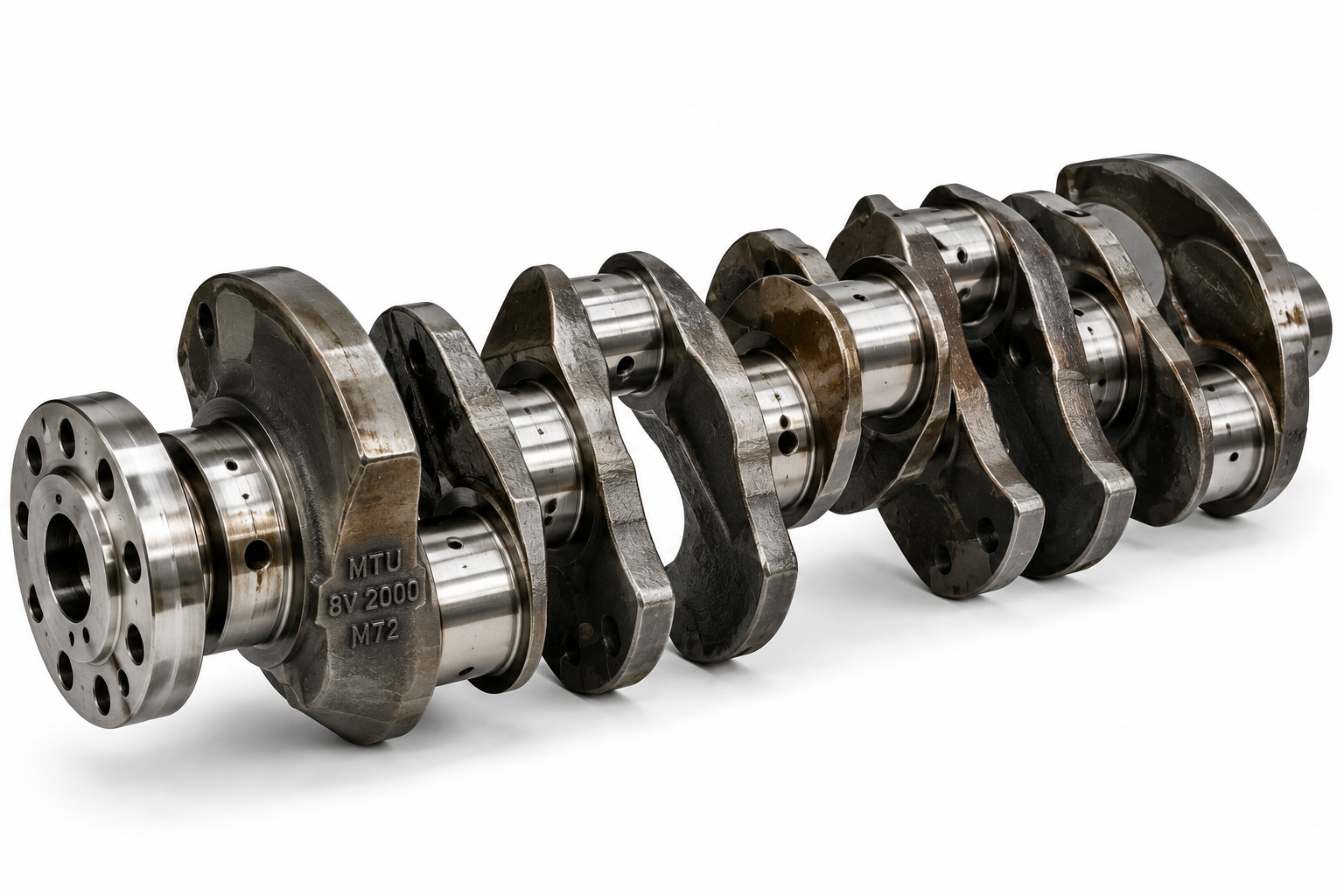
The MTU 8V 2000 M72 is engineered to operate for thousands of hours under demanding marine conditions. Its crankshaft is manufactured from high-strength forged steel and designed to handle enormous combustion forces. However, even the strongest component depends on proper lubrication, correct bearing clearances, balanced combustion, and regular inspections.
One overlooked vibration, one drop in oil pressure, or one ignored oil analysis report can gradually lead to bearing wear that eventually affects the crankshaft.
In this guide, we'll explore how the crankshaft works, why problems develop, what warning signs to look for, and how marine engineers can detect issues long before catastrophic damage occurs.
What Does the Crankshaft Do?
Think of the crankshaft as the engine's backbone.
Every time fuel burns inside a cylinder, the piston is pushed downward.
The connecting rod transfers that force to the crankshaft, which converts the piston's up-and-down movement into rotary motion.
That rotation eventually drives:
- Marine gearbox
- Propeller shaft
- Propeller
Without the crankshaft, the engine simply cannot produce usable power.
Why Is the Crankshaft So Reliable?
Many owners assume the crankshaft is a wear item.
In reality, it is designed to last for a very long time.
Under normal operating conditions, a crankshaft often remains in service through several engine overhauls.
So why do crankshaft failures happen?
Almost never because of the crankshaft itself.
Instead, failures usually begin elsewhere.
A Real Marine Engineering Story
A commercial patrol vessel powered by MTU 8V 2000 M72 engines completed nearly every scheduled maintenance service on time.
Oil changes were performed regularly.
Fuel filters were replaced.
Cooling systems were maintained.
Yet one maintenance recommendation was repeatedly postponed—routine oil analysis.
Months later, engineers noticed a slight reduction in oil pressure during hot operation.
The engine still sounded normal.
There were no warning alarms.
An oil sample was finally sent to a laboratory.
The results showed elevated bearing material in the oil.
During inspection, technicians discovered significant wear on one main bearing.
Because the issue had been detected before bearing failure, the crankshaft only required polishing rather than replacement.
Had the vessel continued operating, the repair could easily have become a complete engine rebuild.
What Causes Crankshaft Problems?
The crankshaft itself is rarely the first component to fail.
Instead, problems usually begin with the systems supporting it.
Bearing Wear
Main bearings create a thin oil film between themselves and the crankshaft journals.
If this oil film weakens, metal-to-metal contact begins.
Even microscopic wear gradually increases bearing clearance.
Low Oil Pressure
Lubrication is everything.
Reduced oil pressure limits the oil film protecting the crankshaft journals.
Without sufficient lubrication, bearing temperatures rise rapidly.
Contaminated Oil
Engine oil contaminated with:
- Dirt
- Water
- Fuel
- Soot
- Metal particles
accelerates crankshaft bearing wear.
Engine Overloading
Continuous heavy loading increases combustion forces.
Although the crankshaft is designed for demanding conditions, excessive loading over long periods places additional stress on bearings.
Injector Problems
Poor combustion caused by worn injectors creates uneven firing forces.
These uneven loads increase stress throughout the crankshaft assembly.
Early Warning Signs
Most crankshaft problems develop gradually.
Common warning signs include:
- Lower oil pressure
- Metallic particles in engine oil
- Increased vibration
- Higher bearing temperatures
- Knocking noises
- Oil analysis showing bearing metals
- Reduced engine smoothness
- Increased oil consumption
- Abnormal engine trend data
- Slight power loss
These warning signs often appear weeks or months before major damage occurs.
Why Oil Analysis Is So Valuable
One of the best ways to monitor crankshaft health doesn't require dismantling the engine.
Oil analysis provides a snapshot of what's happening inside.
Laboratories can identify:
- Iron
- Copper
- Lead
- Tin
- Aluminium
- Chromium
These metals often originate from bearings and rotating components.
Trending oil analysis reports over time allows engineers to identify gradual wear before mechanical failure occurs.
Many fleets consider routine oil analysis one of the most cost-effective maintenance practices available.
Components That Should Be Inspected Together
Whenever crankshaft condition is being evaluated, engineers should also inspect:
- Main bearings
- Connecting rod bearings
- Lubricating oil pump
- Oil filters
- Oil cooler
- Connecting rods
- Pistons
- Fuel injectors
- Engine mounts
- Vibration damper
A healthy crankshaft depends on the health of every supporting component.
Why Vibration Monitoring Matters
Modern maintenance is no longer based solely on visual inspections.
Condition monitoring has become an essential tool for marine engineers.
Increasing vibration levels often indicate:
- Bearing wear
- Misalignment
- Combustion imbalance
- Rotating assembly problems
Comparing vibration trends over time allows engineers to detect changes long before failures occur.
Preventive Maintenance Checklist
The best crankshaft maintenance focuses on prevention.
✔ Change engine oil at recommended intervals.
✔ Replace oil filters.
✔ Perform routine oil analysis.
✔ Monitor oil pressure daily.
✔ Record bearing temperatures.
✔ Monitor engine vibration.
✔ Investigate unusual knocking immediately.
✔ Maintain injector performance.
✔ Keep cooling systems operating efficiently.
✔ Review engine trend data after every voyage.
Marine Engineer Tip
Never assume that normal engine sound means everything is healthy.
Bearing wear often develops silently.
Daily monitoring of oil pressure, vibration trends, and laboratory oil analysis usually provides earlier warning than your ears ever will.
Common Maintenance Mistakes
Avoid these common errors:
- Ignoring small drops in oil pressure.
- Delaying oil analysis.
- Continuing operation after detecting metallic particles.
- Ignoring increasing vibration.
- Assuming knocking noises will disappear.
- Overlooking bearing temperature trends.
Frequently Asked Questions
How long should an MTU crankshaft last?
With proper lubrication and maintenance, an MTU crankshaft is designed to provide an exceptionally long service life and often remains usable through multiple engine overhauls.
Can oil analysis detect crankshaft problems?
Oil analysis detects bearing wear that may eventually affect the crankshaft, making it one of the best predictive maintenance tools available.
Does low oil pressure damage the crankshaft?
Indirectly, yes. Low oil pressure reduces bearing protection, allowing wear that may eventually damage crankshaft journals.
Can injectors affect crankshaft life?
Yes. Uneven combustion creates uneven loading that increases stress on bearings and rotating components.
Should vibration monitoring be part of preventive maintenance?
Absolutely. Trend analysis often identifies developing crankshaft or bearing problems before major damage occurs.
Worldwide Marine Engine Spare Parts Supply
Alfa Marine Spare Parts supplies genuine, OEM, aftermarket, remanufactured, and reconditioned spare parts for the MTU 8V 2000 M72 and the complete MTU Series 2000 engine family.
We support:
- Commercial shipping companies
- Luxury yacht operators
- Offshore vessels
- Shipyards
- Marine engineers
- Chief engineers
- Technical superintendents
- Government fleets
- Fishing companies
- Marine maintenance contractors
We regularly ship marine engine spare parts to customers in the United Kingdom, United States, Dubai (UAE), Monaco, Nigeria, the Netherlands, Italy, Spain, France, Germany, Norway, and Greece, helping vessels minimize downtime worldwide.
Browse Our Complete Spare Parts Catalog
Alfa Marine Spare Parts supplies:
- Crankshafts
- Main bearings
- Connecting rod bearings
- Connecting rods
- Pistons
- Cylinder liners
- Oil pumps
- Oil coolers
- Fuel injectors
- Turbochargers
- Camshafts
- Complete overhaul kits
Browse our complete catalog:
https://alfamarinespareparts.com/spareparts
Why Choose Alfa Marine Spare Parts?
At Alfa Marine Spare Parts, we know that reliable engines depend on quality components and proactive maintenance. Whether you're planning a scheduled overhaul or responding to an unexpected repair, our experienced team can help identify the correct parts quickly and accurately.
We supply genuine, OEM, aftermarket, remanufactured, and reconditioned spare parts with worldwide shipping and technical support for MTU, Caterpillar, Wärtsilä, Cummins, MAN, Volvo Penta, Scania, Detroit Diesel, Perkins, Yanmar, and many other marine engine brands.
Our goal is to help marine professionals reduce downtime, improve reliability, and keep vessels operating safely wherever they are in the world.
Contact Alfa Marine Spare Parts
Need assistance finding the correct MTU 8V 2000 M72 crankshaft, bearings, or overhaul components?
Website: https://alfamarinespareparts.com
Email: request@alfamarinespareparts.com
Our marine engine specialists are ready to help you identify the right components for maintenance, repair, or complete engine overhauls.
Conclusion
The crankshaft is one of the strongest components in the MTU 8V 2000 M72, but it relies entirely on healthy bearings, clean lubrication, balanced combustion, and consistent preventive maintenance. Catastrophic crankshaft failures are uncommon because the engine almost always provides warning signs first—through oil pressure changes, vibration trends, bearing temperatures, or oil analysis results. By paying attention to these early indicators and acting before minor wear becomes major damage, marine engineers can extend engine life, reduce repair costs, and keep their vessels operating reliably for thousands of hours.