Extended Interval Servicing for the Caterpillar 3208 Marine Engine: Complete Coolant Change Guide
Extended Interval Servicing for the Caterpillar 3208 Marine Engine: When Should You Replace Extended Life Coolant?
Introduction
Cooling system maintenance is often overlooked until engine temperatures begin to rise.
However, experienced marine engineers understand that coolant does far more than simply prevent overheating. It protects internal engine components against corrosion, helps transfer heat efficiently, lubricates certain cooling system components, and contributes directly to the long-term reliability of the Caterpillar 3208 Marine Engine.
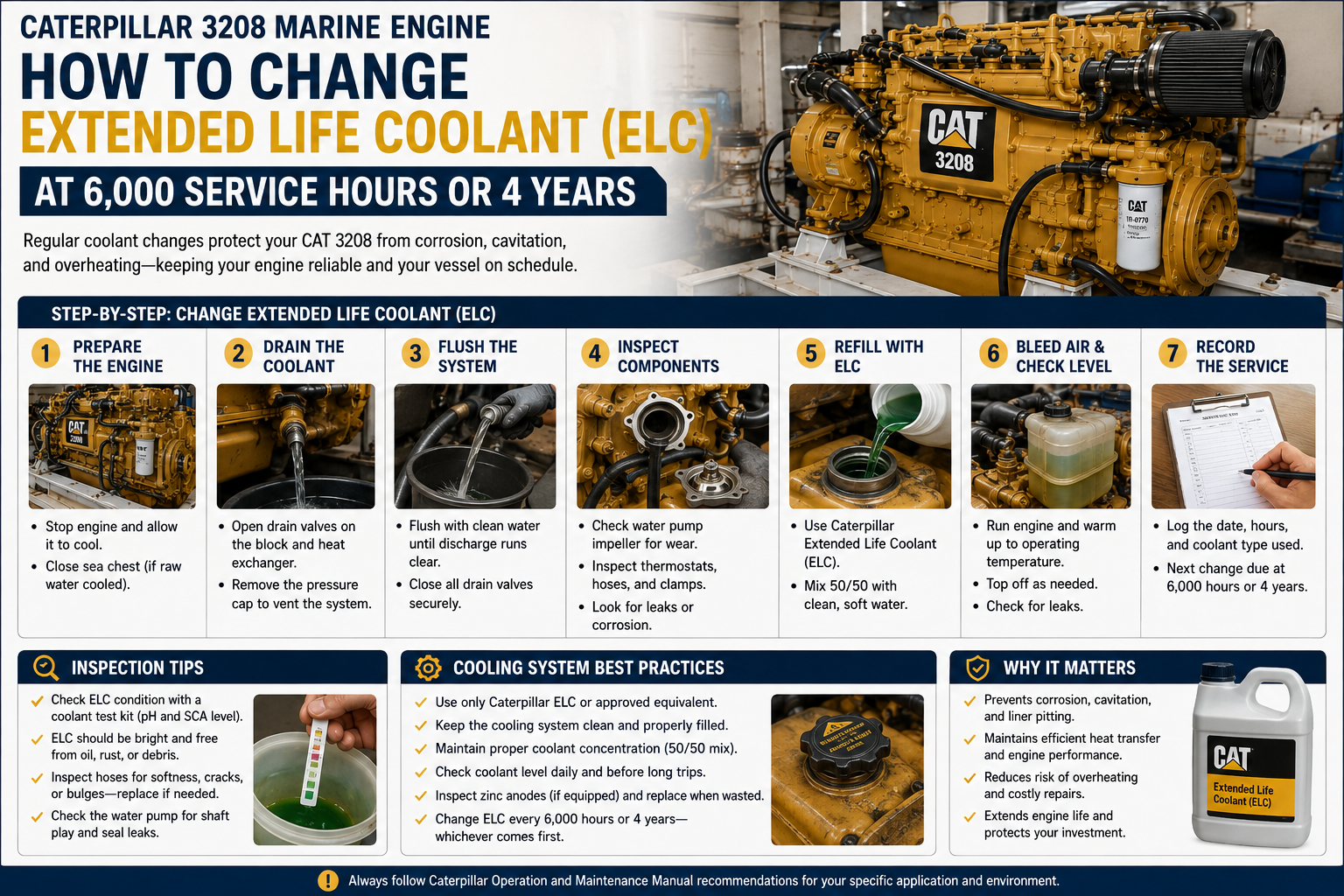
For engines operating with Extended Life Coolant (ELC), Caterpillar recommends a complete coolant replacement at the extended service interval, typically around 6,000 service hours, 216,000 litres (57,000 US gallons) of fuel consumed, or every four years, depending on engine operation and maintenance practices.
Replacing coolant at the recommended interval is not simply routine maintenance—it is an investment in the health of the engine's entire cooling system.
At Alfa Marine Spare Parts, we help marine engineers, chief engineers, technical superintendents, shipyards, and vessel owners maintain reliable marine propulsion systems by supplying quality replacement parts and sharing practical maintenance knowledge. In this guide, we'll explain why coolant replacement matters, how Extended Life Coolant protects the engine, and what should be inspected while the cooling system is drained.
Table of Contents
- Why Coolant Change Matters
- The Role of Coolant in Marine Diesel Engines
- Understanding Extended Life Coolant (ELC)
- Benefits of Using ELC
- Symptoms of Degraded Coolant
- Required Tools and Materials
- Step-by-Step Coolant Replacement Procedure
- Post-Service Checks
- Cooling System Maintenance Tips
- Engine Room Insight
- Chief Engineer's Tip
- Frequently Asked Questions
- Related Caterpillar 3208 Marine Engine Parts
- Why Choose Alfa Marine Spare Parts
- Technical Reference
- Final Thoughts
Why Coolant Change Matters for the Caterpillar 3208 Marine Engine
Unlike engine oil, coolant is often left untouched for long periods because it continues to look clean.
Unfortunately, coolant condition cannot always be judged by appearance alone.
Over time, the protective additives within the coolant gradually become depleted. As this happens, the coolant becomes less effective at preventing corrosion, cavitation, scale formation, and internal deposits.
Replacing the coolant at the recommended interval helps maintain the efficiency of the cooling system and supports the long-term reliability of the engine.
Preventive maintenance is almost always less expensive than repairing damage caused by cooling system neglect.
The Role of Coolant in Marine Diesel Engines
The cooling system is responsible for maintaining stable engine operating temperatures under varying load conditions.
Inside the Caterpillar 3208 Marine Engine, coolant performs several important functions:
- Transfers heat away from the engine.
- Protects metal surfaces from corrosion.
- Reduces cavitation damage.
- Helps prevent scale formation.
- Maintains efficient heat transfer.
- Supports overall cooling system performance.
A healthy cooling system contributes directly to engine efficiency and dependable operation.
Understanding Extended Life Coolant (ELC)
Modern marine diesel engines commonly use Extended Life Coolant (ELC) because it provides long-lasting protection when maintained correctly.
Unlike conventional coolants that require more frequent additive replacement, ELC is formulated to deliver extended protection against corrosion and cavitation while helping maintain cooling system cleanliness.
Although ELC offers a longer service life, it should still be replaced at the recommended maintenance interval.
Ignoring coolant replacement simply because the engine appears to be operating normally may increase the risk of internal cooling system wear over time.
What Is Extended Life Coolant?
Extended Life Coolant is a specially formulated coolant designed for long-term operation in heavy-duty diesel engines.
When maintained correctly, it helps protect:
- Cylinder liners.
- Cylinder heads.
- Water pumps.
- Heat exchangers.
- Coolant passages.
- Thermostats.
Using the correct coolant specification is just as important as replacing it at the recommended interval.
Benefits of Using ELC in the Caterpillar 3208 Marine Engine
Maintaining the correct Extended Life Coolant offers several advantages:
- Improved corrosion protection.
- Reduced scale formation.
- Better heat transfer.
- Longer coolant service intervals.
- Reduced cooling system maintenance.
- Protection against cavitation.
- Improved water pump reliability.
Together, these benefits contribute to longer engine service life and improved cooling system performance.
Symptoms of Degraded Coolant
Coolant gradually loses its protective properties over time.
Warning signs that coolant may require replacement include:
- Rust-coloured coolant.
- Cloudy appearance.
- Sediment or debris.
- Oil contamination.
- Overheating.
- Reduced cooling efficiency.
- Coolant leaks.
- Frequent coolant top-ups.
If any of these conditions are observed, further inspection of the cooling system is recommended.
Engine Room Insight
Many experienced marine engineers monitor coolant condition just as closely as they monitor engine oil.
Although coolant replacement occurs less frequently, neglecting the cooling system can eventually affect almost every major engine component.
Routine inspections during scheduled maintenance provide an opportunity to identify developing issues before they lead to overheating or expensive repairs.
Chief Engineer's Tip
Whenever draining the cooling system, inspect every accessible component—not just the coolant itself.
Take the opportunity to examine:
✔ Heat exchanger.
✔ Water pump.
✔ Thermostats.
✔ Coolant hoses.
✔ Hose clamps.
✔ Expansion tank.
✔ External leaks.
Performing these inspections while the system is empty often saves considerable labour later.
We'll cover:
- Required Tools and Materials
- Step-by-Step Coolant Replacement Procedure
- Engine Cool Down and Safety Preparation
- Draining the Old Coolant
- Cooling System Inspection
- Optional Cooling System Flush
- Refilling with Extended Life Coolant
- Bleeding the Cooling System
- Proper Coolant Disposal
- Post-Service Checks
- Common Cooling System Mistakes
Part 2 – Step-by-Step Coolant Replacement Procedure for the Caterpillar 3208 Marine Engine
Required Tools and Materials
Before replacing the coolant in a Caterpillar 3208 Marine Engine, it's good practice to prepare the necessary tools and materials. Having everything ready before starting the job helps reduce downtime and makes the maintenance process more efficient.
Typical items include:
- Recommended Extended Life Coolant (ELC)
- Clean drain container
- Funnels
- Replacement hose clamps (if required)
- Replacement hoses (if worn)
- Clean cloths
- Personal protective equipment (PPE)
- Basic hand tools
- Flashlight for inspections
Depending on the vessel's configuration, additional tools may be required to access the cooling system.
Step-by-Step Coolant Replacement Procedure
Changing the coolant is more than simply draining and refilling the system. It also provides an excellent opportunity to inspect cooling system components while they are easily accessible.
Step 1 – Engine Cool Down and Safety Preparation
Before opening any part of the cooling system:
- Shut down the engine.
- Allow the engine to cool completely.
- Ensure the cooling system is no longer under pressure.
- Wear suitable personal protective equipment.
- Place collection containers beneath drain points.
Opening a pressurised cooling system while the engine is still hot can result in serious injury.
Safety should always be the first priority.
Step 2 – Drain the Old Coolant
Once the engine has cooled sufficiently, drain the coolant from the engine and cooling system according to the manufacturer's recommended procedure.
During draining, observe:
- Coolant colour.
- Presence of rust.
- Sediment.
- Oil contamination.
- Foreign particles.
Changes in coolant condition may provide useful information about the overall health of the cooling system.
Step 3 – Inspect Cooling System Components While Drained
With the cooling system empty, access to several important components becomes much easier.
Experienced marine engineers commonly inspect:
Water Pump
Check for:
- Coolant leakage.
- Bearing condition.
- Shaft movement.
- Seal wear.
Heat Exchanger
Inspect for:
- External corrosion.
- Blocked cooling passages.
- Damaged end caps.
- Signs of leakage.
Thermostats
Inspect thermostat housings for:
- Corrosion.
- Seal condition.
- Damage.
- Coolant deposits.
Hoses and Clamps
Inspect all coolant hoses for:
- Cracking.
- Swelling.
- Soft spots.
- Abrasion.
- Loose clamps.
Replacing worn hoses during scheduled maintenance is often more cost-effective than dealing with an unexpected coolant leak during operation.
Step 4 – Optional Cooling System Flush
If coolant contamination or deposits are present, the cooling system may require flushing before new coolant is installed.
A flushing procedure can help remove:
- Scale.
- Rust particles.
- Sediment.
- Old coolant residue.
A clean cooling system supports more efficient heat transfer and helps extend the life of new coolant.
Step 5 – Refill with Extended Life Coolant (ELC)
Once inspections have been completed and the cooling system is ready, refill with the recommended Extended Life Coolant (ELC).
When refilling:
- Use the correct coolant specification.
- Fill slowly to reduce trapped air.
- Follow the manufacturer's recommended filling procedure.
- Check coolant level as filling progresses.
Using the correct coolant helps maintain corrosion protection and efficient cooling performance.
Step 6 – Bleed the Cooling System
Air trapped inside the cooling system may reduce coolant circulation and create localised hot spots.
After refilling:
- Follow the recommended bleeding procedure.
- Allow trapped air to escape.
- Monitor coolant level.
- Top up if necessary.
Removing trapped air helps restore proper coolant circulation throughout the engine.
Step 7 – Dispose of Old Coolant Properly
Used coolant should always be disposed of responsibly.
Follow local environmental regulations and the vessel's waste management procedures.
Never discharge used coolant into waterways or the marine environment.
Proper disposal protects both the environment and the vessel's compliance with applicable regulations.
Post-Service Checks
After replacing the coolant, carry out a complete inspection before returning the engine to normal operation.
Typical post-service checks include:
- Coolant level.
- Coolant leaks.
- Hose connections.
- Engine operating temperature.
- Water pump operation.
- Heat exchanger performance.
- Expansion tank level.
Continue monitoring the cooling system during the first operating hours following maintenance.
Common Mistakes to Avoid
Even routine coolant replacement can create future problems if important steps are overlooked.
Common mistakes include:
❌ Opening the cooling system while the engine is hot.
❌ Mixing incompatible coolant types.
❌ Failing to inspect hoses and clamps.
❌ Ignoring corrosion inside the cooling system.
❌ Leaving trapped air inside the system.
❌ Reusing damaged seals or gaskets.
❌ Overlooking heat exchanger maintenance.
Taking a systematic approach helps improve cooling system reliability.
Engine Room Insight
Experienced marine engineers treat coolant replacement as a complete cooling system inspection—not simply a fluid change.
The time spent inspecting the water pump, heat exchanger, hoses, thermostats, and connections while the system is drained often prevents unexpected failures later.
Many cooling system problems are identified during these scheduled maintenance periods long before they affect engine performance.
Chief Engineer's Tip
Whenever coolant is replaced, record:
✔ Engine operating hours.
✔ Date of service.
✔ Coolant specification used.
✔ Cooling system inspection findings.
✔ Components replaced.
✔ Coolant level after bleeding.
Maintaining accurate maintenance records makes future servicing easier and helps identify long-term cooling system trends.
Cooling System Preventive Maintenance Checklist
Daily
✔ Check coolant level.
✔ Monitor engine temperature.
✔ Inspect for coolant leaks.
Weekly
✔ Inspect hoses and clamps.
✔ Monitor water pump condition.
✔ Check expansion tank level.
Monthly
✔ Inspect the heat exchanger.
✔ Check coolant condition.
✔ Inspect cooling system connections.
Every 6,000 Service Hours or 4 Years
✔ Replace Extended Life Coolant (ELC).
✔ Inspect the water pump.
✔ Inspect thermostats.
✔ Inspect the heat exchanger.
✔ Replace worn hoses where required.
✔ Inspect cooling system seals.
Regular maintenance helps preserve the long-term reliability of the Caterpillar 3208 Marine Engine and reduces the risk of overheating during demanding marine operations.
We'll complete the guide with:
- Maintain System Pressure
- Inspect Heat Exchanger and Zinc Rods
- Monitor Water Pump
- Watch for Air Locks
- Signs It's Time to Replace Coolant Earlier
- Long-Term Cooling System Health Plan
- Frequently Asked Questions
- Related Caterpillar 3208 Marine Engine Parts
- Why Choose Alfa Marine Spare Parts
- Technical Reference
- Final Thoughts
Part 3 – Long-Term Cooling System Care, FAQs & Why Choose Alfa Marine Spare Parts
Maintain System Pressure
Maintaining the correct cooling system pressure is essential for the long-term reliability of the Caterpillar 3208 Marine Engine.
The cooling system is designed to operate within a specific pressure range. Correct pressure helps increase the coolant's boiling point, improves heat transfer, and reduces the likelihood of coolant loss during normal operation.
During routine maintenance, marine engineers should inspect:
- Pressure cap condition.
- Expansion tank.
- Coolant reservoir.
- Hose connections.
- External coolant leaks.
A faulty pressure cap or leaking connection may reduce cooling efficiency even when the coolant itself is in good condition.
Inspect the Heat Exchanger and Zinc Rods
The heat exchanger is one of the most important components within the cooling system.
Its purpose is to transfer heat from the engine coolant to the raw water circuit while keeping the two systems separate.
During extended interval servicing, inspect:
- Heat exchanger core.
- End caps.
- Internal passages.
- Sealing surfaces.
- Corrosion.
- Marine growth where applicable.
Where sacrificial zinc anodes are installed, inspect them for wear and replace them when necessary.
Healthy zinc rods help reduce internal corrosion and extend the life of cooling system components.
Monitor the Water Pump
Although coolant replacement occurs every few years, the water pump should be inspected much more frequently.
Routine monitoring should include:
- Coolant leaks.
- Bearing noise.
- Shaft movement.
- Seal condition.
- Pump housing.
The water pump operates continuously whenever the engine is running.
Early detection of wear often prevents overheating and more extensive engine damage.
Watch for Air Locks
After any cooling system service, trapped air should be removed before the engine returns to normal operation.
Air trapped inside the cooling system may:
- Reduce coolant circulation.
- Create localised hot spots.
- Affect thermostat operation.
- Reduce cooling efficiency.
Following the recommended bleeding procedure helps restore normal coolant flow throughout the engine.
Continue monitoring coolant level after the first operating cycle, as additional topping up may occasionally be required.
Common Mistakes to Avoid
Even routine coolant replacement can lead to future problems if important maintenance steps are overlooked.
Common mistakes include:
❌ Mixing incompatible coolant types.
❌ Reusing damaged hoses or clamps.
❌ Ignoring corrosion within the cooling system.
❌ Forgetting to bleed trapped air.
❌ Failing to inspect the heat exchanger.
❌ Neglecting sacrificial zinc anodes.
❌ Overlooking small coolant leaks.
Taking a systematic approach during maintenance helps improve the long-term reliability of the Caterpillar 3208 Marine Engine.
Signs It's Time to Replace Coolant Earlier
Although Extended Life Coolant is designed for long service intervals, certain operating conditions may require earlier replacement.
Examples include:
- Repeated overheating.
- Coolant contamination.
- Internal corrosion.
- Frequent coolant loss.
- Oil contamination.
- Cooling system repairs requiring major coolant loss.
If coolant quality is in doubt, further inspection is recommended before continuing normal operation.
Long-Term Cooling System Health Plan
A reliable cooling system depends on consistent preventive maintenance rather than waiting for problems to appear.
A structured maintenance programme should include:
Daily
✔ Monitor engine temperature.
✔ Check coolant level.
✔ Inspect for external leaks.
Weekly
✔ Inspect hoses and clamps.
✔ Monitor water pump operation.
✔ Check the expansion tank.
Monthly
✔ Inspect the heat exchanger.
✔ Monitor coolant condition.
✔ Inspect the pressure cap.
Every Scheduled Maintenance Interval
✔ Inspect thermostats.
✔ Inspect the water pump.
✔ Inspect heat exchanger cores.
✔ Inspect zinc rods where fitted.
✔ Check coolant concentration.
Every 6,000 Service Hours or Four Years
✔ Replace Extended Life Coolant (ELC).
✔ Inspect the complete cooling system.
✔ Replace worn hoses, seals, and clamps where required.
✔ Inspect the water pump and cooling circuit.
Following this maintenance schedule helps maximise engine reliability and reduce unexpected downtime.
Engine Room Insight
Experienced Chief Engineers understand that coolant replacement is one of the best opportunities to inspect the entire cooling system.
Because the system is already drained, components such as the heat exchanger, thermostats, hoses, water pump, and sealing surfaces are far easier to inspect.
Using scheduled coolant replacement as a complete cooling system inspection often prevents future breakdowns.
Chief Engineer's Tip
Whenever coolant is replaced, record:
✔ Engine operating hours.
✔ Date of coolant replacement.
✔ Coolant specification used.
✔ Components inspected.
✔ Components replaced.
✔ Cooling system observations.
Accurate maintenance records help identify long-term trends and simplify future servicing.
Frequently Asked Questions About the Caterpillar 3208 Marine Engine Cooling System
Why should Extended Life Coolant be replaced if it still looks clean?
The appearance of the coolant does not always reflect its protective properties.
Over time, corrosion inhibitors and other additives become depleted, reducing the coolant's ability to protect internal engine components.
Replacing the coolant at the recommended interval helps maintain effective cooling system protection.
Can I mix different coolant types?
Mixing coolant formulations is generally not recommended unless specifically approved by the coolant manufacturer.
Using incompatible coolants may reduce corrosion protection and shorten coolant service life.
Always follow the engine manufacturer's recommendations for coolant selection.
What components should be inspected during coolant replacement?
Extended interval servicing provides an excellent opportunity to inspect:
- Water pump.
- Heat exchanger.
- Thermostats.
- Coolant hoses.
- Hose clamps.
- Pressure cap.
- Expansion tank.
- Zinc rods where fitted.
Inspecting these components while the cooling system is drained helps reduce future labour.
Why are zinc rods important?
Sacrificial zinc anodes help protect cooling system components from corrosion.
Regular inspection and replacement of worn zinc rods contribute to the long-term health of the cooling system.
Can proper coolant maintenance extend engine life?
Yes.
Maintaining the cooling system helps:
- Improve temperature control.
- Reduce corrosion.
- Prevent overheating.
- Protect internal engine components.
- Support reliable long-term engine operation.
Preventive cooling system maintenance remains one of the best investments in engine reliability.
Related Caterpillar 3208 Marine Engine Parts
During extended interval cooling system maintenance, marine engineers frequently inspect or replace related components, including:
- Freshwater Pumps
- Seawater Pumps
- Water Pump Repair Kits
- Heat Exchangers
- Thermostats
- Coolant Hoses
- Hose Clamps
- Pressure Caps
- Expansion Tanks
- Oil Coolers
- Cooling System Gasket Sets
- Zinc Anodes
- Cylinder Head Gaskets
- Complete Cooling System Repair Kits
Replacing worn components during planned maintenance helps improve cooling system reliability and minimise future downtime.
Why Choose Alfa Marine Spare Parts?
At Alfa Marine Spare Parts, we help marine professionals identify the correct replacement parts for the Caterpillar 3208 Marine Engine using:
- Engine Model
- Engine Serial Number
- Arrangement Number
- Existing Part Numbers
- Technical Documentation
We supply:
- Genuine Marine Parts
- OEM Replacement Parts
- Premium Aftermarket Components
- Professionally Remanufactured Parts
- Cooling System Components
- Complete Overhaul Parts
Whether you're carrying out scheduled maintenance or planning a complete engine overhaul, our experienced team is ready to help identify the right parts for your vessel.
Industries We Support
We proudly support:
- Marine Engineers
- Chief Engineers
- Technical Superintendents
- Shipyards
- Commercial Shipping Companies
- Offshore Operators
- Fishing Fleets
- Tugboat Operators
- Ferry Companies
- Government Fleets
- Naval Operators
- Yacht Management Companies
- Marine Service Companies
- Boat Builders
- Marine Equipment Distributors
Worldwide Marine Spare Parts Supply
Alfa Marine Spare Parts supplies marine engine components worldwide, including:
- Spain
- Netherlands
- Germany
- Italy
- France
- Norway
- Greece
- United Kingdom
- United States
- Canada
- Brazil
- United Arab Emirates
- Saudi Arabia
- Qatar
- Nigeria
- South Africa
- Singapore
- Australia
We support commercial shipping, offshore operations, fishing fleets, ferries, workboats, patrol vessels, and recreational marine operators across major maritime markets.
Browse Our Complete Marine Spare Parts Catalog
Looking for parts for your Caterpillar 3208 Marine Engine?
Browse our complete catalogue:
https://alfamarinespareparts.com/spareparts
We supply marine parts for:
- Caterpillar
- MTU
- Cummins
- Twin Disc
- MAN
- Volvo Penta
- Wärtsilä
- Scania
- Perkins
- Detroit Diesel
- Deutz
- Mitsubishi
- John Deere
- Komatsu
- Doosan
- Yanmar
Contact Alfa Marine Spare Parts
Need assistance identifying the correct cooling system components for your Caterpillar 3208 Marine Engine?
Our experienced team is ready to assist.
Website
https://alfamarinespareparts.com
Browse Our Marine Spare Parts Catalog
https://alfamarinespareparts.com/spareparts
request@alfamarinespareparts.com
Providing your engine model, serial number, arrangement number, or existing part number allows us to identify compatible replacement parts more accurately.
Technical Reference
This guide is based on recognised marine engineering practices and maintenance procedures applicable to heavy-duty marine diesel engines. Coolant specifications, service intervals, inspection procedures, and replacement recommendations may vary depending on engine configuration and operating conditions. Always consult the appropriate manufacturer documentation before performing cooling system maintenance or coolant replacement.
Final Thoughts
Replacing Extended Life Coolant (ELC) at the recommended service interval is one of the most effective ways to protect the Caterpillar 3208 Marine Engine from corrosion, overheating, and premature cooling system wear. While the coolant itself plays a vital role, this maintenance interval also provides an excellent opportunity to inspect the water pump, heat exchanger, thermostats, hoses, zinc anodes, and other key cooling system components.
A well-maintained cooling system supports stable operating temperatures, efficient heat transfer, and long-term engine reliability. By following a structured maintenance programme and addressing minor issues before they become major failures, vessel owners and marine engineers can significantly reduce unexpected downtime and extend engine service life.
At Alfa Marine Spare Parts, we support marine engineers, chief engineers, technical superintendents, shipyards, fleet operators, and vessel owners with genuine, OEM, aftermarket, and professionally remanufactured Caterpillar marine engine parts. Whether you're replacing cooling system components, carrying out scheduled servicing, or planning a complete overhaul, our experienced team is ready to help you keep your Caterpillar 3208 Marine Engine operating safely, efficiently, and reliably for years to come.