
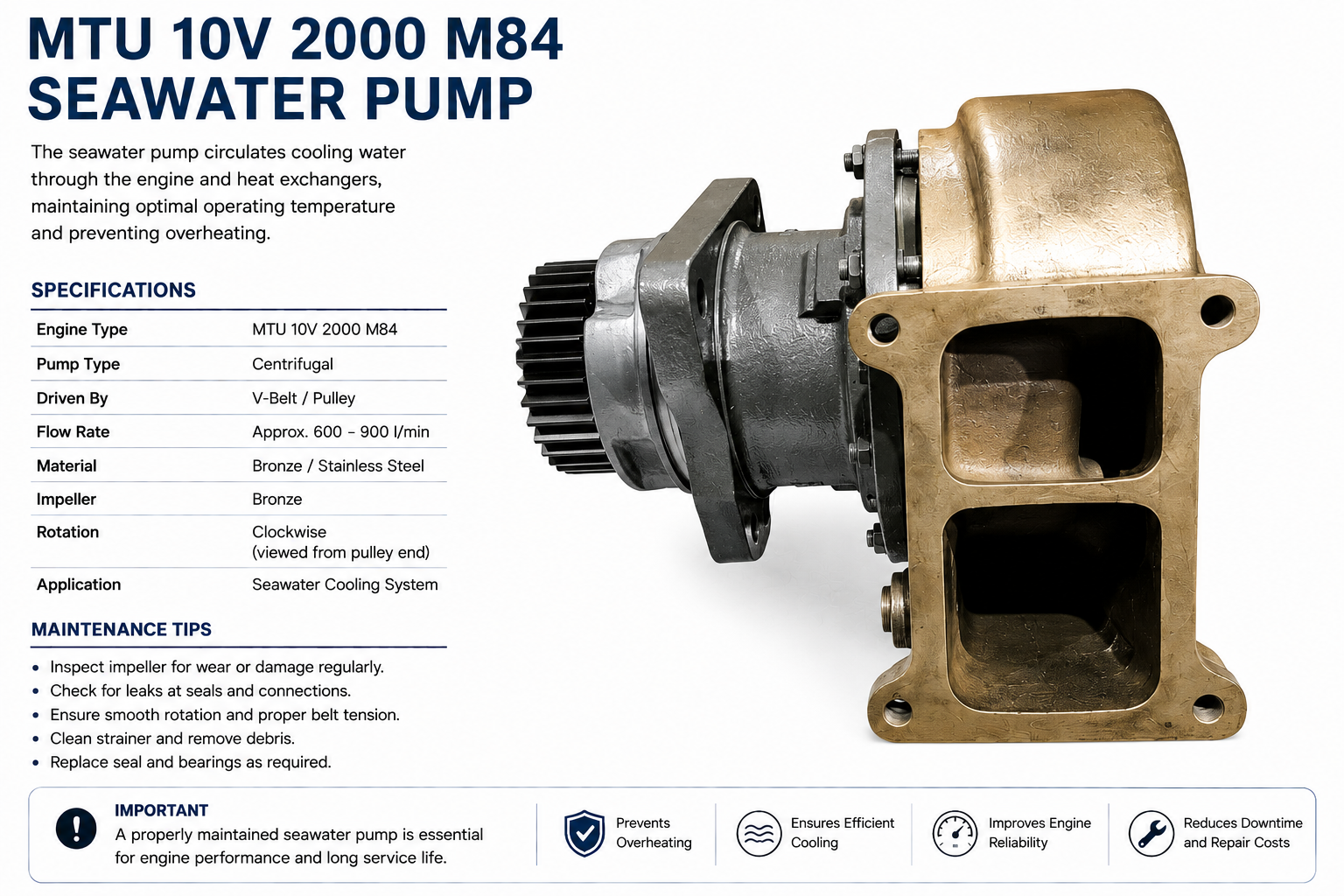
MTU 10V 2000 M84 Seawater Pump Maintenance: Why One Small Leak Can Lead to Major Engine Damage
Have you ever opened the engine room after a voyage and noticed a few drops of seawater beneath the front of your MTU 10V 2000 M84 engine?
It's tempting to wipe them away and assume they're nothing to worry about.
After all, the engine temperature stayed normal, there were no alarms, and the vessel completed its trip without any obvious problems.
But experienced marine engineers know that small seawater leaks often tell a much bigger story.
One of the most common sources of these leaks is the seawater pump—a component that quietly keeps your engine cool every minute it's operates. While it rarely gets the same attention as the turbocharger or fuel injectors, the seawater pump is one of the most important parts of the cooling system.
Ignoring early warning signs can eventually lead to overheating, reduced engine performance, damaged heat exchangers, and even costly engine repairs.
Let's look at how the seawater pump works, why it fails, and what every vessel owner and marine engineer should inspect before problems become serious.
Why Does the Seawater Pump Matter?
Unlike the freshwater cooling circuit that circulates coolant inside the engine, the seawater pump brings seawater into the cooling system.
Its job is to provide a continuous flow of seawater through components such as:
- Heat exchanger
- Charge air cooler
- Oil cooler
- Exhaust cooling system (where applicable)
After absorbing heat, the seawater is discharged overboard.
Without this constant flow, engine temperatures quickly begin to rise.
A Marine Engineer's Perspective
Many engineers describe the seawater pump as the "heart" of the external cooling system.
Just like your heart circulates blood through your body, the seawater pump circulates cooling water through the engine's heat exchangers.
If circulation slows, every cooling component becomes less effective.
The result isn't always immediate overheating.
Instead, the engine may begin operating a few degrees warmer than usual, fuel consumption may increase slightly, and exhaust temperatures may slowly rise.
Those small changes are often the first warning signs.
A Real Marine Maintenance Story
A sport fishing yacht powered by MTU 10V 2000 M84 engines returned from several offshore trips with no reported engine alarms.
The captain only mentioned that the engines seemed to run "a little warmer" than normal.
The engineering team inspected the thermostats.
They cleaned the heat exchangers.
Coolant levels were correct.
During a closer inspection, they discovered dried salt deposits around the seawater pump housing.
The mechanical seal had begun leaking.
Although the leak was small, the pump's efficiency had gradually decreased, reducing seawater flow through the cooling system.
Replacing the seal and servicing the pump restored normal operating temperatures before any major damage occurred.
How Does a Seawater Pump Wear Out?
Marine environments are demanding.
Unlike many other engine components, the seawater pump works continuously with saltwater, making routine maintenance essential.
Common causes of wear include:
Mechanical Seal Wear
The mechanical seal prevents seawater from escaping around the rotating shaft.
Over thousands of operating hours, normal wear gradually reduces sealing performance.
Small leaks usually appear first.
Impeller Wear
Depending on the pump design, the impeller experiences continuous contact with seawater.
Sand, shell fragments, and debris accelerate wear.
A worn impeller reduces cooling efficiency.
Bearing Wear
Pump bearings support the rotating shaft.
When bearings begin wearing, shaft movement increases.
This often leads to seal failure shortly afterwards.
Corrosion
Saltwater is highly corrosive.
Even with quality materials, corrosion may eventually affect the pump housing if maintenance is neglected.
Debris
Seaweed, shells, plastic, and other foreign material entering through the seawater intake can restrict flow or damage internal components.
Early Warning Signs
The good news is that seawater pumps usually provide warning signs before complete failure.
Watch for:
- Salt deposits around the pump
- Small seawater leaks
- Rising coolant temperatures
- Higher exhaust temperatures
- Reduced seawater discharge
- Unusual bearing noise
- Increased engine room humidity
- Rust stains
- Reduced cooling efficiency
- Steam during heavy engine loading
Never assume these symptoms will disappear on their own.
Why Small Leaks Should Never Be Ignored
One question marine engineers hear regularly is:
"It's only leaking a little. Can we wait until the next service?"
Sometimes you can.
Often you shouldn't.
A leaking mechanical seal may also indicate:
- Bearing wear
- Shaft wear
- Reduced pump efficiency
- Internal corrosion
Waiting too long may turn a simple seal replacement into a complete pump overhaul.
Components That Should Be Inspected Together
Whenever the seawater pump is serviced, inspect:
- Seawater strainers
- Heat exchanger
- Charge air cooler
- Oil cooler
- Cooling hoses
- Hose clamps
- Thermostats
- Freshwater circulation pump
- Temperature sensors
- Seawater intake valves
A restriction elsewhere in the cooling system can place additional load on the seawater pump.
Why Water Quality Makes a Difference
Not all seawater is the same.
Engines operating in tropical waters often experience:
- Faster marine growth
- More salt deposits
- Increased biological fouling
Meanwhile, shallow harbours may introduce:
- Sand
- Mud
- Shell fragments
Understanding the vessel's operating environment helps determine the ideal inspection schedule.
Can Oil Analysis Help?
Oil analysis won't identify a leaking seawater pump directly.
However, it may reveal secondary problems caused by overheating, including:
- Increased oxidation
- Reduced oil viscosity
- Coolant contamination (if cooling system failures develop further)
Oil analysis should always be viewed as one part of a complete preventive maintenance program.
Preventive Maintenance Checklist
Consistent maintenance greatly extends seawater pump life.
✔ Inspect for leaks before every voyage.
✔ Clean seawater strainers regularly.
✔ Monitor engine operating temperatures.
✔ Check seawater discharge.
✔ Inspect hoses and clamps.
✔ Clean the heat exchanger.
✔ Perform scheduled cooling system inspections.
✔ Replace worn seals promptly.
✔ Record operating temperatures.
✔ Investigate any gradual temperature increase.
Marine Engineer Tip
One of the easiest ways to detect a developing seawater pump problem is after shutting down the engine.
Take a few minutes to inspect around the pump housing.
Fresh salt crystals or dried white deposits often reveal small leaks that aren't obvious while the engine is running.
Finding them early usually saves both time and money.
Common Maintenance Mistakes
Avoid these common errors:
- Ignoring small seawater leaks.
- Delaying seal replacement.
- Failing to clean seawater strainers.
- Assuming all overheating is caused by thermostats.
- Ignoring salt deposits around the pump.
- Waiting for high-temperature alarms before investigating.
Frequently Asked Questions
How long does an MTU seawater pump last?
Service life depends on operating hours, water quality, maintenance practices, and environmental conditions. Regular inspections significantly extend pump life.
Can a leaking seawater pump cause overheating?
Yes. Reduced seawater flow decreases cooling efficiency, eventually increasing engine temperatures.
Why are salt deposits forming around my pump?
Salt deposits often indicate a developing mechanical seal leak.
Should the heat exchanger be inspected during pump maintenance?
Absolutely. Both components work together and should always be inspected as part of the complete cooling system.
Is preventive maintenance cheaper than replacing the pump?
Almost always. Early seal replacement and routine inspections are generally far less expensive than complete pump replacement.
Worldwide Marine Engine Spare Parts Supply
Alfa Marine Spare Parts supplies genuine, OEM, aftermarket, remanufactured, and reconditioned spare parts for the MTU 10V 2000 M84 and the complete MTU Series 2000 engine family.
We proudly support:
- Commercial shipping companies
- Luxury yacht operators
- Offshore operators
- Shipyards
- Marine engineers
- Chief engineers
- Technical superintendents
- Government fleets
- Fishing fleets
- Marine repair companies
We regularly deliver marine engine spare parts throughout the United Kingdom, United States, Dubai (UAE), Monaco, Nigeria, the Netherlands, Italy, Spain, France, Germany, Norway, and Greece.
Browse Our Complete Spare Parts Catalog
Alfa Marine Spare Parts supplies:
- Seawater pumps
- Water pumps
- Heat exchangers
- Charge air coolers
- Oil coolers
- Thermostats
- Cooling hoses
- Turbochargers
- Fuel injectors
- Oil pumps
- Cylinder heads
- Complete overhaul kits
Browse our complete catalog:
https://alfamarinespareparts.com/spareparts
Why Choose Alfa Marine Spare Parts?
Keeping a vessel operating reliably starts with dependable components and knowledgeable support. At Alfa Marine Spare Parts, we help marine engineers, shipyards, and vessel operators source the correct parts for planned maintenance and emergency repairs.
We offer:
- Genuine, OEM, aftermarket, remanufactured, and reconditioned spare parts
- Worldwide shipping
- Technical support for part identification
- Fast quotations and responsive customer service
- Components for MTU, Caterpillar, Wärtsilä, MAN, Cummins, Volvo Penta, Scania, Detroit Diesel, Perkins, Yanmar, and many other leading marine engine brands
Whether you're maintaining a single yacht or managing a fleet of commercial vessels, we're committed to helping you reduce downtime and maximize engine reliability.
Contact Alfa Marine Spare Parts
Need help finding the correct MTU 10V 2000 M84 seawater pump or cooling system components?
Website: https://alfamarinespareparts.com
Email: request@alfamarinespareparts.com
Our marine parts specialists are ready to assist you with spare parts identification, preventive maintenance planning, and worldwide delivery.
Conclusion
The seawater pump on the MTU 10V 2000 M84 is one of the most important components in the engine's cooling system, yet it's often overlooked until a problem develops. Fortunately, seawater pumps usually provide early warning signs—small leaks, salt deposits, reduced cooling efficiency, or slightly higher operating temperatures. By inspecting the pump regularly, maintaining the entire cooling circuit, and addressing minor issues before they escalate, marine engineers can avoid overheating, extend component life, and keep their MTU engines operating reliably for thousands of hours