MTU 16V 2000 M72 Heat Exchanger Maintenance: The Cooling System Component That Quietly Protects Your Engine
Have you ever wondered why an MTU engine that has been running perfectly for years suddenly begins running hotter during the summer months, even though the water pump, thermostat, and coolant level all seem normal?
It's a situation many marine engineers have experienced.
The alarms don't sound immediately. The engine still develops full power. The crew notices only a small increase in coolant temperature and perhaps slightly higher exhaust temperatures when the vessel is under heavy load.
At first glance, these symptoms may not appear serious.
But experienced engineers know that one of the first places to investigate is the heat exchanger.
The MTU 16V 2000 M72 is designed to deliver reliable power for yachts, patrol vessels, workboats, and commercial marine applications. Like every high-performance diesel engine, it depends on an efficient cooling system to maintain stable operating temperatures.
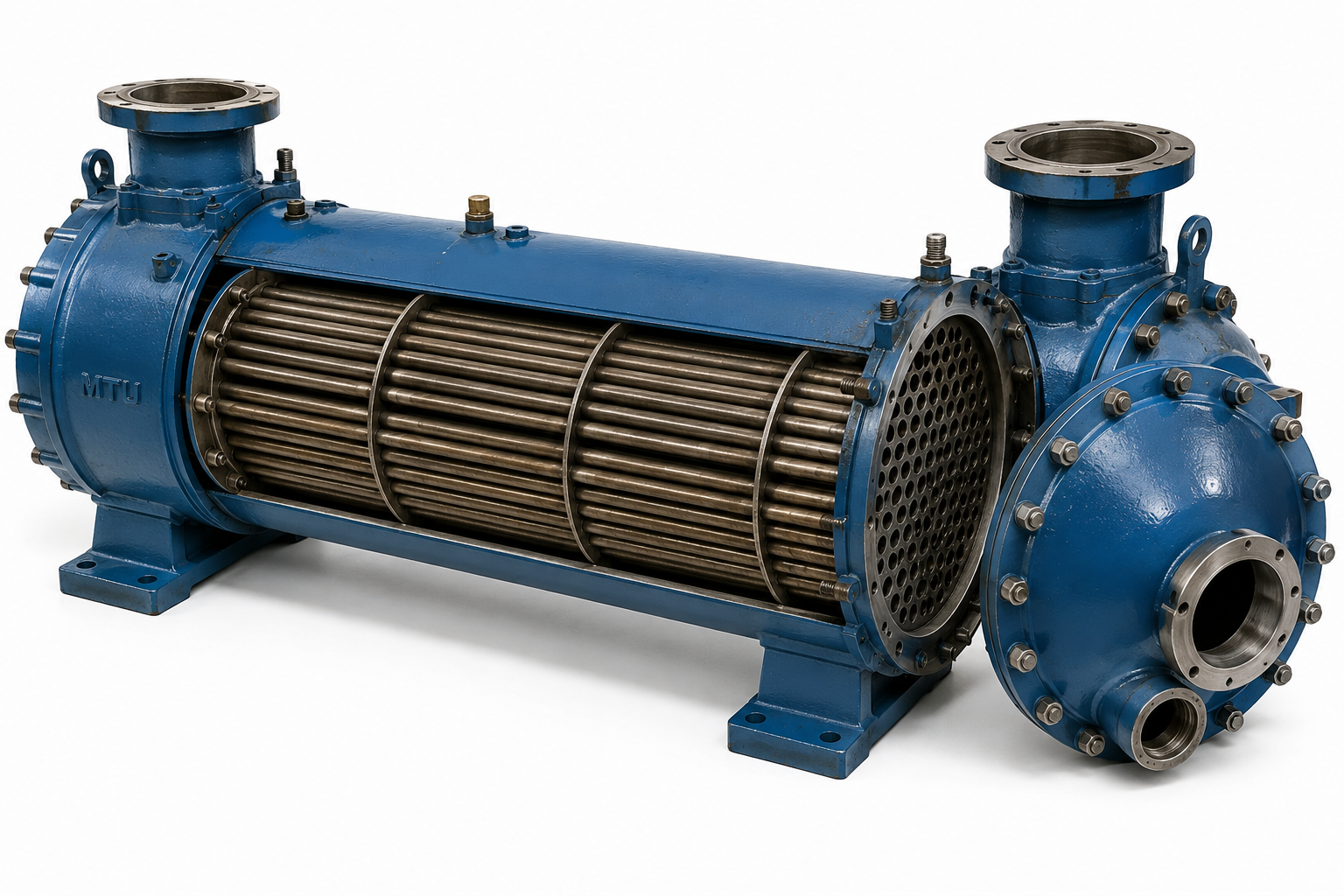
At the center of that cooling system is the heat exchanger—a component that quietly removes enormous amounts of heat every minute the engine is running.
Let's explore why this part deserves far more attention than it usually receives.
What Does a Heat Exchanger Do?
Think of the heat exchanger as the engine's radiator.
Unlike an automotive radiator that uses air, marine engines transfer heat from the freshwater cooling circuit into seawater.
Inside the heat exchanger, these two fluids flow through separate passages.
They never mix.
Instead, heat transfers through the metal tubes before the seawater carries it overboard.
This process allows the engine to maintain a safe operating temperature while protecting internal components from corrosive seawater.
Why Is Cooling So Important?
Every combustion cycle produces tremendous heat.
Without efficient cooling:
- Cylinder heads become too hot.
- Pistons expand excessively.
- Turbochargers operate at higher temperatures.
- Lubricating oil degrades faster.
- Engine efficiency decreases.
Cooling isn't simply about preventing overheating.
It's about maintaining the precise operating temperature the engine was designed to use.
Even small increases in temperature can gradually reduce engine life.
A Real Marine Engineering Story
A fast crew transfer vessel equipped with MTU 16V 2000 M72 engines began showing coolant temperatures approximately four degrees higher than normal whenever operating above 80% load.
No alarms were triggered.
The water pump had recently been replaced.
Thermostats were functioning correctly.
After investigating the cooling system, engineers removed the heat exchanger for inspection.
The freshwater side remained clean.
However, the seawater tubes contained marine growth, salt deposits, and small shell fragments that had gradually restricted water flow.
After professional cleaning, coolant temperatures immediately returned to their normal operating range.
The engine itself had never been the problem.
The restriction had slowly developed over months of operation.
How Does a Heat Exchanger Become Restricted?
Restrictions usually develop gradually.
Some of the most common causes include:
Marine Growth
Operating in warm coastal waters often allows marine organisms to attach inside seawater passages.
Even thin layers reduce heat transfer efficiency.
Salt Deposits
As seawater evaporates, minerals remain behind.
Over time these deposits reduce coolant flow and thermal efficiency.
Corrosion
Although marine heat exchangers are designed to resist corrosion, neglected maintenance or poor coolant quality can accelerate deterioration.
Debris
Small shells, sand, seaweed, and other debris entering through the seawater intake may partially block the tubes.
This is especially common after operating in shallow or heavily vegetated waters.
Poor Coolant Maintenance
Many engineers focus only on the seawater side.
However, contaminated freshwater coolant may also create scale and internal deposits.
Maintaining both cooling circuits is equally important.
Early Warning Signs
Heat exchanger problems usually appear gradually rather than suddenly.
Watch for:
- Higher coolant temperatures
- Increased exhaust temperatures
- Reduced engine performance
- Higher fuel consumption
- More frequent cooling fan or pump operation
- Temperature fluctuations
- Reduced cooling efficiency under heavy load
- Steam around the expansion tank
- Pressure changes within the cooling system
Trend monitoring often reveals these small changes long before an alarm activates.
Why Cleaning Matters More Than Replacement
One common misconception is that a heat exchanger should only receive attention after overheating occurs.
In reality, regular cleaning restores cooling efficiency and often prevents unnecessary replacement costs.
Scheduled cleaning removes:
- Marine growth
- Salt deposits
- Scale
- Rust particles
- Organic material
Preventive cleaning is significantly less expensive than repairing overheating damage.
Components That Should Be Inspected Together
Whenever servicing the heat exchanger, engineers should also inspect:
- Seawater pump
- Freshwater circulation pump
- Thermostats
- Charge air cooler
- Expansion tank
- Coolant quality
- Cooling hoses
- Hose clamps
- Temperature sensors
- Seawater strainers
A cooling system should always be viewed as one complete unit rather than individual components.
Can Oil Analysis Reveal Cooling Problems?
Surprisingly, yes.
Oil analysis may detect early signs of cooling system problems before visible engine damage occurs.
Laboratory testing can identify:
- Coolant contamination
- Sodium
- Potassium
- Water contamination
- Increased oxidation
- Reduced lubricant effectiveness
Combined with coolant analysis, oil testing provides valuable predictive maintenance information.
Preventive Maintenance Checklist
Following a consistent routine helps extend heat exchanger life.
✔ Inspect seawater strainers before every voyage.
✔ Monitor coolant temperatures during operation.
✔ Clean the heat exchanger according to the maintenance schedule.
✔ Replace coolant at the recommended intervals.
✔ Inspect hoses and clamps.
✔ Check for leaks around end covers.
✔ Monitor seawater flow.
✔ Perform regular oil analysis.
✔ Record operating temperatures.
✔ Investigate gradual temperature increases immediately.
Marine Engineer Tip
One of the easiest ways to detect a developing heat exchanger problem is by comparing engine temperatures from one season to the next.
If the same engine begins operating slightly hotter under identical conditions, don't assume it's simply warmer weather.
Small temperature increases often indicate that cooling efficiency is beginning to decline.
Common Maintenance Mistakes
Avoid these common errors:
- Waiting for overheating alarms before inspecting the heat exchanger.
- Ignoring seawater strainers.
- Using incorrect coolant.
- Cleaning only one side of the heat exchanger.
- Assuming every overheating problem is caused by the thermostat.
- Ignoring gradual increases in coolant temperature.
Frequently Asked Questions
How often should a marine heat exchanger be cleaned?
Cleaning frequency depends on water quality, operating hours, and environmental conditions. Vessels operating in warm or contaminated seawater generally require more frequent inspections.
Can a dirty heat exchanger increase fuel consumption?
Yes. Reduced cooling efficiency causes higher operating temperatures, which can reduce combustion efficiency and increase fuel usage.
Does the heat exchanger use seawater directly inside the engine?
No. The freshwater cooling circuit remains separate from the seawater circuit. Heat transfers through the exchanger without the fluids mixing.
What causes marine growth inside the heat exchanger?
Marine organisms, shell fragments, algae, and mineral deposits gradually accumulate during normal vessel operation.
Can overheating damage the turbocharger?
Yes. Higher engine temperatures place additional thermal stress on the turbocharger and other engine components.
Worldwide Marine Engine Spare Parts Supply
Alfa Marine Spare Parts supplies genuine, OEM, aftermarket, remanufactured, and reconditioned spare parts for the MTU 16V 2000 M72 and the complete MTU Series 2000 engine family.
We proudly support:
- Commercial shipping companies
- Luxury yacht operators
- Offshore support vessels
- Shipyards
- Marine engineers
- Chief engineers
- Technical superintendents
- Government fleets
- Fishing fleets
- Marine repair companies
We regularly ship marine engine spare parts worldwide to the United Kingdom, United States, Dubai (UAE), Monaco, Nigeria, the Netherlands, Italy, Spain, France, Germany, Norway, and Greece, helping customers keep their vessels operating safely and efficiently.
Browse Our Complete Spare Parts Catalog
Alfa Marine Spare Parts offers a complete range of cooling system components for MTU Series 2000 engines, including:
- Heat exchangers
- Charge air coolers
- Seawater pumps
- Freshwater pumps
- Thermostats
- Water pumps
- Cooling hoses
- Expansion tanks
- Temperature sensors
- Turbochargers
- Oil coolers
- Complete overhaul kits
Browse our complete catalog:
https://alfamarinespareparts.com/spareparts
Why Choose Alfa Marine Spare Parts?
Cooling system reliability begins with quality components and expert support. At Alfa Marine Spare Parts, we help marine professionals source the correct parts for planned maintenance, emergency repairs, and complete engine overhauls.
We offer:
- Genuine, OEM, aftermarket, remanufactured, and reconditioned spare parts
- Worldwide shipping
- Technical assistance with part identification
- Fast quotations and responsive customer service
- Parts for MTU, Caterpillar, Wärtsilä, Cummins, MAN, Volvo Penta, Scania, Detroit Diesel, Perkins, Yanmar, and many other marine engine brands
Whether you manage a commercial fleet or maintain a single yacht, we're committed to helping keep your engines running reliably.
Contact Alfa Marine Spare Parts
Need assistance finding the correct MTU 16V 2000 M72 heat exchanger or cooling system components?
Website: https://alfamarinespareparts.com
Email: request@alfamarinespareparts.com
Our experienced marine parts specialists are ready to assist you with maintenance planning, spare parts identification, and worldwide delivery.
Conclusion
The heat exchanger is one of the most overlooked yet essential components on the MTU 16V 2000 M72 marine engine. While it operates quietly in the background, its ability to remove heat directly influences engine efficiency, fuel economy, and long-term reliability. Most heat exchanger problems develop slowly through marine growth, salt deposits, corrosion, or neglected maintenance rather than sudden failure. By monitoring engine temperatures, maintaining clean cooling circuits, inspecting related components, and following a preventive maintenance schedule, marine engineers can avoid overheating, reduce downtime, and help ensure their MTU engines continue delivering dependable performance for thousands of operating hours.