Caterpillar Marine Engine Types: What Is the Difference, and Which Engine Belongs in Which Vessel?
Ask ten marine engineers to name a Caterpillar marine engine and you might get ten different answers.
One engineer may immediately say:
“3208.”
Another may think of the 3412.
A yacht engineer may be more familiar with the C18 or C32.
A tugboat superintendent may think of the 3512C or 3516C.
And someone working around large ferries, offshore vessels or high-power installations might be dealing with a 3600 Series or C280.
They are all Caterpillar marine engines, but they were designed for very different jobs.
Caterpillar's marine range itself is divided across commercial propulsion, high-performance propulsion, auxiliary engines and marine generator sets, which is a good reminder that there is no single “best Cat marine engine.” The correct engine depends on what the vessel actually has to do.
So rather than simply listing model numbers, let's look at the Caterpillar marine engine families the way an engineer or vessel owner might:
What makes each one different?
Where are they commonly found?
Which engines make sense for yachts, fishing boats, tugs, ferries, generators or offshore vessels?
First: Caterpillar Marine Engines Fall Into Different Generations
One of the easiest mistakes is to think Caterpillar's marine range simply became larger over time.
It is more complicated than that.
The installed marine fleet includes older engines such as:
- Caterpillar 3208
- Caterpillar 3406
- Caterpillar 3408
- Caterpillar 3412
Later electronically controlled engines include families such as:
- Caterpillar C9
- Caterpillar C15
- Caterpillar C18
- Caterpillar C32
Current smaller marine products also include engines such as:
- Caterpillar C4.4
- Caterpillar C7.1
- Caterpillar C9.3
And when considerably more power is needed, Caterpillar has large-engine families such as:
- Caterpillar 3508
- Caterpillar 3512
- Caterpillar 3516
- Caterpillar 3606
- Caterpillar 3608
- Caterpillar 3612
- Caterpillar 3616
- Caterpillar 3618
- Caterpillar C280-6
- Caterpillar C280-8
- Caterpillar C280-12
- Caterpillar C280-16
Caterpillar's current marine overhaul program still lists support solutions for many of the older large engines—including 3406, 3408 and 3412—alongside C18, C32, 3500, 3600 and C280 engines.
That tells us something important:
Old does not necessarily mean irrelevant in the marine world.
Caterpillar 3208: The Compact Old-School Marine Engine
If there is one Caterpillar engine that many boat owners immediately recognize, it is the 3208.
Caterpillar still maintains a dedicated 3208 Marine Engine equipment and parts section, even though this is very much a legacy engine today.
What Kind of Engine Is the 3208?
The 3208 is a compact V8 diesel that became very common in older marine installations.
Its appeal was relatively straightforward:
compact size + respectable power + simple mechanical engineering.
That made it attractive for boats where engine-room space mattered.
Where Might You Find a Caterpillar 3208?
Typical installed-fleet examples include:
- Older motor yachts
- Sportfishing boats
- Small commercial boats
- Fishing vessels
- Patrol-type craft
- Marine generator applications
The 3208 was also used outside marine service, which is another reason there is still a broad replacement-parts market around the engine.
Who Still Likes the 3208?
Owners who value:
- Mechanical simplicity
- Familiarity
- Relatively straightforward servicing
- Large used and rebuilt parts market
But there is a catch.
A 3208 installation is now generally an older installation.
Condition and maintenance history can matter more than the badge on the valve cover.
Caterpillar 3406: The Inline-Six Workhorse
The Caterpillar 3406 marine engine takes a different approach.
Instead of a compact V8, the 3406 is associated with the classic heavy-duty inline-six Caterpillar architecture.
Caterpillar still provides marine parts resources for the 3406 and 3406E, and its current marine overhaul program includes the 3406 family.
Why Do Engineers Like Inline-Six Engines?
An inline-six has some practical characteristics marine engineers often appreciate:
- Straightforward cylinder-bank access
- One cylinder bank rather than two
- Long, familiar heavy-duty architecture
- Good suitability for continuous commercial service
Where Does a 3406 Make Sense?
Installed examples can include:
- Fishing vessels
- Workboats
- Small commercial vessels
- Tugs
- Auxiliary applications
- Older heavy-duty marine propulsion installations
Compared with a 3208, the 3406 generally feels more like a commercial workhorse than a compact yacht engine.
3406 vs. 3208: What Is the Practical Difference?
Think about it this way:
⚓ CAT 3208
Character: Compact V8
Strength: Fits tighter installations
Typical personality: Older yacht, fishing and lighter commercial applications
⚓ CAT 3406
Character: Heavy-duty inline six
Strength: Commercial work and continuous-service heritage
Typical personality: Fishing vessel, workboat or heavier marine installation
Neither is automatically better.
A boat originally designed around a compact V8 may not be a natural candidate for a much longer inline-six engine.
Caterpillar 3408: When the Boat Needs More Muscle
The Caterpillar 3408 moves into V8 heavy-duty territory.
Unlike the smaller 3208, the 3408 is a substantially more serious engine family.
Caterpillar continues to maintain an official 3408 Marine Engine equipment dashboard, parts resources and marine overhaul solutions for the engine.
What Kind of Vessel Uses a 3408?
Common installed applications can include:
- Commercial fishing vessels
- Tugboats
- Workboats
- Offshore support craft
- Larger yachts
- Heavy auxiliary installations
The 3408 is the sort of engine where seawater pumps, turbochargers, cylinder heads, fuel nozzles and major overhaul parts become substantial maintenance items.
Caterpillar even continues to offer reman seawater-pump solutions for 3408/3412 applications.
Caterpillar 3412: One of the Classic Big Marine Cats
The 3412 is one of the most recognizable older Caterpillar marine engines.
It is a larger V12 relative within the classic 3400 family.
Caterpillar maintains a dedicated 3412 Marine Engine parts and manuals platform today.
Where Does a 3412 Fit?
A 3412 makes sense where the vessel requires considerably more power than smaller Caterpillar engines can provide.
Typical installed-fleet applications include:
- Large fishing vessels
- Workboats
- Tugboats
- Offshore vessels
- Commercial craft
- Large yachts
- Generator and auxiliary applications
Why Does the 3412 Still Matter?
Because there are still many working engines.
A well-maintained 3412 may continue working long after newer engine generations have entered the market.
That is also why components such as:
- Raw-water pumps
- Water-cooled exhaust manifolds
- Cylinder heads
- Turbochargers
- Fuel-system parts
- Pistons
- Liners
- Bearings
remain relevant to the marine spare-parts industry.
Caterpillar 3408 vs. 3412
The simplest distinction is:
3408 → V8
3412 → V12
More cylinders generally mean the ability to deliver more total output—but they also mean:
- More injectors
- More pistons
- More liners
- More valves
- More cylinder-head components
- More bearings
- More overhaul parts
So when a fleet manager moves from a 3408 to a 3412, the engine is not just more powerful.
The maintenance project gets larger too.
Caterpillar C9: Moving Into Electronic Control
The C9 Marine Engine represents a later generation than the classic 3208/3400 families.
Caterpillar still maintains dedicated marine parts and manuals resources for the C9.
What Changed?
Compared with older mechanical Caterpillar engines, the C-Series brought increasing use of:
- Electronic engine control
- More sophisticated fuel injection
- Electronic diagnostics
- Sensors and monitoring
This changes the mechanic's job.
With an older mechanical diesel, troubleshooting may rely heavily on:
- Pressure
- Temperature
- Smoke
- Mechanical adjustment
- Hands-on inspection
With an electronically controlled engine, you add:
- Fault codes
- Sensor data
- Wiring
- ECM diagnostics
Where Does a C9 Fit?
The C9 has been used in marine propulsion where relatively compact commercial power was needed.
It can be found in:
- Fishing craft
- Workboats
- Patrol craft
- Harbor craft
- Other medium-sized commercial vessels
Caterpillar C15: Heavy-Duty Inline-Six Marine Power
The C15 Marine Engine is another Caterpillar engine with significant marine service history, and Caterpillar still maintains dedicated C15 Marine parts and resource pages.
The C15 can be thought of as a substantial inline-six engine suited to applications requiring more power and durability than the smaller C-Series engines.
Where Does the C15 Fit?
Typical applications can include:
- Commercial fishing vessels
- Workboats
- Offshore-support vessels
- Tug-type applications
- Marine auxiliary installations
The C15 sits in an interesting position:
It offers significant commercial-duty capability without moving into the size and complexity of a V12 C32 or 3500 Series engine.
Caterpillar C18: One of the Most Versatile Modern Marine Cat Engines
The C18 is particularly interesting because Caterpillar uses the platform across multiple marine roles.
Current Caterpillar information lists the C18 commercial propulsion engine at 454–803 bhp, while a separate high-performance version is offered for recreational marine propulsion. Caterpillar also uses C18-based marine auxiliary and generator configurations.
That makes the C18 one of the easier engines to explain to a boat owner:
It can work hard commercially, but it can also work very well in a yacht.
Which Boats Suit a Caterpillar C18?
Depending on rating and configuration:
- Motor yachts
- Sportfishing boats
- Commercial fishing vessels
- Fast workboats
- Patrol craft
- Offshore vessels
- Auxiliary installations
- Marine generators
Caterpillar specifically describes the commercial C18 as suitable across applications “from fishing to offshore,” while its high-performance line targets recreational propulsion.
That flexibility is one reason the C18 has such a strong marine presence.
Caterpillar C32: When a C18 Is Not Enough
The C32 marine engine moves significantly upward in power.
It is a V12 and remains an important current Caterpillar marine propulsion platform.
Caterpillar's current C32 commercial propulsion engine is offered across multiple ratings and emissions configurations. The engine uses separate-circuit aftercooling for A–C ratings and seawater aftercooling for D–E ratings.
That detail alone shows why simply saying:
“C32 marine engine”
doesn't completely describe the installation.
Where Does the Caterpillar C32 Fit?
The C32 is at home in applications such as:
- Larger yachts
- Sportfishing vessels
- Fast commercial craft
- Patrol vessels
- Ferry applications
- Workboats
- Offshore vessels
- Marine generator installations
Caterpillar also offers a C32 marine generator set, using SCAC across those generator configurations.
C18 vs. C32: Which One Makes More Sense?
⚓ CATERPILLAR C18
Configuration: Inline six
Character: Compact high-output marine engine
Good fit: Yachts, fishing vessels, workboats, auxiliary applications
Why choose it: Strong power without moving to a large V-engine package
⚓ CATERPILLAR C32
Configuration: V12
Character: Higher-output propulsion platform
Good fit: Larger yachts, commercial craft, patrol vessels, higher-power applications
Why choose it: Much more output where space and vessel design support the larger engine
The important point isn't that the C32 is “better.”
The C32 is simply a different tool.
Caterpillar C4.4: Compact Marine Auxiliary and Generator Power
Not every Cat marine engine is supposed to turn a propeller on a large commercial vessel.
The C4.4 is a good example.
Caterpillar currently offers the C4.4 as a marine generator set, with configurations for commercial and pleasure-craft applications. Current generator ratings span roughly 36–99 ekW depending on frequency and cooling configuration.
Where Does a C4.4 Make Sense?
- Onboard generator
- Auxiliary power
- Smaller commercial vessel
- Yacht genset
- Workboat electrical system
So when someone says:
“I have a Caterpillar engine in my yacht.”
it might not be the propulsion engine at all.
It could be the generator.
Caterpillar C7.1: Compact Propulsion and Generator Applications
The C7.1 bridges the gap between small auxiliary engines and more substantial propulsion engines.
Caterpillar currently offers the C7.1 as a commercial propulsion engine at 280–425 bhp, and also offers a marine generator version around 100–200 ekW.
What Kind of Boat Suits a C7.1?
Depending on rating:
- Small workboats
- Patrol craft
- Fishing vessels
- Utility boats
- Small passenger craft
- Auxiliary/generator applications
It offers modern marine power without the installation size of a C18.
Caterpillar C9.3: Modern Mid-Range Marine Power
The C9.3 is a newer platform than the legacy C9.
It should not be treated as though the two names are interchangeable.
Caterpillar currently offers a C9.3 marine generator set producing roughly 200–300 ekW, using electronic controls and common-rail fuel injection.
The move to common rail tells you immediately what kind of engine generation you are dealing with.
Compared with older mechanical Caterpillars, the maintenance and troubleshooting world increasingly includes:
- High-pressure common-rail components
- Electronic controls
- Sensors
- Diagnostic data
What About the Caterpillar 3500 Series?
Now we are entering true heavy-duty commercial marine territory.
The core family includes:
- 3508
- 3512
- 3516
and later generations such as:
- 3512C
- 3512E
- 3516C
- 3516E
Caterpillar's current marine overhaul support covers the 3508, 3512 and 3516, while current propulsion offerings include newer 3512C/E and 3516C/E variants.
Caterpillar 3508: The V8 Heavy-Duty Option
The 3508 is the eight-cylinder member of the 3500 family.
Think of it as part of a modular progression:
3508 → V8
3512 → V12
3516 → V16
These engines are not the sort of propulsion units you typically squeeze under the salon floor of a small pleasure boat.
They belong naturally in serious commercial-duty installations.
Caterpillar 3512: A Very Popular Heavy Marine Layout
The 3512 has a strong history in commercial marine service.
Modern versions include the 3512C and 3512E.
Caterpillar describes the current 3512C as suited to demanding applications such as tugs, government vessels and other workboats.
The 3512E brings newer emissions technology, with Caterpillar currently offering ratings compliant with U.S. EPA Tier 4 and IMO II/III requirements.
Where Does a 3512 Make Sense?
- Tugboats
- Large fishing vessels
- Offshore-support vessels
- Government vessels
- Large commercial workboats
- Larger displacement vessels
- Heavy auxiliary power
This is a very different world from a C7.1-powered small utility boat.
Caterpillar 3516: More Cylinders, More Power, Bigger Project
The 3516 is the 16-cylinder member of the family.
Caterpillar currently offers the 3516C with a broad commercial propulsion range, and specifically describes it for demanding applications including tugs, government vessels and workboats.
The newer 3516E adds current emissions-compliant options for commercial marine propulsion.
Why Does Cylinder Count Matter to Maintenance?
Compare a 3508 and 3516.
The 3516 has twice as many cylinders.
That means a major overhaul can potentially involve twice as many:
- Pistons
- Liners
- Connecting rods
- Injectors
- Cylinder positions
- Valve sets
So increasing power can also dramatically increase the size of the maintenance project.
Caterpillar 3600 Series: Large Marine Engine Territory
The Caterpillar 3600 family moves beyond the 3500 into a class designed for very substantial industrial and marine installations.
Important marine members include:
- 3606
- 3608
- 3612
- 3616
- 3618
Caterpillar's current marine overhaul program continues to support all five of these families.
How Are They Arranged?
A useful way to remember them:
3606 → inline six
3608 → inline eight
3612 → V12
3616 → V16
3618 → V18 marine engine
These are large, comparatively slower-speed, heavy-duty engines compared with the compact high-speed C-Series used in yachts and smaller workboats.
Which Vessels Suit the 3600 Series?
Think:
- Large offshore vessels
- Ferries
- Large commercial vessels
- Heavy-duty propulsion
- Large generator installations
- Specialized marine applications
A 3600 is not simply a bigger C18.
It belongs to a completely different installation and lifecycle philosophy.
Maintenance planning may include very substantial top-end and major-overhaul work involving:
- Cylinder heads
- Unit injectors
- Pistons
- Cylinder liners
- Main bearings
- Connecting-rod bearings
- Camshaft components
- Turbochargers
- Large pumps
- Cooling-system components
Caterpillar C280: When You Need Serious Megawatt Power
At the upper end of Caterpillar's marine diesel range sits the C280 family.
Important versions include:
- C280-6
- C280-8
- C280-12
- C280-16
Caterpillar's overhaul program explicitly includes all four.
The current C280-6 alone is offered at approximately 5,420–8,000 bkW at 900–1,000 rpm, illustrating just how far this family sits above ordinary yacht and workboat engines.
Caterpillar says today's C280 range reaches up to roughly 8 MW while emphasizing its high power-to-weight ratio.
What Kind of Vessel Uses a C280?
Think:
- Large ferries
- Naval/government vessels
- Offshore vessels
- Large commercial ships
- Specialized high-power craft
- Large generator/power installations
A C280 engine decision is much closer to ship engineering than recreational boat engine selection.
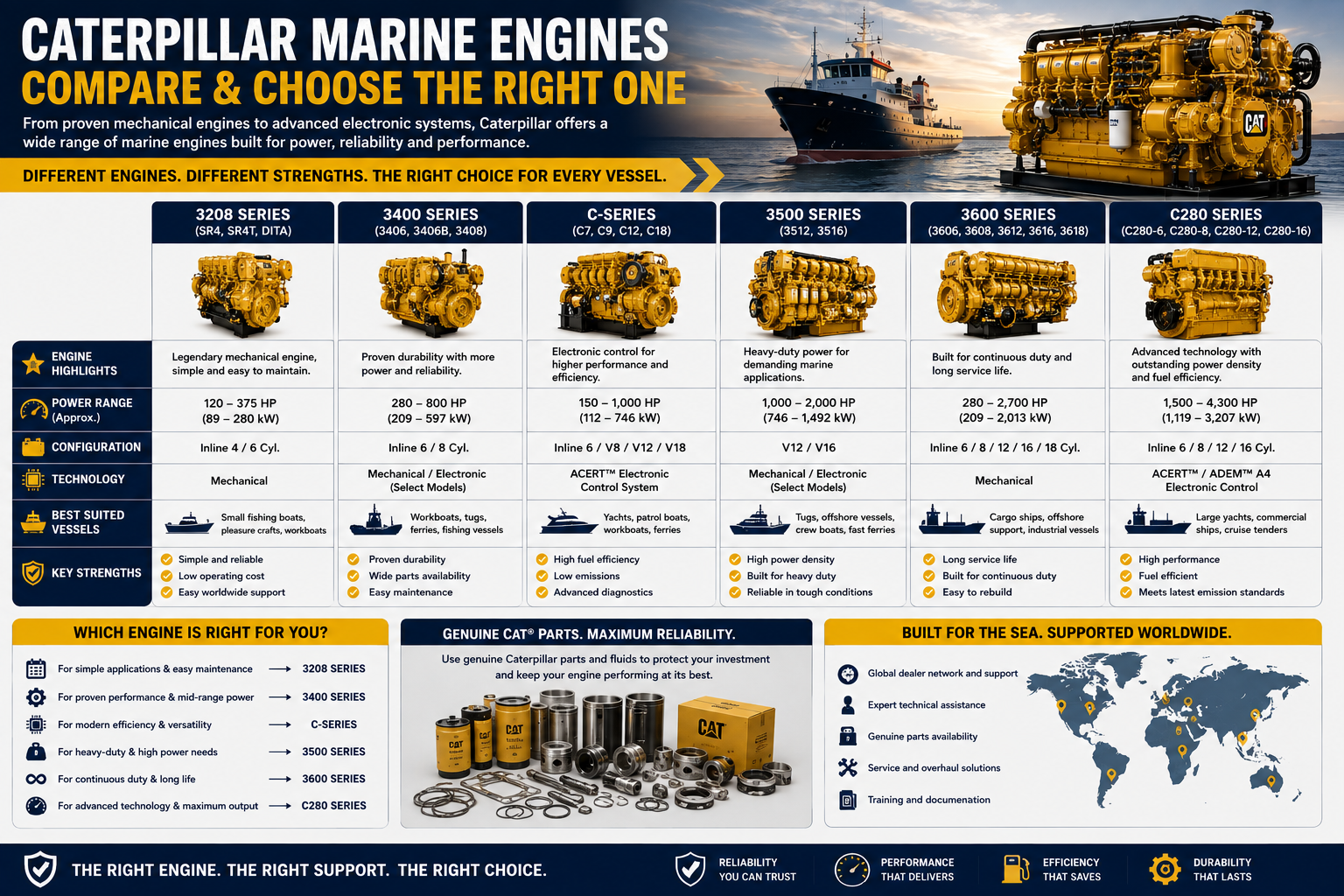
Quick Caterpillar Marine Engine Comparison
⚓ WHICH CAT ENGINE FITS WHICH KIND OF JOB?
| Engine FamilyGeneral CharacterTypical Marine Fit | ||
| 3208 | Compact legacy mechanical V8 | Older yachts, fishing boats, small commercial craft |
| 3406 / 3406E | Heavy-duty inline six | Fishing vessels, workboats, commercial propulsion |
| 3408 | Larger legacy V8 | Workboats, fishing vessels, offshore craft |
| 3412 | Large legacy V12 | Tugs, fishing vessels, offshore craft, larger yachts |
| C4.4 | Compact modern auxiliary engine | Yacht and commercial generators |
| C7.1 | Compact modern propulsion/genset | Small workboats, utility craft, generators |
| C9 / C9.3 | Mid-range electronic power | Workboats, patrol craft, gensets |
| C15 | Heavy inline-six | Commercial workboats and fishing vessels |
| C18 | High-output versatile inline-six | Yachts, sportfishers, commercial craft, auxiliary |
| C32 | High-output V12 | Larger yachts, patrol boats, commercial high-speed craft |
| 3508 | Heavy-duty V8 | Large commercial marine |
| 3512 | Heavy-duty V12 | Tugs, offshore, fishing and government vessels |
| 3516 | Heavy-duty V16 | Large tugs, workboats and commercial vessels |
| 3600 Series | Large heavy-duty engine platform | Ferries, offshore and major commercial vessels |
| C280 | Megawatt-class propulsion | Large commercial, government and specialized vessels |
This is best read as an application guide, not an interchangeability chart. Exact engine selection depends on rating, vessel resistance, gearbox, propeller, duty cycle and installation requirements.
Which Caterpillar Engine Makes Sense for a Yacht?
For a yacht, you normally care about:
- Power-to-weight ratio
- Engine-room size
- Noise
- Smooth acceleration
- Cruise performance
- Reliability
- Service support
Caterpillar specifically markets its high-performance propulsion engines toward yachting and sportfishing, and the current C18 has a dedicated high-performance recreational version.
For larger yachts, the C32 can also become relevant.
Older yachts may still operate:
- 3208
- 3408
- 3412
- C15
- C18
The “best” engine is usually the engine around which the vessel was correctly designed and that is being properly maintained.
Which Caterpillar Engine Makes Sense for a Fishing Vessel?
Fishing boats place very different demands on an engine.
They may require:
- Long operating hours
- Strong continuous-duty performance
- Good low-speed torque
- Simple maintenance
- Reliable cooling
- Easy access to parts
Depending on vessel size and generation, fishing fleets may use engines ranging from:
3208 / 3406
through
C18 / C32
and into
3512 / 3516 territory.
Caterpillar explicitly identifies the C18 commercial engine for fishing-to-offshore applications, while the 3512/3516 class is suited to substantially heavier working vessels.
Which Caterpillar Engine Makes Sense for a Tugboat?
Tugs are demanding.
They frequently require:
- High torque
- Rapid load changes
- Heavy-duty construction
- Long service life
- Commercial-duty ratings
This is where larger families become attractive.
Strong candidates depending on vessel size include:
- C32
- 3512C
- 3512E
- 3516C
- 3516E
Caterpillar explicitly positions the 3512C and 3516C for tug and other workboat applications.
Which Caterpillar Engine Makes Sense for an Offshore Vessel?
Offshore vessels often accumulate enormous annual hours.
That changes engine selection.
The question becomes less:
“Which engine has the highest horsepower?”
and more:
“Which engine can provide this output reliably for the required duty cycle?”
Depending on vessel scale, relevant families can include:
- C18
- C32
- 3500
- 3600
- C280
Caterpillar specifically describes the C18 as covering applications from fishing through offshore service.
Which Caterpillar Engine Makes Sense for a Marine Generator?
Here the engine may not drive the propeller at all.
Its job is to keep the vessel alive electrically.
Current Caterpillar marine generator offerings include models based on:
- C4.4
- C7.1
- C9.3
- C18
- C32
- Larger engine platforms
Caterpillar's current marine generator portfolio spans multiple power levels and is designed for commercial and recreational vessel applications.
Mechanical Caterpillar vs. Electronic Caterpillar
This is one of the biggest differences an owner notices when moving between generations.
Older Mechanical Engines
Examples include many configurations of:
- 3208
- 3406
- 3408
- 3412
The mechanic often works directly with:
- Mechanical injection
- Governor adjustment
- Fuel pressure
- Valve adjustment
- Turbocharger condition
- Cooling
- Compression
- Smoke and temperature
Later Electronic Engines
Examples include:
- C9
- C15
- C18
- C32
- Newer 3500 variants
Now diagnostics increasingly involve:
- ECMs
- Sensors
- Wiring
- Fault codes
- Electronic injectors
- Data logging
Modern Common-Rail / Emissions-Control Engines
Newer Caterpillar configurations can add:
- Common-rail injection
- More sophisticated control
- SCR/aftertreatment where required
- Additional sensors
- Emissions-system components
The current C9.3 marine genset, for example, uses common-rail injection, while the 3512E and 3516E families incorporate newer emissions-compliant configurations.
Which One Is Easier to Repair?
An older mechanical Cat may be easier to troubleshoot with traditional workshop skills.
A newer electronic Cat can give you far more diagnostic information.
So the real tradeoff is:
Older engine: fewer electronics, more mechanical diagnosis.
Newer engine: more diagnostics, better electronic monitoring, but greater dependence on sensors, control systems and specialized tools.
For a remote fishing vessel, simplicity may be extremely valuable.
For a modern yacht or commercial fleet with good technical support, electronic diagnostics may be a major advantage.
Why You Should Never Choose a Marine Engine by Horsepower Alone
Suppose a vessel currently has a 700 hp engine.
You find another Caterpillar engine producing approximately 700 hp.
Can you install it?
Not necessarily.
You must also consider:
- Rated engine speed
- Continuous/intermittent duty
- Gearbox ratio
- Propeller curve
- Engine dimensions
- Weight
- Mounting points
- Exhaust arrangement
- Cooling capacity
- Fuel supply
- Electrical system
- Electronic controls
- Classification requirements
A 700 hp yacht engine and a 700 hp continuous-duty commercial engine may have very different intended operating lives.
The Importance of Engine Rating
This is one of the most misunderstood areas of marine engine selection.
An engine can be offered at different ratings depending on how it will be operated.
A fast yacht may use very high output for comparatively short periods.
A commercial vessel may run thousands of hours near significant load.
Those are different jobs.
For example, Caterpillar offers the C32 across multiple rating classes, and even its aftercooling arrangement changes between A–C and D–E ratings.
So asking:
“How much horsepower does a C32 make?”
is not enough.
Ask:
“Which C32 rating?”
Marine Engineer Tip
⚙️ DON'T ASK ONLY: “WHICH CAT ENGINE?”
Also ask:
Which model?
Which serial number?
Which arrangement number?
Which rating?
Propulsion or generator?
Commercial or recreational duty?
Which cooling system?
How many operating hours per year?
Those answers often matter more than the family name.
Caterpillar itself encourages identifying parts using the engine or equipment serial number through its Parts Store diagrams.
Classic Caterpillar vs. Modern Caterpillar: Which Would You Choose?
Imagine two vessels.
Vessel A
An older fishing boat operating far from a major port.
The crew knows mechanical engines well.
Electronics support is limited.
A mechanically simple 3406 or 3412 may be attractive because the crew understands it.
Vessel B
A modern high-speed commercial vessel.
The operator values:
- Electronic monitoring
- Efficient fuel control
- Emissions compliance
- Advanced diagnostics
- Fleet data
A modern C-Series, 3500 E-generation or other newer platform may make more sense.
Neither approach is automatically correct.
The vessel decides.
Caterpillar Marine Engines and Their “Personality”
If we humanize the families a little:
🟨 3208
The compact veteran.
Small enough to fit where bigger engines cannot, familiar to generations of boat mechanics.
🟨 3406
The workhorse.
Straight-six commercial diesel thinking: straightforward and built around doing a job.
🟨 3408
The muscular old-school V8.
More serious commercial power while retaining classic Caterpillar mechanical character.
🟨 3412
The classic big Cat.
A V12 familiar to fishing, offshore, workboat and yacht engineers around the world.
🟨 C18
The all-rounder.
Small enough for many yacht installations, serious enough for commercial work.
🟨 C32
The high-performance V12.
When the vessel requires substantially more power without moving into medium-speed ship-engine territory.
🟨 3512 / 3516
The commercial heavyweights.
Tugboat, government and serious workboat territory.
🟨 3600
The ship engineer's Cat.
Big engines, major maintenance projects and long lifecycle planning.
🟨 C280
The megawatt machine.
When the conversation has moved beyond horsepower and into megawatts.
Which Caterpillar Marine Engine Is “Best”?
The answer is:
the one correctly matched to the vessel.
If you want a compact generator, a 3516 makes no sense.
If you are powering a major commercial vessel, a C4.4 is obviously not your propulsion answer.
If you own an older fishing boat and already have a well-maintained 3406, replacing it simply because a newer engine exists may not automatically be the best economic decision.
Engine selection is always a combination of:
power + duty + installation + maintenance + availability + economics.
Common Caterpillar Marine Spare Parts by Family
Legacy 3208 / 3400 Engines
Common requests include:
- Fuel injectors/nozzles
- Injection pumps
- Turbochargers
- Raw-water pumps
- Freshwater pumps
- Heat exchangers
- Water-cooled exhaust manifolds
- Cylinder heads
- Pistons
- Piston rings
- Liners
- Main bearings
- Connecting-rod bearings
- Gaskets and seals
- Overhaul kits
Caterpillar continues to provide marine parts and overhaul support for several of these legacy families.
C-Series Engines
Typical requirements include:
- Electronic fuel injectors
- Fuel filters
- Oil filters
- Turbochargers
- Seawater pumps
- Freshwater pumps
- Aftercoolers
- Heat exchangers
- Sensors
- ECM-related components
- Cylinder heads
- Pistons and liners
- Bearings
- Gasket sets
3500 / 3600 / C280
Major maintenance can involve:
- Complete cylinder heads
- Unit injectors
- Turbochargers
- Pistons
- Cylinder liners
- Connecting rods
- Main bearings
- Rod bearings
- Camshafts
- Crankshaft components
- Large oil pumps
- Cooling pumps
- Oil coolers
- Aftercoolers
- Exhaust-system components
- Complete top-end and major-overhaul packages
Caterpillar's current marine overhaul program specifically supports numerous engines across these large families.
Frequently Asked Questions
What are the main Caterpillar marine engine families?
The installed fleet spans legacy engines such as the 3208, 3406, 3408 and 3412, later C-Series engines including C9, C15, C18 and C32, heavy-duty 3500 and 3600 families, and the large C280 range. Caterpillar currently supports many of these older and larger models through its marine parts and overhaul programs.
What Caterpillar engine is good for a yacht?
The answer depends on yacht size and performance requirements. Caterpillar currently offers high-performance marine propulsion specifically for yachting and sportfishing, including the C18 platform.
What Caterpillar engine is good for a tugboat?
Depending on tug size and duty, engines such as the C32, 3512C or 3516C may be relevant. Caterpillar specifically identifies the 3512C and 3516C for tug and heavy workboat applications.
What is the difference between a C18 and C32?
The C18 is an inline-six platform suited to a broad range of commercial and recreational uses. The C32 is a larger V12 platform designed for considerably higher outputs and multiple commercial rating classes.
Is the 3208 still supported for parts?
Caterpillar currently maintains a dedicated 3208 Marine Engine equipment and parts catalog in its Parts Store.
Are 3408 and 3412 marine engines still relevant?
Yes. Caterpillar continues to provide official parts resources for both and includes them in its marine engine overhaul solutions.
What is the difference between the Caterpillar C9 and C9.3?
They are different engine generations and should not be treated as interchangeable. Caterpillar maintains a legacy C9 Marine Engine parts platform, while newer C9.3 marine products use modern electronic/common-rail technology.
What are the largest Caterpillar marine diesel engines?
The large end of Caterpillar's marine portfolio includes the 3600 Series and C280 family. The current C280 range reaches megawatt-class outputs, with the C280-6 alone offered up to 8,000 bkW.
Caterpillar Marine Engine Spare Parts
Alfa Marine Spare Parts can assist marine customers sourcing parts for Caterpillar engine families including:
3208 • 3406 • 3408 • 3412 • C4.4 • C7.1 • C9 • C9.3 • C15 • C18 • C32 • 3500 Series • 3600 Series • C280 Series
Depending on the engine and availability, requirements may include:
- Oil filters
- Fuel filters
- Air filters
- Fuel injectors
- Injection pumps
- High-pressure pumps
- Turbochargers
- Raw-water pumps
- Freshwater pumps
- Heat exchangers
- Aftercoolers
- Water-cooled exhaust manifolds
- Cylinder heads
- Pistons
- Piston rings
- Cylinder liners
- Connecting rods
- Main bearings
- Connecting-rod bearings
- Crankshafts
- Camshafts
- Sensors
- Electronic components
- Gaskets
- O-rings
- Overhaul kits
Why Accurate Caterpillar Engine Identification Matters
A request saying:
“Need a CAT water pump.”
is almost impossible to quote accurately.
Even:
“Need a Caterpillar 3412 water pump.”
may require more information.
Caterpillar's own parts system asks users to identify equipment using the engine serial number so it can show compatible parts diagrams.
For a good inquiry, provide:
Engine model: Caterpillar 3412 Marine
Serial number: __________
Arrangement number: __________
Existing part number: __________
Quantity: __________
Photos: Recommended
That is particularly important with legacy engines where several arrangements may exist.
Why Choose Alfa Marine Spare Parts?
The marine market contains Caterpillar engines from several generations operating side by side.
One customer may need a 3208 seawater-pump component for an older yacht.
Another may require C18 injectors.
A tug operator may need a 3516C cylinder-head component.
An offshore customer may be preparing a 3600 top-end overhaul.
Alfa Marine Spare Parts assists shipyards, marine engineers, technical superintendents, fleet managers, boat owners and marine service companies with sourcing genuine, OEM, aftermarket, remanufactured and reconditioned Caterpillar marine engine components, depending on the engine and availability.
The goal is not simply to search by the word “Caterpillar.”
It is to identify the exact engine, configuration and component before anything is shipped.
Worldwide Caterpillar Marine Spare Parts Supply
Alfa Marine Spare Parts supports:
- Shipyards
- Ship repairers
- Marine engineers
- Chief engineers
- Technical superintendents
- Yacht managers
- Fleet operators
- Fishing companies
- Tug operators
- Offshore companies
- Government fleets
- Maritime contractors
- Marine service companies
- Boat builders
- Marine equipment distributors
Browse Our Complete Catalog
Website:
https://alfamarinespareparts.com
Marine Spare Parts Catalog:
https://alfamarinespareparts.com/spareparts
For Caterpillar parts inquiries, provide the engine model, serial number, arrangement number and current component number whenever possible.
Contact Alfa Marine Spare Parts
Email: request@alfamarinespareparts.com
Contact Alfa Marine Spare Parts for Caterpillar marine engine filters, injectors, pumps, turbochargers, heat exchangers, cylinder heads, pistons, liners, bearings, gasket kits and major overhaul components with worldwide supply.
One Final Thought
There really is no such thing as one typical Caterpillar marine engine.
A 3208 is a compact veteran from another era.
A 3406 is the classic inline-six workhorse.
A 3412 is the old-school V12 familiar to generations of marine engineers.
A C18 can comfortably live in both yacht and commercial worlds.
A C32 moves into serious high-output V12 propulsion.
A 3512 or 3516 belongs naturally around tugs, government vessels and demanding commercial applications.
And when you reach the 3600 and C280 families, the conversation has moved from ordinary boat engines into large-vessel engineering and megawatt-class power.
So when somebody asks:
“Which Caterpillar marine engine is the best?”
the answer should be:
Best for which vessel?
Because the right engine for a sportfishing boat, tugboat, offshore vessel, yacht generator and large ferry will never be the same.