Perkins Marine Engine Types: What Is the Difference, and Which Engine Fits Which Vessel?
When somebody says:
“I have a Perkins marine engine.”
that could mean a surprisingly wide range of engines.
It might be an older Perkins 4.108 that has spent decades in a sailing yacht.
It could be a Perkins Sabre M92B in a displacement cruiser.
It might be an M185C or M300C in a commercial fishing boat.
Or it could be one of the newer M175C, M200C or M245C propulsion engines designed around a modern Perkins marine platform.
Perkins has been supplying engines to marine applications for more than 85 years, powering sailing yachts, fishing vessels, pleasure craft, ferries, tugs, dredges and other commercial vessels. Perkins also supplies auxiliary engines for onboard electrical generation and other shipboard equipment.
That history is one reason there are so many Perkins model names still circulating in boatyards and engine rooms.
So instead of asking:
“Which Perkins engine is best?”
the more useful question is:
“Which Perkins marine engine fits the vessel, operating profile and required power?”
Understanding the Perkins Marine Engine Family
Perkins marine engines can broadly be thought of in three groups.
First, there are the classic legacy engines, including many older Perkins and Perkins Sabre models still operating around the world.
Then there are later electronically controlled engines based on families such as the 1100 Series.
Finally, there is the newer generation of marine propulsion products, including the M175C, M200C and M245C.
Perkins' current marine business states that its propulsion engines cover small pleasure craft, high-speed powerboats and commercial vessels, while marine auxiliary products provide electrical power for lighting, pumps, net hauling and other onboard systems.
The Main Perkins Marine Engine Types You May Encounter
A practical guide to the installed fleet includes names such as:
- Perkins 4.107
- Perkins 4.108
- Perkins 4.154
- Perkins 4.236
- Perkins 6.354
- Perkins Prima M50
- Perkins M65
- Perkins M85T
- Perkins M90 / M92 / M92B
- Perkins M115T
- Perkins Sabre M130C
- Perkins M135
- Perkins M150Ti
- Perkins M185C
- Perkins M190C
- Perkins M200
- Perkins M215C
- Perkins M225Ti
- Perkins M250C
- Perkins M265Ti
- Perkins M300Ti
- Perkins M300C
- Perkins M175C
- Perkins M200C
- Perkins M245C
Perkins' own marine technical library still provides documentation for many of these legacy models, including the M92B, M130C, M150Ti, M185C, M215C, M225Ti, M250C, M265Ti, M300Ti, M190C, M216C and M300C.
That is important because many older Perkins engines remain valuable working engines rather than museum pieces.
Perkins Marine Heritage: Why So Many Old Engines Are Still Around
Perkins' marine history goes back well before the modern electronic engine era.
A major milestone came in 1991, when Perkins began working with Sabre Marine. The Perkins Sabre generation was formally launched shortly afterward, and in 2000 Sabre Engines became part of Perkins' parent-company structure, with Wimborne in Dorset becoming the global center for Perkins marine engines.
That is why the marine market contains several related names:
Perkins
Perkins Sabre
Sabre
and even heritage engines associated with Ford Sabre and Ford Lehman, which Perkins says its marine support network can still help with.
Perkins 4.108: The Classic Sailing-Yacht Engine
For many sailors, the name Perkins 4.108 immediately means:
old-school marine diesel.
This engine became well known in sailing yachts and displacement craft because of its relatively compact size, simple mechanical construction and reputation for long working life.
The 4.108 is not an engine people normally associate with high-speed planing craft.
Its natural home is more like:
- Sailing yachts
- Motor sailers
- Small displacement cruisers
- Older workboats
- Auxiliary propulsion
Why Do Owners Still Like Engines Like the 4.108?
Because simplicity has value.
With an older mechanical engine, the engineer may troubleshoot using:
- Fuel pressure
- Injection timing
- Compression
- Valve clearances
- Cooling temperature
- Exhaust smoke
- Mechanical inspection
There are fewer electronic systems between the mechanic and the engine.
Of course, age introduces another problem.
A 40-year-old simple engine can still need:
- Injection-pump overhaul
- Injector service
- Water-pump repair
- Cylinder-head work
- Bearings
- Pistons and rings
- Gaskets
- Oil seals
Simple does not mean maintenance-free.
Perkins 4.236: The Bigger Traditional Four-Cylinder
The 4.236 is another classic Perkins name.
Compared with smaller Perkins marine diesels, it provided more displacement and commercial capability while remaining a four-cylinder engine.
Typical marine applications historically included:
- Fishing boats
- Workboats
- Trawlers
- Displacement craft
- Marine generators
- Auxiliary machinery
This is the kind of engine many traditional workshops understand well because the design philosophy is straightforward.
Perkins 6.354: The Classic Six-Cylinder Workhorse
Move upward and you reach one of the most famous Perkins families:
6.354
This engine became widely used across marine, industrial and agricultural applications.
In marine service, it could be found in:
- Fishing boats
- Trawlers
- Workboats
- Motor yachts
- Passenger craft
- Generator installations
The six-cylinder configuration gives smoother power than many smaller four-cylinder engines while maintaining a relatively simple inline layout.
Why Inline Six?
Marine engineers often appreciate an inline-six because it gives:
one cylinder bank
straightforward valve access
simple exhaust routing
and
smooth power delivery.
The drawback is length.
A six-cylinder inline engine requires more engine-room length than a compact four-cylinder or V-type design.
Old Perkins vs. Perkins Sabre: What Changed?
The Perkins Sabre generation represented a move toward purpose-developed marine packages.
The base engine was still Perkins technology, but the marine package could include the components necessary to make the engine suitable for a boat:
- Marine cooling
- Heat exchanger
- Water-cooled exhaust
- Marine mounts
- Gearbox interfaces
- Marine controls
- Marine electrical systems
This distinction is important.
A marine engine is not simply an industrial engine painted a different color.
Perkins M65: Compact Marine Propulsion
The M65 sits in the smaller Perkins Sabre propulsion range.
Perkins still lists installation drawings for the M65 in its marine technical archive, including versions with PRM and ZF/Hurth gearboxes.
Which Boats Suit an M65?
Think:
- Sailing yachts
- Displacement cruisers
- Small workboats
- Small fishing craft
- Repower projects
This is an engine for vessels where reliability and steady propulsion matter more than extreme horsepower.
Perkins M85T: Add Turbocharging
The M85T is another useful example of how one engine family evolves.
The “T” points toward turbocharging.
Turbocharging allows more air into the cylinders, which enables the engine to burn more fuel efficiently and produce more power from the same basic engine size.
That gives the boatbuilder more output without moving immediately into a much larger engine.
But turbocharging also adds maintenance items.
Now the engineer needs to consider:
- Turbocharger bearings
- Compressor cleanliness
- Oil supply
- Turbine deposits
- Exhaust temperature
- Boost pressure
More power almost always means more systems to watch.
Perkins M92 and M92B: A Familiar Cruiser Engine
The M92 / M92B became a familiar Perkins marine model.
Perkins still hosts user guides, installation manuals and gearbox drawings for the M92B, demonstrating how strongly these engines remain represented in the installed fleet.
Where Does an M92B Fit?
Typical applications can include:
- Sailing yachts
- Motor sailers
- Displacement cruisers
- Small commercial vessels
- Repower projects
Perkins describes engines like the M92B as offering good power-to-weight characteristics, fuel economy and smooth operation for pleasure craft.
Perkins M115T: A Step Up in Power
The M115T takes the same general marine market into a higher power class.
Perkins' technical archive still includes M115T installation drawings for both PRM and Hurth gearboxes.
For an owner repowering a larger displacement yacht or workboat, the M115T class can make more sense than a smaller M65 or M92.
Again, engine selection should not be based on horsepower alone.
The propeller, gearbox and hull resistance all matter.
Perkins Sabre M130C and M135
Move further upward and you meet engines such as the:
M130C
and
M135
Perkins still publishes installation documentation for both engines with multiple gearbox arrangements.
These models are particularly relevant in:
- Larger cruising yachts
- Fishing boats
- Commercial workboats
- Passenger craft
They represent the transition from relatively modest yacht propulsion into stronger commercial-duty engine territory.
Perkins M150Ti
The M150Ti represents another increase in output and complexity.
A “Ti” designation usually indicates a turbocharged and intercooled marine engine configuration.
Intercooling matters because compressed air from a turbocharger becomes hot.
Cooler intake air is denser.
Denser air allows better cylinder filling and greater power potential.
The tradeoff is another heat exchanger or cooler for the engineer to maintain.
Perkins M185C: Proven in Commercial Passenger Service
The M185C is a good example of Perkins moving into larger six-cylinder marine propulsion.
Perkins documented twin M185C engines powering a Croatian water taxi. The engines are described as six-cylinder, 6-liter marine diesels, with the operator highlighting reliability, low operating cost and low noise and vibration.
That tells you where this engine fits naturally:
- Water taxis
- Passenger launches
- Commercial workboats
- Fishing vessels
- Larger leisure craft
M185C Personality
The Commercial Cruiser
Enough displacement and cylinder count for serious propulsion, without moving into very large-engine territory.
Perkins M190C and M216C
The M190C and M216C represent later marine propulsion developments.
Perkins continues to provide dedicated installation documentation for these engines with multiple ZF and PRM gearbox options.
These engines fit naturally around:
- Commercial fishing vessels
- Workboats
- Passenger craft
- Larger motor cruisers
- Repower applications
The availability of several gearbox interface drawings is a reminder that the engine cannot be selected independently from the driveline.
Perkins M215C and M225Ti
The M215C and M225Ti are another well-known part of Perkins Sabre history.
Perkins specifically mentions these models as important historic marine products, noting the success of the M225Ti because of its performance, compact package and weight.
Where Do These Engines Fit?
Think:
- Larger fishing boats
- Workboats
- Passenger craft
- Planing or semi-planing pleasure boats
- Commercial repowers
The M225Ti in particular represents the classic principle:
more output from a manageable engine package.
Perkins M250C and M300C
The M250C and M300C represent some of the larger later-generation Perkins marine propulsion engines.
Perkins' marine technical library includes installation drawings for these engines with several ZF and PRM marine gearboxes.
The M300C is particularly interesting.
Perkins identifies it as a 6.6-liter, six-cylinder electronic marine engine from the 1100 Series platform.
Perkins M300C: The Electronic Commercial Workhorse
The M300C is a very useful example of how Perkins marine technology evolved.
Perkins published the M300C at:
225 kW
at
2,400 rpm
with peak torque of 1,050 Nm at 1,400 rpm. Perkins also describes 500-hour service intervals for the engine.
That makes it suitable for substantial commercial applications.
Where Has the M300C Been Used?
Perkins has documented more than 30 M300C engines supplied for Nor-Dan Speedsjark 35 fishing boats in Norway.
Those vessels are roughly 10.65 meters long and operate commercially, with the engine selected for low fuel consumption, low noise and ease of maintenance.
This is a very useful real-world example.
The M300C is not just brochure horsepower.
It has been used as a working fishing-boat engine.
Why the M300C Matters in Perkins History
Perkins describes the M300C, launched in 2010, as an important milestone because it was the company's first new electronically controlled Perkins marine propulsion engine of that generation.
This marks the change from engines where almost every fuel-system decision is mechanical to engines where electronic control becomes an important part of operation and diagnostics.
Mechanical Perkins vs. Electronic Perkins
This is one of the easiest ways to understand the difference between generations.
Older Mechanical Perkins
Troubleshooting commonly involves:
- Mechanical fuel injection
- Injector nozzles
- Injection timing
- Valve clearance
- Compression
- Fuel pressure
- Turbocharger inspection
- Cooling temperature
Later Electronic Perkins
Now add:
- ECU
- Sensors
- Electronic fuel control
- Fault codes
- Wiring harness
- Diagnostic tools
Perkins' Electronic Service Tool can identify fault codes, record events such as low oil pressure and perform diagnostic tests including cylinder cut-outs on applicable electronic engines.
The electronic system does not replace mechanical diagnosis.
It gives the engineer additional information.
The New Perkins Marine Propulsion Generation
Perkins has now introduced a newer range of propulsion engines:
M175C
M200C
M245C
All three are six-cylinder engines based on one core platform.
Perkins publishes them at:
M175C — 173 hp / 129 kW
M200C — 200 hp / 149 kW
M245C — 249 hp / 186 kW
Rated speed — 2,400 rpm
This is particularly interesting because Perkins designed one engine platform to cover several marine power requirements.
Why Use One Platform for Three Ratings?
Because marine vessels vary enormously.
A displacement fishing boat may need one rating.
A passenger launch may need another.
A pleasure craft may want more output.
Using a shared core platform allows Perkins to create different power levels while retaining common engineering concepts. Perkins says the engines can also be configured from relatively simple installations through to more fully equipped certified builds.
M175C vs. M200C vs. M245C
A simple way to think about them:
Perkins M175C
173 hp
More conservative output.
Suitable where reliability and steady commercial work matter more than maximum horsepower.
Perkins M200C
200 hp
Middle of the range.
A useful balance between output and installation size.
Perkins M245C
249 hp
Highest output of the initial three-engine platform.
Better suited where the vessel needs more propulsion power from the same core architecture.
All three share the six-cylinder platform and 2,400-rpm rated speed.
Which Perkins Engine Fits a Sailing Yacht?
For traditional displacement sailing yachts, older engines such as:
- 4.108
- M65
- M85T
- M92 / M92B
- M115T
are frequently encountered.
Why do they fit well?
Because a sailing yacht usually values:
- Reliability
- Compact packaging
- Good low-speed operation
- Fuel economy
- Straightforward maintenance
rather than enormous propulsion horsepower.
The auxiliary diesel's job is often to get the vessel safely through harbor, motor in calm weather and provide dependable power when sailing is not practical.
Which Perkins Engine Fits a Motor Yacht?
A motor yacht generally needs considerably more propulsion power.
Depending on size and age, relevant Perkins models can include:
- M130C
- M150Ti
- M185C
- M215C
- M225Ti
- M250C
- M300C
- Newer M175C / M200C / M245C depending on vessel requirements
Perkins describes its pleasure-craft engines as compact, with strong power-to-weight characteristics suited to both new installations and repowers.
Which Perkins Engine Fits a Fishing Boat?
Fishing vessels are a natural Perkins application.
Perkins states that its marine engines have historically powered fishing vessels as well as many other types of commercial craft.
Depending on vessel size, you may encounter:
4.236
6.354
M92B
M130C
M185C
M215C
M225Ti
M300C
or newer propulsion engines.
The M300C's real-world use in Norwegian fishing vessels is particularly relevant here.
Which Perkins Engine Fits a Workboat?
Workboats vary enormously.
A small harbor boat may need less than 100 hp.
A larger commercial workboat may need two or three times that.
Relevant Perkins families can therefore range from smaller four-cylinder legacy engines through the larger Sabre and 1100-Series marine products.
This is why “workboat” alone does not determine the engine.
Ask:
How large is the vessel?
How many annual hours?
What speed?
What propeller?
What gearbox?
What percentage of time is spent at high load?
Which Perkins Engine Fits a Passenger Boat or Water Taxi?
Passenger boats often need:
- Reliable starting
- Smooth running
- Low noise
- Good fuel economy
- Predictable service intervals
The M185C case study is a good example. Perkins documented a six-cylinder, six-liter M185C installation in a Croatian water taxi, where the operator valued reliability and low noise and vibration.
Larger passenger craft may also use M190C, M216C, M250C or M300C-class engines depending on the design.
What About Tugs and Dredges?
Perkins says its marine engines have historically served tugs and dredges as part of its commercial marine installed base.
But Perkins' current propulsion range is focused at a lower power level than giant commercial propulsion families such as MTU 4000 or Caterpillar 3500.
So for Perkins, think more naturally about:
- Smaller tugs
- Harbor support craft
- Auxiliary power
- Workboat systems
- Smaller dredging machinery
rather than huge ocean-going tug propulsion plants.
Perkins Marine Auxiliary Engines
Propulsion gets most of the attention, but a vessel may contain a Perkins engine that never turns the propeller.
Perkins also supplies marine engines for auxiliary power.
These engines may drive generators that provide electricity for:
- Lighting
- Pumps
- Refrigeration
- Air conditioning
- Deck equipment
- Net hauling
- Navigation equipment
- Hotel loads
Perkins explicitly highlights these applications in its marine product range.
Generator Engine vs. Propulsion Engine
This distinction matters.
A propulsion engine usually operates at variable speed and load.
A generator engine often operates at a fixed speed to maintain frequency.
That is why Perkins' broader engine nomenclature uses a final G on many engine models to identify constant-speed generator applications, while variable-speed engines may omit that final G.
For example:
TG / TAG / TTAG
type designations in Perkins families can indicate turbocharging, aftercooling and generator applications.
Understanding Perkins Engine Names
Perkins has actually published a useful guide to its modern naming system.
For example:
1103C-33TG
can be decoded as:
- 1100 Series
- 3 cylinders
- C emissions generation
- 3.3-liter displacement
- Turbocharged
- Generator application
And:
1204J-E44TA
means:
- 1200 Series
- 4 cylinders
- J emissions generation
- Electronic control
- 4.4 liters
- Turbocharged and aftercooled
Perkins also states that:
T = turbocharged
TA = turbocharged and aftercooled
TTA = twin turbocharged and aftercooled.
Understanding these letters can be extremely useful when identifying marine auxiliary engines.
Perkins 400 Series in Marine Auxiliary Applications
The 400 Series sits at the compact end of the Perkins family.
Perkins describes the broader 400 Series as ranging from approximately 0.5 to 2.2 liters, with two-, three- and four-cylinder configurations.
These compact engines are particularly useful where onboard power requirements are modest.
Potential marine roles include:
- Small generator sets
- Emergency generators
- Auxiliary pumps
- Small vessel electrical power
The 400 Series is not something you would normally choose to propel a large fishing vessel.
It belongs in another job class.
Perkins 1100 Series
The 1100 Series is especially important to the marine market because several major Perkins propulsion and auxiliary products are based on it.
Perkins' broader 1100 family includes three-, four- and six-cylinder diesel engines from roughly 3.3 to 7.1 liters, depending on configuration.
The M300C is one marine example of this family.
This makes the 1100 Series a useful bridge between compact auxiliary engines and more substantial propulsion power.
Perkins 1200 Series and Marine Development
Perkins has also developed marine products using its 1200 Series core platform.
The company says the E70 was its first 1200-Series-based electronic marine auxiliary engine, designed around modern emissions requirements and future marine applications.
This shows an important trend:
Perkins marine products increasingly share core engine technology with industrial families, but are then specifically engineered and packaged for marine operation.
Industrial Perkins vs. Marine Perkins
This distinction matters.
A base engine may share:
- Block
- Crankshaft
- Basic cylinder architecture
- Some internal components
with an industrial version.
But the marine engine can add:
- Heat exchanger
- Raw-water pump
- Water-cooled exhaust manifold
- Marine turbocharger arrangement
- Marine ECU calibration
- Marine wiring
- Marine mounts
- Gearbox interface
- Marine certification
Perkins says its engines undergo a dedicated marinisation and customization process at Wimborne before being supplied for marine service.
So do not automatically assume:
industrial 1106 = marine M300C.
They may be related.
They are not necessarily identical.
Why Marine Cooling Changes Everything
Put any diesel engine in a boat and cooling becomes a major engineering issue.
A marine engine may use:
- Freshwater internal cooling
- Raw-water pump
- Heat exchanger
- Charge-air cooler
- Oil cooler
- Water-cooled exhaust manifold
The seawater side is particularly demanding.
Saltwater can cause:
- Corrosion
- Scale
- Fouling
- Deposits
- Seal deterioration
A minor cooling restriction can eventually become a cylinder-head or piston problem if engine temperature rises far enough.
The Raw-Water Pump Is More Important Than It Looks
The raw-water pump may appear relatively simple compared with the crankshaft or cylinder head.
But without seawater flow, the engine can quickly become very expensive.
Inspect:
- Impeller where applicable
- Pump shaft
- Bearings
- Seals
- Pump housing
- Hose condition
- Sea strainer
- Heat exchanger
- Cooler passages
A new pump cannot compensate for a blocked intake.
Always think about the whole cooling circuit.
Why Perkins' 500-Hour Service Interval Matters
Perkins currently highlights 500-hour service intervals as one of the advantages of its modern marine products.
The M300C is also specifically documented with a 500-hour service interval.
For a commercial operator, that matters.
Imagine an engine accumulating:
2,500 hours per year.
A 500-hour service point arrives roughly five times annually.
Now filters, oils and routine service parts become a predictable annual procurement requirement.
Which Perkins Engine Is Easiest to Repair?
If you ask an experienced old-school mechanic, they may prefer a classic mechanical engine such as a 4.108 or 6.354.
Why?
Because much of the troubleshooting can be performed with:
- Mechanical tools
- Pressure gauges
- Compression testing
- Injector testing
- Valve measurements
A newer electronic engine may require diagnostic software as well.
But modern electronics also provide benefits.
Fault codes and sensor data can make troubleshooting much faster when the technician has the correct tools.
So there is no universal winner.
Classic Perkins vs. Modern Perkins
A simple comparison:
CLASSIC PERKINS
Examples:
4.108 / 4.236 / 6.354
Character: Mechanical, simple and familiar.
Best suited to: Older yachts, traditional fishing craft and repower projects where simplicity matters.
PERKINS SABRE
Examples:
M65 / M92B / M130C / M225Ti
Character: Purpose-developed marine packages with more power and stronger marine integration.
Best suited to: Yachts, workboats and commercial craft.
ELECTRONIC PERKINS MARINE
Examples:
M185C / M300C
Character: Cleaner electronic control and improved diagnostics.
Best suited to: Commercial fishing, passenger and modern pleasure craft.
NEW GENERATION
M175C / M200C / M245C
Character: Shared modern six-cylinder platform with different power nodes.
Best suited to: Current commercial and pleasure-craft repowers and new builds.
Perkins Marine Engine “Personalities”
Sometimes this is the easiest way to remember the range.
4.108 — The Sailor
Compact, mechanical and familiar to generations of cruising-yacht owners.
4.236 — The Traditional Worker
A bigger four-cylinder suited to displacement and commercial applications.
6.354 — The Classic Workhorse
Smooth inline-six power with a long history in boats and industrial equipment.
M92B — The Cruiser
A familiar displacement-yacht and repower engine with good marine packaging.
M225Ti — The Compact Performer
One of the important Perkins Sabre models recognized by Perkins for its performance and compact package.
M185C — The Passenger-Boat Engine
A six-liter six-cylinder demonstrated in commercial water-taxi service.
M300C — The Commercial Electronic Workhorse
6.6 liters, 225 kW and proven in fishing-vessel service.
M175C / M200C / M245C — The New Generation
Three power ratings from one modern six-cylinder marine platform.
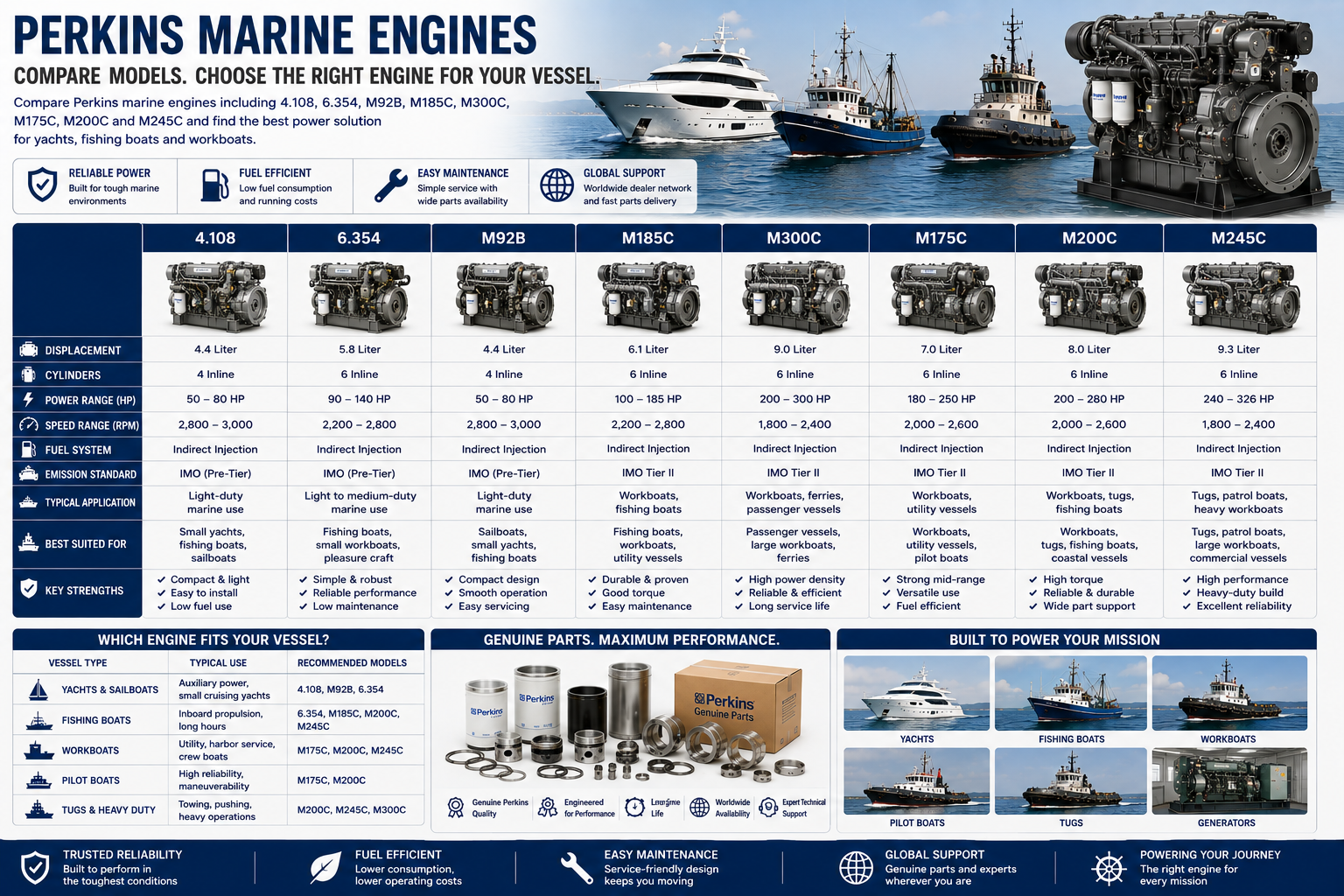
Quick Perkins Marine Engine Comparison
| Engine / FamilyGeneral CharacterTypical Marine Fit | ||
| 4.108 | Small mechanical classic | Sailing yachts, cruisers |
| 4.236 | Larger traditional four-cylinder | Fishing, workboats, displacement craft |
| 6.354 | Classic inline-six | Trawlers, yachts, commercial craft |
| M65 | Compact Sabre marine engine | Yachts, small workboats |
| M85T | Turbocharged compact engine | Cruisers and workboats |
| M92 / M92B | Mid-size yacht/displacement engine | Yachts, motor sailers, repowers |
| M115T | Higher-output compact marine diesel | Cruisers, workboats |
| M130C / M135 | Medium marine propulsion | Fishing, workboats, yachts |
| M150Ti | Turbo/intercooled propulsion | Commercial and recreational craft |
| M185C | 6-cylinder, 6-liter class | Passenger, workboat, fishing |
| M190C / M216C | Later medium propulsion | Commercial and pleasure craft |
| M215C / M225Ti | Stronger Sabre propulsion | Workboats, fishing, larger leisure craft |
| M250C / M300C | High-output electronic propulsion | Fishing and commercial vessels |
| M175C / M200C / M245C | Current shared six-cylinder platform | New builds and repowers |
Which Perkins Engine Would You Choose for Different Boats?
Sailing Yacht
Look naturally toward the smaller traditional and Sabre classes:
4.108
M65
M85T
M92B
depending on vessel displacement and required power.
Fishing Boat
Possible engines move from:
4.236 / 6.354
through:
M130C / M185C / M225Ti
and into:
M300C
or newer M-series products depending on vessel design.
Workboat
Depending on size:
M92B → M130C → M185C → M225Ti → M300C
can represent a useful progression.
Passenger Boat / Water Taxi
Models such as:
M185C
M190C
M216C
M250C
M300C
can fit naturally depending on vessel size.
Pleasure Craft
Perkins specifically markets marine propulsion for small pleasure craft and notes strong power-to-weight, smooth operation and repower flexibility.
Buying a Used Perkins Marine Engine: What Should You Check?
A used Perkins engine may be inexpensive compared with a new repower.
But always look beyond the paint.
Ask for:
- Full engine model
- Serial number
- Engine hours
- Service records
- Previous overhaul history
- Oil pressure
- Coolant temperature
- Cold-start video
- Running video
- Exhaust smoke under load
- Injector history
- Injection-pump history
- Turbocharger history
- Heat-exchanger condition
- Raw-water pump condition
- Reason for removal
For an old mechanical Perkins, maintenance history can matter more than appearance.
Why the Perkins Engine Serial Number Matters
Perkins states that the engine serial number is the only reliable way to identify the exact engine specification.
That makes it extremely important when ordering parts.
A request saying:
“Need Perkins 6.354 parts.”
may not be enough.
A better inquiry is:
Engine: Perkins 6.354 Marine
Serial Number: __________
Existing Part Number: __________
Application: Propulsion / generator
Quantity: __________
Photographs: Attached
For Perkins Sabre and later M-series engines, the same rule applies.
Common Perkins Marine Spare Parts
Depending on engine generation, common requirements include:
- Oil filters
- Fuel filters
- Air filters
- Fuel injectors
- Injector nozzles
- Mechanical injection pumps
- High-pressure fuel components
- Fuel lift pumps
- Turbochargers
- Raw-water pumps
- Impellers
- Freshwater pumps
- Heat exchangers
- Charge-air coolers
- Oil coolers
- Thermostats
- Water-cooled exhaust manifolds
- Cylinder heads
- Intake valves
- Exhaust valves
- Valve guides
- Pistons
- Piston rings
- Cylinder liners
- Connecting rods
- Main bearings
- Connecting-rod bearings
- Crankshaft components
- Camshaft components
- Oil pumps
- Starters
- Alternators
- Sensors
- Electronic control components
- Gaskets
- O-rings
- Oil seals
- Complete overhaul parts
Why Cooling Parts Are Especially Important on Old Perkins Engines
An older Perkins may still have excellent internal mechanical condition.
But marine cooling components can deteriorate over time.
Pay close attention to:
- Heat exchanger
- Seawater pump
- Impeller
- Exhaust elbow
- Water-cooled exhaust manifold
- Hoses
- Thermostat
- Internal coolant passages
Perkins notes that the correct coolant also protects against corrosion, cavitation and cylinder pitting—not merely overheating or freezing.
A cheap cooling-system shortcut can therefore create expensive internal engine damage.
Marine Engineer Tip
Don't identify a Perkins engine only from the red paint or the valve-cover name.
Check:
Complete engine model
Serial number
Propulsion or generator
Turbocharged / naturally aspirated
Intercooled or non-intercooled
Gearbox
Cooling arrangement
Current part number
Engine hours
Photos
This is especially important with Perkins because the installed marine fleet spans many decades and several model generations.
Frequently Asked Questions
Does Perkins Still Make Marine Engines?
Yes. Perkins currently provides marine propulsion and auxiliary products and operates its global marine-engine center in Wimborne, England.
What Boats Use Perkins Marine Engines?
Perkins says its engines have served sailing yachts, fishing vessels, pleasure craft, ferries, tugs, dredges and numerous other commercial craft.
What Is Perkins Sabre?
Perkins began collaborating with Sabre Marine in 1991, and Perkins Sabre engines were formally introduced shortly afterward. Sabre later became part of the same group, with Wimborne becoming the global Perkins marine center.
Is the Perkins M300C a Six-Cylinder Engine?
Yes. Perkins describes the M300C as a six-cylinder 6.6-liter electronic marine engine from the 1100 Series platform.
How Much Power Does the M300C Produce?
Perkins lists 225 kW at 2,400 rpm.
Are M300C Engines Used in Fishing Boats?
Yes. Perkins documented more than 30 M300C engines supplied to Norwegian Nor-Dan Speedsjark 35 fishing boats.
What Are the New Perkins Marine Propulsion Engines?
Perkins' newer range includes the M175C, M200C and M245C, all using a shared six-cylinder platform.
How Much Power Do the M175C, M200C and M245C Produce?
Perkins lists:
M175C: 173 hp / 129 kW
M200C: 200 hp / 149 kW
M245C: 249 hp / 186 kW
all at 2,400 rpm.
Does Perkins Make Marine Generator Engines?
Yes. Perkins supplies marine auxiliary engines used for generators and other onboard electrical-power applications.
What Is the Difference Between a Perkins Propulsion Engine and Generator Engine?
A propulsion engine is generally designed for variable-speed propulsion duty, while generator engines are typically configured for constant-speed operation. Perkins' naming convention often uses a final “G” to identify power-generation applications.
Can Perkins Support Old Marine Engines?
Perkins says its marine support network covers heritage brands including Perkins Sabre, Sabre, Ford Sabre and Ford Lehman engines.
Perkins Marine Engine Spare Parts
Alfa Marine Spare Parts can assist with parts inquiries for Perkins marine engines including:
- Perkins 4.108 Marine Engine
- Perkins 4.236 Marine Engine
- Perkins 6.354 Marine Engine
- Perkins M65
- Perkins M85T
- Perkins M92 / M92B
- Perkins M115T
- Perkins M130C
- Perkins M135
- Perkins M150Ti
- Perkins M185C
- Perkins M190C
- Perkins M215C
- Perkins M216C
- Perkins M225Ti
- Perkins M250C
- Perkins M265Ti
- Perkins M300Ti
- Perkins M300C
- Perkins M175C
- Perkins M200C
- Perkins M245C
- Selected Perkins marine generator and auxiliary engines
Depending on engine type and availability, requirements may include genuine, OEM, aftermarket, remanufactured or reconditioned components.
Related Perkins Marine Engine Pages
- Perkins 4.108 Marine Engine Spare Parts
- Perkins 4.236 Marine Engine Spare Parts
- Perkins 6.354 Marine Engine Spare Parts
- Perkins M65 Marine Engine Spare Parts
- Perkins M85T Marine Engine Spare Parts
- Perkins M92B Marine Engine Spare Parts
- Perkins M115T Marine Engine Spare Parts
- Perkins M130C Marine Engine Spare Parts
- Perkins M150Ti Marine Engine Spare Parts
- Perkins M185C Marine Engine Spare Parts
- Perkins M215C Marine Engine Spare Parts
- Perkins M225Ti Marine Engine Spare Parts
- Perkins M250C Marine Engine Spare Parts
- Perkins M300C Marine Engine Spare Parts
- Perkins M175C Marine Engine Spare Parts
- Perkins M200C Marine Engine Spare Parts
- Perkins M245C Marine Engine Spare Parts
Why Choose Alfa Marine Spare Parts?
Perkins is a good example of why the exact engine model matters.
A customer may write:
“I need parts for a Perkins marine engine.”
That could mean a mechanical 4.108 built for a yacht decades ago or an electronically controlled M300C working in a commercial fishing boat.
Before identifying the component, it helps to know:
Which engine?
What serial number?
Propulsion or generator?
Which gearbox?
Which current part number?
Which cooling configuration?
Alfa Marine Spare Parts supports marine engineers, shipyards, ship repair companies, yacht managers, fishing-vessel operators, workboat companies and technical superintendents with Perkins marine diesel spare-parts requirements.
The objective is simple:
identify the exact Perkins engine first, then identify the correct part.
Worldwide Perkins Marine Spare Parts Supply
Alfa Marine Spare Parts supports:
- Shipyards
- Ship repairers
- Marine engineers
- Chief engineers
- Technical superintendents
- Sailing-yacht owners
- Motor-yacht operators
- Fishing fleets
- Workboat operators
- Passenger-vessel operators
- Harbor craft
- Maritime contractors
- Marine service companies
- Marine equipment distributors
For a parts inquiry, provide:
Perkins engine model + serial number + existing part number + quantity + photographs where available.
Contact Alfa Marine Spare Parts
Email: request@alfamarinespareparts.com
Website:
https://alfamarinespareparts.com
Marine Spare Parts Catalog:
https://alfamarinespareparts.com/spareparts
One Final Thought
The easiest way to understand Perkins marine engines is to look at how the brand evolved.
The 4.108, 4.236 and 6.354 represent the traditional mechanical Perkins era—simple engines that earned their reputation in yachts and commercial boats.
The Perkins Sabre generation, with engines such as the M65, M92B, M130C and M225Ti, developed that basic philosophy into more purpose-built marine propulsion packages. Perkins identifies the M225Ti and M215C as important engines in this marine-development history.
Then engines such as the M185C and M300C brought stronger six-cylinder commercial power and electronic control. The M300C has proven itself in working fishing boats and delivers 225 kW from its 6.6-liter platform.
And now the M175C, M200C and M245C give Perkins a newer six-cylinder marine propulsion platform covering three different power points.
So if somebody asks:
“Which Perkins marine engine is the best?”
the answer should begin with:
What kind of vessel are we talking about?
Because the right Perkins for a sailing yacht, commercial fishing boat, passenger launch and marine generator will never be exactly the same.