MTU 183 Engine Components: A Complete Guide to Understanding Every Major Part of the Engine
Have you ever looked at an MTU 183 marine engine and wondered how hundreds of individual components work together to produce reliable power every single day?
Whether you're a marine engineer, chief engineer, technical superintendent, shipyard manager, or vessel owner, understanding the purpose of every engine component helps you perform better inspections, recognize early signs of wear, and plan maintenance before minor issues become expensive repairs.
The MTU Series 183 has earned an excellent reputation throughout the marine industry for its compact design, dependable performance, and long service life. Found aboard patrol boats, pilot boats, workboats, ferries, fishing vessels, luxury yachts, and commercial craft, these engines continue operating worldwide because every internal component is engineered to work as one complete system.
Instead of looking at the engine as one large machine, think of it as hundreds of precision parts that constantly depend on one another. When one component begins wearing, it often affects several others.
Let's explore the engine from the inside out.
What Are MTU 183 Engine Components?
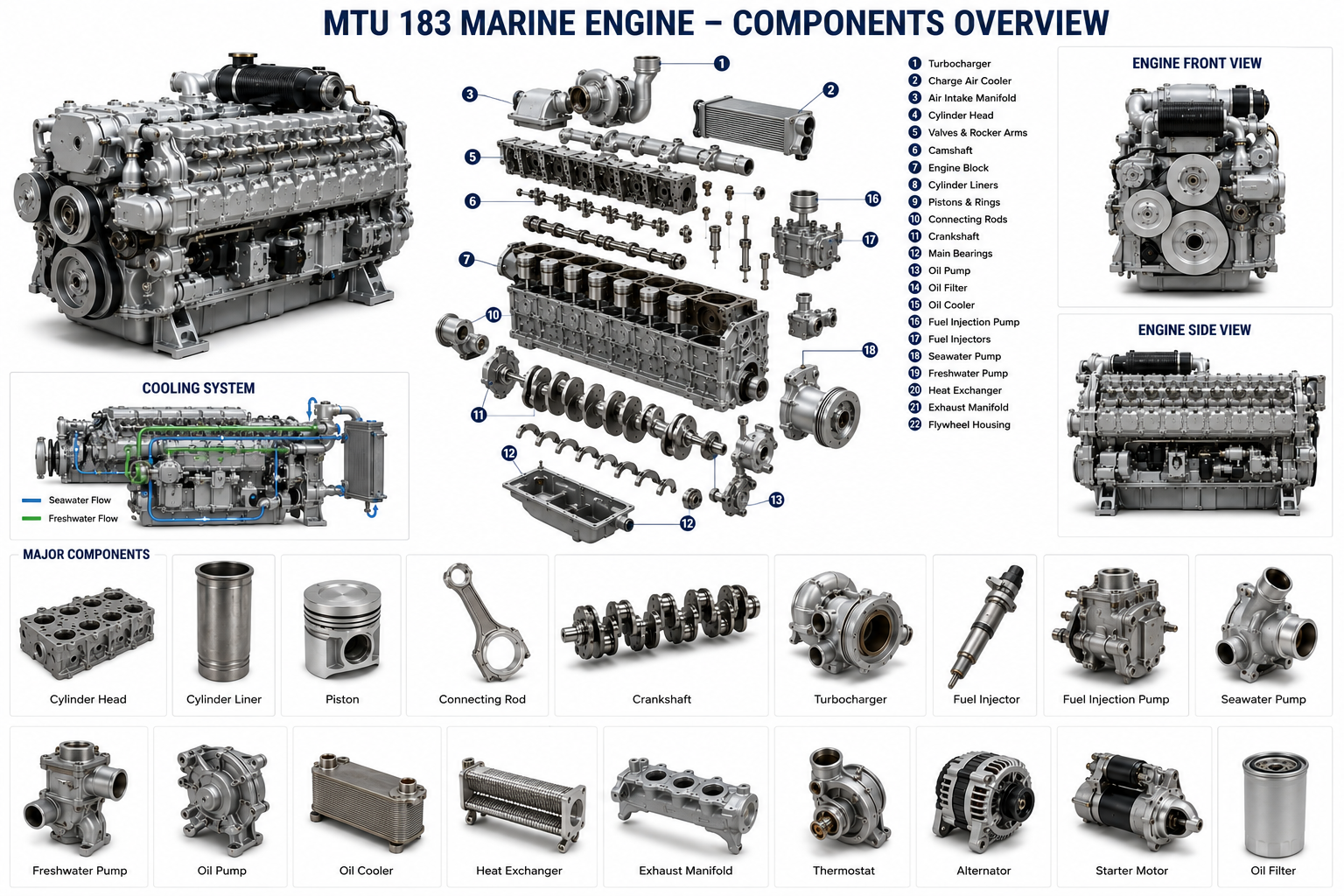
Simply put, MTU 183 engine components are every mechanical, cooling, lubrication, fuel, and air-handling part that allows the engine to generate reliable horsepower.
Every combustion cycle depends on several systems working together:
- Air enters the engine.
- Fuel is injected precisely.
- Combustion creates power.
- Pistons transfer force.
- The crankshaft converts motion into rotation.
- Lubricating oil reduces friction.
- Cooling systems remove heat.
- Sensors continuously monitor engine operation.
If one component underperforms, the entire engine can become less efficient.
That is why experienced marine engineers inspect the complete system—not just individual parts.
MTU 183 Engine Technical Information
| SpecificationInformation | |
| Engine Series | MTU Series 183 |
| Engine Type | High-speed marine diesel |
| Configuration | V-type diesel engine (various versions) |
| Cooling | Freshwater with seawater heat exchanger |
| Aspiration | Turbocharged |
| Fuel System | Direct fuel injection |
| Lubrication | Forced pressure lubrication |
| Applications | Commercial vessels, patrol boats, yachts, pilot boats, fishing vessels |
The exact specifications vary depending on the engine variant, but the overall component layout remains largely similar across the Series 183 family. Manufacturer documentation describes the engine as using integrated lubrication, cooling, and fuel systems designed for continuous marine duty.
Engine Block (Crankcase): The Foundation of the MTU 183 Engine
If there is one component that supports every moving part inside the MTU 183 engine, it is the engine block, also called the crankcase.
Think of it as the skeleton of the entire engine.
Every cylinder, bearing, oil gallery, cooling passage, and rotating assembly is mounted inside or attached to the block. The block must withstand enormous combustion forces, constant vibration, and continuous thermal expansion while remaining perfectly aligned.
Marine diesel engines often operate for thousands of hours under heavy loads. This is why the MTU 183 engine block is manufactured from high-strength cast materials designed for rigidity and durability.
What Does the Engine Block Do?
The crankcase performs several critical functions:
- Supports the crankshaft
- Houses the cylinder liners
- Contains lubricating oil galleries
- Contains coolant passages
- Supports the camshaft drive
- Maintains structural alignment
- Absorbs combustion forces
- Reduces vibration throughout the engine
Without a rigid crankcase, bearings would wear quickly, oil pressure would become unstable, and internal components could lose alignment.
Cylinder Heads: Where Combustion Happens
Every cylinder on the MTU 183 engine is sealed by a precision-machined cylinder head.
This component may appear simple from the outside, but internally it contains several of the engine's most important systems.
Inside every cylinder head you'll typically find:
- Intake valves
- Exhaust valves
- Valve guides
- Valve seats
- Valve springs
- Injector opening
- Cooling jackets
- Combustion chamber
Each combustion cycle begins and ends here.
Fresh air enters through the intake valves, fuel is injected into the combustion chamber, combustion occurs, and exhaust gases leave through the exhaust valves.
The cylinder head is constantly exposed to extreme temperatures, making proper cooling essential for long engine life.
Cylinder Liners: Protecting the Engine Block
Instead of allowing pistons to move directly inside the engine block, MTU uses replaceable cylinder liners.
These liners provide several advantages.
Why are cylinder liners important?
They:
- Provide a hardened wear surface
- Improve heat transfer
- Simplify engine overhauls
- Protect the engine block
- Help maintain compression
During major overhauls, worn liners can often be replaced without replacing the entire engine block.
This significantly reduces overhaul costs while extending engine service life.
Pistons: Converting Combustion into Mechanical Power
The piston is one of the hardest-working components inside the MTU 183 engine.
Every combustion event pushes the piston downward with tremendous force.
That force is transferred to the connecting rod and eventually to the crankshaft.
A single piston may travel thousands of times every minute while exposed to temperatures exceeding several hundred degrees Celsius.
Because of these extreme operating conditions, MTU pistons are engineered to provide:
- High thermal resistance
- Excellent strength
- Low weight
- Efficient heat dissipation
- Long fatigue life
Proper lubrication and cooling are essential to prevent excessive piston wear.
Piston Rings: Small Components with a Big Responsibility
Although piston rings are relatively small, they perform several essential functions.
Their job is to seal the combustion chamber while controlling lubricating oil.
A typical piston uses multiple rings that each serve a different purpose.
Compression Rings
Compression rings prevent combustion gases from escaping into the crankcase.
Good compression means:
- Better fuel efficiency
- Higher engine power
- Easier starting
- Cleaner combustion
Oil Control Rings
Oil rings regulate the amount of lubricating oil on the cylinder wall.
Too much oil can lead to:
- Increased oil consumption
- Carbon deposits
- Smoke from the exhaust
- Reduced combustion efficiency
Too little oil increases friction and accelerates cylinder wear.
Finding the right balance is essential.
Connecting Rods: Transferring Power
The connecting rod links the piston to the crankshaft.
Its task sounds simple, but the forces involved are enormous.
During every combustion cycle the connecting rod experiences:
- Compression
- Tension
- Bending
- High rotational loads
For this reason, connecting rods are manufactured from forged high-strength steel.
The connecting rod bearings create a thin oil film that allows the rod to rotate smoothly around the crankshaft journal while minimizing friction.
Crankshaft: The Heart of the MTU 183 Engine
Many marine engineers refer to the crankshaft as the heart of the engine.
Its purpose is to transform the pistons' up-and-down movement into smooth rotary motion that ultimately drives the vessel's propeller through the marine gearbox.
A precision-machined crankshaft contains:
- Main journals
- Crankpins
- Counterweights
- Oil passages
- Balance features
Proper lubrication is critical because the crankshaft rotates continuously under extremely high loads.
Even slight bearing wear can increase vibration, reduce oil pressure, and shorten the service life of surrounding components.
Marine Engineer's Tip
One of the best ways to monitor the health of the MTU 183 engine's rotating assembly is through routine lubricating oil analysis.
Oil analysis can reveal early signs of wear by detecting microscopic metal particles from components such as:
- Main bearings
- Connecting rod bearings
- Crankshaft journals
- Pistons
- Cylinder liners
Identifying these trends early allows maintenance to be planned before wear develops into a major failure.
Did You Know?
Many internal engine components begin showing measurable wear long before operators notice changes in engine performance. Regular inspections, oil analysis, and trend monitoring help marine engineers detect these early signs, supporting planned maintenance rather than unexpected repairs.
Next: Part 3 covers the MTU 183 fuel system, turbocharger, cooling system, seawater pump, freshwater pump, heat exchanger, lubrication system, and filtration, with practical maintenance insights and FAQs.
Fuel Injection System: Precision That Powers the MTU 183
Every marine diesel engine depends on precise fuel delivery, and the MTU 183 is no exception.
Rather than simply pumping fuel into the cylinders, the fuel system delivers an accurately measured quantity of diesel at high pressure and at precisely the right moment in each combustion cycle. This timing has a direct influence on engine power, fuel consumption, exhaust emissions, and overall reliability.
A typical MTU 183 fuel system includes:
- Fuel transfer pump
- Fuel filters
- High-pressure injection pump
- High-pressure fuel lines
- Fuel injectors
- Pressure regulating components
- Fuel return lines
These components work together to provide clean, pressurized fuel to every cylinder.
Why Clean Fuel Matters
Marine diesel engines can be extremely sensitive to contaminated fuel.
Water, rust, dirt, or microbial contamination may lead to:
- Poor combustion
- Injector wear
- Reduced engine performance
- Difficult starting
- Increased fuel consumption
For this reason, replacing fuel filters at the recommended service intervals and draining water separators regularly is an essential part of preventive maintenance.
Fuel Injectors: Small Components with a Big Job
The fuel injector is responsible for atomizing diesel fuel into a fine mist inside the combustion chamber.
Proper atomization allows the fuel to mix efficiently with compressed air, producing a cleaner and more complete combustion process.
Healthy injectors contribute to:
- Smooth engine operation
- Stable idle
- Efficient fuel consumption
- Reduced smoke
- Consistent power output
Over time, injector nozzles may become worn or develop deposits that affect spray quality. Periodic testing and servicing can help maintain optimum engine performance.
Turbocharger: Using Exhaust Energy to Produce More Power
One of the most recognizable components on the MTU 183 is the turbocharger.
Instead of allowing exhaust gases to leave the engine unused, the turbocharger recovers part of that energy to compress incoming air.
More air allows more fuel to be burned efficiently, resulting in:
- Increased engine power
- Improved torque
- Better fuel efficiency
- Cleaner combustion
Because the turbocharger operates at extremely high rotational speeds and temperatures, it relies on clean lubricating oil and proper cooling for long service life.
Regular inspection of intake piping, air filters, and oil supply lines helps protect this important component.
Charge Air Cooling System
After air leaves the turbocharger it becomes hotter.
Hot air is less dense, meaning it contains less oxygen.
The charge air cooler reduces the temperature of the compressed air before it enters the cylinders.
This provides several advantages:
- Higher air density
- Improved combustion
- Better engine efficiency
- Lower combustion temperatures
- Increased power output
Marine engineers often include charge air cooler cleaning as part of scheduled maintenance because fouling can gradually reduce cooling efficiency.
Cooling System: Protecting the Engine from Excess Heat
Every combustion event produces an enormous amount of heat.
Without an effective cooling system, engine temperatures would rise rapidly and shorten the life of internal components.
The MTU 183 marine engine typically uses a closed freshwater cooling circuit combined with a raw seawater circuit.
These two systems work together through the heat exchanger.
Freshwater Pump
The freshwater circulation pump moves coolant through the engine block, cylinder heads, and heat exchanger.
Its main responsibilities include:
- Maintaining coolant circulation
- Removing combustion heat
- Preventing localized hot spots
- Stabilizing engine temperature
A properly functioning freshwater pump helps maintain even cooling across the engine.
Seawater Pump
The seawater pump is one of the most important external engine components.
Instead of circulating coolant, it draws seawater through the vessel's intake and delivers it to the heat exchanger.
The seawater itself never enters the engine block.
Instead, it absorbs heat from the freshwater circuit before being discharged overboard.
Routine inspection should include:
- Mechanical seals
- Bearings
- Pump shaft
- Wear plate
- Impeller (where fitted)
- Gaskets and O-rings
- Housing condition
A small leak or worn bearing may seem insignificant, but over time it can reduce cooling performance and increase the risk of overheating.
Heat Exchanger
The heat exchanger acts like a radiator designed specifically for marine engines.
Inside the heat exchanger:
- Hot engine coolant flows through one circuit.
- Cool seawater flows through another.
- Heat transfers through metal tubes without allowing the two fluids to mix.
Marine environments naturally lead to salt deposits, marine growth, and scale formation over time.
Regular cleaning helps maintain efficient heat transfer and supports stable operating temperatures.
Thermostat
The thermostat controls coolant flow according to engine temperature.
When the engine is cold:
- Coolant circulation is restricted.
- The engine warms up more quickly.
Once the correct operating temperature is reached:
- The thermostat opens.
- Full coolant circulation begins.
Maintaining the proper operating temperature improves combustion efficiency and reduces unnecessary engine wear.
Lubrication System: Protecting Every Moving Component
Engine oil does much more than reduce friction.
It also:
- Carries away heat
- Cleans internal components
- Suspends contaminants
- Protects against corrosion
- Cushions heavily loaded bearings
The MTU 183 lubrication system includes:
- Oil pump
- Oil galleries
- Oil filter
- Oil cooler
- Pressure regulating valve
- Oil sump
Maintaining correct oil pressure and using the specified lubricant are fundamental to long engine life.
Oil Filters
Oil filters continuously remove contaminants from the lubricating oil.
Over time they capture:
- Carbon particles
- Metal wear particles
- Dirt
- Oxidation products
Replacing filters during scheduled oil changes helps maintain clean lubrication throughout the engine.
Marine Engineer's Practical Tip
When carrying out routine maintenance, don't inspect the cooling system in isolation.
A complete inspection should include:
- Seawater pump
- Freshwater pump
- Heat exchanger
- Thermostat
- Hoses
- Clamps
- Coolant quality
- Belt tension
- Oil cooler
Looking at the cooling system as one integrated circuit can help identify developing issues before they affect engine reliability.
Ask Yourself
If your MTU 183 begins operating only a few degrees warmer than usual, is it simply a seasonal change in seawater temperature—or could it be an early indication of reduced cooling efficiency?
Monitoring temperature trends over time is often more valuable than reacting only when an alarm is triggered.
Coming in Part 4
The final section will cover:
- Electrical and monitoring components
- Routine inspection checklist
- Preventive maintenance schedule
- Frequently Asked Questions
- Browse Our Complete Catalog
- Related Products
- Related Engine Pages
- Why Choose Alfa Marine Spare Parts
- Contact information
- Final conclusions optimized for SEO and your website.
Electrical and Monitoring Components
Modern MTU 183 marine engines rely on more than mechanical precision. Electrical and monitoring components provide the information that allows marine engineers to operate the engine safely and efficiently.
Depending on the engine configuration, these components may include:
- Starter motor
- Alternator
- Oil pressure sender
- Coolant temperature sensor
- Engine speed sensor
- Alarm switches
- Wiring harness
- Instrument panel connections
- Electronic monitoring modules (on later variants)
These components allow operators to monitor engine condition in real time and respond to abnormal operating conditions before damage occurs.
Why Preventive Maintenance Matters
Ask any experienced Chief Engineer what keeps a marine engine reliable, and you'll often hear the same answer:
Consistency.
The MTU 183 was designed for long service life, but reliability depends on regular inspections and preventive maintenance rather than waiting for something to fail.
A leaking seal, worn bearing, clogged filter, or contaminated coolant may seem insignificant today, but together they can reduce engine efficiency and increase operating costs over time.
The goal of preventive maintenance is to identify normal wear before it develops into an unexpected breakdown.
MTU 183 Preventive Maintenance Checklist
A routine inspection program helps keep the engine operating at peak performance.
Daily
- Check engine oil level.
- Inspect coolant level.
- Look for oil, fuel, or coolant leaks.
- Monitor operating temperatures.
- Listen for unusual noises.
- Check exhaust appearance.
Weekly
- Inspect drive belts.
- Examine hose clamps.
- Check seawater pump for leakage.
- Inspect freshwater pump.
- Drain water from fuel separators if fitted.
- Verify battery condition.
Monthly
- Inspect turbocharger air piping.
- Check charge air cooler connections.
- Inspect fuel system fittings.
- Examine engine mounts.
- Inspect wiring and connectors.
- Check alternator belt tension.
Scheduled Service
- Replace engine oil.
- Replace oil filters.
- Replace fuel filters.
- Inspect injectors.
- Service seawater pump.
- Flush cooling system if required.
- Inspect heat exchanger.
- Replace worn O-rings and gaskets.
- Perform lubricating oil analysis.
- Record engine operating trends.
Maintaining a detailed service history makes it easier to recognize gradual changes and plan future maintenance.
Marine Engineer's Toolbox
Many experienced marine engineers rely on condition monitoring tools in addition to scheduled maintenance.
These may include:
- Oil analysis
- Coolant analysis
- Infrared thermal inspections
- Vibration monitoring
- Endoscope (borescope) inspections
- Bearing temperature trending
- Fuel consumption records
By tracking engine condition over time, maintenance decisions can be based on actual operating data rather than assumptions.
Common Questions About MTU 183 Engine Components
What are the most important components of the MTU 183 engine?
The engine block, crankshaft, pistons, connecting rods, cylinder heads, fuel injection system, turbocharger, lubrication system, cooling system, and heat exchanger all play essential roles in reliable engine operation.
How often should the seawater pump be inspected?
Visual inspections should be carried out during routine maintenance. Mechanical seals, bearings, shaft condition, housing, and wear components should be checked according to the engine manufacturer's maintenance schedule and the vessel's operating conditions.
Why is oil analysis recommended?
Oil analysis can identify microscopic wear particles from bearings, pistons, cylinder liners, and other internal components before symptoms become noticeable, allowing maintenance to be planned proactively.
Can individual MTU 183 engine components be replaced?
Many components—including pumps, filters, bearings, injectors, seals, gaskets, and cylinder liners—can be replaced during routine maintenance or engine overhaul, depending on inspection results and manufacturer recommendations.
Which industries use the MTU 183 engine?
The MTU 183 is widely used in:
- Commercial shipping
- Patrol boats
- Pilot boats
- Workboats
- Luxury yachts
- Passenger vessels
- Fishing vessels
- Government fleets
- Offshore support vessels
- Marine service companies
Browse Our Complete Spare Parts Catalog
Alfa Marine Spare Parts supplies a wide range of marine diesel engine spare parts for MTU and many other leading manufacturers.
Our inventory includes:
- Engine overhaul kits
- Pistons
- Cylinder liners
- Cylinder heads
- Crankshafts
- Connecting rods
- Bearings
- Fuel injectors
- Fuel pumps
- Water pumps
- Seawater pumps
- Freshwater pumps
- Heat exchangers
- Oil coolers
- Turbochargers
- Gaskets
- O-rings
- Filters
- Thermostats
- Sensors
- Electrical components
Browse our complete catalog:
https://alfamarinespareparts.com/spareparts
Related Products
You may also be interested in:
- MTU 183 Seawater Pumps
- MTU 183 Freshwater Pumps
- MTU 183 Fuel Injectors
- MTU 183 Turbochargers
- MTU 183 Oil Pumps
- MTU 183 Heat Exchangers
- MTU 183 Cylinder Heads
- MTU 183 Crankshafts
- MTU 183 Bearings
- MTU 183 Gasket Sets
Related Engine Pages
Explore more MTU engine guides:
- MTU Series 2000
- MTU Series 396
- MTU Series 4000
- MTU Series 1163
- MTU Series 8000
Why Choose Alfa Marine Spare Parts?
At Alfa Marine Spare Parts, we support marine professionals around the world with dependable spare parts for leading marine diesel engines.
We serve:
- Shipyards
- Ship repair companies
- Marine engineers
- Chief engineers
- Technical superintendents
- Fleet operators
- Commercial fishing companies
- Offshore operators
- Government fleets
- Maritime contractors
- Boat builders
- Marine equipment distributors
We supply genuine, OEM-quality, aftermarket, and remanufactured marine engine components with worldwide shipping to major ports and maritime regions, including Nigeria, Dubai (UAE), Miami, Texas, Toronto, Italy, Monaco, and many other international destinations.
Contact Alfa Marine Spare Parts
Need help identifying the correct MTU 183 engine component for your vessel?
Our experienced team can assist with part identification and availability.
Website: https://www.alfamarinespareparts.com
Email: request@alfamarinespareparts.com
We are committed to helping marine operators keep their engines running reliably with high-quality spare parts and responsive worldwide support.
Final Thoughts
Understanding MTU 183 engine components is about more than learning part names. It is about understanding how each component contributes to the performance, efficiency, and reliability of the engine as a complete system.
From the engine block and crankshaft to the fuel injectors, seawater pump, heat exchanger, and lubrication system, every component has a specific purpose. Regular inspections, condition monitoring, and preventive maintenance help maximize service life and reduce the likelihood of unplanned downtime.