Water Cooled Marine Exhaust Manifold Caterpillar 3408 & 3412 Engines: Why It Is Critical for Marine Engine Reliability
Have You Ever Wondered Why Marine Caterpillar Engines Use Water-Cooled Exhaust Manifolds?
If you've worked in an engine room, you've probably noticed that the exhaust system on a Caterpillar 3408 or Caterpillar 3412 marine engine looks very different from the exhaust manifold found on a truck or industrial engine.
The reason is simple—marine engines operate in enclosed engine rooms where heat management is just as important as engine power.
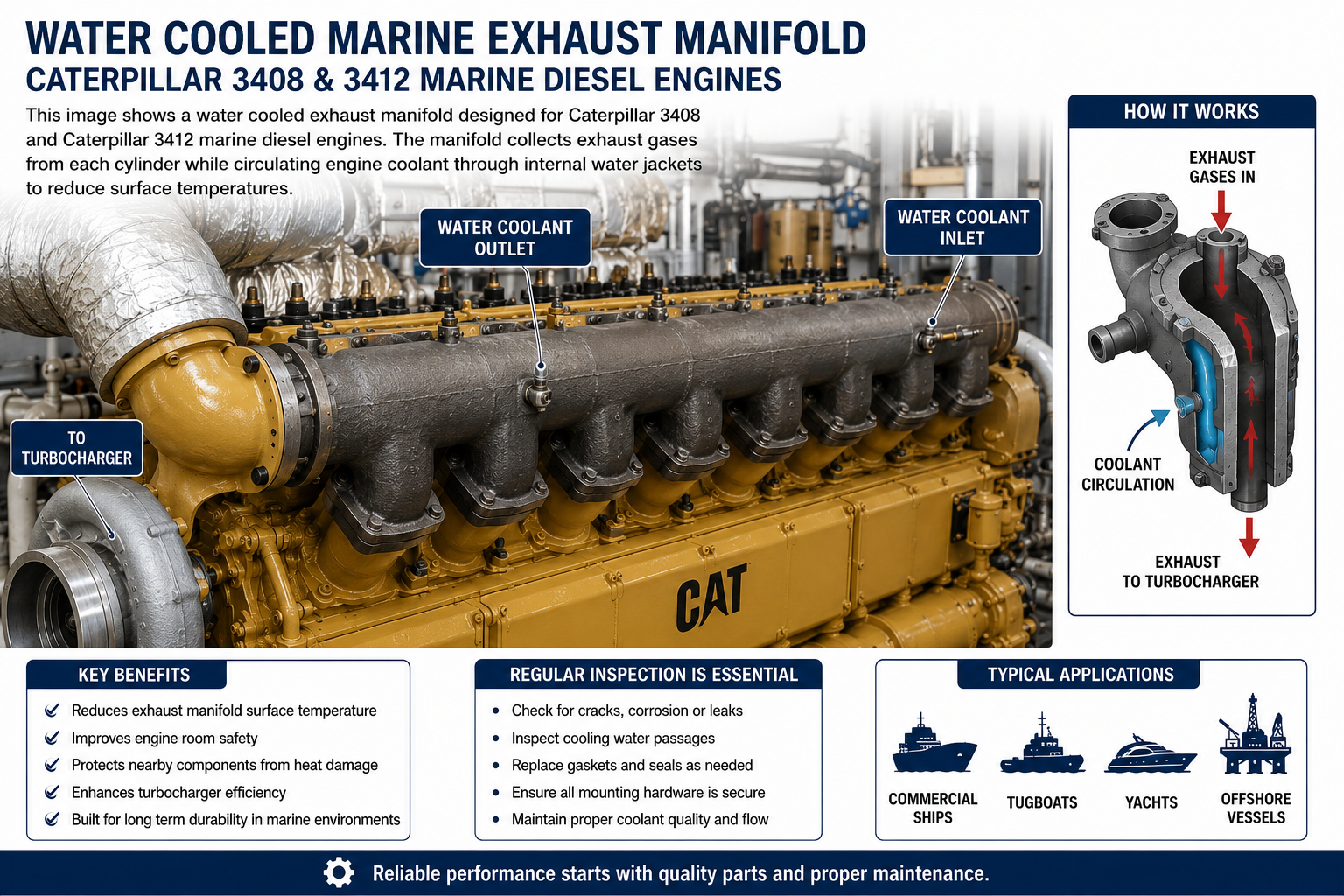
A Water Cooled Marine Exhaust Manifold Caterpillar 3408 3412 Engines is specifically designed to reduce exhaust surface temperatures while safely directing exhaust gases from the engine to the turbocharger and exhaust outlet. By circulating cooling water around the manifold, it protects surrounding equipment, improves safety, and helps extend the life of the entire exhaust system.
Whether your engine powers a commercial fishing vessel, tugboat, offshore support vessel, passenger ferry, workboat, or luxury yacht, maintaining the water-cooled exhaust manifold is essential for reliable operation.
Why This Component Matters
Although it may appear to be a simple casting, the water-cooled exhaust manifold performs several critical functions:
- Collects exhaust gases from each cylinder.
- Directs exhaust flow toward the turbocharger.
- Reduces external surface temperatures using cooling water.
- Protects nearby wiring, hoses, and engine room equipment from excessive heat.
- Improves engine room safety for maintenance personnel.
- Helps maximize turbocharger efficiency.
- Reduces thermal stress on engine components.
Without effective cooling, exhaust manifold temperatures can become extremely high, increasing the risk of component damage and engine room heat buildup.
Engineering Lesson
How Does a Water-Cooled Marine Exhaust Manifold Work?
After combustion occurs inside each cylinder, exhaust gases leave through the exhaust valves and enter the manifold.
Unlike dry exhaust systems used on many land-based engines, the Caterpillar 3408 and 3412 marine exhaust manifold contains internal cooling passages. Freshwater from the engine's closed cooling circuit circulates around these passages, absorbing heat from the exhaust gases while keeping the manifold's outer surface at a much lower temperature.
This design offers several advantages:
- Reduced radiant heat in the engine room.
- Lower thermal expansion and contraction.
- Improved durability of nearby components.
- More stable operating temperatures.
- Better protection for the turbocharger and exhaust piping.
A properly functioning cooling system ensures the manifold can withstand continuous operation under demanding marine conditions.
Engine Room Reality
Marine engineers know that exhaust manifold issues rarely occur in isolation.
Whenever the manifold is inspected, it is good practice to examine:
- Turbocharger.
- Exhaust elbows.
- Expansion joints.
- Cooling water passages.
- Gaskets.
- Mounting bolts.
- Cylinder head exhaust ports.
- Cooling hoses.
- Temperature sensors.
- Heat exchangers.
A complete inspection helps identify underlying cooling or exhaust problems before they develop into expensive repairs.
Chief Engineer's Notebook
"A leaking exhaust manifold is more than an exhaust problem—it can become a cooling problem, a turbocharger problem, and ultimately an engine reliability problem."
Routine inspections help prevent minor defects from becoming major failures.
Understanding the Construction of the Caterpillar 3408 & 3412 Water-Cooled Exhaust Manifold
The manifold is built to withstand:
- High exhaust gas temperatures.
- Constant vibration.
- Marine corrosion.
- Thermal cycling.
- Continuous engine loading.
Typical construction includes:
- Heavy-duty cast housing.
- Internal water jackets.
- Precision-machined mounting surfaces.
- High-temperature sealing faces.
- Reinforced exhaust outlets.
- Corrosion-resistant cooling passages.
These features enable reliable performance in demanding commercial marine applications.
Common Components Associated with the Exhaust Manifold
Exhaust Manifold Housing
The main casting channels exhaust gases from each cylinder while surrounding them with cooling water.
Internal Water Jackets
These passages circulate engine coolant around the exhaust runners to absorb heat and reduce external temperatures.
Exhaust Manifold Gaskets
High-temperature gaskets provide a gas-tight seal between the manifold and the cylinder head, preventing exhaust leaks and maintaining engine efficiency.
Mounting Hardware
High-strength studs, bolts, and clamps keep the manifold securely attached despite vibration and thermal expansion.
Turbocharger Connection
The manifold directs exhaust gases to the turbocharger, where exhaust energy is converted into increased intake air pressure for improved engine performance.
Cooling Water Connections
Inlet and outlet ports allow coolant to circulate continuously through the manifold, ensuring consistent heat removal.
Temperature Monitoring
Many installations include temperature sensors that help engineers monitor exhaust system performance and identify abnormal operating conditions before damage occurs.
Typical Signs That an Exhaust Manifold Requires Inspection
Marine engineers should investigate if they notice:
- Coolant leaks around the manifold.
- Exhaust gas leaks.
- Reduced turbocharger performance.
- Higher-than-normal exhaust temperatures.
- Visible corrosion.
- Cracks in the manifold housing.
- Steam around the manifold.
- Unusual exhaust noise.
- Salt deposits near cooling passages.
- Increased engine room temperatures.
Early detection can prevent costly repairs and reduce the risk of secondary damage to the turbocharger or cylinder heads.
Real Marine Maintenance Scenario
A Small Coolant Leak That Could Have Become a Major Engine Failure
A commercial fishing vessel powered by Caterpillar 3412 marine engines returned to port after the engineering crew noticed a gradual increase in engine room temperature during extended operation.
Although engine coolant temperature remained within acceptable limits, the Chief Engineer observed:
- Small traces of coolant around the exhaust manifold.
- Slight white staining near the manifold water jacket.
- Increased exhaust temperature readings.
- Minor loss of coolant over several operating days.
- No noticeable loss of engine performance.
Rather than waiting for the next overhaul, the crew scheduled an inspection during a planned maintenance stop.
After removing insulation and pressure testing the cooling circuit, engineers discovered a small crack inside the water-cooled exhaust manifold caused by years of thermal cycling and internal corrosion.
The repair included:
- Replacing the damaged water-cooled exhaust manifold.
- Installing new exhaust manifold gaskets.
- Renewing mounting studs and locking hardware.
- Flushing the cooling system.
- Inspecting the turbocharger inlet for heat damage.
- Checking cylinder head exhaust ports.
- Pressure testing the complete cooling circuit.
After installation:
- Coolant loss stopped completely.
- Exhaust temperatures returned to normal.
- Engine room temperatures decreased.
- Turbocharger efficiency improved.
- The vessel returned to service without further issues.
Early detection prevented coolant from entering the exhaust system and avoided costly secondary damage to the turbocharger and cylinder heads.
Oil Analysis
Although the exhaust manifold itself does not contain lubricating oil, routine oil analysis helps identify related engine problems that may contribute to excessive exhaust temperatures and overall engine stress.
Iron
Iron may originate from:
- Cylinder liners
- Camshafts
- Crankshaft journals
- Timing gears
Elevated iron levels can indicate abnormal wear that increases engine load and exhaust temperatures.
Copper
Copper often indicates wear of:
- Main bearings
- Connecting rod bearings
- Bushings
Lead
Lead commonly indicates bearing overlay deterioration.
Early detection prevents major rotating assembly damage.
Aluminium
Aluminium may come from pistons or bearing housings.
Abnormal increases require investigation.
Silicon
Silicon usually indicates airborne dirt entering through the intake system.
Dust contamination accelerates engine wear and can increase combustion temperatures.
Fuel Dilution
Fuel contamination lowers lubricant viscosity and reduces protection for internal engine components.
Water Contamination
Water contamination promotes corrosion throughout the engine lubrication system.
Oxidation
Oil oxidation reflects lubricant ageing caused by prolonged high operating temperatures.
Viscosity
Maintaining correct oil viscosity protects bearings, crankshaft journals, pistons, and valve train components.
Routine oil analysis supports overall engine reliability and helps reduce thermal stress on the exhaust system.
Engineer's Toolbox
Components to Inspect During Exhaust Manifold Replacement
Experienced Caterpillar marine engineers inspect:
✔ Water-cooled exhaust manifold.
✔ Exhaust manifold gaskets.
✔ Mounting studs and nuts.
✔ Turbocharger flange.
✔ Expansion joints.
✔ Cooling water passages.
✔ Cooling hoses.
✔ Temperature sensors.
✔ Cylinder head exhaust ports.
✔ Heat exchanger performance.
✔ Freshwater circulation pump.
Replacing worn supporting components at the same time reduces future downtime.
Preventive Maintenance Checklist
Daily
- Check coolant level.
- Monitor engine temperature.
- Inspect for coolant leaks.
- Observe exhaust temperatures.
- Listen for exhaust leaks.
Weekly
- Inspect manifold exterior.
- Check cooling hose condition.
- Review engine monitoring data.
- Inspect mounting hardware.
- Verify turbocharger operation.
Every 250–500 Operating Hours
- Pressure test the cooling system.
- Inspect manifold gaskets.
- Clean external cooling surfaces.
- Verify coolant quality.
- Inspect expansion joints.
Every 1,000 Operating Hours
- Inspect internal cooling passages.
- Examine turbocharger mounting.
- Inspect manifold casting for cracks.
- Replace worn gaskets if necessary.
- Review temperature trends.
Long-Term Maintenance
- Replace ageing coolant according to Caterpillar recommendations.
- Maintain correct coolant chemistry.
- Flush cooling passages during major overhauls.
- Inspect the exhaust system during every scheduled engine overhaul.
- Replace heavily corroded manifolds before failure occurs.
Marine Engineer Tip
The earliest signs of exhaust manifold problems are often coolant stains, slight temperature increases, or small leaks around the water jacket. Addressing these issues early can prevent turbocharger damage and expensive repairs.
Marine Engineer Quote
"Heat is the enemy of every marine engine. A healthy water-cooled exhaust manifold keeps temperatures under control and protects everything around it."
Common Maintenance Mistakes
Avoid these common mistakes:
- Ignoring minor coolant leaks.
- Reusing old exhaust manifold gaskets.
- Mixing incompatible coolant types.
- Operating with partially blocked cooling passages.
- Delaying pressure testing after repairs.
- Ignoring abnormal exhaust temperatures.
- Overtightening manifold mounting bolts.
- Failing to inspect the turbocharger during manifold replacement.
Frequently Asked Questions
What is a water-cooled marine exhaust manifold?
A water-cooled marine exhaust manifold collects exhaust gases from the engine cylinders while circulating engine coolant through internal water jackets to reduce surface temperatures and protect surrounding engine room components.
Why do Caterpillar 3408 and 3412 marine engines use water-cooled manifolds?
These engines are commonly installed in enclosed engine rooms where controlling radiant heat is essential for safety, component longevity, and efficient turbocharger operation.
What are the common signs of manifold failure?
Typical symptoms include:
- Coolant leaks.
- Steam around the manifold.
- White salt deposits.
- Cracks in the casting.
- Exhaust leaks.
- High exhaust temperatures.
- Reduced turbocharger performance.
- Increased engine room heat.
Can a leaking manifold damage the engine?
Yes. If left unattended, coolant leaks or exhaust leaks can damage the turbocharger, cylinder heads, exhaust valves, and nearby engine room components.
Does Alfa Marine Spare Parts supply Caterpillar 3408 and 3412 exhaust manifolds?
Yes. Alfa Marine Spare Parts supplies genuine, OEM, aftermarket, remanufactured, and reconditioned Water Cooled Marine Exhaust Manifolds for Caterpillar 3408 and Caterpillar 3412 marine engines, together with complete exhaust system components and overhaul parts.
Worldwide Marine Engine Spare Parts Supply
Alfa Marine Spare Parts supplies genuine, OEM, aftermarket, remanufactured, and reconditioned Caterpillar marine engine spare parts for the 3408 and 3412 engine series.
Our product range includes:
- Water-cooled exhaust manifolds
- Exhaust elbows
- Turbochargers
- Cylinder heads
- Exhaust valves
- Pistons
- Cylinder liners
- Fuel injectors
- Water pumps
- Heat exchangers
- Oil coolers
- Gasket kits
- Bearings
- Complete overhaul kits
We proudly support:
- Shipyards
- Ship repair companies
- Marine engineers
- Chief engineers
- Technical superintendents
- Fleet operators
- Commercial fishing companies
- Offshore operators
- Government fleets
- Maritime contractors
- Boat builders
- Marine equipment distributors
Worldwide shipping is available to the United Kingdom, United States, Canada, Italy, Spain, France, Germany, the Netherlands, Norway, Greece, Croatia, Monaco, Dubai (UAE), Saudi Arabia, Nigeria, Singapore, Malaysia, Australia, South Africa, Brazil, and major seaports around the world.
Browse Our Complete Catalog
Browse thousands of marine engine components for Caterpillar, MTU, Cummins, MAN, Wärtsilä, Deutz, Volvo Penta, Perkins, Yanmar, Komatsu, and many other leading marine engine manufacturers.
Website: https://alfamarinespareparts.com
Browse Our Complete Catalog: https://alfamarinespareparts.com/spareparts
Related Engine Pages
- Caterpillar 3408 Marine Engine Spare Parts
- Caterpillar 3412 Marine Engine Spare Parts
- Caterpillar C18 Marine Engine Spare Parts
- Caterpillar C32 Marine Engine Spare Parts
- Caterpillar 3512 Marine Engine Spare Parts
- Caterpillar 3516 Marine Engine Spare Parts
Related Products
- Water Cooled Exhaust Manifolds
- Exhaust Elbows
- Turbochargers
- Heat Exchangers
- Seawater Pumps
- Freshwater Pumps
- Cylinder Heads
- Exhaust Valves
- Gasket Kits
- Oil Coolers
- Fuel Injectors
- Thermostats
Further Reading
To learn more about Caterpillar marine engines, explore these topics:
- Understanding Marine Engine Cooling Systems
- How Turbochargers Improve Caterpillar Marine Engine Performance
- Preventive Maintenance for Caterpillar 3408 & 3412 Engines
- Common Cooling System Problems in Marine Diesel Engines
- Best Practices for Marine Exhaust System Inspections
Why Choose Alfa Marine Spare Parts?
Alfa Marine Spare Parts is a trusted supplier of genuine, OEM, aftermarket, remanufactured, and reconditioned Caterpillar marine spare parts. We help shipowners, marine engineers, technical superintendents, and repair facilities source the correct components quickly and efficiently.
From Water Cooled Marine Exhaust Manifolds for Caterpillar 3408 and 3412 engines to complete overhaul kits, turbochargers, pumps, and cylinder heads, our experienced team provides technical support and fast worldwide shipping to keep your vessels operating with minimal downtime.
Contact Alfa Marine Spare Parts
Website: https://alfamarinespareparts.com
Browse Our Complete Catalog: https://alfamarinespareparts.com/spareparts
Email: request@alfamarinespareparts.com
Contact Alfa Marine Spare Parts today for expert assistance with Water Cooled Marine Exhaust Manifolds for Caterpillar 3408 and 3412 engines and a comprehensive range of Caterpillar marine spare parts delivered worldwide.
One Final Thought
The Water Cooled Marine Exhaust Manifold on Caterpillar 3408 and 3412 marine engines plays a vital role in managing exhaust heat, protecting the turbocharger, and maintaining a safe engine room environment. Regular inspections, proper coolant maintenance, and prompt replacement of worn components can significantly extend the life of the exhaust system and reduce the risk of unplanned downtime. Partnering with an experienced supplier such as Alfa Marine Spare Parts ensures access to quality replacement components and expert support, helping your vessel remain reliable wherever it operates.