
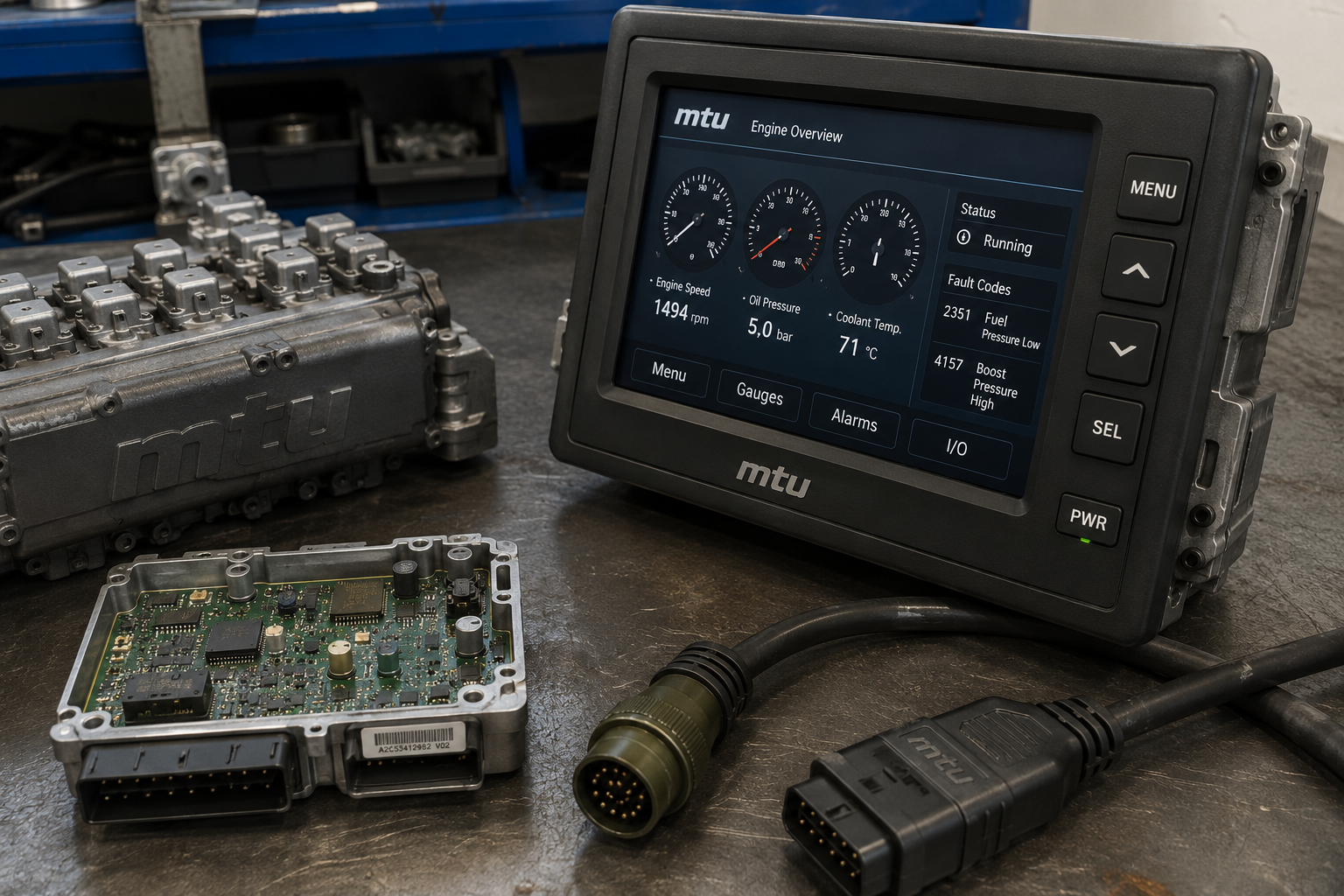
MTU ECU Panel Troubleshooting: What Every Marine Engineer Should Check First
If you’ve spent enough time in a vessel’s engine room, you know the exact sinking feeling: an MTU engine suddenly drops power, or worse, refuses to crank at all while the ECU display flashes a yellow warning or a bright red alarm.
It’s easy to panic and assume the ECU module itself has given up the ghost. But here’s the truth: an ECU failure is actually pretty rare. Nine times out of ten, the brain of the engine is just doing its job—reacting to a bad ground, a corroded plug, a voltage drop, or a faulty $50 sensor. Replacing expensive electronic modules off the bat is usually a waste of time and money.
Here is a practical breakdown of how MTU ECU panels work, why they throw codes, and the logical steps you should take to diagnose the problem like an experienced marine engineer.
What Is the ECU Actually Doing?
Think of the ECU (Engine Control Unit) as the engine's central nervous system. Every second, it processes data from dozens of sensors positioned all over the engine block. It monitors oil pressure, manages fuel injection timing, tracks coolant temps, and regulates engine speed. Most importantly, it acts as a safety guard to shut down or de-rate the engine before a minor issue turns into a catastrophic mechanical failure.
The display panel is simply the engine’s way of talking to you. It gives you real-time metrics—like RPM, boost pressure, coolant temps, and battery voltage—and acts as the board where active alarms and historical fault codes are logged.
The Biggest Misconception About Fault Codes
A fault code doesn't mean something is broken. It just means the ECU received a reading outside its expected operating range.
If a sensor circuit sees a brief drop in voltage because a battery bank is low, the ECU will throw a code for that sensor. The sensor isn't bad; the power supply feeding it is. A code gives you a direction to look in—it isn't a shopping list for replacement parts.
Real-World Troubleshooting: Common MTU Engine Scenarios
1. The Engine Won’t Crank
Before you start pulling off components, check the simple stuff:
- Check the battery voltage first. If the ECU logic board drops below its minimum operating voltage during cranking, it won't trigger the fuel injectors or start logic.
- Is an E-Stop button latched somewhere on the bridge or in the engine room?
- Check for a blown inline fuse or a loose power supply relay feeding the main ECU harness.
- Look for active crank/cam speed sensor faults using your diagnostic tool.
2. You Get a Solid Red Alarm
A red alarm means stop and assess immediately. It indicates an active condition that can destroy the engine within minutes if ignored:
- Severe oil pressure drop
- Critical coolant loss or high temperature spike
- Engine overspeed conditions
- Major sensor reference failure
If safety allows, pull back the load or shut down the engine right away. Continuing to run an engine on a red alarm is an easy way to turn a small fix into a full overhaul.
3. The Engine Suddenly Loses Power (Limp Mode)
If your MTU won't spool up or reach full RPM, the ECU has likely triggered "de-rate" or limp mode. It’s restricting fuel delivery on purpose to protect the engine block from overheating or running with improper rail pressure. Common culprits include clogged fuel filters causing low rail pressure, turbo boost leaks, or faulty temperature sensors sending extreme spikes to the ECU.
4. Random, Spurious Alarms keep Popping Up
Intermittent issues are usually wiring problems, plain and simple. Marine environments are tough on electronics. Constant engine vibration, salt air, and moisture inside electrical plugs will create high resistance in the harness. Check for:
- Corroded pins insideDeutsch or AMP connectors
- Loose ground studs on the engine block
- A weak or failing battery bank
- Chafed wiring harnesses rubbing against engine brackets
5. Multiple Sensor Faults Trigger at the Same Time
It is almost mathematically impossible for five sensors to burn out simultaneously. When a cluster of sensors trips codes together, look at what they share: a common 5V sensor power supply rail, a shared ground bus, or a main connector plug into the ECU module. Fix the shared circuit, and all the sensor faults will clear.
6. ECU Communication Loss (CAN Bus Faults)
When the panel loses comms with the ECU, the problem usually sits in the CAN Bus wiring network. Inspect the CAN termination resistors, check for pinched cables, and look for green oxidation inside the connector housings before blaming the hardware itself.
The Golden Rule: Don't Just Clear Codes
It's tempting to hit "clear fault" on the display and hope it doesn't come back. But clearing a code without fixing the root cause just wipes away vital diagnostic history. The ECU will usually flag the exact same code the second the engine runs up to operating temperature again.
Follow this logical routine instead:
- Read & Record: Write down all active and stored fault codes.
- Check Power: Test battery voltage under load.
- Inspect the Physicals: Check fuses, grounds, and physical wiring harnesses for chafing or corrosion.
- Isolate the Source: Use live diagnostic data to see if a sensor reading makes physical sense (e.g., does the engine really think coolant temperature is $150^\circ\text{C}$ on a cold morning?).
- Repair & Test: Fix the broken wire or replace the confirmed bad component, then clear the code and run the engine under load to confirm.
Prevention Saves Hours in the Bilge
Preventative maintenance on electrical systems is just as vital as changing your oil filters. Keep your batteries topped up and tested, spray electrical contacts with a marine-grade moisture barrier, tie back loose wiring harnesses to stop vibration damage, and check your stored fault history during routine services.
Most electrical gremlins give subtle warnings long before they completely shut down your engine in the middle of a trip.
What’s the most stubborn MTU fault code you’ve had to chase down onboard? Drop your troubleshooting experiences and tricks in the comments below!